
Unified Growth Solution
World-class tech needs world-class drivers. AI platform and expert services, unified
Read time 10 minutes


Agents that let you act while others are still analyzing!
Executive Summary :
Black Friday and Cyber Monday create two major opportunities for marketers: re-engaging existing customers and attracting new ones. Consumer intent and behavioral data from 2025 show that these shopping moments concentrate customer attention, purchase intent, and brand discovery.
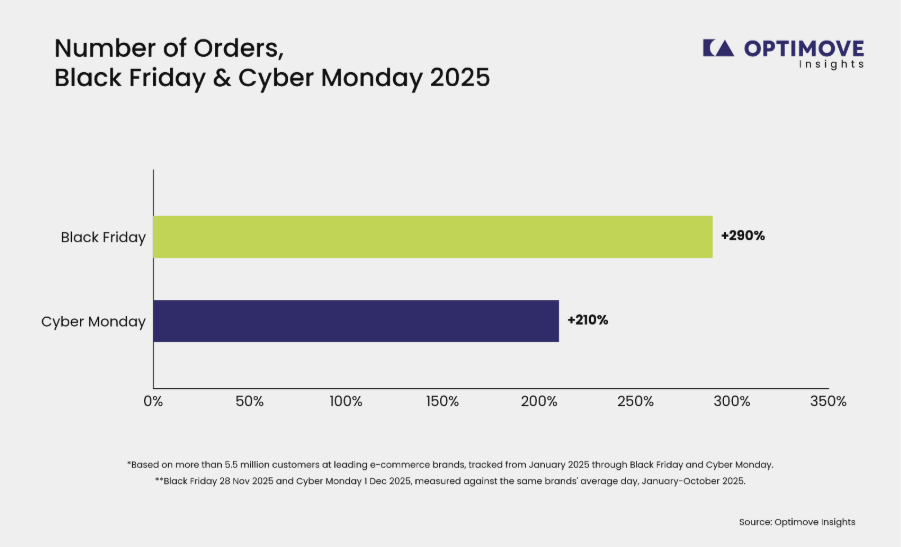
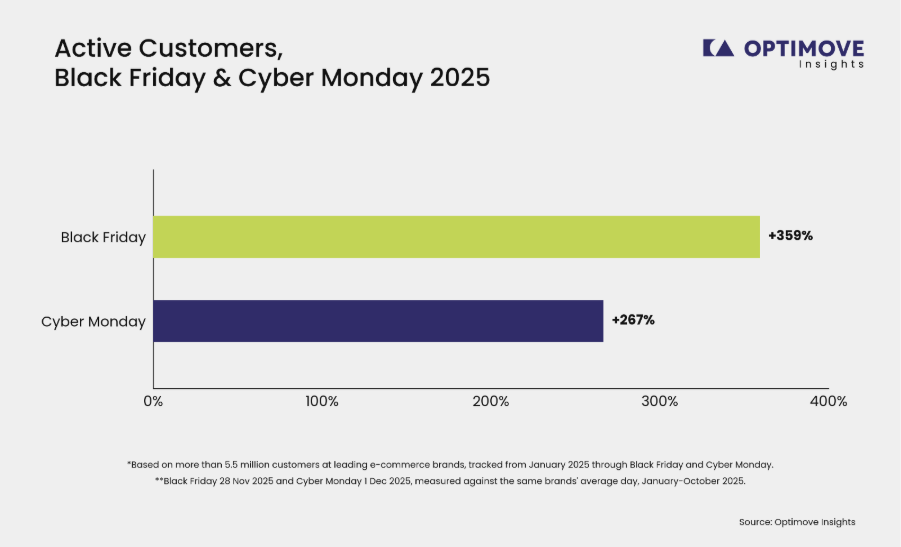
The results show that active customers (returning customers are customers with at least one purchase from the brand prior to the measured day) increased by 359% on Black Friday and 267% on Cyber Monday compared with an average day from January through October. Orders rose by 290% and 210%, respectively.
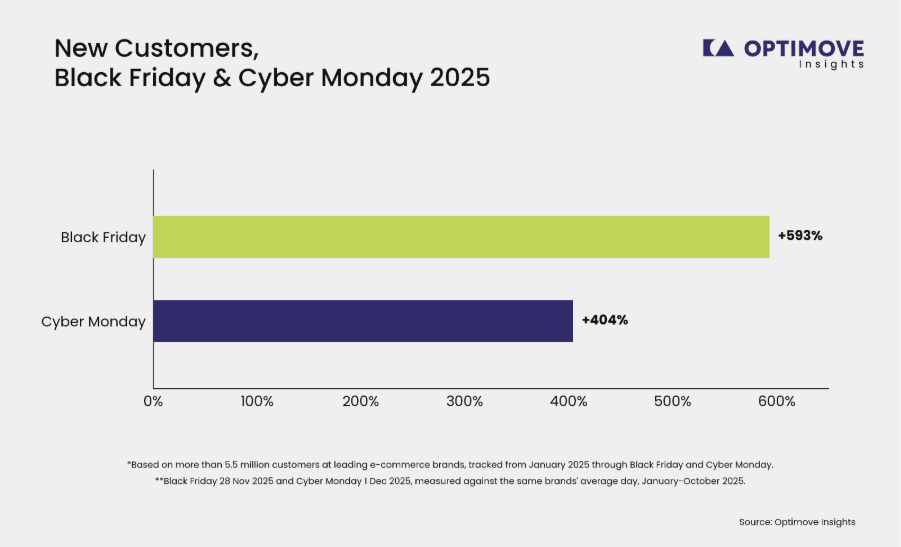
At the same time, new customer activity (new customers are those who made their first purchase with the brand on that day) increased by 593% on Black Friday and 404% on Cyber Monday, in 2025 while nearly half of consumers (47%) say they plan to explore new brands on 2026 holiday season.
For marketers, the challenge is to compete on both fronts while delivering highly personalized timely marketing messages to each and every shopper.
That means making products discoverable, recognizing each customer when they engage, and using real-time data and agentic decisioning to deliver the right message, offer, channel, and timing.
Positionless Marketing brings data, AI, and execution together so marketers can respond to both existing and new customers at the speed and scale Black Friday and Cyber Monday demand.
Methodology :
This report combines consumer survey data with first-party behavioral data from Optimove customers. It examines how shoppers approach Black Friday and Cyber Monday and how their behavior changes during the promotional period.
Optimove surveyed 648 U.S. consumers in Spring 2026, ages 18+, with household incomes of $75,000+. The analysis focuses on shopping behaviors and attitudes, using both dedicated questions and related cross-survey data on discovery, decision-making, messaging, payments, and multichannel behavior. The survey is forward-looking and measured holiday shopping intentions for 2026, including when consumers plan to begin shopping, their willingness to explore new brands, and their use of AI tools for shopping ideas and gift recommendations.
The behavioral analysis is based on historical data and covers more than 5.5 million customers across leading e-commerce brands. Black Friday and Cyber Monday 2025 activity was compared with the brands' average daily performance from January through October 2025, including changes in active customers, new customers, and order volume.
Findings
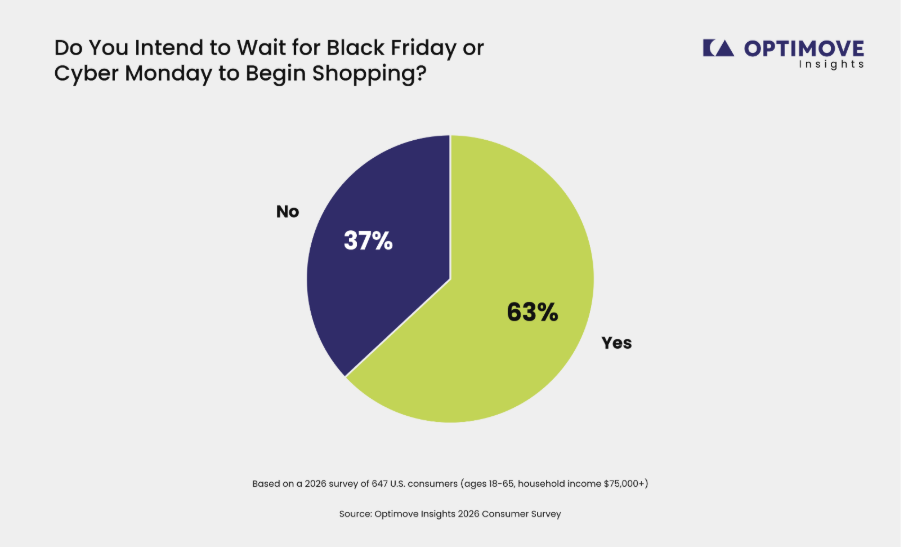
Nearly two-thirds of consumers (63%) say they intend to wait for Black Friday or Cyber Monday before beginning their holiday shopping. Just 37% say they plan to start shopping before the promotional period.
Optimove Insights data from more than 5.5 million customers at leading e-commerce brands show how strongly existing customer activity increased during Black Friday and Cyber Monday 2025. Compared with an average day from January through October, the number of active customers increased by 359% on Black Friday and 267% on Cyber Monday.
Order volume also rose sharply. Orders increased by 290% on Black Friday and 210% on Cyber Monday compared with the same brands' average day during the January–October period.
Insights
The data shows that Black Friday and Cyber Monday create a major re-engagement opportunity with customers who already know the brand. With 63% of consumers saying they plan to wait for the promotional period to begin holiday shopping; many customers are entering these days with deliberate purchase intent.
The 2025 behavioral data reinforces this pattern. Existing customer activity increased around threefold on both Black Friday and Cyber Monday, showing how effectively these events can bring customers back into an active shopping mindset.
There is also an important distinction between customer activity and order volume. Both increased dramatically, but active customers grew faster than orders on both days. This suggests that not every returning customer converts immediately. Some may be browsing, comparing products, evaluating promotions, or waiting for the right moment to purchase.
Returning customers do not always return for the same reasons. A shopper who has bought running shoes three times may arrive on Black Friday looking to restock, or may be browsing outdoor jackets for the first time. The data suggests many returning customers engage without immediately purchasing, and understanding why matters. When a brand can connect a returning customer's purchase history with what they are browsing in the moment, it can respond appropriately: making it easy to reorder a familiar product, or recognizing that the customer is exploring something new and offering guidance, comparisons, or answers to their questions. In a new category, a loyal customer may need the same help as a first-time shopper, with the added advantage of an existing relationship. Used well, this context should feel like helpful service rather than surveillance.
For marketers, this means Black Friday and Cyber Monday should be treated as concentrated moments of customer attention. Dormant, occasional, and highly engaged customers may all return during the same period, but their history with the brand and their likelihood to purchase can vary significantly.
How Marketers Should Respond
Marketers should prepare for Black Friday and Cyber Monday as re-engagement moments, rather than sending the same promotion to the entire customer base. Customers can be differentiated by past purchases, recency, category affinity, value, discount sensitivity, and recent behavior to determine who needs an incentive, who may respond to product relevance, and who is already showing strong purchase intent.
Because customer behavior can change quickly throughout the period, marketers also need the ability to adapt audiences, offers, and messages in real time.
Marketers should also consider what a returning customer is browsing now, not only what they bought before, since the right response differs for a customer restocking a favorite product and one exploring a new category.
Positionless Marketing enables marketers to move from insight to execution faster, using customer data and AI to identify re-engagement opportunities and respond while customer attention and purchase intent are at their highest.
Findings
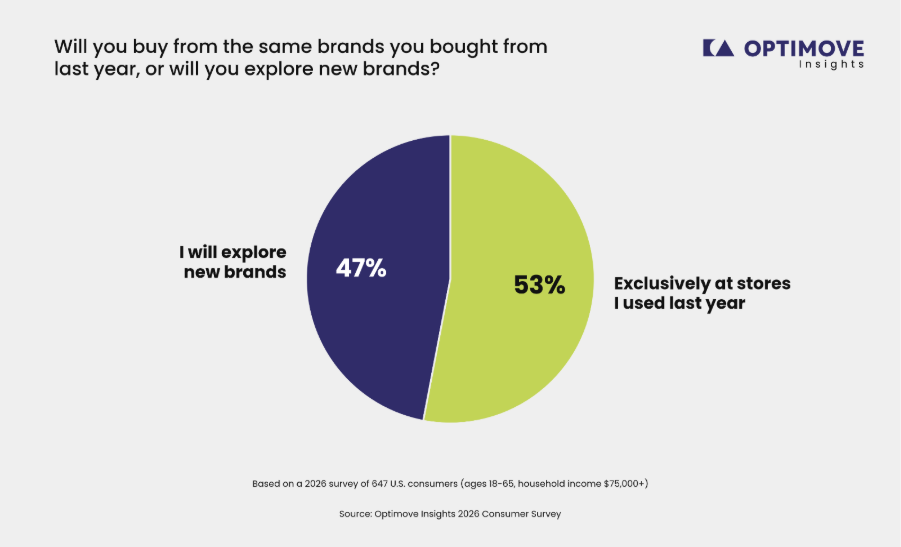
Nearly half of consumers (47%) say they plan to explore new brands this holiday season, while 53% expect to shop exclusively with brands they used last year.
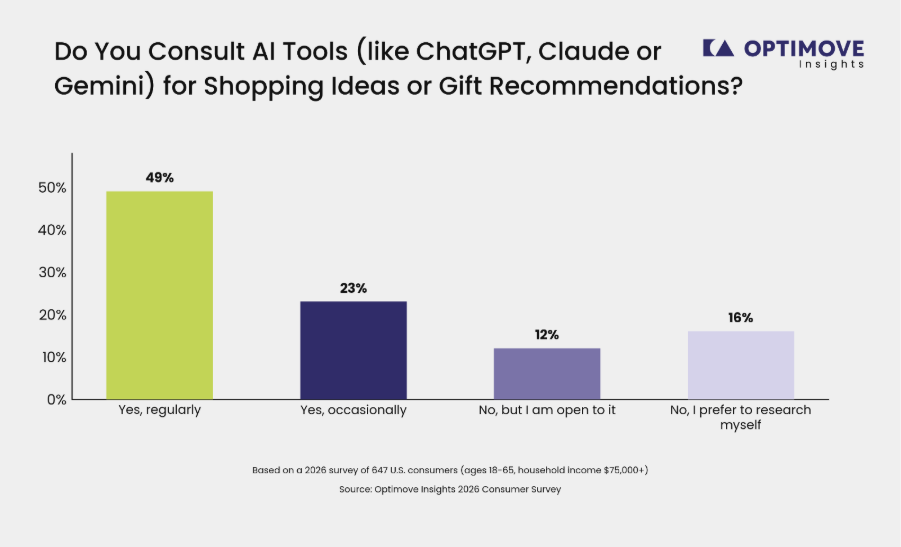
AI is already playing a significant role in product and brand discovery. 49% of consumers say they regularly consult AI tools such as ChatGPT, Claude, or Gemini for shopping ideas or gift recommendations, while another 23% do so occasionally. An additional 12% say they do not currently use AI for shopping but are open to it, while 16% prefer to research on their own.
Optimove data from more than 5.5 million customers at leading e-commerce brands also shows a sharp increase in new customer activity during Black Friday and Cyber Monday 2025. Compared with an average day from January through October, new customers increased by 593% on Black Friday and 404% on Cyber Monday.
Insights
Black Friday and Cyber Monday are major moments of brand discovery also, not only heightened shopping activity. The 2025 data shows that the number of new customers rose several times above an average day, while this year's survey indicates that nearly half of consumers are already planning to look beyond the brands they purchased from previously.
That openness is increasingly being shaped by AI. With 72% of consumers already using AI regularly or occasionally for shopping ideas and gift recommendations, discovery is no longer limited to search engines, marketplaces, advertising, or direct brand channels. AI assistants are becoming another place where consumers decide which products and brands deserve consideration.
This creates both opportunity and competition. Consumers may be more willing to try something new during Black Friday and Cyber Monday, but brands are competing for attention in a discovery environment where recommendations can be influenced by relevance, product information, value, and how clearly a brand fits the shopper's needs.
The combination of strong new-customer activity and growing AI-assisted discovery means that Black Friday and Cyber Monday can introduce brands to customers who may have had little or no previous relationship with them. The opportunity is not simply to generate a first purchase, but to make that first interaction relevant enough to become the start of a longer customer relationship.
How Marketers Should Respond
Marketers should treat Black Friday and Cyber Monday as key discovery moments and prepare for a much larger population of first-time customers. That means making offers, product information, and messaging easy to understand and relevant to different needs, while also identifying new customers quickly so their experience can evolve from a promotional interaction into a personalized relationship.
Marketers should also account for AI as an increasingly important discovery layer. Brands need accurate, useful product information and strong customer relevance wherever consumers are exploring their options.
Positionless Marketing helps marketers respond to these new customers in real time, moving quickly from discovery to personalized engagement and giving each new relationship a stronger chance to continue beyond Black Friday and Cyber Monday.
Black Friday and Cyber Monday create two opportunities. Existing customers return with stronger purchase intent, while new shoppers are actively exploring brands they may not have considered before.
The ideal for marketers is not choosing between retention and acquisition. It is recognizing who each customer is, what they are trying to accomplish, and what they need next.
The answer starts with data. Real-time behavioral signals can reveal whether someone is a loyal customer returning to a familiar category, a dormant customer responding to a seasonal offer, or a first-time visitor comparing products. Those signals allow marketers to move beyond broad Black Friday segments and respond to the customer’s actual journey as it unfolds.
AI Decisioning Agents make that level of personalization possible faster and at scale. Rather than relying on predetermined campaign flows for every shopper, AI agents can continuously interpret customer data and determine the next best action based on behavior, preferences, purchase history, context, and business objectives.
The goal is to reach each customer with the right message, offer, channel, and timing, while avoiding unnecessary discounts or irrelevant communications. This is especially important when the right response depends on combining a customer's history with what they are doing in the moment, such as a loyal customer exploring an unfamiliar category.
Discovery also increasingly begins outside the brand’s own channels. As consumers turn to AI assistants for product ideas and recommendations, marketers need to think about how their products and offers are represented to large language models. Clear, accurate, detailed, and useful content about products, use cases, pricing, availability, promotions, and differentiators can make it easier for AI systems to understand when a product is relevant to a consumer’s request, and therefore more likely to surface it as part of the consideration process.
In summary, make products discoverable, recognize the customer when they arrive, and use real-time data and agentic decisioning to determine what should happen next.
Positionless Marketing gives marketers the ability to act on those signals quickly, combining data, AI, and execution so personalization can happen at the speed and scale Black Friday and Cyber Monday demand.
The most advanced orchestration engine, ever.
Unified data, AI decisioning, and Self-Optimizing Journeys — all in one.