
Unified Growth Solution
World-class tech needs world-class drivers. AI platform and expert services, unified
Read time 8 minutes


Gartner Ranks Optimove #1 in Real Time Personalization and Decisioning
Top three across every 2026 use case, and a Visionary in the Gartner® Magic Quadrant™ for the third consecutive year

Why it matters:
Optimove was ranked highest of any vendor evaluated for Real-Time Personalization and Decisioning in the 2026 Gartner® Critical Capabilities for Multichannel Marketing Hubs report, and named a Visionary in the companion 2026 Gartner® Magic Quadrant™ for Multichannel Marketing Hubs for the third consecutive year. Together, the two findings point buying committees toward a platform whose AI decisioning holds up across use cases, not just one.
Key takeaways:
Optimove was ranked number one for Real-Time Personalization and Decisioning in the 2026 Gartner® Critical Capabilities for Multichannel Marketing Hubs report. In the companion 2026 Gartner® Magic Quadrant™ for Multichannel Marketing Hubs, Optimove was named a Visionary for the third consecutive year.
The two Gartner findings show different strengths of the same platform. Each is compelling on its own. They are worth evaluating apart rather than folding into one bigger claim.
This post addresses them in four parts: 1) what Gartner means by a multichannel marketing hub in 2026, 2) why Real-Time Personalization and Decisioning is the use case that B2C brands should focus on, 3) what the decisioning chain behind that ranking is actually built from, and 3) how Optimove AI's inside, outside, and on-top structure explains a scorecard that is strong across the board rather than lopsided.
Gartner defines Multichannel Marketing Hubs as platforms that enable marketing teams to design, orchestrate and optimize multistep customer journeys across multiple channels, by unifying customer attributes, identity and interaction history, then applying decision logic, next-best-action selection and AI agent orchestration to activate messaging through native execution or integrated channel services, with governed measurement, consent and operational controls.
That is a longer definition than the category used to need. Decision logic, next-best-action selection and AI agent orchestration were not always centered this explicitly in how Gartner described the space. This year's definition assumes marketers require AI decisioning and agents, not just campaigns and channels, and it treats governance, consent and operational control as part of the platform's job rather than a separate compliance layer bolted on afterward. Optimove's 2026 results line up with exactly that shift, across both reports.
Gartner defines Real-Time Personalization and Decisioning as “applying real-time decisioning and prescriptive intelligence to digital interactions, to optimize sessions, transactions, content and post-purchase moments across touchpoints like web, mobile and social.” The use case is built to measure whether a platform can react to what a customer is doing right now, not what they did last week, while still keeping a human in the loop through analytics and performance insight rather than letting automation run unsupervised.
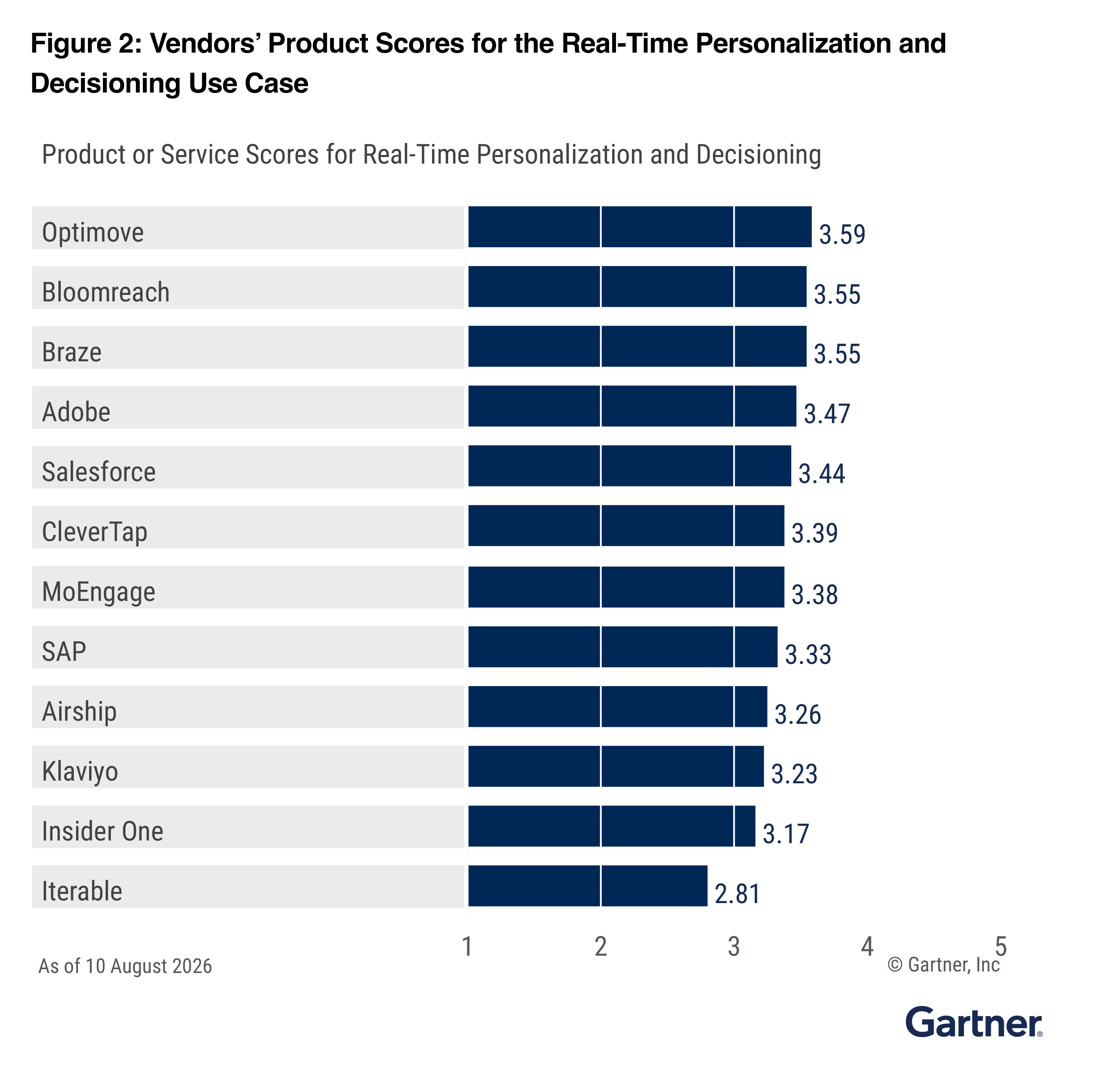
Optimove ranked 1st compared to any vendor evaluated in this use case. In practice, this looks like suppression and reprioritization that respond to a live event rather than a scheduled send: a customer partway through a post-purchase campaign who opens a support ticket gets moved into a service-recovery journey immediately, not after the next batch run. The same logic applies in reverse — a customer who abandons a cart mid-session can be met with a relevant offer before they close the tab, instead of an email that arrives a day later, after intent has already cooled. While Optimove AI is responsible for decisioning across channels, Optimove Personalize is where most of that real-time, on-site personalization work gets delivered, pairing in-session behavior with a customer's full history to decide what happens next.
Separately, in the Gartner Magic Quadrant for Multichannel Marketing Hubs, which evaluates Completeness of Vision and Ability to Execute rather than use-case performance, Optimove was named a Visionary for the third year running.
The Magic Quadrant evaluates companies: it says something about a vendor's overall strategy and its ability to execute on it over time, independent of any single capability.
Separately, Critical Capabilities evaluates products: it is built for buyer groups actively comparing platforms against their own use case, and a #1 ranking says a platform performs well on a specific job.
As noted, these two different reports evaluate two different things. They are worth keeping apart rather than folding into one bigger claim.
Optimove did not only rank 1st in one category. It ranked in the top three across all four use cases Gartner evaluated for 2026 in evaluating 12 vendors:
Optimove Insight: a single 1st ranking can happen almost anywhere. Landing a top ranking in all four categories means the platform has to be built for range, not for one strong feature carrying the rest. Range is harder to fake than a single spike.
The Real-Time Personalization and Decisioning ranking does not come from one model. It comes from a coordinated chain of agents that hand decisions to one another: an Audience Decisioning Agent, a Journey Decisioning Agent, an Offer Decisioning Agent, a Content Decisioning Agent, and a Send Time Decisioning Agent, all running inside the AI Decisioning Studio in Optimove Orchestrate.
Each agent owns one decision: which audience, which journey, which offer, which piece of content, what time. The chain is what lets a single customer event, like that support ticket, move through the whole chain at once instead of waiting on separate systems to catch up with each other. Without a coordinated chain, “real-time” tends to mean one system reacts instantly while the others are still working off yesterday's data — the customer gets a fast response in one channel and a stale one in the next.
Optimove has described its AI architecture the same way since launching Optimove AI in June 2026. Inside the platform, that is Native AI: the decisioning agents above, grounded directly in a customer's unified profile. Outside the platform, that is the Optimove MCP, a governed connection that lets Claude, ChatGPT or any other AI tool read Optimove's data and write back campaigns, audiences and templates, inheriting the same permissions and guardrails a marketer would have inside the platform itself. On top of the platform, that is Custom Apps: tailored applications built by Optimove's Forward-Deployed Engineers (FDEs) for a specific business need, running inside the same governance envelope as everything else, maintained as a product rather than handed off as a one-time project.
It is a useful way to read this year's scorecard, too. Real-Time Personalization and Decisioning is mostly an inside question: how good the agents are and how directly they're grounded in real customer data. Conversational and Agent-Augmented Marketing leans more on outside and on top, on how open and extensible the platform is when AI needs to reach beyond it, into a chat interface or a purpose-built application. Scoring well across all four use cases means all three of these have to hold up at once, not just the one that is easiest to demo.
Three consecutive years as a Visionary and a number-one use-case ranking in the same cycle make the same argument, checked twice, by two different Gartner methodologies: one about the company, one about the product. Gartner's own definition of a Multichannel Marketing Hub has moved toward decision logic and AI agent orchestration. Optimove's decisioning chain, and its inside, outside, and on-top architecture, are what that definition looks like running in production — which is the actual test a buying committee should apply, not just which quadrant a vendor lands in.
For more insights, contact us to request a demo.

Rony Vexelman is Optimove’s SVP of Marketing. Rony leads Optimove’s marketing strategy across regions and industries.
Previously, Rony was Optimove's Director of Product Marketing leading product releases, customer marketing efforts and analyst relations. Rony holds a BA in Business Administration and Sociology from Tel Aviv University and an MBA from UCLA Anderson School of Management.