

Unified Growth Solution
World-class tech needs world-class drivers. AI platform and expert services, unified
Read time 9 minutes


Personalize anything. Everywhere.
Tailor every page, message, and moment with AI-driven personalization.

There is a stat that surfaces often in marketing conversations: 64% of consumers expect companies to interact with them in real time. That expectation sounds intense. Until you learn it actually comes from 2016.
A decade ago, real-time responsiveness was a differentiator. Today, 35% of consumers will abandon a brand that does not engage with them directly in real time. Expectation has become a baseline. And when something becomes a baseline, it stops being a competitive advantage and starts to be a commodity.
That is precisely what has happened to real-time marketing. Nearly every marketing platform now claims real-time capabilities. And because the capability is now table stakes, it has become difficult to evaluate and even harder to compare. So, vendors have latched onto the one thing that is easy to measure: speed.
This vendor can respond to an event in 50 milliseconds. That one can do it in 20. But customers do not feel milliseconds. They feel whether a message was relevant, contextual, and worth receiving. The marketing industry has been optimizing for speed at the expense of something far more valuable: context.
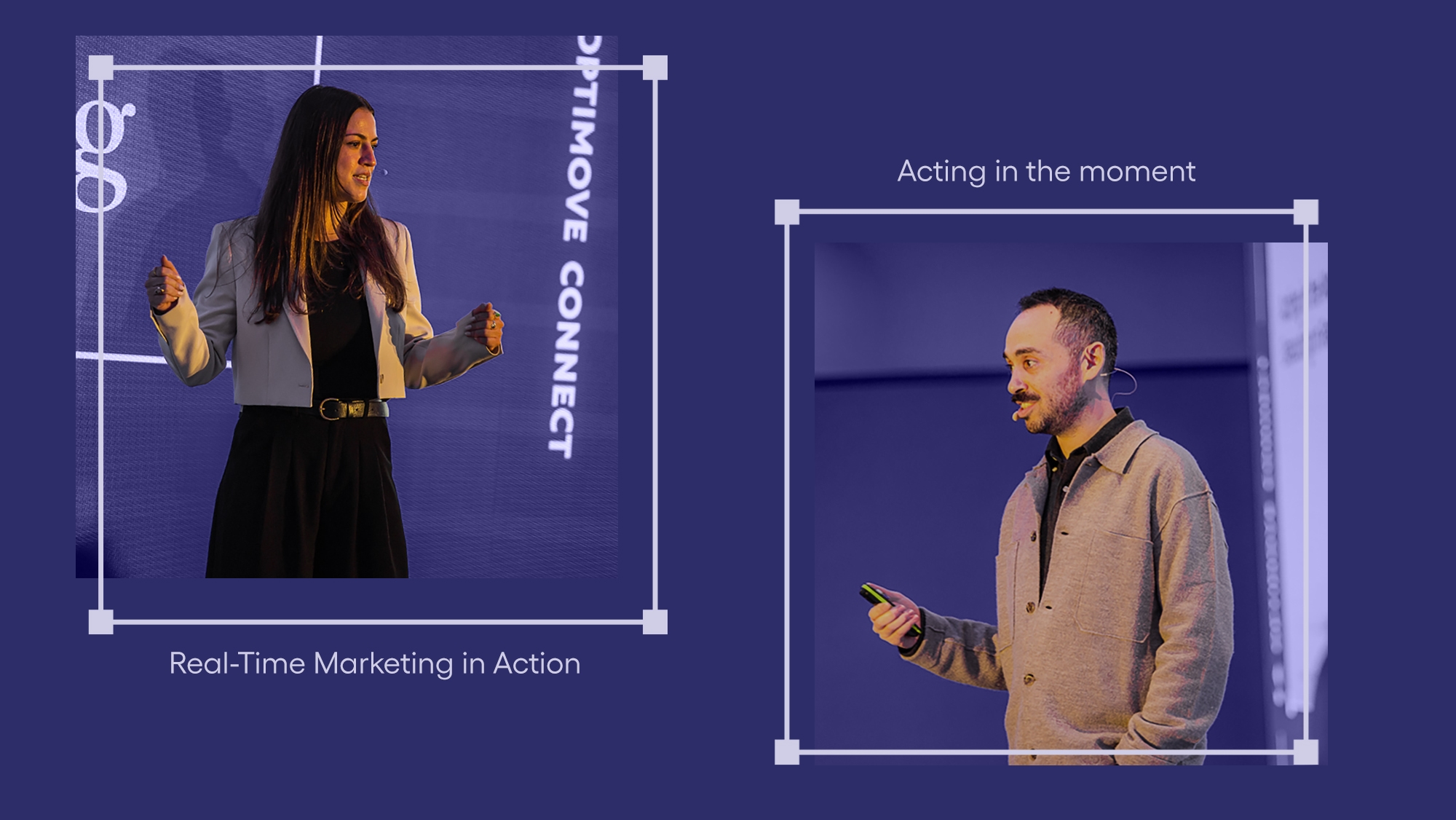
This was the focus of an Optimove Connect 2026 session led by Asaf Stein, Director of Solution Engineering, and Tricia Williams, Customer Success Team Lead, where they showed what it takes to move real-time marketing beyond fast reactions and toward customer experiences shaped by context. Let’s dive in.
When a customer abandons a deposit, visits a product page, logs into an app, or starts a purchase, a signal has been generated.
But a signal only becomes meaningful when combined with everything else known about that customer: who they are, what they usually do, whether this behavior is unusual, what their predicted value is, how close they are to churning, what they are eligible for right now, and what they have recently received.
Without that context, a real-time trigger is just a fast reaction. And a fast reaction to the wrong interpretation of a signal is noise delivered quickly.
The change that matters is from reactive to contextual. In a reactive model, an event triggers a campaign. The logic is simple: this happened, so send this. In a contextual model, the logic is richer: this happened, and here is what it means for this specific customer at this specific point in their journey.
The clearest way to understand why context is so important is to look at the same real-time event across different customers.
Consider deposit abandonment: a customer who starts but does not complete a deposit. In a purely reactive model, every customer who triggers this event gets the same abandonment message, the same promotion, and the same urgency.
But contextual understanding reveals something different. Such as:
Same event. Three customers. Three completely different interpretations. Three different responses. This is what contextual real-time marketing looks like in practice: not a single automated reaction, but a way to read behavior considering history, value, and risk.
The starting point for contextual marketing is knowing who the right audience is based on who customers are right now.
Real-time events should continuously refresh segmentation and eligibility throughout the day. As customer state changes, as deposits are made, balances change, and behaviors evolve, the audiences that customers belong to should update accordingly.
Consider the deposit abandonment scenario. A marketer building this audience might start with a straightforward criterion: customers who initiated but did not complete a deposit. But contextual segmentation goes further.
What if some of those customers already have $50 sitting in their wallet? It may not make sense to target them with a promotion at all. They already have funds. A real-time balance attribute can be layered in to filter them out. And because the attribute is always calculating off live event data, it stays accurate no matter when the campaign runs.
This matters beyond individual campaigns. Real-time segmentation allows targeting decisions to be made throughout the day, not only at the moment a campaign is scheduled. It ensures that the eligibility feeding those decisions is always current.
Once the audience is defined, the next question is what actually happens, and for whom.
In a more contextual approach, marketers can build multi-step, multi-channel journeys that combine customer data with real-time signals at every decision point. In a deposit abandonment journey, the flow does not start by blasting every qualified customer with the same message. It starts by layering context.
The first filter could be churn factor: a calculated metric that reflects how many of a customer’s average behavioral cycles they have missed. A customer who typically deposits weekly but has not deposited in four weeks has a churn factor of four. For customers with a churn factor above four, the abandonment represents a genuine risk, and a promotional email makes sense. For customers whose churn factor is below two, no communication may be needed at all.
For customers who fall in between, a second layer of context kicks in: predictive lifetime value. Among mid-risk customers, only the high-value ones receive the promotion. Lower-value customers might receive a lighter nudge, or nothing at the current moment.
After a message is sent, the journey continues to react. If the customer logs back in within three hours, an in-app or on-site message can reinforce the same offer. If they do not, a mobile push can nudge them again through a different channel.
Every step is conditional. Every branch reflects actual customer context. The goal is to recognize which events matter and respond accordingly.
Not every meaningful moment begins with a simple trigger. Some moments emerge from patterns that only become visible through real-time calculation.
Consider the deposit abandonment customer from earlier who eventually comes back, completes his deposit, and starts playing. Then, within a few hours, he loses more than 50% of what he just deposited. That is a significant moment. He is high value, he was already at elevated churn risk, and now he has had a materially bad experience.
No single event captures this. It requires a rolling calculation: deposit-to-loss ratio over a defined window of time. This is where real-time calculations become valuable. A formula can be configured to track how much a customer has lost relative to their recent deposits, continuously updated as new event data arrives. When that ratio crosses a threshold, say 50% within a six-hour window; it can trigger a contextually appropriate response for high-value, high-risk customers.
The goal is to create signals that reflect customer experience as it is actually unfolding.
All the contextual decisioning in the world loses its value if the message the customer ultimately receives is generic.
In email and messaging, dynamic content fields can pull directly from real-time data, including the event or event parameters that triggered the journey in the first place. A deposit abandonment email can surface the exact amount the customer was attempting to deposit, the specific promotional value calculated for them individually, and their current balance.
It can also include product or game recommendations based on what the customer has played recently and what inventory or content is currently available.
Content can update at the point of open. This ensures that a customer who opens an email hours after receiving it still sees current balance information, active loyalty points, or live offer details rather than data that has since changed.
The message reflects the customer’s actual state at the moment they encounter it.
The takeaway from all of this is that speed without context is insufficient, and in many cases, counterproductive.
Not every change in customer behavior is a moment worth acting on. Sometimes an event is routine. Sometimes it signals elevated churn risk. Sometimes it only becomes meaningful when multiple data points are combined in real time.
CRM and lifecycle marketing work best when they are grounded in history. Behavior that looks alarming in isolation may be completely routine in context. Behavior that looks routine may, for a specific customer profile, indicate something significant.
Real-time marketing should not be evaluated by how quickly a message can be triggered. It should be evaluated by whether the brand understood what was happening correctly, and responded in a way that reflected genuine knowledge of that customer.
That is what separates fast marketing from meaningful marketing. And in a world where speed has become the baseline, meaning is the differentiator.
Watch the full Optimove Connect session to learn how marketing teams can move from reacting to customer activity to recognizing the moments that matter.
To explore how this approach can work for your team, contact us to request a demo.
Generic experiences cost revenue.

Writers in the Optimove Team include marketing, R&D, product, data science, customer success, and technology experts who were instrumental in the creation of Positionless Marketing, a movement enabling marketers to do anything, and be everything.
Optimove’s leaders’ diverse expertise and real-world experience provide expert commentary and insight into proven and leading-edge marketing practices and trends.