
Unified Growth Solution
World-class tech needs world-class drivers. AI platform and expert services, unified
Read time 8 minutes


Exclusive Forrester Report on AI in Marketing
Customer lifecycle marketing is a high-level approach to personalized customer communications, based on recognizing that different marketing messages and strategies work best for customers at different stages of their journey with a brand. To forge stronger relationships with your customers, you need to understand the distinct lifecycle stages that your customers go through and provide the highest value at each stage, in order to realize the most effective customer engagement, monetization and long-term retention.
All customers progress through a series of phases during their relationship with a brand. Understanding – and mapping out – the customer lifecycle of your particular business is an important step in tailoring your marketing strategies. To get you started, here is a very basic series of lifecycle stages to consider:
Here is a more granular series of customer lifecycle phases, typical of an online business:
Once you have mapped out the most relevant lifecycle stages, you need to decide how to define which customers fall into which stage. For certain stages, this is obviously quite simple. However, for other stages, you will need to analyze your customer data a bit more deeply to decide which customers should be classified into which stage. For example, determining which customers are at risk of churn, and even which customers have already churned, can be more challenging (you can read more about this in the blog post, Defining Churn). There are various statistical and predictive techniques typically used to achieve accurate classifications for these stages.
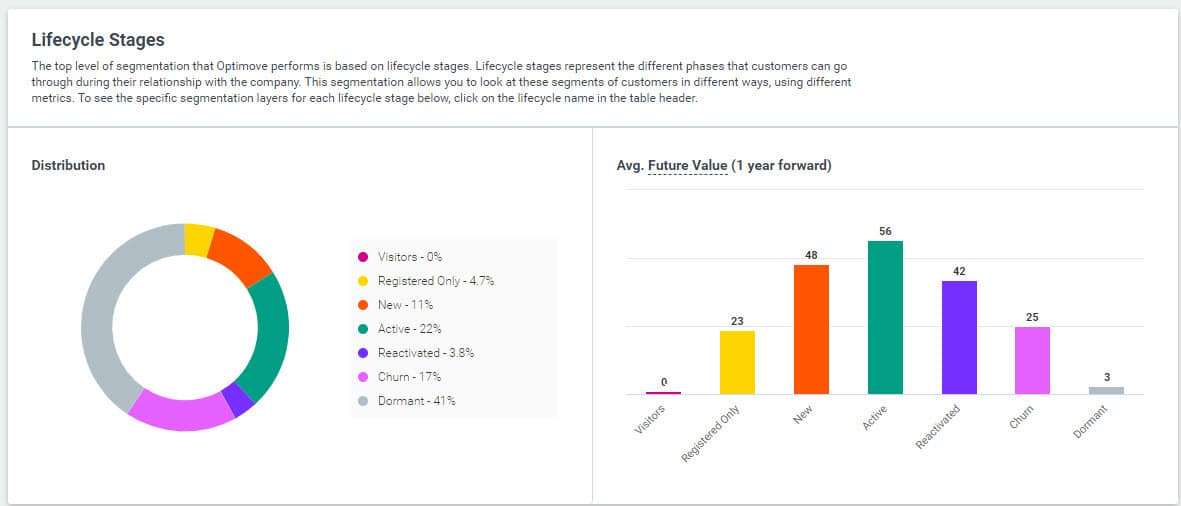
To achieve greater levels of engagement, spend and long-term loyalty, customers must feel that they are understood and valued by the brand. Customers in different lifecycle stages have different needs, and different types of messages/offers will appeal to them differently. Mapping and defining lifecycle stages will also differ for each type of brand. For example, retailers will emphasize different lifecycle stages and analyze customer behavior differently than . At its most basic level, customer lifecycle marketing is about providing customers with the greatest value at each stage of their relationship with the brand. At a higher level, it is about positively influencing their emotions and behavior over the long term.
While the goal is always to develop an engaged and loyal customer base, there are different tactics and messages that will resonate more with customers at different stages of the customer lifecycle. Here are some examples of how to do this:
So, how do you go about planning a lifecycle-first strategy? Watch the 3-minute video or read the transcript here it to find out!
https://www.youtube.com/embed/Sagq\_ckV1dI
As already mentioned, the primary benefits of customer lifecycle marketing include increased customer engagement, monetization, retention and loyalty. This is because personalized customer marketing always provides customers with a more positive experience that may make them stick with you, even when your competitors try to pull them away.
No one wants to be inundated with irrelevant emails, texts and ads. From the customer’s point of view, more relevant, timely and emotionally intelligent communications make them feel understood and valued. When you succeed at delivering true value, your customers will be more responsive and feel a stronger connection with your brand. This, in turn, leads to greater brand loyalty and, ultimately, higher customer lifetime value.
Another clear benefit is increased marketing ROI: when your paid channels deliver relevant and timely messaging, you will consistently see greater uplift from your campaigns.
On a more strategic level, customer lifecycle marketing is invaluable as a first step towards achieving true 1:1 personalized customer communications. Instead of sending the same communications to large swatches of your customers (or even every customer in your database!), lifecycle marketing forces you to start thinking about customers as individuals. In this way, it serves as a starting point for your marketing team to think about the differences between customers – and what might provide them with the greatest value at each stage of their relationship with your brand.
The next step beyond customer lifecycle marketing is aiming for true 1:1 personalized customer communications. The only way to do this is to dive far deeper into your customer data to achieve the understanding and insights necessary for the level of emotionally intelligent customer marketing that will make your customers fall in love with your brand and never consider leaving you!
Doing this at scale is challenging, but recent advances in technologies, such as predictive customer modeling, dynamic customer micro-segmentation, multi-channel campaign automation and AI-driven campaign optimization, have made it a reality already today.
Whether you’re interested in getting your team started with basic customer lifecycle email marketing or you want to dive into large-scale, automated 1:1 multi-channel customer lifecycle marketing automation, you need to check out Optimove. Optimove’s Relationship Marketing Hub is customer lifecycle marketing software that combines the most advanced customer intelligence technologies with an automated customer lifecycle marketing orchestration and optimization platform. Optimove helps marketers implement a systematic approach to planning, executing, measuring and optimizing a complete, highly personalized customer lifecycle marketing strategy.
Visit the Optimove Product page or request a Web demo to learn how you can use Optimove’s Relationship Marketing Hub to automate a complete system of highly personalized and highly effective customer marketing activities.
Exclusive Forrester Report on AI in Marketing
In this proprietary Forrester report, learn how global marketers use AI and Positionless Marketing to streamline workflows and increase relevance.