

Unified Growth Solution
World-class tech needs world-class drivers. AI platform and expert services, unified
Read time 7 minutes


Exclusive Forrester Report on AI in Marketing
Database marketing is the practice of leveraging customer data to deliver more personalized, relevant and effective marketing messages to customers (both existing and potential customers). While the term database marketing can be applied to marketing programs that are aimed at acquiring new customers, the huge amount of data available on existing customers (and the high relative value of retaining them) makes it much more valuable in the realm of customer marketing.
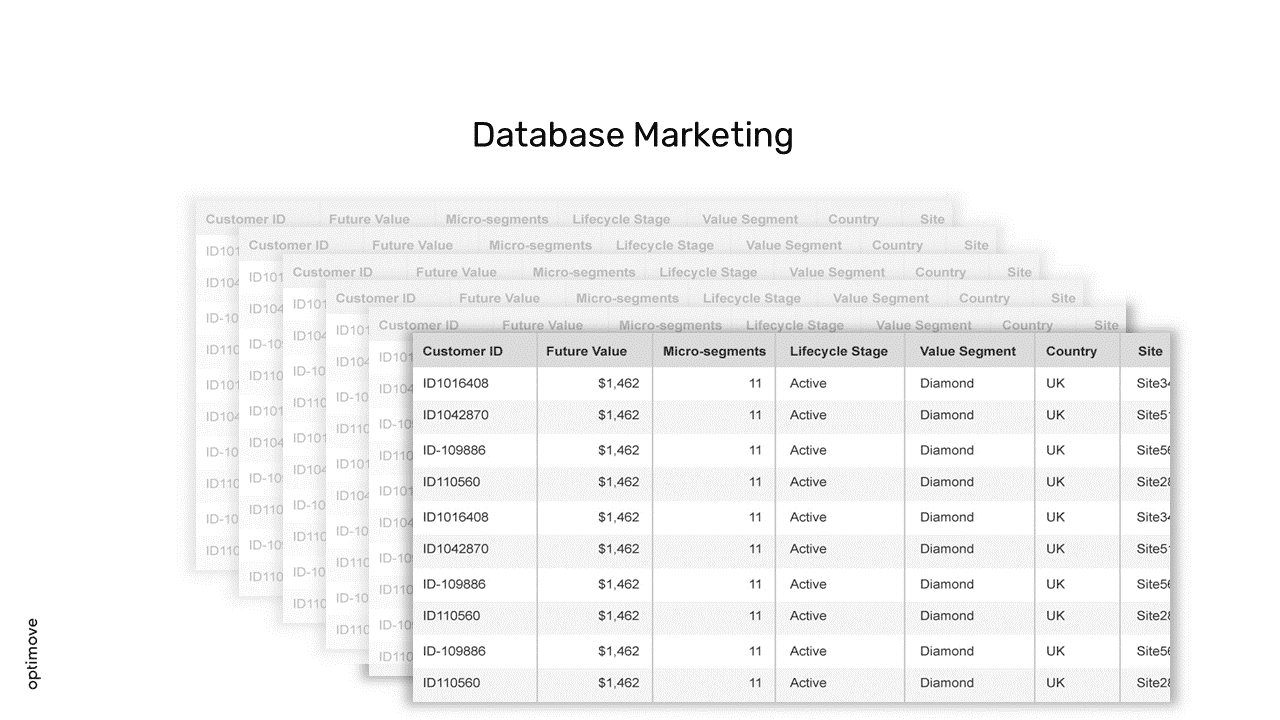
While deploying a large-scale marketing database is not a new concept, two recent factors have made this approach to personalized marketing more practical to implement:
The overriding goal of marketing via a customer information database is to utilize all the customer data available to establish and maintain a successful, mutually beneficial and long-term relationship with each customer. With a deep understanding of how the company can please – and provide value to – each customer, companies are able to develop the kinds of customer relationships that lead to dedicated brand loyalty, extensive word-of-mouth promotion and dramatically higher customer lifetime value.
There are many internal sources and external sources of data that companies can aggregate in order to construct a single customer view database. These include:
It is important that the various data sources are combined in such a way that the data is clean (free of errors), up-to-date and correctly linked to each individual customer. Each of these requirements can pose challenges, especially the need to associate all customer data, from all sources, with a unique customer identifier. Only once all data sources are properly collected and linked to individual customers can the promises of database marketing be realized.
Fortunately, technology has made terrific advantages in all of these areas over the past few years, a fact that makes it practical – perhaps even mandatory! – for companies to deploy database marketing solutions and reap the benefits.
The primary value of database marketing is that it enables a brand to communicate with customers so that they feel they’re involved in a one-on-one conversation with the brand. Really knowing customers – their wants, needs, preferences, tendencies and even their likely future behaviors – allows the brand to make them feel understood and appreciated, without wasting their time or patronizing them with irrelevant communications. This high degree of messaging personalization and relevance embodies “emotional intelligence” which naturally results in customers who are more engaged, more loyal to the brand and who remain active customers longer.
This process begins with multi-layered customer segmentation based on the data available in the customer data warehouse. Basic segmentation methods rely on one or more database fields, such as demographic characteristics, website/app activity, purchase patterns and response patterns to earlier offers. More complex segmentations leverage analysis of numerous data points, using methods such as Recency, Frequency, Monetary (RFM) analysis or cluster analysis. The most sophisticated segmentation approaches are found in the family of predictive behavior modeling solutions that work well for predicting a customer’s future behavior, forecasting customer lifetime value (LTV), likelihood of churn and other future-facing factors.
By combining the various segmentation approaches, marketers are able to achieve customer micro-segmentation, or even individual-level segmentation (which is sometimes called segment-of-one customer-marketing). This results in highly relevant personalized interactions that exhibit emotional intelligence and can successfully rise above the noise in today’s marketing-saturated world.
The results include dramatically increased customer engagement, spend, long-term loyalty and overall profitability.
Data can also help you power smart product recommendations. If you would like to learn more, watch the 2:28 minute mini-workshop or read the transcript here.
https://www.youtube.com/embed/FxvJyV8UntU
Analyzing the aggregated customer data can yield rich insights and even lead to strategic evolution. Beyond the practical day-to-day applications that database marketing enables, companies can exploit their rich customer data to analyze their customer base and reach strategic insights that have the potential to improve various aspects of the business or even to reshape the brand itself.
Just two possible examples of this are tracking the balance of future revenues expected to come from existing customers versus new customers, and determining the balance of high-value (VIP) customers versus low-value and one-time customers.
Once created for the sake of personalized retention marketing, the customer data warehouse can also be used to improve customer support, usually through integration with the company’s CRM and/or call center system. When a customer contacts the brand for service via a phone call, email or social media channel, company reps can tap into the single customer view database and instantly access everything the company knows about the customer. This allows for more relevant and personalized responses that further enhance customers’ perceptions of the brand as one that really “gets” them.
Mining customer data for a better understanding of what products or services customers want is another benefit. For example, by cross-referencing purchase/engagement patterns and demographic parameters, a brand may discover important insights into its overall product mix. After all, great marketing and customer service can only go so far – the offering must be one that the target market wants!
If you are considering deploying a database marketing solution, take a close look at Optimove. Optimove is a Relationship Marketing Hub that combines the most advanced customer modeling, micro-segmentation and analytics technologies with an automated marketing orchestration platform. Optimove enables marketers to implement a systematic approach to deploying and optimizing a complete database marketing based customer retention solution.
Request a Web demo to learn more about using Optimove to realize all the benefits of a cutting-edge database marketing solution.
Exclusive Forrester Report on AI in Marketing
In this proprietary Forrester report, learn how global marketers use AI and Positionless Marketing to streamline workflows and increase relevance.