
Unified Growth Solution
World-class tech needs world-class drivers. AI platform and expert services, unified
Read time 76 minutes


Forrester: Optimove’s Total Economic Impact

Trust Is Becoming AI's Competitive Advantage
AI agents are becoming more autonomous, moving from generating recommendations to making marketing decisions in real time. But greater autonomy raises a new question for marketing leaders: what gives those decisions credibility? This week's stories argue that trust doesn't come from the AI model itself. It comes from the quality of the data feeding it and the governance surrounding every action it takes. As AI takes on greater responsibility, what gives marketers confidence that its decisions are the right ones?
Peter Allen Clark, EMarketer, 7/22/2026
eMarketer explores why customer data has become the true foundation of marketing AI. While AI capabilities are rapidly becoming standard features across marketing platforms, the quality of an AI agent's recommendations remains limited by the customer data it can access. Agents operating on fragmented or incomplete datasets can only optimize within those constraints, regardless of how sophisticated the underlying model may be.
The article argues that competitive advantage is increasingly built upstream. Organizations with unified, real-time customer data enable AI to create richer audiences, optimize campaigns continuously, and respond to changing customer behavior far faster than traditional marketing workflows allowed. As AI becomes a strategic partner rather than simply an efficiency tool, the data foundation behind it becomes a defining business asset.
Gary Drenik, Forbes.com, 7/16/2026
Forbes examines the other side of autonomous marketing: accountability. As AI agents begin adjusting budgets, reallocating audiences, and changing campaign logic without waiting for human approval, traditional governance models struggle to keep pace. Reviewing dashboards after campaigns launch is no longer enough when thousands of AI-driven decisions may already have reached customers.
The article argues that governance must evolve from oversight to embedded decision-making. Rather than explaining actions after the fact, AI agents should create an auditable record of every decision as it happens, documenting the data, policies, and rules behind each action. As marketing organizations adopt increasingly autonomous systems, explainability becomes less about compliance alone and more about maintaining trust in every customer-facing decision.
As AI takes on more responsibility, marketers need confidence in more than the model itself. They need confidence that every recommendation is grounded in complete customer data, and every autonomous action can be understood, explained, and defended.
The organizations that gain the greatest advantage from AI won't simply deploy smarter agents. They'll build the data foundations and governance frameworks that allow those agents to make better decisions, earn greater trust, and scale responsibly.
Check back next week for another roundup of Media That Matters.
For more insights on Optimove and our Positionless Marketing Platform, contact us.
AI Learns Fast. Do Organizations?
AI is improving at an extraordinary pace, but many organizations still treat implementation as the finish line rather than the starting point. Whether deploying customer-facing bots or equipping marketers with AI assistants, success increasingly depends on building continuous learning into the organization itself. The companies pulling ahead are creating systems that help both their technology and their people improve over time. As AI evolves daily, how can organizations ensure their own capabilities evolve just as quickly?
Francesca Roche, CX Today, 7/14/26
CX Today explores why the biggest challenge in AI automation begins after deployment. While many organizations celebrate getting a bot into production, static assumptions and limited reporting quickly cause automated experiences to drift away from real customer behavior. Without continuous monitoring, AI can scale poor experiences just as efficiently as good ones.
CallMiner argues that organizations should manage bots much like they manage human employees. Instead of measuring only technical performance, leaders should evaluate every customer interaction, identify emerging patterns, and use conversation intelligence to retrain and improve performance over time. As AI becomes another representative of the brand, continuous feedback and governance become business disciplines, not technical maintenance.
Constantine von Hoffman, MarTech, 7/15/26
MarTech highlights a similar challenge inside marketing organizations. While marketers overwhelmingly value AI for eliminating repetitive work and increasing productivity, researchers found growing concern about something less obvious: if AI performs the work that once taught marketers their craft, where will the next generation develop judgment, creativity, and strategic thinking?
The study argues that AI adoption must be accompanied by a new approach to talent development. Technical skills such as prompt engineering matter, but so do critical thinking, ethical reasoning, experimentation, and the ability to challenge AI's conclusions. As marketers increasingly supervise AI instead of producing every first draft themselves, organizations will need intentional ways to help employees continue learning even as the nature of the work changes.
Both stories arrive at the same conclusion from different directions: AI performance depends on an organization's ability to keep learning. Bots require continuous feedback from real customer conversations, while employees need new opportunities to develop the judgment that AI cannot replace.
The next competitive advantage will belong to organizations that build learning into everything they do. They will continuously improve both their AI systems and the people responsible for guiding them, recognizing that long-term success depends as much on organizational capability as on the technology itself.
Check back next week for another roundup of Media That Matters.
For more insights on Optimove and our Positionless Marketing Platform, contact us.
The Best AI May Be the One You Never Have to Open
The AI race is no longer about building standalone assistants. Increasingly, the winners are embedding AI into the applications people already use every day. This week's stories show Slack and Microsoft bringing AI directly into conversations, CRM records, documents, and team workflows, reducing the need to switch tools or learn new interfaces. As AI becomes part of the flow of work, does the interface matter more than the model behind it?
Michael Nuñez, Venture Beat, 7/8/2026
VentureBeat reports that Slackbot can now access Salesforce CRM data, generate Tableau charts, trigger DocuSign approvals, and interact with dozens of enterprise applications through natural language, all from within a Slack conversation. Powered by Salesforce's Model Context Protocol (MCP) infrastructure, the update positions Slack less as a collaboration tool and more as a shared workspace where AI can retrieve information and execute work across systems.
The broader implication goes beyond CRM access. Slack is betting that the future of enterprise AI is collaborative rather than individual. Instead of employees interacting with isolated AI assistants in separate windows, AI becomes part of the team's shared conversation, where context, decisions, and actions remain visible to everyone. In that model, the conversation itself becomes the interface for work.
Alex Cole, CX Today, 7/8/2026
Microsoft is taking a similar approach. CX Today shows that Sales Agent and Service Agent are now generally available across Microsoft 365 Copilot and Dynamics 365, allowing sales and service teams to access CRM insights, summarize meetings, update records, draft responses, and coordinate work without leaving Outlook, Teams, or Dynamics.
Like Slack, Microsoft's strategy focuses less on introducing another AI application and more on removing friction from existing workflows. Rather than asking employees to adopt a separate assistant, AI is embedded directly into the tools they already rely on every day. As intelligent agents become more capable, competitive advantage may depend less on the sophistication of the model itself and more on how naturally that intelligence fits into daily work.
Enterprise AI is becoming less visible and more pervasive. The goal is no longer to give every employee another AI tool to open, but to make intelligence available wherever work already happens.
Whether through Slack, Microsoft, or other enterprise platforms, the companies likely to see the greatest adoption will be those that reduce friction instead of adding it. In the next phase of AI, the best interface may be the one users barely notice.
Check back next week for another roundup of Media That Matters.
For more insights on Optimove and our Positionless Marketing Platform, contact us.
When Building AI Gets Easier, Integration Becomes the Hard Part
Building AI applications is becoming dramatically easier. Marketers can now create workflows, automations, integrations, and internal tools that once required dedicated development teams. But the bigger challenge is moving downstream: connecting those tools to trusted data, governed systems, and real business workflows. This week's stories show that the next competitive advantage belongs to teams that can orchestrate AI across the enterprise. As AI lowers the barriers to creation, what becomes the real differentiator for marketers?
Andrew Birmingham - Martech | Ecom | CX editor, Mi3, 6/29/2026
MI3 explores what Chiefmartec's Scott Brinker calls the fastest technology shift the martech industry has ever seen: "vibe coding." New research from Chiefmartec and UserEvidence found that 70% of SaaS marketing teams are already using AI-powered code generation with some level of organizational structure, while 41% have embedded it into everyday marketing workflows.
The real story is how quickly marketers are becoming capable of building their own operational software. Instead of waiting for IT or vendors to solve integration challenges, marketing teams are increasingly creating automations, connecting APIs, cleaning data, and orchestrating workflows around existing platforms. Brinker argues that technologies like Model Context Protocol (MCP), combined with stronger governance, are making that possible at unprecedented speed. As building becomes easier, the organizations creating the most value are the ones putting structure around it.
Scott Clark, CMSWire, 6/30/2026
CMSWire argues that Salesforce's recent acquisition spree follows the same logic from a different direction. Through acquisitions including Informatica, Contentful, and Fin, Salesforce is assembling what increasingly looks like an enterprise AI operating layer, combining data governance, integration, content, analytics, collaboration, and autonomous agents into a single ecosystem.
The strategy also highlights a growing challenge for enterprise AI. Owning all the pieces does not automatically create value. AI agents depend on trusted data, consistent context, and seamless interoperability across systems. As enterprises deploy more autonomous workflows, the challenge changes from adding capabilities to making those capabilities work together. Integration, governance, and orchestration are becoming just as important as the AI models themselves.
Marketing is entering a phase where creating AI-powered experiences is becoming increasingly accessible. Connecting those experiences across people, platforms, and data is proving far more difficult.
Whether companies build their own AI workflows or rely on enterprise platforms, the competitive advantage is increasingly the same: creating an environment where AI has access to the right context, trusted data, and clear governance. In the AI era, building may become the easy part. Orchestrating everything around it is where leaders will differentiate themselves.
Check back next week for another roundup of Media That Matters.
For more insights on Optimove and our Positionless Marketing Platform, contact us.
Marketing’s AI Problem Is Organizational, Not Technical
The AI conversation in marketing is moving beyond tools and experimentation. This week's stories suggest that the companies creating real value are adopting AI while also reshaping how marketing operates, from customer data and personalization to workflows, decision-making, and team structure. As AI becomes more accessible, competitive advantage is increasingly determined by organizational readiness rather than technology alone. What does it take to turn AI investment into lasting marketing transformation?
Regine Laguilles, IT Brief UK, 6/24/2026
Marketing Dive reports that Gap is bringing AI across its portfolio of brands through a coordinated transformation of its marketing organization. Working with Google Cloud, Zeta Global, and Publicis Sapient, the retailer is building a unified data foundation, AI-powered decisioning, and more connected workflows to personalize experiences, accelerate campaign delivery, and improve customer engagement.
The announcement stands out because it goes well beyond introducing new AI capabilities. Gap is redesigning how marketing teams work together by connecting data, technology, talent, and processes around continuous learning. Their goal is to build a marketing organization that becomes smarter with every customer interaction, allowing teams to spend more time on strategy, storytelling, and brand building.
Chris Kelly, Marketing Dive, 6/23/2026
McKinsey's latest research reaches a similar conclusion from a broader industry perspective. While AI has the potential to generate up to $90 billion in additional marketing returns in the U.S., fewer than 10% of organizations have successfully scaled it across marketing workflows. The disconnect is no longer access to AI. It is the ability to redesign organizations around it.
The research notes that the biggest gains come from fundamentally changing how marketing operates. That includes moving from campaign-based planning to always-on engagement, creating new AI-focused marketing roles, and connecting brand, performance, creative, and customer experience into a single operating model. Companies that make those changes are already reporting higher productivity, faster execution, and stronger business results. Those that simply layer AI onto existing processes risk capturing only a fraction of AI's potential.
The next competitive advantage in marketing will not come from choosing the right AI platform. It will come from building an organization that knows how to use AI across every stage of the customer journey.
The companies moving fastest are treating AI as an organizational capability rather than a standalone technology initiative. That requires new workflows, new skills, new ways of measuring success, and, ultimately, a different way of thinking about how marketing creates value.
Check back next week for another roundup of Media That Matters.
For more insights on Optimove and our Positionless Marketing Platform, contact us.
When AI Becomes Standard, What Sets Marketers Apart?
The conversation around AI in marketing is evolving. The question is no longer whether marketers should use AI, but what happens when everyone has access to the same tools. This week's stories suggest that competitive advantage is moving away from technology itself and toward the people using it. As AI lowers the barriers to content creation, analysis, and execution, creativity, judgment, and adaptability are becoming more valuable, not less. What skills will separate great marketers when AI becomes available to everyone?
Leon Siciliano, Lara O’Reilly and Jessica Orwig, Business Insider, 6/17/2026
Business Insider features Raja Rajamannar, Mastercard's former CMO, who argues that AI could usher in a new "golden era" for marketing rather than diminish the profession. His reasoning is straightforward: when every company has access to similar AI capabilities, differentiation becomes harder, creating what he calls a "sea of sameness."
That dynamic increases the importance of the things AI cannot easily replicate. Original creativity, consumer understanding, empathy, and strong judgment become more valuable when technology levels the playing field. Rajamannar's view is optimistic but practical. AI may automate parts of marketing, but marketers still need to understand what resonates with people and why. In a market flooded with generated content, distinct ideas become more important, not less.
Preston Fore, Fortune, 6/17/2026
Fortune explores a related challenge from a different angle. While demand for AI-literate marketing talent is rising rapidly, only a small percentage of marketers have formally added AI skills to their professional profiles. To help close that gap, Adobe and LinkedIn are launching a free "AI Essentials for Marketers" program focused on practical applications across content, social, analytics, and digital marketing.
The initiative reflects a growing reality across the industry. AI proficiency is becoming an expected skill rather than a specialized one. But technical familiarity alone is not enough. Adobe and LinkedIn both emphasize experimentation, adaptability, and the ability to apply AI to real business problems. The marketers most likely to thrive are not necessarily the ones with the most AI tools, but the ones who learn how to use them effectively.
The AI conversation is moving beyond automation and efficiency. The focus is increasingly shifting toward differentiation.
As AI becomes widely available, competitive advantage may depend less on access to technology and more on the human skills surrounding it. Creativity, curiosity, judgment, and the ability to learn quickly are emerging as some of the most valuable assets marketers can bring to the table.
Check back next week for another roundup of Media That Matters.
For more insights on Optimove and our Positionless Marketing Platform, contact us.
AI Shopping Is Becoming the New Storefront
AI shopping is moving from platform strategy to consumer behavior. This week’s stories show Sephora bringing prestige beauty into Google’s AI ecosystem, while back-to-school shoppers prepare to use AI tools to compare products, find deals, and even make purchases on their behalf. The shift is not just where shopping happens, but who guides the decision. How should brands show up when AI becomes the shopper’s first stop?
Zofia Zwieglinska, Glossy, 6/3/2026
Glossy reports that Sephora is expanding its partnership with Google to enable shopping directly within Google’s AI-powered platform through Agentic Checkout. Shoppers will be able to ask beauty questions, compare products, build routines, add items to basket, and check out without leaving Google’s ecosystem.
For Sephora, the move extends its guided beauty experience into the platforms where discovery is already happening. The brand is using AI to make product discovery easier and more personalized, while still anchoring the experience in expertise, trust, and human service. That balance matters in a category like beauty, where advice, emotion, and confidence still shape the purchase.
Zachary Russell, Chain Store Age, 6/2/2026
Chain Store Age highlights how quickly AI-assisted shopping is becoming mainstream. According to Minty, 77% of back-to-school shoppers plan to use AI this year, with many turning to tools like ChatGPT, Gemini, and Meta AI to compare products, discover deals, optimize searches, and curate personal options.
That behavior is already showing up in consumer conversations. In r/NoStupidQuestions, one user asked, “Do people actually use ChatGPT or Perplexity to find products to buy?” The question itself is telling. What felt experimental a year ago is becoming normal shopping behavior. Minty’s data suggests AI is moving from assistant to decision-maker, with nearly half of respondents having already let AI influence a purchase decision and many expecting agents to complete purchases on their behalf in the coming months. For marketers, that compresses the shopping journey into a conversation where discovery, evaluation, recommendation, and conversion can happen almost at once.
AI shopping is no longer only about better recommendations. It is becoming a new interface for discovery, advice, comparison, and checkout.
For brands, the challenge is to be present without losing control of the experience. The winners will be the ones that make their product data, expertise, offers, and trust signals easy for AI systems to understand, while still preserving what makes the brand feel human.
Check back next week for another roundup of Media That Matters.
For more insights on Optimove and our Positionless Marketing Platform, contact us.
The Battle to Own Agentic Shopping Is Heating Up
Agentic commerce is moving from concept to infrastructure. This week’s stories show Google and Amazon racing to become the layer that connects shoppers, retailers, ads, carts, offers, and checkout. This is about more than making shopping easier. If AI agents start guiding product discovery and purchases, platforms will have more influence over which brands surface, which offers convert, and who owns the customer relationship. Who controls the shopping experience when AI becomes the path to purchase?
Kimeko McCoy, Digiday, 5/25/2026
Digiday highlights how Google is expanding its role in the commerce journey through Universal Cart and its broader Universal Commerce Protocol. The company is positioning itself as the connective layer across Search, Gemini, YouTube, Gmail, ads, and checkout, giving shoppers a way to discover, compare, save, and buy across multiple surfaces.
That creates a new kind of platform power. Google says it is not trying to become a retailer or marketplace, but its role is moving closer to matchmaker, decision layer, and transaction enabler. For brands, the opportunity is clear: fewer steps between intent and purchase. But the risk here is just as clear: greater dependence on the platforms deciding which products and offers appear at the moment of decision.
Annie Palmer, CNBC, 5/27/2026
Amazon is taking a different path toward the same prize. CNBC reports that AWS is packaging the technology behind Alexa for Shopping so other retailers can launch their own AI shopping assistants in as little as 60 days. Kate Spade is already using the service for a gifting assistant, with other retailers in testing.
The pitch is strategic. Rather than handing the shopping experience to a general-purpose AI intermediary, Amazon is telling retailers to build agents grounded in their own storefronts, catalogs, and brand knowledge. That reframes the agentic commerce race. Google wants to organize shopping across the open web. Amazon wants to provide the infrastructure retailers use to build their own AI shopping experiences. Either way, AI is becoming less of a feature and more of the operating layer for commerce.
The future of shopping is not just about better recommendations. It is about who owns the interface where decisions happen.
Google, Amazon, OpenAI, retailers, and marketplaces are all competing to shape that layer. For marketers, the question is not only how to show up in AI-powered shopping experiences, but how to protect brand visibility, customer data, and commercial control as agents move closer to the transaction.
Check back next week for another roundup of Media That Matters.
For more insights on Optimove and our Positionless Marketing Platform, contact us.
CRM Is No Longer a Database. It Is Becoming a Decision Layer.
The next phase of customer experience is less about collecting data and more about activating it. This week’s stories show two sides of the same problem: CRM and customer data systems still hold enormous value, but too much of that value stays trapped in records, reports, and disconnected workflows. At the same time, Google is pushing search and commerce closer to direct action, where ads become answers and AI agents reduce the distance between intent and transaction. How do brands turn customer data into action before the moment is gone?
Nicole Willing, CX Today, 5/19/2026
A CX Today roundtable argues that many CRM and CDP programs still fall short because they were built as systems of record, not systems of action. Companies have more customer data than ever, yet much of it remains trapped in reports, dashboards, and disconnected workflows instead of helping teams anticipate needs or reduce customer effort.
The discussion makes clear that actionable CRM is not just about adding AI or automation layers. It requires organizations to align data, workflows, governance, and teams around customer outcomes rather than internal metrics alone. AI can accelerate progress by surfacing knowledge, summarizing interactions, and recommending next-best actions, but the panel also emphasizes that customer journeys still require context and human judgment. The challenge is turning customer intelligence into decisions teams can act on quickly and confidently.
Peter Adams, Marketing Dive, 5/20/2026
Marketing Dive highlights how Google is adapting search advertising for a more conversational and agentic environment. New tools announced at Google Marketing Live are designed to make ads feel more like answers, while also reducing friction between discovery and purchase. That includes agentic capabilities for campaign creation, reporting, personalized offers, and native checkout within AI Mode.
This matters because the customer journey is becoming more compressed. A consumer can ask a complex question, receive AI-curated recommendations, see a tailored offer, and move closer to purchase without following the traditional path from search to site to checkout. For marketers, that raises the stakes for data quality, context, and timing. If AI interfaces are deciding which answers, offers, and products surface in the moment, brands need systems that can act as quickly as customer intent forms.
Customer data is only valuable if it changes what happens next. CRM, CDPs, search ads, and commerce tools are all moving toward the same expectation: less storage, less handoffs, more action.
The advantage will belong to brands that can connect insight to execution quickly and responsibly. In a market where AI can surface, recommend, and transact in real time, the question is not whether companies have customer data. It is whether they can use it before the opportunity passes.
Check back next week for another roundup of Media That Matters.
For more insights on Optimove and our Positionless Marketing Platform, contact us.
AI Ambition Is Outpacing Marketing Readiness
AI is now at the center of CMO strategies, but the harder question is not whether marketing leaders are prioritizing it. They are. The gap is between ambition and operating reality. This week’s stories show that many organizations are investing in AI before they have the infrastructure, processes, governance, and talent to make it work at scale. What does it take for marketing teams to turn AI investment into actual business impact?
Sara Karlovitch, Marketing Dive, 5/11/2026
Marketing Dive highlights a widening gap between AI priority and AI preparedness. Gartner’s latest CMO Spend Survey found that 70% of CMOs say becoming an AI leader is a key goal for 2026, yet only 30% believe their organizations have the infrastructure needed to achieve it.
That matters because AI is increasingly being positioned as a way to do more with less, especially as marketing budgets remain mostly flat. But tools alone will not solve the problem. Without the right data foundations, governance, workflows, and talent, AI spending risks becoming another layer of complexity. The issue is not whether CMOs believe in AI. It is whether their organizations are built to capture its value.
Constantine von Hoffman , Senior Editor, MarTech, 5/12/2026
MarTech takes the same Gartner data one step further, arguing that many CMOs are buying AI their organizations are not ready to use. Marketing teams are allocating an average of 15.3% of their budgets to AI, but most still lack mature internal processes to implement and scale it effectively.
The companies pulling ahead appear to be doing something different. They are not just spending more on AI. They are pairing that spend with stronger operational discipline, better infrastructure, and more flexible budgets. That reframes the AI race. It is becoming less about access to technology and more about management capacity: how well teams connect AI to data, people, processes, and measurable outcomes.
The next phase of marketing AI will not be won by the teams that buy the most tools. It will be won by the teams that can operationalize them.
For CMOs, the mandate is becoming clearer. AI leadership requires more than ambition and budget allocation. It requires organizational foundations to make AI repeatable, measurable, and useful at scale.
Check back next week for another roundup of Media That Matters.
For more insights on Optimove and our Positionless Marketing Platform, contact us.
When AI Agents Enter CRM, Governance Becomes the Product
AI agents are no longer being tested at the edges. They are being embedded into the core of enterprise systems, with direct access to customer data, workflows, and decision-making processes. That changes the nature of software itself. The challenge is no longer building AI that can act, but defining the conditions under which it should. As agents move from assistance to execution, the question becomes less about capability and more about boundaries. When should AI act independently and when should humans stay in the loop?
Nicole Willing, CX Today, 5/5/2026
CX Today reports that HubSpot is preparing to give AI agents direct control over its CRM platform, opening up its APIs and data layers so agents can access and operate every function. This move reflects a broader transition from human-first software to agent-ready systems. Agents do not navigate dashboards or interfaces. They interact through APIs, execute workflows, and act on structured data. HubSpot’s vision pushes this further than most, aiming for full operational access rather than limiting agents to predefined tasks.
But that ambition introduces real risk. As agents gain autonomy, errors, misuse, or unintended actions can happen at machine speed. That tension is starting to surface beyond enterprise software circles too. In r/artificial, one user asked, “When should AI recommend a decision vs make one?” It captures the core challenge companies are now facing: the problem is no longer whether AI can act autonomously, but where humans should remain in the loop.
Rob Wilkinson, CX Today, 5/5/2026
At the same time, CX Today highlights how ServiceNow is taking a more controlled approach to the same problem. Its new Autonomous CRM replaces fragmented systems and manual routing with agents that execute workflows across departments, turning customer requests into completed tasks without human intervention.
The difference is in how that autonomy is managed. ServiceNow is building governance directly into the system through its AI Control Tower, aiming to monitor, secure, and regulate agent behavior. That reflects a growing concern across enterprises: without oversight, automation quickly becomes chaos. Many organizations already have more AI running than they can track. The risk is not that AI fails to execute, but that it executes without alignment.
CRM is becoming the next test case for agentic AI. HubSpot is pushing toward open, agent-ready systems, while ServiceNow is emphasizing controlled execution through governance and workflow oversight.
The takeaway is clear: giving agents access is only the first step. The real challenge is deciding what they can do, when they need approval, and how businesses prevent speed from becoming risk. In the agentic CRM era, governance is not a back-office concern. It is the foundation for making autonomy useful.
Check back next week for another roundup of Media That Matters.
For more insights on Optimove and our Positionless Marketing Platform, contact us.
When Marketing Runs Itself, What Actually Sets Brands Apart?
This week’s stories highlight a new reality: marketing is no longer defined by what teams can execute, but by what systems can optimize. AI is now handling targeting, creative, bidding, and performance in real time, often with minimal human input. At the same time, a new wave of startups is trying to solve what those systems still lack: brand context. As execution becomes automated, differentiation is moving elsewhere. When marketing runs itself, what actually makes one brand outperform another?
Patrick Coffee, The Wall Street Journal, 4/29/2026
A new funding round covered by The Wall Street Journal shows where the next layer of AI marketing competition is emerging. Hightouch, now valued at $2.75 billion, is betting that the real limitation of AI is not generation, but understanding.
Its approach focuses on training AI agents on a brand’s historical campaigns, ensuring outputs reflect past performance, tone, and identity. That signals a broader shift. As generative AI becomes widely accessible, producing content is no longer the differentiator. What matters is whether that content is grounded in real brand context. Without that, even the most advanced models risk producing work that feels interchangeable.
Tripp Mickle and Eli Tan, The New York Times, 4/29/2026
At the same time, a story from The New York Times shows how far automation has already gone. DribbleUp, a sports equipment company, now places its Facebook ads entirely through Meta’s AI tools, with sales outpacing marketing expenses. It is a clear example of how AI is already managing large parts of the advertising process end to end, from targeting and bidding to creative optimization and performance measurement.
The results are significant. AI is helping platforms like Google and Meta deliver more relevant ads, reduce costs, and increase campaign efficiency, which in turn is driving a surge in digital ad revenue. But that efficiency comes with a trade-off. As systems take over decision-making, marketers gain performance but lose visibility into how outcomes are produced. What used to be a set of deliberate choices is becoming a system that continuously optimizes itself.
AI is turning marketing into a system that runs with increasing autonomy. Campaigns are created faster, optimized continuously, and scaled with far less manual effort.
But as execution becomes commoditized, differentiation moves to something harder to replicate: brand context. The advantage will come from what the system learns from, how it represents the brand, and whether automation can still produce work that feels distinct.
Check back next week for another roundup of Media That Matters.
For more insights on Optimove and our Positionless Marketing Platform, contact us.
What Happens When Your Customer Is Also an AI Agent?
This week’s stories point to a new reality in customer experience: brands are no longer designing journeys only for people. As AI agents begin searching, comparing, planning, and acting on behalf of customers, marketing has to serve two audiences at once: the human buyer and the system influencing their decisions. How do you market to a customer who is no longer making decisions alone?
Margo Waldrop, The Drum, 4/21/2026
At Adobe Summit 2026, leaders framed agentic AI as a turning point for customer experience. As reported by The Drum, Adobe’s view is that brands are moving into an era where journeys are shaped by systems that interpret behavior, context, and intent in real time, not just by campaigns designed for human audiences.
That changes the role of marketing. If customers are using tools like ChatGPT, Claude, Copilot, and Gemini to search, compare, and decide, brands have to think beyond traditional engagement. Content, data structure, timing, and context become inputs that determine how AI systems understand and represent the brand. The marketer’s job becomes less about producing more content and more about making sure the right signals are available, consistent, and useful when agents enter the decision-making process.
Belle Lin, The Wall Street Journal, 4/20/2026
The Wall Street Journal highlights the business stakes behind Adobe’s push into agentic AI. Its new CX Enterprise platform is not just about adding capabilities. It is about staying relevant as AI-native tools begin to challenge traditional software models.
That pressure reveals something bigger. The advantage will not come from having AI alone, but from owning the systems that guide it. Enterprise platforms still hold the data, workflows, and governance that agents rely on to operate effectively. As more decisions are delegated to AI, the value of software may shift from execution to orchestration. The question is no longer which tool marketers use, but which system AI trusts to act on their behalf.
AI agents are changing customer experience from both sides. Customers are starting to use agents to make decisions, and companies are starting to use agents to execute work, from audience selection and journey orchestration to offer, timing, and content decisioning.
That creates a new marketing reality. Brands will still need to persuade people, but they will also need to be legible to the systems acting for them. Platforms like Optimove’s AI Decisioning Studio show where this is heading: marketers managing teams of AI agents that work across data, journeys, offers, and content to make customer engagement more adaptive, contextual, and scalable. The next competitive edge will come from designing for both people and the agents shaping their decisions.
Check back next week for another roundup of Media That Matters.
For more insights on Optimove and our Positionless Marketing Platform, contact us.
If AI Can Do Everything, What Actually Makes Marketing Work?
This week points to a growing gap in how AI is being used in marketing. On one side, brands can now generate, test, and deploy thousands of variations at scale. On the other hand, most of those outputs still lack something critical: context. As AI reshapes both discovery and execution, the advantage is changing from who can produce more and toward who understands more. When everything can be automated, what actually makes marketing effective?
Francesca Roche, CX Today, 4/14/2026
The next phase of AI in marketing is not about more automation. It is about better understanding. Recent updates reported by CX Today from HubSpot signal a shift toward what it calls “context-aware AI,” designed to move beyond generic outputs by grounding decisions in real customer data, behavior, and workflows.
The problem it is trying to solve is increasingly clear. Most AI tools can process data, but they do not understand why things happen. That gap shows up in generic campaigns, poorly timed outreach, and missed intent signals. HubSpot’s approach reframes AI as something that should operate across the full customer lifecycle, connecting marketing, sales, and support through a shared layer of context. In this model, visibility in AI-driven discovery, through tools like AEO, depends less on volume and more on how well a brand aligns with real customer questions.
Dan Berthiaume, Chain Store Age, 4/14/2026
At the same time, AI is dramatically expanding what marketers can do at scale. In a recent Q&A covered by Chain Store Age, Bain & Company outlines how generative and agentic AI are removing two of the biggest historical constraints in personalization: creative production and data processing.
But scale alone is not the breakthrough. The real shift is in how fast marketers can learn and adapt. AI is turning marketing teams from production engines into what Bain describes as data-driven “newsrooms,” where campaigns are continuously tested, refined, and redeployed. That raises a more important question. If every brand can personalize at scale, what actually makes those experiences resonate? The answer increasingly comes down to relevance, timing, and understanding intent, not just the ability to produce more.
AI is making marketing faster, more scalable, and far easier to automate. But as those advantages become more widely available, they stop being differentiators.
The edge is moving to something harder to replicate: context. Not just knowing what customers did, but understanding what they want, when they need it, and how to respond in a way that actually feels relevant.
Check back next week for another roundup of Media That Matters.
For more insights on Optimove and our Positionless Marketing Platform, contact us.
Are Marketers Finally Shifting from Acquisition to Retention?
This week highlights a growing tension in how brands approach growth. For years, success was tied to volume: more traffic, more users, more sign-ups. But that model is starting to show its limits. Loyalty programs are struggling to convert early momentum into repeat behavior, and customer experience alone is no longer enough to keep customers coming back. The focus is shifting from how many customers you acquire to how many you retain. What actually makes customers come back?
Joseph Gabriel Lagonsin, Ecommerce News, 4/7/2026
The biggest failure in loyalty programs is not engagement. It is what happens right after sign-up. New data from a Paytronix report shows that the first 90 days are critical, yet many brands fail to convert new members into repeat customers. In some segments, nearly three in four users never return after joining, highlighting a widening gap between acquisition and actual engagement.
What stands out is how the definition of loyalty is changing. Enrollment is no longer a meaningful metric. Repeat behavior is. Securing a fourth visit is now seen as a stronger indicator of long-term value than simply growing a member base. This is pushing brands away from traditional points-based systems toward more personalized, experience-driven strategies powered by first-party data. The shift is clear: loyalty is not built at sign-up; it is built immediately after.
Shep Hyken, Forbes, 4/5/2026
At the same time, the industry is being forced to rethink what customer experience is actually meant to achieve. As highlighted in Forbes, experience is not the goal. It is the mechanism. The outcome that matters is retention. Research continues to show that even small improvements in retention can drive disproportionate increases in profitability, especially compared to constantly replacing lost customers.
That tension becomes more obvious when you look at how people describe loyalty outside of marketing frameworks. In r/AskReddit, one user asked, “What brand are you loyal to and why?” The answers were telling. People pointed to durability, reliability, and trust built over time, not points programs or messaging. Loyalty was not driven by a single great experience. It was earned through consistency. That is the gap many brands are still trying to close.
Marketing is not losing its focus on growth. It is redefining how growth happens. Acquisition still matters, but it is no longer the hardest part. Retention is.
Check back next week for another roundup of Media That Matters.
For more insights on Optimove and our Positionless Marketing Platform, contact us.
Is Marketing Entering Its “Build Less, Prove More” Era?
This week, a shift is becoming hard to ignore. After years of constant reinvention, marketing is starting to stabilize. Martech stacks are changing less. Traffic is declining. But under the surface, performance is not collapsing; it is being redefined. AI is not just introducing new tools. It is forcing marketers to rethink what actually matters. The real question now is not what to replace, but what to keep, what to measure, and what is still worth optimizing.
Mike Pastore, MarTech, 3/30/2026
After years of constant churn, martech stacks are stabilizing. According to new data from MarTech, 2025 saw the lowest levels of replacement across core systems like CRM, marketing automation, and CMS in the survey’s history. Even categories that have faced major disruption, like SEO, are being replaced less aggressively than before.
But this is not about satisfaction. It is about recalibration. AI is changing how teams evaluate their stack, not triggering mass replacement, but influencing more targeted decisions. Some companies are even revisiting build vs buy, as AI-assisted development lowers the barrier to creating custom solutions. At the same time, cost pressure is rising sharply, with nearly 44% of marketers citing cost reduction as a reason for replacing tools. The era of “rip and replace” is not over because the stack is perfect. It is over because the focus has shifted to making what exists work harder.
Katie Morgan, Search Engine Journal, 3/31/2026
At the same time, another long-standing marketing assumption is being challenged. Traffic is no longer a reliable proxy for performance. Data highlighted by Search Engine Journal shows that while brands are losing between 10% and 40% of organic traffic, referral traffic from answer engines is growing rapidly and converting at significantly higher rates.
This shift is forcing a deeper rethink of how value is measured. Answer engines are shaping brand perception before intent even exists, often without generating a click. That means visibility, citations, and share of voice are becoming more important than traffic volume. It also means influence is happening in places marketers do not fully control, from AI-generated responses to discussions across forums and communities. That tension is starting to surface more broadly. In r/ChatGPT, one user asked, “Why am I so annoyed when I come across completely AI generated content?” The frustration is not just about AI itself, but about declining signal quality and trust. As more content is generated, differentiation becomes harder, and what feels useful becomes harder to recognize.
Marketing is not slowing down. It is becoming more selective. Fewer tools are being replaced, but expectations for performance are rising. Less traffic is coming in, but its value is increasing.
As AI reshapes both infrastructure and discovery, the challenge is no longer scale. It is signal. When everything can be generated, surfaced, and optimized, the real advantage lies in what still feels credible, differentiated, and worth acting on.
Check back next week for another roundup of Media That Matters.
For more insights on Optimove and our Positionless Marketing Platform, contact us.
When AI Scales Everything, What Still Feels Real?
This week, a clear tension is emerging in marketing. AI is quickly becoming the engine behind discovery, content, and decision-making, but the more it scales, the more fragile trust becomes. Consumers are open to trading data for relevance, yet push back the moment it feels opaque or unfair. At the same time, audiences are gravitating toward human signals like creators, craft, and community as a counterbalance to algorithmic abundance. AI is driving efficiency, but authenticity is becoming the differentiator. The question is no longer whether AI improves marketing, but where it starts to erode it.
Constantine von Hoffman, Senior Editor, MarTech, 3/24/2026
Consumers are becoming more comfortable sharing data if the value exchange is clear. According to new data highlighted by MarTech, browsing behavior, purchase history, and even location data are increasingly on the table when they directly improve recommendations and speed up decisions. AI is already shaping how people discover products, with a growing share of shoppers trusting AI-generated recommendations over traditional search.
But that trust has clear boundaries. The moment personalization crosses into manipulation, like dynamic pricing or unclear recommendation logic, confidence drops quickly. People are not rejecting AI. They are rejecting the loss of control. That tension shows up clearly outside industry circles too. In r/AI_Agents, one user asked, “Is the rampant use of AI freaking anyone else out?” The concern is not the technology itself, but the lack of visibility into how decisions are being made. For marketers, that makes transparency and restraint just as important as precision.
Vihan Mathur, Mediaweek, 3/25/2026
At the same time, the surge of AI-generated content is creating a different kind of shift. As volume increases, so does skepticism. When everything can be produced instantly, audiences start looking for signals that something was made by a real person. That is driving what Ogilvy’s latest Futures report calls a “human premium,” where authenticity, craft, and creator-led experiences carry more weight than polished, large-scale campaigns.
This is already reshaping how influence works. Smaller communities, creator ecosystems, and more intentional content formats are becoming more effective because they feel human, not automated. AI still plays a critical role in scaling execution and performance, but it is moving behind the scenes. The experience itself is becoming more human-facing. For brands, the implication is straightforward. Efficiency alone is no longer a differentiator. Perceived authenticity is.
AI is not replacing the fundamentals of marketing. It is putting pressure on them. Relevance still drives engagement, but only when it feels fair. Scale still matters, but only when it does not dilute meaning.
The brands that win will not be the ones that use AI the most. They will be the ones that know where to stop.
Check back next week for another roundup of Media That Matters.
For more insights on Optimove and our Positionless Marketing Platform, contact us.
AI Was Supposed to Save Time. So Why Are Marketing Teams Busier Than Ever?
This week’s stories highlight a growing paradox in AI adoption. As marketers invest more in automation and data, many teams are becoming busier rather than more effective. One piece shows marketers are spending most of their time managing AI workflows without closing the gap between data and insight. The other reveals that AI transformation often stalls not because of tools or strategy, but because execution breaks down in the middle of the organization. Together, they answer a critical question: why is AI increasing complexity faster than it is delivering clarity?
Decision Marketing, 3/17/2026
A new report from Brandwatch highlights how much the marketer’s role is shifting. Today, 79% of marketers say they are spending more time managing AI workflows, and over half are focused on data analysis, often at the expense of traditional marketing activities. Yet despite this surge in data and tooling, only a quarter feel they truly understand their audiences, revealing a growing gap between information and insight.
That gap is also reflected in how the industry is thinking about AI itself. In a recent r/AI_Agents discussion, one user asked, “Is it actually worth learning AI agents right now?” The top response pointed to a disconnect between hype and reality, noting that real value comes from solving practical business problems, not chasing trends. The Brandwatch findings reinforce that point. As AI adoption accelerates, the challenge is no longer access to tools, but the ability to turn activity into insight and execution into strategy.
Talisha Padgett, MarTech, 3/17/2026
AI transformation is not failing because of lack of tools or executive buy-in. It is stalling in the middle. A recent MarTech piece highlights how middle managers, the layer responsible for translating strategy into execution, are often overlooked and under-supported in AI initiatives.
This exposes a critical operational gap. AI does not transform organizations on its own; workflows do. And those workflows are shaped by middle management. Without clear ownership, decision rights and metrics tied to process change, AI remains an added layer of work rather than a driver of efficiency, leaving teams busier without fundamentally improving how work gets done.
AI is not simplifying marketing. It is making inefficiencies more visible.
As teams take on more AI-driven work, the challenge is no longer access to tools, but the ability to turn activity into insight and strategy into execution. The companies that succeed will not be the ones that adopt AI fastest, but the ones that reduce complexity and redesign how work actually gets done.
Check back next week for another roundup of Media That Matters.
For more insights on Optimove and our Positionless Marketing Platform, contact us.
AI Isn’t Replacing Marketers. It’s Raising the Bar.
This week’s stories examine a growing disconnect between AI ambition and AI readiness in marketing. From CMOs who risk irrelevance by failing to upgrade their own skills, to content roles splitting into execution-heavy and strategic growth ownership, to rising productivity expectations without corresponding headcount cuts, the message is clear: AI is not shrinking marketing. It is restructuring it. The real question is not whether jobs will disappear, but whether marketers can evolve fast enough to stay indispensable.
Peter Adams, Marketing Dive, 2/23/2026
In an article published by Marketing Dive, new Gartner research reveals a widening credibility gap between CMOs and CEOs when it comes to AI readiness. While 65% of CMOs acknowledge that AI will significantly reshape marketing, only 32% believe they need meaningful personal skill upgrades. Meanwhile, just 15% of CEOs consider their marketing leaders AI-savvy. Gartner predicts that by 2027, lack of AI literacy will be a top three reason large enterprise CMOs are replaced.
The findings answer a pressing executive question: If AI is strategic, why aren’t marketing leaders treating it that way? Gartner argues that many CMOs still view AI primarily as a productivity tool tied to content generation and workflow automation, rather than as a structural shift in how growth is driven. The leaders who will remain relevant, according to Gartner, are those who prioritize high-impact use cases tied to measurable outcomes, understand model limitations, and institutionalize validation and governance across teams.
Constantine von Hoffman, MarTech, 2/20/2026
In coverage from MarTech, a Semrush analysis of 8,000 U.S. content marketing job listings shows a profession undergoing structural polarization. Traditional mid-level roles such as “Content Marketing Manager” and “Content Marketing Specialist” have declined sharply, while execution-heavy roles and senior ownership titles are surging. “Head of Content Marketing” postings rose by 376%, and hybrid “Content SEO Manager” roles now account for 20% of listings.
The data answers a strategic workforce question: What does content ownership look like in AI-driven discovery environments? As search converges with AI-mediated visibility, companies are no longer hiring content teams solely to produce assets. They are hiring to control visibility, narrative, and measurable acquisition performance across search engines, AI assistants, and answer platforms. The middle layer is shrinking because AI compresses production work while increasing demand for strategic oversight and growth accountability.
Mark Stenberg, AdWeek, 2/17/2026
AdWeek reports that proprietary NewtonX research found minimal AI-driven job elimination across marketing organizations. Sixty-seven percent of advertising decision-makers said AI eliminated either no roles or just 1% to 5% of positions over the past year. However, 63% reported that AI has already significantly changed their day-to-day responsibilities, with rising expectations around speed, complexity, and output.
The findings mirror a live industry debate. In a recent r/AiAutomations thread, one user asked, “Is AI automation actually saving time or just creating new kinds of work?” The data suggests the latter may be closer to reality. While AI accelerates tasks, leadership expectations quickly expand to fill the reclaimed time. Marketing teams are not shrinking, but they are operating under tighter timelines, more complex deliverables, and higher performance standards. The shift is less about workforce reduction and more about role elevation and pressure.
AI is not triggering mass layoffs in marketing. It is triggering mass recalibration. The marketers at risk are not the ones being automated out of existence. They are the ones who fail to upgrade their literacy, redefine their scope of ownership, and align AI deployment with measurable business outcomes.
Marketing’s future will not be defined by who adopts AI tools first. It will be defined by who evolves their role fast enough to lead through them.
Check back next week for another roundup of Media That Matters.
For more insights on Optimove and our Positionless Marketing Platform, contact us.
From AI Pilots to Enterprise Backbone: How Global Brands Are Scaling AI
This week’s stories examine how global enterprises are operationalizing AI at scale. One focuses on building an AI-first digital backbone to prepare brands for discovery and commerce in AI-shaped environments. The other explores what enterprise-scale agentic AI deployment looks like in retail, from conversational search to workforce enablement. Together, they answer a critical executive question: how do brands move from AI experimentation to measurable, enterprise-wide impact?
Liz Dominguez, Consumer Goods Technology, 2/17/2026
In an article by Consumer Goods Technology, Unilever announced a five-year partnership with Google Cloud to build an “AI-first digital backbone” across its global operations. The initiative will migrate enterprise applications and data platforms to Google Cloud, leveraging Vertex AI and Gemini to enhance marketing measurement, accelerate AI adoption and prepare the organization for AI-driven commerce.
The move answers a broader strategic question many executives are asking: how are global brands preparing for AI-shaped discovery and purchasing environments? As Willem Uijen, Unilever’s Chief Supply Chain and Operations Officer, stated, “Technology has moved to the core of value creation at Unilever. As brands are increasingly discovered and chosen in environments shaped by AI, we must lead this shift.” After piloting AI-powered content production and digital twin initiatives, Unilever is now embedding AI into enterprise infrastructure to ensure its brands remain visible and competitive in AI-mediated marketplaces.
Saffron Humphreys, Technology Magazine, 2/17/2026
Technology Magazine reports that Wesfarmers has expanded its partnership with Google Cloud to deploy agentic AI across brands including Kmart Group, Bunnings, Officeworks, and Priceline. The rollout includes conversational search through Gemini Enterprise, cross-brand shopping via OnePass and AI assistants designed to personalize customer journeys while improving employee productivity across retail divisions.
The initiative addresses a growing executive question: what does enterprise-scale agentic AI deployment look like in practice? At the same time, industry forums reflect a related sentiment. In a recent r/AI_Agents discussion, one user asked, “Why is every single company suddenly obsessed with AI agents?” Wesfarmers’ answer is grounded in execution. Rather than chasing trends, the company is tying AI to measurable customer outcomes and structured workforce upskilling. As CEO Rob Scott noted, scaling AI must happen “responsibly, at scale, and with the right partners,” reinforcing that agentic AI is being positioned as operational infrastructure rather than experimentation.
AI maturity is no longer defined by isolated pilots or experimental features. It is defined by infrastructure, integration, and measurable accountability. The companies leading this shift are not simply adopting AI tools. They are redesigning operating models, embedding AI into workflows, and tying deployment directly to customer outcomes and business performance.
Check back next week for another roundup of Media That Matters.
For more insights on Optimove and our Positionless Marketing Platform, contact us.
AI Agents or Just Automation? How Enterprises Are Redefining AI Adoption
This week’s stories explore how AI is moving from experimentation to infrastructure. One examines whether enterprise AI agents are truly redefining marketing orchestration or simply rebranding automation. The other looks at how retailers are recalibrating vendor selection in a market flooded with AI tools and rapid innovation cycles. Together, they surface a pressing question leaders are actively asking: what actually counts as meaningful AI adoption, and how do you choose the right tools without adding more complexity?
Mike Pastore, MarTech, 2/10/2026
In an article by MarTech, Oracle announced an expanded set of role-based AI agents embedded directly within Oracle Fusion Cloud Applications for marketing, sales and customer service teams. Rather than introducing another marketplace of standalone tools, Oracle is integrating prebuilt agents into everyday workflows to help revenue teams surface enterprise-wide data, automate operational tasks and generate predictive insights across the customer lifecycle.
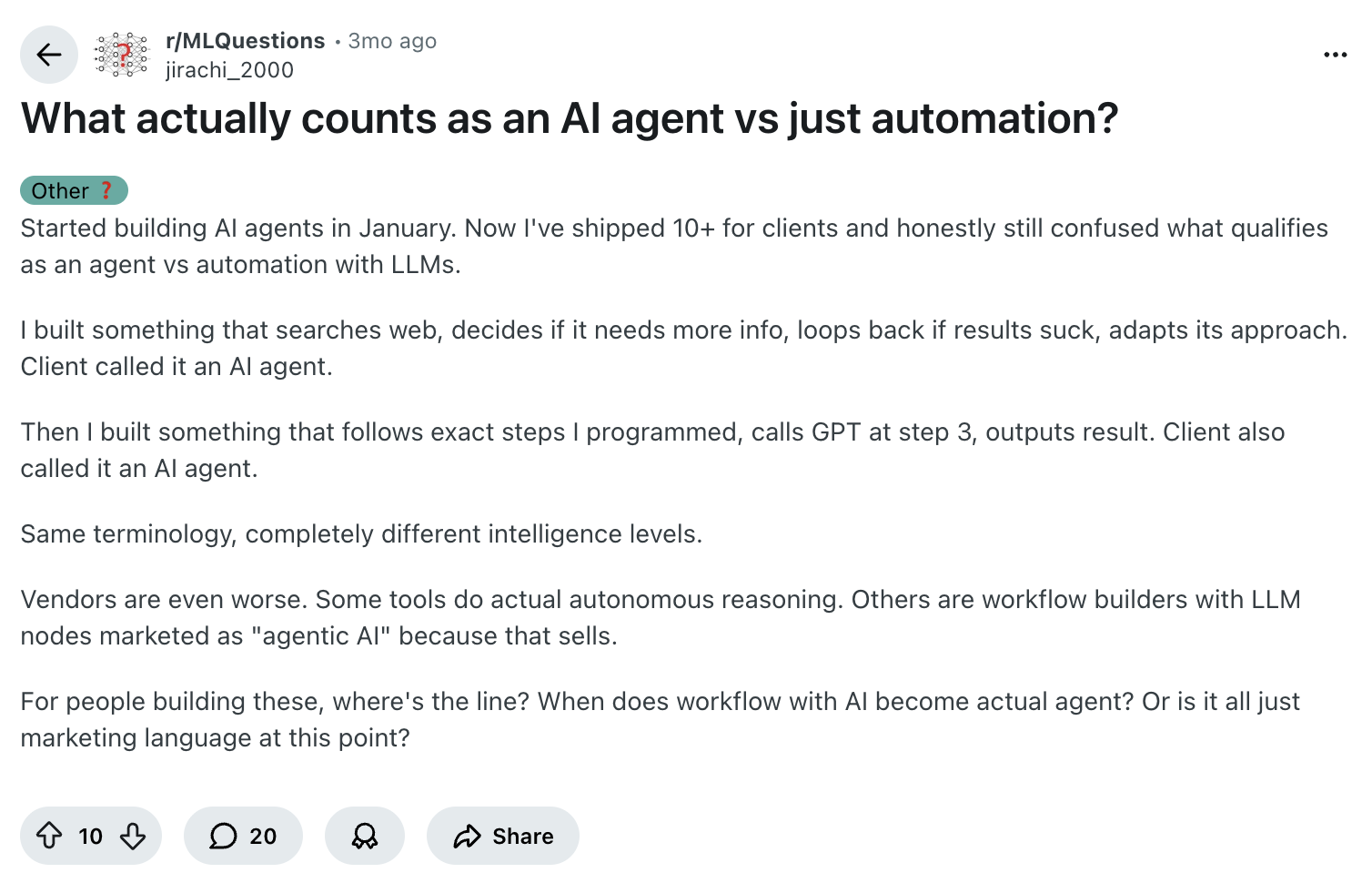
That positioning speaks directly to debates practitioners are having about what separates true AI agents from traditional automation. As one Reddit user recently asked in a discussion on r/MLQuestions: “What actually counts as an AI agent vs just automation?” Oracle’s answer is strategic: these agents are designed to expose — not hide — enterprise data silos so marketers can draw insights from across functions such as procurement cycles, service history and order management. According to Oracle SVP Rob Pinkerton, “The battleground for marketers has shifted… The job is no longer to find prospects online.” By embedding agents that operate natively within enterprise applications and launching AI Agent Studio for custom workflows, Oracle is positioning AI as an orchestration infrastructure that enables smarter strategy, not just accelerated execution.
Mitchell Parton, Modern Retail, 2/9/2026
In reporting from Modern Retail, Mitchell Parton examines how the rapid rise of AI-powered tools is reshaping how retailers evaluate and select technology partners across marketing, supply chain, and merchandising. As consumer expectations accelerate, with surveys showing shoppers are increasingly open to AI-assisted purchasing, retailers are under pressure to experiment quickly while still managing cost, risk, and long-term complexity.
The shift raises a practical question technology leaders are actively debating: will AI platforms replace existing automation and martech tools, or simply extend them? Executives interviewed in the piece suggest the answer is outcome-driven rather than ideological. CarMax, Lowe’s, and others are making build-versus-buy decisions based on measurable impact, speed to scale and operational fit. As CarMax’s Nick Anderson put it, “It’s picking the right tool for the right problem.” Rather than chasing AI trends, retailers are focusing on whether solutions move conversion, efficiency, and customer experience metrics and whether current vendors can evolve fast enough to support that shift.
AI maturity is no longer about adding features. It is about orchestration, integration, and measurable impact. The organizations that win will not be the ones deploying the most AI tools, but the ones building systems that connect data, align teams, and deliver real business outcomes.
Check back next week for another roundup of Media That Matters.
For more insights on Optimove and our Positionless Marketing Platform, contact us.
How Brands Are Scaling AI Without Losing the Human Edge
This week’s stories explore how leading brands are moving from AI experimentation to operational reality. One looks at how human judgment and creativity still shape effective marketing even as automation scales, while the other shows how AI is becoming the connective tissue that enables faster, more fluid omnichannel decision-making. Together, they surface a critical question for modern organizations: how do you use AI to move faster and personalize at scale without losing the human insight that makes brands resonate?
Amrit Virdi, Marketing Week, 1/30/2026
In an article published by Marketing Week, Lloyds Banking Group outlines how generative AI delivered £50m in value during 2025, with the bank forecasting more than £100m in additional value this year. The coverage details how Lloyds has rolled out more than 50 AI use cases across marketing, customer experience, and internal operations, improving in-app search, accelerating query resolution, and reducing information search times by 66% for more than 20,000 frontline colleagues.
The results speak directly to a question many practitioners are actively debating. As one Reddit user asked in a discussion on automation: “What’s the best way to balance automation with the human touch to ensure efficiency without losing personalization?” Lloyds’ own experimentation suggests that while AI excels at rapid analysis, structure, and momentum, it still falls short when it comes to translating insights into emotionally resonant, well-crafted ideas. The article reinforces that the future of marketing is not full automation, but human–AI collaboration, as Lloyds expands into agentic AI use cases, launches an AI Academy for its workforce, and embeds AI more deeply into both customer-facing assistants and brand storytelling.
Liz Dominguez, Consumer Goods Technology, 2/3/2026
Colgate-Palmolive’s latest push into AI is less about isolated use cases and more about rewiring how the organization drives demand. In coverage by Consumer Goods, the company outlines how its 2030 strategy is reshaping content, commerce, and decision-making into a single, omnichannel operating model, breaking down the traditional divide between e-commerce and brick-and-mortar teams.
At the center of the shift is a practical challenge facing many global brands: how do you stay fluid and consumer-centric when personalization, pricing, and promotion must adapt in real time? Colgate-Palmolive is leaning on AI-driven data, analytics, and automation to make faster decisions across supply chain, advertising, and revenue growth management. Speaking during the company’s recent earnings call, CEO Noel Wallace emphasized that success now depends on being “very fluid and dynamic” in how brands execute digitally and personalize messaging at the right moment. Rather than positioning AI as a single transformation lever, the article presents it as the connective layer enabling consistency, speed, and scale in a volatile consumer environment.
AI is no longer just accelerating marketing workflows, it is redefining how organizations are structured, how decisions are made, and where human value shows up. As companies scale automation across demand generation and customer experience, the real competitive edge will come from knowing when to let AI lead and when human judgment still makes the difference.
Check back next week for another roundup of Media That Matters.
For more insights on Optimove and our Positionless Marketing Platform, contact us.
When AI Becomes the Interface, How Do Brands Stay Visible and Trusted?
This week’s picks examine how brands are being forced to rethink discovery, visibility, and trust as AI agents reshape how people research and buy. From the rise of agentic commerce, where algorithms increasingly act on behalf of consumers, to the growing fragmentation of search across AI tools and traditional channels, both pieces point to the same underlying question: how do brands stay relevant, accurate, and trustworthy when answers are surfaced by machines, not humans?
Oguz A. Acar and David A. Schweidel, Harvard Business Review Magazine
In Preparing Your Brand for Agentic AI, Harvard Business Review explores how large language models and AI agents are fundamentally changing how consumers research and buy products. Drawing on global consumer research and brand case studies, the article argues that brands are entering a new environment where AI systems increasingly act as intermediaries, shaping recommendations, comparisons, and even purchases without direct human involvement.
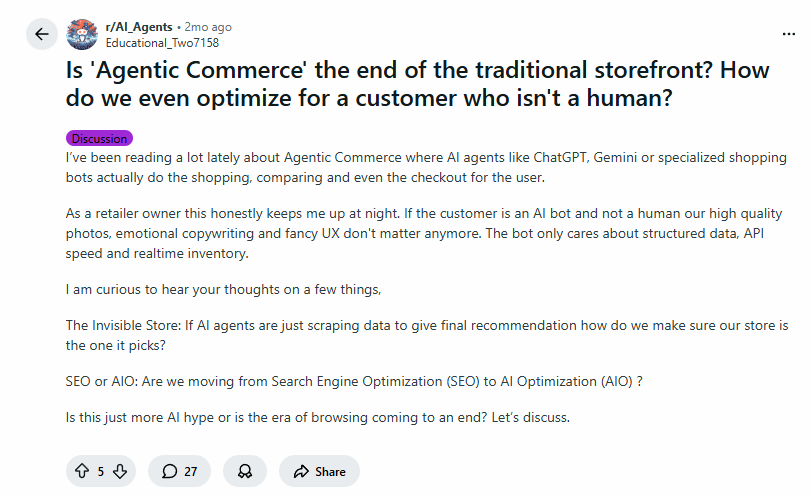
That change is already surfacing as a real concern among practitioners. As one Reddit user asked in a discussion on r/AI_Agents, “Is ‘Agentic Commerce’ the end of the traditional storefront? How do we even optimize for a customer who isn’t a human?” The article suggests this question is no longer theoretical, noting that “companies will soon be managing their brands in an era when agentic AI, built on top of LLMs, works on behalf of customers, completing transactions without human assistance.” As AI agents move from research tools to autonomous decision-makers, brands must rethink how visibility, trust, and differentiation are created when algorithms, not people, increasingly control the buying journey.
Francesca Roche, CX Today, 1/21/2026
In an article published by CX Today, new research from Gartner shows that marketers are facing rising expectations as search behavior fragments across traditional engines, AI-powered answers, and emerging agentic tools. While only about one-third of consumers believe generative AI can fully replace classic search, the findings suggest that AI summaries and conversational queries are already reshaping how people research products, compare options, and build trust, forcing brands to support multiple discovery paths at once.
The article highlights a growing strategic challenge for marketing teams: how do you stay visible, credible, and consistent when customers expect answers to align across search engines, AI tools, and autonomous agents? Gartner cautions against treating AI as a replacement for search, emphasizing instead the need to optimize for both environments simultaneously. As Emma Mathison, Senior Principal in Gartner’s Marketing practice, explains, “Winning visibility now means optimizing for both AI-driven answers and classic search results, with content that is specific, conversational, and trustworthy.” As agentic AI becomes more embedded in martech stacks, the coverage notes that data governance, transparency, and ongoing oversight will become foundational requirements for marketing performance.
AI is no longer just influencing how customers discover brands; it is becoming the interface itself. As agentic systems and AI-driven search raise expectations for consistency, accuracy, and transparency, marketing teams must evolve from channel optimization to system-level orchestration, where governance, data quality, and trust determine whether a brand is chosen or ignored.
Check back next week for another roundup of Media That Matters.
For more insights on Optimove and our Positionless Marketing Platform, contact us.
How Much Autonomy Should AI Have in Marketing and Retail?
This week’s selections explore how artificial intelligence is shifting from promise to practice across marketing and retail, from long-term visions of AI-embedded martech stacks to the real-world rollout of autonomous shopping agents today. Together, they surface a critical question for the AI era: how far should companies go in handing decisions, execution, and customer interactions over to intelligent systems, and what must remain under human control?
Sean Nolan, CX Today, 1/18/2026
The CX Today piece looks ahead to a marketing world where AI is no longer experimental but embedded into daily execution. Rather than predicting a single dominant platform, the article outlines a 2030 martech toolkit built around interconnected AI capabilities spanning data, content, orchestration, and governance, positioning AI as core infrastructure across the marketing workflow.
This forward-looking view raises a practical question: how does AI move from producing insights to taking action inside real marketing systems? The article points to automation as the catalyst that turns intelligence into execution. As Heather Chevalley of Fluency notes in the piece, “automation is a force multiplier for AI. With automation, AI can go from insightful to fully actionable.” Together, these ideas frame a future where AI co-pilots, governed content, and real-time decisioning operate continuously in the background.
Kim Bhasin and Sophia June, New York Times, 1/17/2026
According to The New York Times, retailers are already pushing artificial intelligence into nearly every corner of their businesses, from shopping assistants and advertising to hiring, inventory, and product design. Reporting from the National Retail Federation conference shows an industry eager to avoid being caught off guard again, as tech giants and startups alike pitch AI as the foundation of the next era of commerce.
As AI becomes more autonomous, a defining question emerges: how much control should retailers give AI agents that guide discovery, recommendations, and checkout? While executives from Walmart and Google describe an AI-led future, many brands remain cautious about trust and accuracy. One retail leader told the Times, “Anything we do from an A.I. standpoint has to have that trust,” underscoring the tension between rapid adoption and the responsibility to protect the customer relationship.
AI is no longer a future capability; it is becoming operational infrastructure. As marketing and retail teams embed AI deeper into decision-making and execution, the real question is no longer whether to adopt AI, but how much autonomy to give it without losing control, trust, and accountability.
Check back next week for another roundup of Media That Matters.
For more insights on Optimove and our Positionless Marketing Platform, contact us.
Who Controls Shopping When AI Agents Buy for Us?
This week’s picks look at how Google is shaping the next phase of LLM-powered commerce, from the infrastructure that allows AI agents to transact across platforms to the tools retailers are using to deploy their own agents. Together, they surface a central question: how will AI agents reshape who controls discovery, purchasing, and the customer relationship in an AI-first buying experience?
Jennifer Elias, CNBC, 1/11/2026
How will AI agents complete purchases end to end across different retailers and platforms? Google is betting the answer lies in standardization. At the National Retail Federation’s annual show, the company unveiled its Universal Commerce Protocol (UCP), an open-source framework designed to let AI shopping agents operate seamlessly across discovery, checkout, and post-purchase support. The goal is to remove fragmentation in AI-driven commerce by giving retailers a unified way to connect search, payments, and customer interactions, without having to build custom integrations at every step.
The move places Google squarely in the race to define the infrastructure behind agentic commerce, alongside players like OpenAI, Perplexity, and Amazon. Developed with partners including Shopify, Etsy, Wayfair, and Target, UCP will soon enable direct purchases inside Google’s AI experiences, signaling a broader shift toward LLM-powered shopping flows where intent, conversation, and transaction happen in one continuous interaction.
Belle Lin, Wall Street Journal, 1/11/2026
Google is expanding its push into AI-powered commerce with Gemini Enterprise for Customer Experience, a new set of tools designed to help retailers deploy AI agents for shopping, ordering, and customer support. The launch marks Google’s first purpose-built move into agent-based retail AI, as brands look to meet shoppers who are increasingly turning to LLM-driven assistants to search, compare, and buy products.
So who will control AI-powered shopping: retailers themselves, or the platforms running the agents? Major chains including Lowe’s, Kroger, and Papa Johns are using Google’s technology to build or power their own agents, allowing them to personalize experiences, handle transactions, and retain control over product presentation, customer data, and loyalty. As players like OpenAI and Microsoft push in-chat checkout inside consumer AI tools, Google is positioning itself as the infrastructure layer that helps retailers participate in agentic commerce without surrendering the customer relationship.
AI-powered shopping is quickly moving from concept to infrastructure. With new protocols and retailer-focused AI agents, Google is positioning itself as the backbone of agentic commerce, while retailers face a clear choice: hand over the buying journey to third-party AI platforms or use these tools to retain control over how customers discover, decide, and purchase.
Check back next week for another roundup of Media That Matters.
For more insights on Optimove and our Positionless Marketing Platform, contact us.
The Next Chapter for Marketing and AI
This week’s stories highlight how AI is reshaping marketing from both a leadership and execution standpoint. One looks at how CMOs are rethinking brand presence, team structure, and discovery in a world mediated by AI tools. The other examines what it takes to train AI agents responsibly as they take on more of the customer journey. Together, they show how AI is moving from experimentation to infrastructure, changing how marketing teams operate, and how customer experiences are delivered.
Alyssa Meyers, Jasmine Sheena, Jennimai Nguyen, Katie Hicks, Kristina Monllos, Marketing Brew, 1/5/2026
CMOs are entering 2026 with the understanding that AI has fundamentally changed how marketing works and where brands need to be visible. After a year marked by rapid adoption of AI-generated creative, automation, and AI-influenced discovery, marketing leaders are focusing on how their brands appear inside AI-driven environments such as large language models, summaries, and AI-powered search experiences. As consumers increasingly rely on these tools to make decisions, brand discovery is expanding beyond traditional channels into AI-mediated touchpoints.
At the same time, CMOs are rethinking how their teams operate in an AI-first world. Upskilling has become a priority, with leaders encouraging experimentation, prompt literacy, and new ways of working that blend automation with human judgment. While execution is becoming more automated, skills like strategic thinking, creativity, and customer insight are gaining importance. Several leaders also point to brand trust, storytelling, and emotional relevance as key differentiators as AI becomes a new marketing channel alongside owned and paid platforms.
Rebekah Carter, CX Today, 1/4/2026
As AI agents take on a larger share of customer interactions, companies are increasingly focused on how these systems are trained. Many organizations are moving away from static scripts and FAQ-based models, which struggle to reflect how customers actually behave. Real customer journeys tend to be fragmented and unpredictable, with people switching channels, changing topics mid-conversation, and expressing emotion under stress. When AI systems are trained on full, multi-turn interactions instead of idealized flows, companies are seeing higher resolution rates and fewer abandoned conversations.
At the same time, using real customer journeys introduces new risks around privacy, compliance, and brand trust. Organizations are responding by relying on anonymized transcripts, behavioral signals, and journey-level data while excluding sensitive personal information. Guardrails, human oversight, and continuous monitoring are becoming standard practices to prevent policy violations, tone issues, or unsafe actions. As agentic AI becomes more deeply embedded across sales, marketing, and service workflows, safe, journey-based training is emerging as a prerequisite for scaling automation without compromising customer trust.
AI is no longer just influencing marketing strategy. It is reshaping how teams work, how brands are discovered, and how customer journeys are executed. As leaders rethink both visibility and infrastructure, the next phase of marketing will be defined by how effectively organizations combine AI-driven capabilities with strong foundations, clear governance, and human judgment.
Check back next week for another roundup of Media That Matters.
For more insights on Optimove and our Positionless Marketing Platform, contact us.
From Discovery to Checkout: AI’s Expanding Role in Retail
This week’s stories offer a look at how AI is reshaping shopping from two angles. One examines how industry leaders expect AI to redefine discovery, personalization, and decision-making in the year ahead. The other shows how shoppers are already using AI in everyday ways to research, compare prices, and find better deals, often without realizing it. Together, they capture both where retail is heading and how quickly consumer behavior is changing in real time.
eMarketer, Chris Wood, 12/16/2025
As consumers grow more comfortable using AI, retail leaders see 2026 as a turning point in how people discover, evaluate, and purchase products. According to eMarketer, generative AI is becoming a common part of the consideration phase, with shoppers increasingly turning to tools like ChatGPT, Gemini, and retailer-embedded assistants to research products and get recommendations. Nearly half of consumers say they have already used or plan to use AI for holiday shopping, while usage among younger audiences continues to rise. Industry executives note that agentic AI is beginning to reshape the front end of shopping, particularly in discovery and decision-making, as consumers move away from keyword searches toward more contextual, conversational prompts.
The article also highlights how AI is deepening personalization across ecommerce and social platforms. Companies like Amazon and Pinterest are expanding assistants that help shoppers navigate more specific, taste-driven queries, while retailers explore branded tools designed to streamline the entire journey from discovery to checkout. New features such as Amazon’s “Auto Buy” and Pinterest’s conversational search are opening more of the customer journey to AI-driven interactions. Industry leaders predict these experiences will become increasingly seamless and automated, with security and consent playing a critical role as AI takes on a more active role in shopping workflows.
Betty Lin-Fisher, USA TODAY, 12/16/2025
More shoppers are relying on AI this holiday season, often without actively seeking it out. USA Today reports that AI tools are increasingly embedded into how consumers search for gifts, compare prices, and find deals, functioning as an invisible layer across the shopping journey. Survey data shows that a majority of shoppers have used or plan to use AI this season, with many finding it more helpful than traditional methods like flyers or promotional emails. Rather than replacing retailers, AI is acting as a referral channel, directing shoppers straight to purchase links and accelerating decision-making.
The article highlights deal-seeking as one of AI’s fastest-growing use cases. Consumers are using AI agents to test coupon codes, monitor price changes, and surface relevant offers without manually jumping between tabs. Similarweb data shows sharp growth in traffic to generative AI platforms and a surge in AI-driven referrals to major retailers during peak shopping days. While privacy concerns persist, experts note that many shoppers are prioritizing convenience and savings. As AI becomes more embedded across digital tools, its influence is expanding from tech-savvy early adopters to everyday, price-conscious consumers.
AI is no longer a future concept in retail. As consumers adopt it in practical ways and brands expand its role across the shopping journey, the line between experimentation and everyday use is fading. The retailers that win will be the ones that understand how AI is influencing decisions today and prepare for how it will shape shopping tomorrow.
Check back next week for another roundup of Media That Matters.
For more insights on Optimove and our Positionless Marketing Platform, contact us.
Why 2026 Will Be the Year AI Meets Its Limits — and Its Potential
This week’s stories reveal how rapidly AI is reshaping the core mechanics of marketing and customer experience. New martech trends point to a 2026 defined by real-time systems, more adaptive workflows, and rising expectations for AI to play a strategic role in daily execution. At the same time, industry leaders warn that progress will stall unless organizations address the data foundations that AI depends on. Taken together, these signals show a market shifting from AI experimentation to the deeper operational work needed to make it truly effective.
Scott Clark, CMSWire, 12/2/2025
Marketing leaders are entering 2026 with a martech landscape that is rapidly reshaping itself around AI. According to CMSWire, the year ahead will be defined by tools that enable faster experimentation, more responsive customer journeys, and a shift from batch processing to real-time decision-making. The article notes that organizations are beginning to operate in two modes at once: a Laboratory where teams test new ideas quickly and a Factory where proven tactics can scale with consistency. AI agents are becoming more capable in both settings, prompting new conversations about governance, reliability, and how human oversight should evolve.
The story also highlights the growing importance of Marketing Ops as the connective tissue across data, AI, and execution. As martech stacks modernize, legacy systems are being replaced with pipelines that support instant activation and more automated workflows. These changes reflect a broader push for agility as marketers prepare for more complex customer expectations and faster competitive cycles. The result is a marketing environment where adaptability is becoming a core requirement and AI is taking on a more foundational role in how teams plan, build, and deliver campaigns.
Francesca Roche, CX Today, 12/8/2025
Experts interviewed for CX Today’s 2025 Trends series agree that 2026 will force organizations to confront a problem they have long overlooked: AI is only as strong as the data beneath it. Leaders from Amperity, Constellation Research, Zoho, TechTelligence, and Actionary describe a landscape where enthusiasm for AI has collided with years of fragmented systems, scattered customer information, and cultural resistance to operational change. Customer data platforms are expected to evolve from passive storage systems into active engines of intelligence, while companies grapple with a growing data drought created by AI’s enormous appetite. Analysts warn that most organizations have not prepared their infrastructure, governance processes, or internal workflows for what modern AI requires.
The article also highlights a shift in what will determine AI success. Data readiness and organizational culture are projected to matter more than new features as enterprises try to untangle complex tech stacks and build smoother data layers for decision-making. AI governance is expected to become a top buying criterion, with vendors asked to provide explainable decisions and full accountability for automated actions. Analysts further caution that without a clear orchestration strategy, organizations risk deploying competing AI agents that work at cross purposes and create more chaos than value. The consensus is clear: 2026 will be a pivotal year in which companies stop chasing the newest AI tools and focus instead on the foundational work needed to make those tools effective.
AI is becoming more capable, but its real impact now depends on the foundations supporting it. Marketing and CX teams are entering a phase where progress relies as much on clean data and streamlined systems as on new ideas. As organizations simplify their operations and build for consistency, the ones that stand out will be those that pair AI-driven innovation with the clarity and discipline needed to make it work.
Check back next week for another roundup of Media That Matters.
For more insights on Optimove and our Positionless Marketing Platform, contact us.
This week’s stories reveal how quickly AI is embedding itself into the heartbeat of the holiday shopping season. New tools launched by major retailers promise more intuitive discovery and faster checkout, while early Black Friday data shows that shoppers are actively seeking AI-guided help. Viewed together, these signals point to a moment when AI is no longer an add-on, but a meaningful driver of how consumers navigate crowded product landscapes.
Anne D’Innocenzio, Associated Press, 11/30/2025
Major retailers and tech companies are entering the holiday season with a new wave of AI shopping tools that signal a shift in how consumers discover and buy gifts. Walmart, Amazon, Google, and OpenAI have all upgraded their assistants to move beyond basic search and into true guided shopping, offering personalized suggestions, tracking prices, and even completing purchases through natural conversations. Google’s agent can now call local stores to check inventory, while ChatGPT’s instant checkout feature enables users to buy products directly within the app. Together, these tools are positioning AI as a first stop for holiday shoppers rather than a novelty add-on.
The season is also introducing early signs of autonomous shopping. Amazon’s Rufus can remember preferences and automatically purchase items when prices drop. Google’s AI Mode compiles side-by-side product comparisons and offers a “buy for me” option using Google Pay. Target and Walmart are testing AI-powered gift finders designed to match recipients with the right products based on age, hobbies, or occasions. While adoption is still in its initial stages, the direction is clear: AI is becoming an active participant in the shopping journey, reshaping how people make decisions and how retailers compete for visibility in an increasingly algorithm-driven marketplace.
Sarah Perez, TechCrunch, 12/1/2025
New data shows that Amazon’s AI assistant, Rufus, became an important companion for Black Friday shoppers. Sensor Tower reports that sessions using Rufus were far more likely to lead to a purchase than typical Amazon visits. Conversions in Rufus-assisted sessions doubled compared with the previous month, and day-over-day buying activity rose sharply. Engagement with the chatbot also grew faster than Amazon’s overall site traffic, suggesting that many shoppers preferred guided help while navigating holiday deals.
The trend echoes a growing reliance on AI-driven tools during the season. Adobe Analytics found a substantial increase in visitors arriving at retail sites through AI services, and those users were significantly more likely to complete a purchase. Even as overall visit and download growth lagged behind previous years, interactions with AI tools accelerated. The data confirms that consumers are increasingly turning to conversational assistance to parse options, compare products, and make decisions during high-volume shopping moments.
AI is moving from experiment to everyday utility during the year’s busiest shopping moments. With retailers expanding their capabilities and shoppers embracing them, AI-guided discovery is gaining momentum. The brands that thrive will be those that understand and optimize for these emerging, AI-led pathways.
Check back next week for another roundup of Media That Matters.
For more insights on Optimove and our Positionless Marketing Platform, contact us.
Forrester: Optimove’s Total Economic Impact
The Forrester Total Economic Impact™ Study shows that Optimove’s Positionless Marketing Platform drives an 88% boost in campaign efficiency.


Rob Wyse is Senior Director of Communications at Optimove. As a communications consultant, he has been influential in changing public opinion and policy to drive market opportunity. Example issues he has worked on include climate change, healthcare reform, homeland security, cloud transformation, AI, and other timely issues.