

The Total Economic Impact™ Of Optimove

Cost Savings And Business Benefits Enabled By Optimove

Read time 26 minutes

LinkedInXFacebook

Executive Summary:

According to Forrester’s 2022 Global Marketing Survey, 45% of B2C marketers cited personalizing communications, experiences, and interactions as the greatest challenge with marketing execution.1 Meanwhile, personal data collection and activation have also become increasingly challenging. Under these circumstances, marketers are looking for tools that can improve their data access and campaign orchestration to drive business performance.

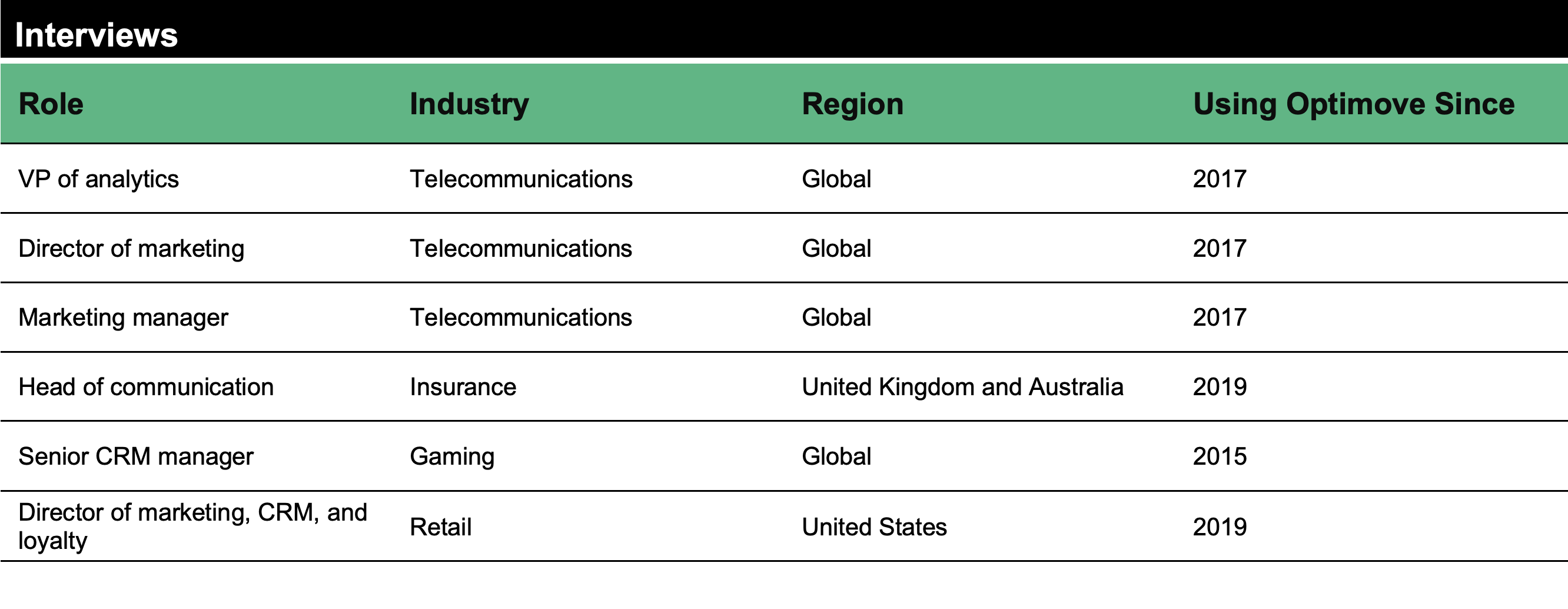
Optimove provides a customer-led marketing platform that empowers marketers to drive measurable growth by planning, orchestrating, and optimizing marketing programs that start with the customer instead of a campaign or product. Optimove commissioned Forrester Consulting to conduct a Total Economic Impact™ (TEI) study and examine the potential return on investment (ROI) enterprises may realize by deploying Optimove. 2 The purpose of this study is to provide readers with a framework to evaluate the potential financial impact of Optimove on their organizations. To better understand the benefits, costs, and risks associated with this investment, Forrester interviewed six representatives at four organizations with experience using Optimove. For the purposes of this study, Forrester aggregated the interviewees’ experiences and combined the results into a single composite organization that is a B2C firm with 500,000 customers and revenue of $150 million per year.
Screenshot 2025-12-12 at 17.45.28.png

Prior to using Optimove, interviewees noted how their organizations struggled to support increasing business volume with existing manual marketing tools. They could only send out bulk emails without much personalization. Once campaigns were launched, they also didn’t have the capability to aggregate and analyze customer data to generate business insights. These limitations prevented marketing organizations from measuring and improving marketing performances.
Screenshot 2025-12-12 at 17.44.38.png

After the investment in Optimove, the interviewees orchestrated campaigns across multiple channels; automated and personalized campaigns easily; and analyzed campaign results and customer data to improve marketing outcomes.

Key findings

Quantified benefits

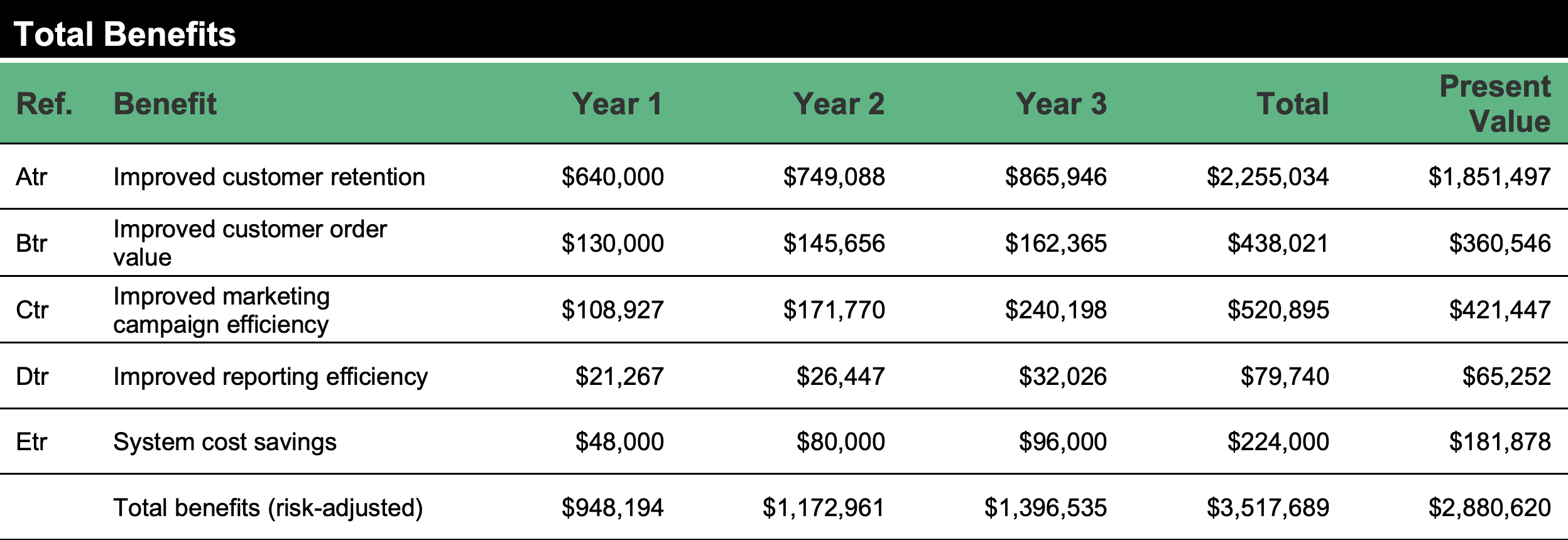
Three-year, risk-adjusted present value (PV) quantified benefits for the composite organization include:
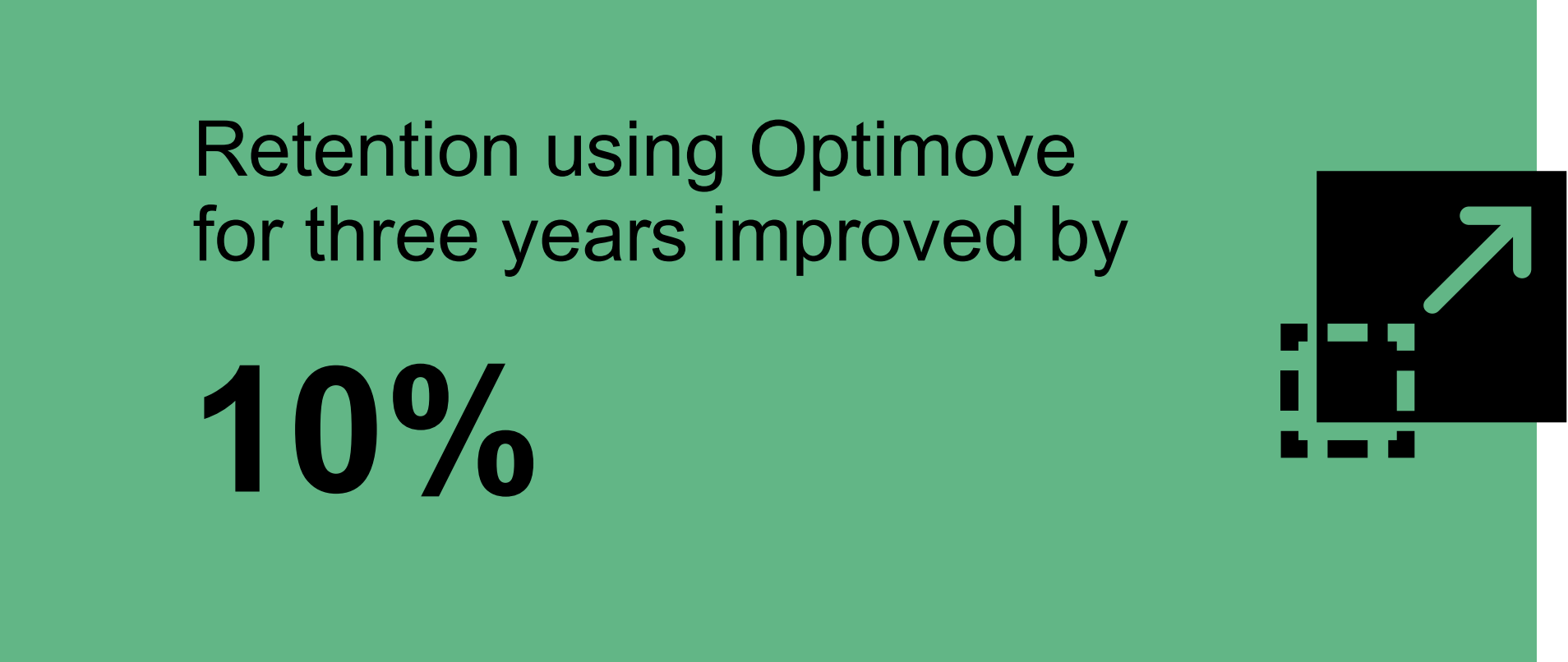
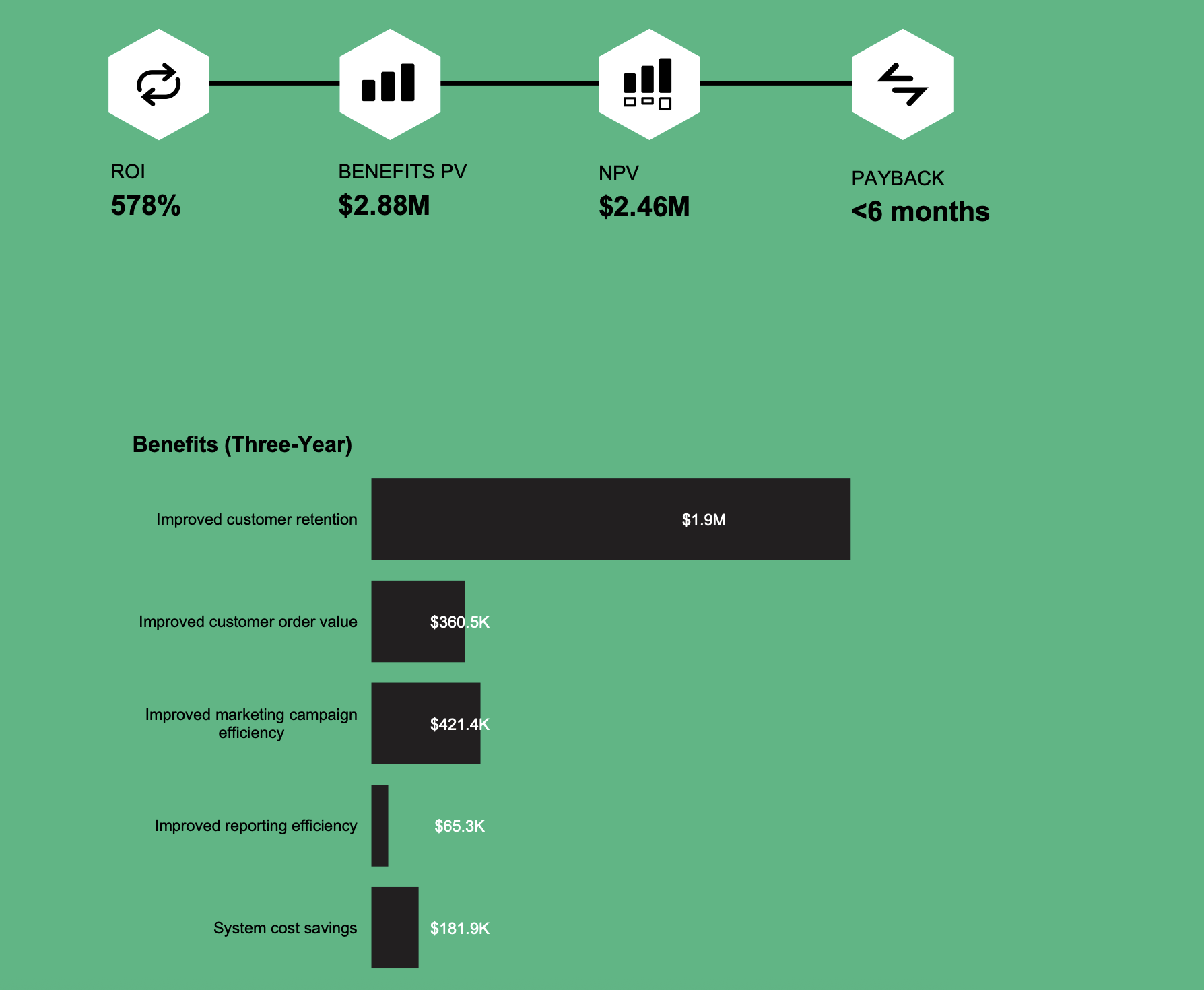
  • Improved customer retention rates by 10%. As the cost of customer acquisition continues to increase, the composite organization redistributes its marketing budget from new customer acquisition to retention. After adopting Optimove, the composite organization’s retention rate increases by 8% in Year 1 due to better customer engagement and continues to increase by a further 1% each year, reaching 10% improvement in Year 3. Overall, the composite organization expects $1.9 million in profit gains with the investment.
  • Improved customer order value by 15%. The composite organization experiences higher customer order value for retained customers. The customer order value improves by 15% after adopting Optimove, which is reflected as a threeyear present value benefit of $361,000 for the composite organization.
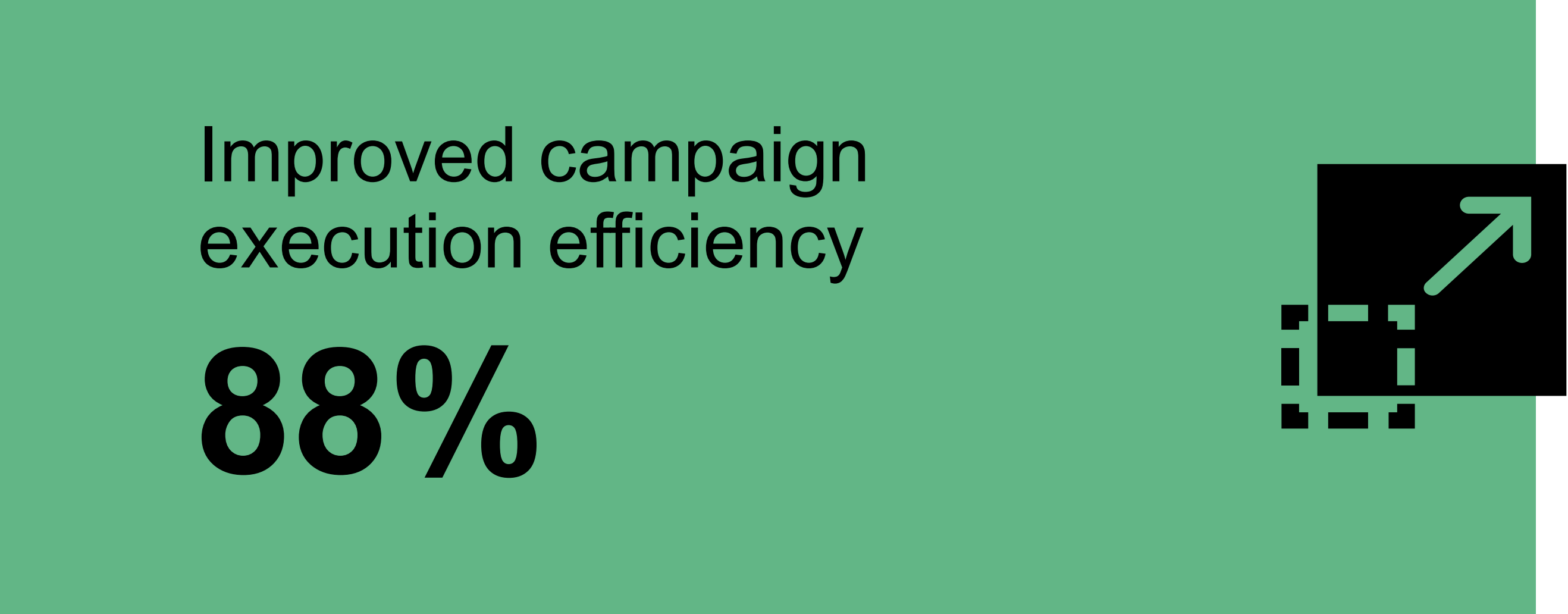
  • Improved campaign efficiency by 88%. Optimove’s segmentation and smart orchestration capabilities improve the composite organization’s campaign execution efficiency. After adopting Optimove, campaign efficiency improves by 88%, allowing marketing teams to create more personalized engagement with existing customers. Improved campaign efficiency also helps the composite organization achieve $421,000 cost savings over three years.

Screenshot 2025-12-12 at 17.48.17.png

  • Improved reporting efficiency by 50% and saved employee time for reporting communications. Optimove’s intuitive platform creates a single customer view and real-time dashboards for user organizations. This saves employee time on reporting and internal meetings, resulting in a three-year benefit of $65,000.
  • Phased out existing point solutions, which reduces costs by $182,000 over three years. Before Optimove, the composite organization uses disconnected point solutions for CRM and email automation. After onboarding Optimove, the composite phases out previous point solutions, achieving a three-year present value benefit of $182,000.

Unquantified benefits

Benefits that provide value for the composite organization but are not quantified in this study include: 

  • Increased visibility of overall marketing plan and campaign orchestration. Optimove helps marketers to stay on top of their large volume of campaigns. Marketing teams can schedule and automate their campaigns to facilitate orchestration and have a clear view on all campaigns in all markets.
  • Improved quality of marketing decisioning. Optimove enables marketers to make more informed decisions. The platform helps users to instantly identify where and why campaign performance drops and provides tools so they can rapidly fix it.
  • Supported social media and search targeting. Optimove enables teams to generate audiences and segments easily, which can be used for search and social media campaigns. Targeted campaigns help marketers reach the right customers and boost customer acquisition as well as retention.
  • Improved efficiency of other channels, such as direct mail. Direct mail is much more expensive than digital channels due to printing and postage costs. Optimove’s segmentation capabilities allow companies to be more selective in sending out direct mail to high-value customers.

Costs

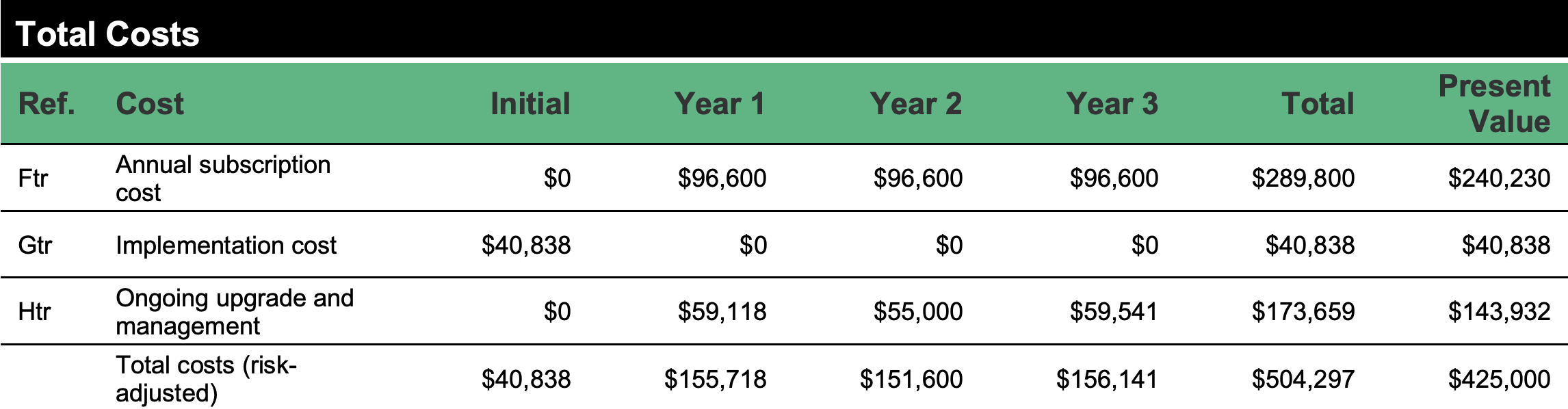
Three-year, risk-adjusted PV costs for the composite organization include: 

  • Annual subscription costs of $240,000. The composite organization pays an annual subscription fee of $80,000 for Optimove, plus $12,000 for OptiMail separately. Over three years, the composite organization incurs $240,000 in subscription costs.
  • Implementation costs of $41,000. Implementation cost includes time and effort required throughout the implementation process and platform learning period. For the composite organization, this is a one-time cost at the beginning of the adoption.
  • Ongoing upgrade and management costs of $144,000. The composite organization purchases 500 professional services hours annually for Optimove consulting and support. This is separated from the subscription cost. Additionally, the composite organization needs to refresh custom integration with different platforms once every two years. For the composite organization, this adds up to $144,000 over the three-year analysis period.

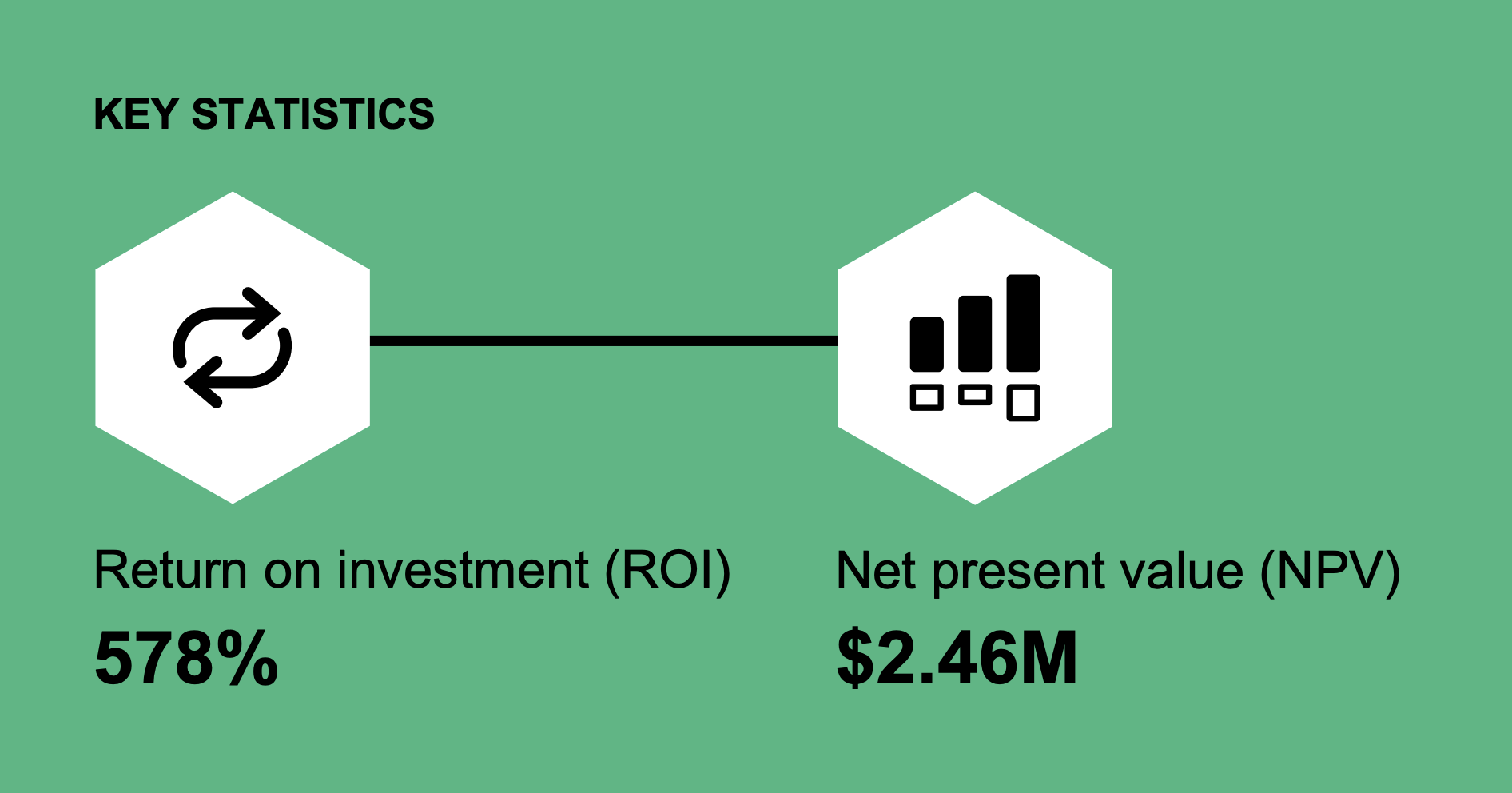
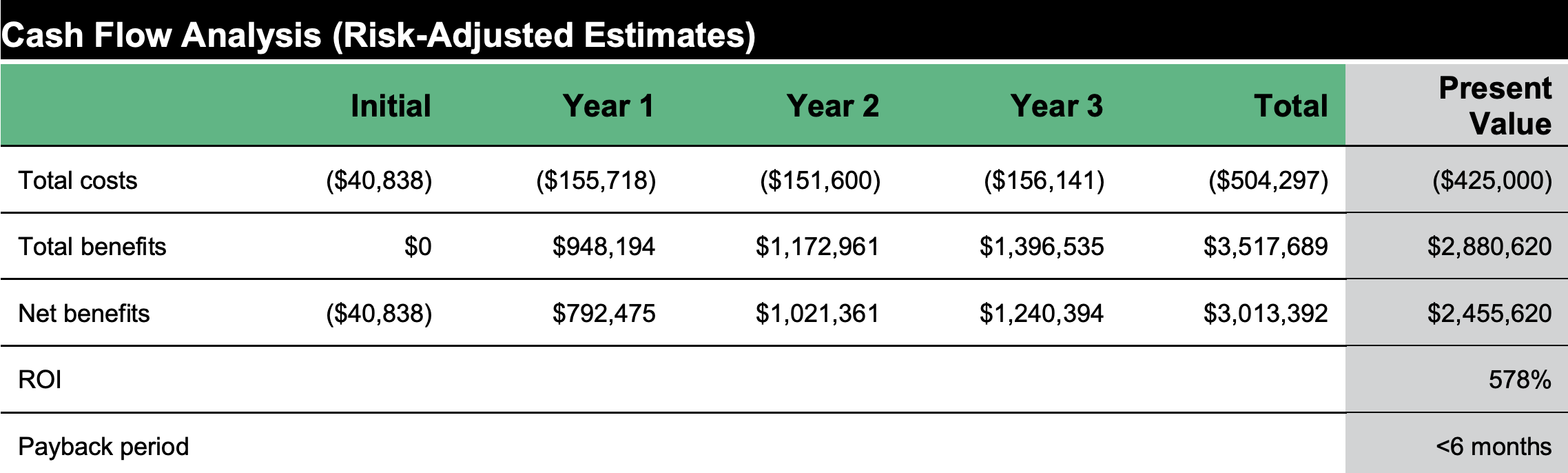
The representative interviews and financial analysis found that a composite organization experiences benefits of $2.88 million over three years versus costs of $425,000, adding up to a net present value (NPV) of $2.46 million and an ROI of 578%.

“Optimove is invaluable in how it gives us the ability to see and figure out where something is wrong and how to fix it. Our previous tools did not come close to that.”
— Senior CRM manager, gaming
Screenshot 2025-12-12 at 17.53.28.png

TEI Framework and Methodology

From the information provided in the interviews, Forrester constructed a Total Economic Impact™ framework for those organizations considering an investment in Optimove. The objective of the framework is to identify the cost, benefit, flexibility, and risk factors that affect the investment decision. Forrester took a multistep approach to evaluate the impact that Optimove can have on an organization.

DUE DILIGENCE

Interviewed Optimove stakeholders and Forrester analysts to gather data relative to Optimove.

INTERVIEWS

Interviewed six representatives at four organizations using Optimove to obtain data with respect to costs, benefits, and risks.

COMPOSITE ORGANIZATION

Designed a composite organization based on characteristics of the interviewees’ organizations.

FINANCIAL MODEL FRAMEWORK

Constructed a financial model representative of the interviews using the TEI methodology and risk-adjusted the financial model based on issues and concerns of the interviewees.

CASE STUDY

Employed four fundamental elements of TEI in modeling the investment impact: benefits, costs, flexibility, and risks. Given the increasing sophistication of ROI analyses related to IT investments, Forrester’s TEI methodology provides a complete picture of the total economic impact of purchase decisions. Please see Appendix A for additional information on the TEI methodology.

DISCLOSURES

Readers should be aware of the following: This study is commissioned by Optimove and delivered by Forrester Consulting. It is not meant to be used as a competitive analysis. Forrester makes no assumptions as to the potential ROI that other organizations will receive. Forrester strongly advises that readers use their own estimates within the framework provided in the study to determine the appropriateness of an investment in Optimove. Optimove reviewed and provided feedback to Forrester, but Forrester maintains editorial control over the study and its findings and does not accept changes to the study that contradict Forrester’s findings or obscure the meaning of the study. Optimove provided the customer names for the interviews but did not participate in the interviews. 
The Optimove Customer Journey

Screenshot 2025-12-12 at 18.03.34.png

Key Challenges

Prior to their investment into Optimove, the interviewees struggled to create a holistic view of their customers. Interviewees faced several common challenges, including:

  • Marketing struggled to support increasing business volume with manual tools. Prior to using Optimove, interviewees managed their marketing campaigns manually with Excel and stand-alone email platforms. This approach became increasingly challenging for marketers as their organizations launched new business lines and grew their customer bases. The head of communication from an insurance company mentioned: “We used to contact customers who had abandoned their quotes by spotting an empty spreadsheet cell in the price column. Then, we would take that list out and contact them.”
  • Previous tools were unable to customize campaigns. Besides laborious campaign creation, interviewees were also unable to customize campaigns based on distinct traits of customers. Sending out only bulk email campaigns severely restricted marketers’ ability to engage and retain customers. The VP of analytics from a telecommunications company said: “As a provider of international services, we have a highly fragmented customer base and each community is a different segment. They all have their own currencies, languages, and operators.”

“Not only has it allowed us to get better results, but it also expanded the amount of customer communications we’re able to do.” 

Director of marketing, telecommunications

  • Previous tools could not aggregate and analyze customer data to generate business insights. Another major challenge for all interviewees’ organizations was the inability to aggregate and analyze customer data. The senior CRM manager from the gaming industry said: “I was literally trying to compile receipts of people that had been into the shop so that I could figure out who our regular customers were, what emails they should receive, and the rest of it. That was the Dark Ages.”
  • Previous tools did not track marketing performance properly. Prior to using Optimove, interviewees were not able to track marketing metrics other than basic email open and conversion rates. For example, when a customer didn’t make a purchase straight away from an email, marketers could not track subsequent activities. It left marketers few opportunities to improve marketing performance based on campaign results.

INVESTMENT OBJECTIVES

Due to the challenges above, interviewees’ organizations searched for a solution that could provide: 

  • Orchestration of cross-channel marketing campaigns.
  • Advanced marketing automation and personalization.
  • Data integration capabilities.
  • Advanced analytics and segmentation.
  • User-friendly interface and features.
  • End-to-end campaign execution and measurement capabilities.
  • Customer support tailored to business needs.

COMPOSITE ORGANIZATION

Based on the interviews, Forrester constructed a TEI framework, a composite company, and an ROI analysis that illustrates the areas that are financially affected. The composite organization is representative of the six interviewees from four organizations, and it is used to present the aggregate financial analysis in the next section. The composite organization has the following characteristics: 

Description of composite. The composite organization is a B2C firm operating in Europe and North America. The organization has an annual revenue totaling $150 million with more than 300 employees.

Deployment characteristics. In Year 1 of adoption, the number of reachable customers is around 500,000 with an average customer order value of $200. There are five employees in the marketing team using Optimove. Outside of marketing, there are another five employees using Optimove dashboards for analytics and decisioning purposes. The composite organization uses the Optimove platform and several add-ons, including OptiMail; Facebook and Google integration; and in-app push notifications. To improve marketing journey and analytics capabilities with Optimove, the organization also purchases 500 professional services hours per year.

Key Assumptions
  • $150 million annual revenue
  • $200 customer order value in Year 1
  • Runs 600 retention campaigns in Year 1

Analysis Of Benefits

Screenshot 2025-12-15 at 17.00.50.png

Improved Customer Retention

Evidence and data. Marketing and advertising are on a wild ride thanks to four major forces: 

  1. restrictive privacy laws designed to protect consumers;
  2. browser and operating system restrictions on data collection;
  3. consumer adoption of privacy tools and privacy-protecting behaviors; and
  4. ever-taller and ubiquitous walled gardens like Amazon, Facebook, and Google. 

These forces — which Forrester collectively calls data deprecation — make it difficult for marketers and advertisers to collect and activate consumer data at scale, and the situation will only get more pronounced over the next year. Given these circumstances, more consumer-facing brands have been gradually redistributing their marketing budget from new customer acquisition to customer retention. Interviewees of this study all acknowledged the importance of Optimove in improving their customer retention. 

  • Prior to using Optimove, interviewees either had no or very limited customization capabilities, making it difficult to cross-sell or upsell to existing customers.
  • Selling to different types of customers, such as in different regions or in different languages, campaigning had become extremely challenging and time-consuming.

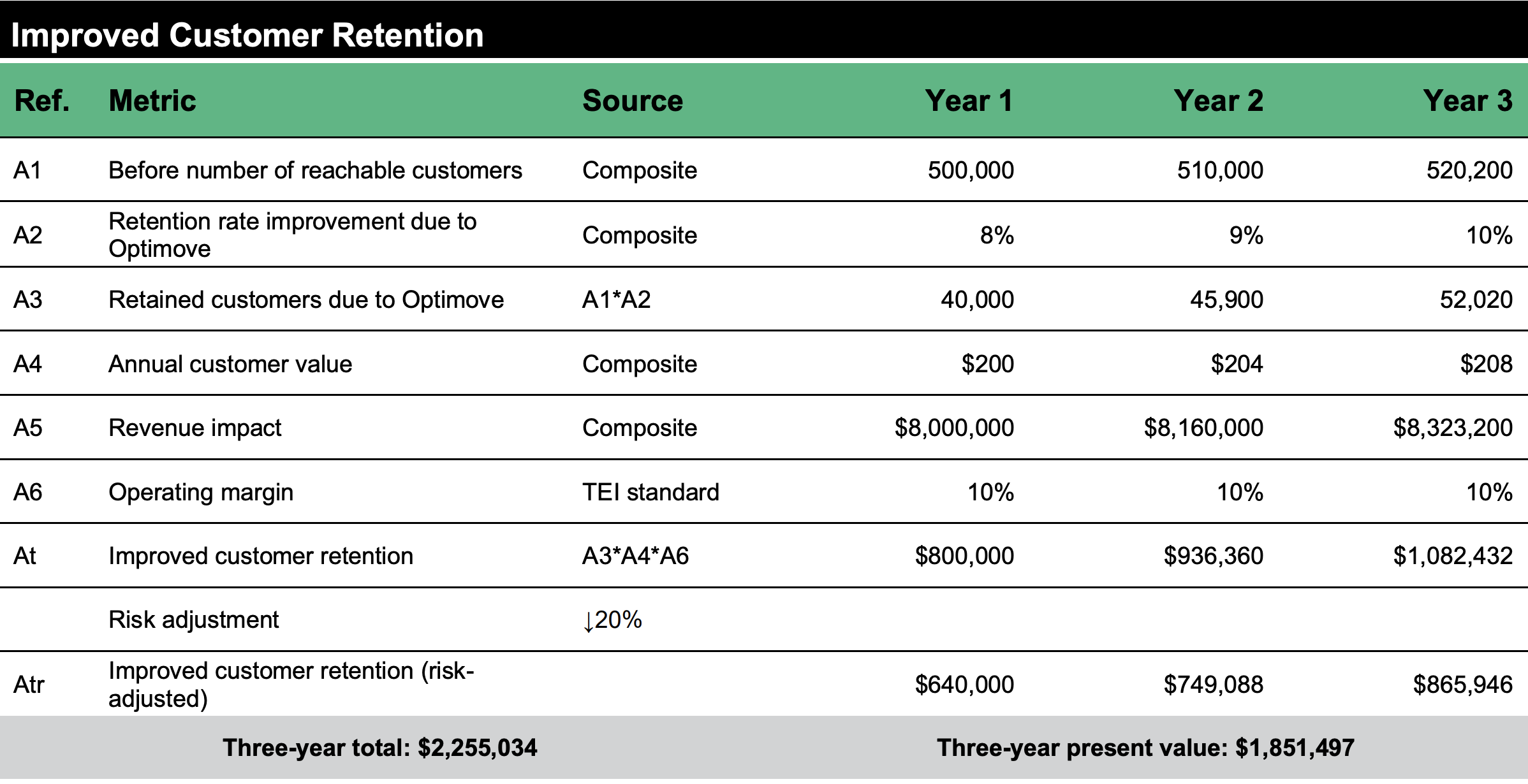
Modeling and assumptions. For the analysis, Forrester assumes the following about the composite organization: 

  • The number of reachable customers in Year 1 is 500,000. Given the composite organization shifts its marketing budget toward retention, new customer acquisition growth maintains a gradual pace of 2% growth.
  • After adopting Optimove, the composite organization’s retention rate increases by 8% in Year 1 due to better customer engagement. As the marketing team works with Optimove to refine customer segmentation, the retention rate continues to increase in Year 2 and Year 3.
  • The basis for average customer order value of the composite organization is $200 in Year 1, and increases by 2% YOY due to inflation and price adjustment. Increased customer order value is calculated in a separate benefit category.
  • Operating margin for this B2C organization is 10%.

“Optimove has helped us shift our business away from relying heavily on customer acquisition and paying to be in the space of paid social, paid search display, and affiliate marketing.”
Director of marketing, CRM, and loyalty, retail

Risks. Several factors could impact the outcome of this benefit, including: 

  • Macroeconomic environment.
  • Operating margin and customer order value variances depending on the industry and location of businesses.
  • Other retention efforts, such as overall budget and resource allocation. 

Results. To account for these risks, Forrester adjusted this benefit downward by 20%, yielding a three-year, risk-adjusted total PV (discounted at 10%) of $1.9 million.
Screenshot 2025-12-15 at 17.08.29.png

Improved Customer Order Value 

Evidence and data. With improved retention, interviewees observed an increase in customer order value for a group of customers. 

  • The VP of analytics of a telecommunications company mentioned they have seen a difference in customer order value in the customers they can engage versus those ones they are not able to.
  • The head of communication at an insurance company mentioned the gross written premium (GWP) increased with those target customers who received sales emails.

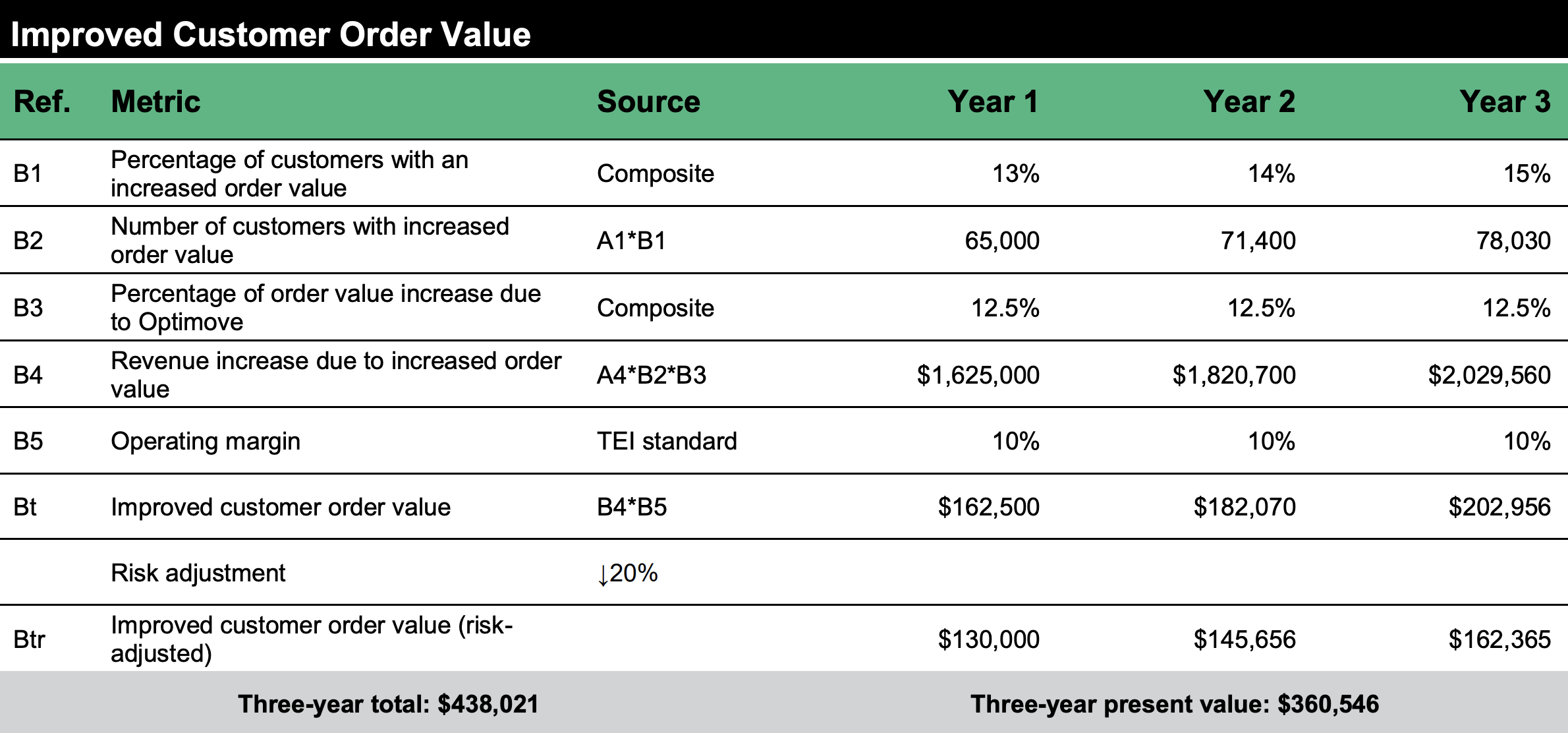
Modeling and assumptions. For the analysis, Forrester assumes the following about the composite organization: 

  • The percentage of customers with an increased customer order value is 13% in Year 1. In Years 2 and 3, the percentage continues to increase given the improved retention rate.
  • There are several reasons that contribute to the increased customer order value, including more targeted retention campaigns and higher promotion budget to retain customers. Forrester estimates a 12.5% increase in customer order value for those customers who are influenced by customized campaigns due to Optimove. 

“The lifetime value is double of customers who we can market to and those that we don’t.” 

VP analytics, telecommunications

Risks. Several factors could impact the outcome of this benefit, including: 

  • Macroeconomic environment.
  • Operating margin and customer order value variances depending on the industry and location of businesses. 

Results. To account for these risks, Forrester adjusted this benefit downward by 20%, yielding a three-year, risk-adjusted total PV of $361,000.
Screenshot 2025-12-15 at 17.12.17.png

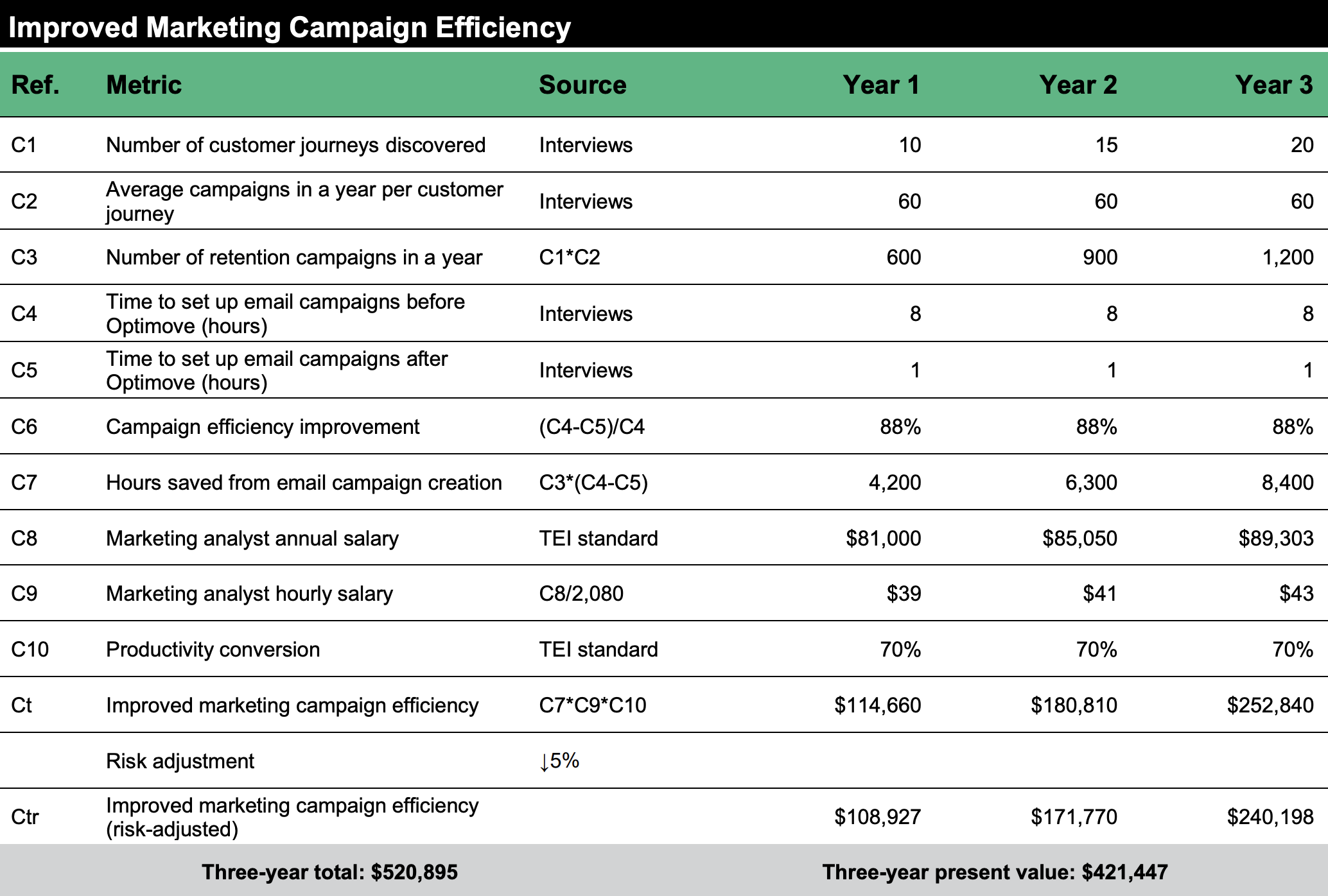
Improved Marketing Campaign Efficiency 

Evidence and data. Because of Optimove’s segmentation and smart orchestration capabilities, interviewees improved marketing operations efficiency, especially when it comes to campaign execution. All interviewees shared that Optimove significantly improved their efficiency in creating new campaigns, which also unleashed new opportunities for their businesses. 

  • After using Optimove, interviewees’ organizations created more personalized campaigns. The director of marketing, CRM, and loyalty at a retail organization said, “Without creating additional headcount, we are able to increase the number of campaigns we are sending out by 40%.”
  • The director of marketing from a telecommunications firm said, “Not only has it allowed us to get better results, but from a volume and velocity standpoint, it’s also allowed us to expand the amount and speed of customer communications we’re able to do.”
  • The head of communication at an insurance company said: “Before we used Optimove, we would have been sending 11 campaigns in a month. Now, we spend the same amount of time to build 48 campaigns.”

Modeling and assumptions. For the analysis, Forrester assumes the following about the composite organization: 

  • In Year 1 of adopting Optimove, the composite discovers 10 unique customer journeys for campaign customization. As the composite continues to use Optimove and leverage Optimove’s consulting and customer support, it discovers five more journeys in Years 2 and 3.
  • For each unique customer journey, the marketing team sends about 60 email campaigns a year on average.
  • The average hourly salary of marketing analysts is $39 the first year with a 5% increase in the following years.
  • The productivity conversion is captured at 70%. Though the solution frees up marketing team members from manual work, they put more effort into strategic planning and customer engagement work after adopting Optimove.

Risks. Several factors could impact the outcome of this benefit, including:

  • Tools and marketing automation capabilities before using Optimove varies.
  • Salary and efficiency of marketing staff varies.

Results. To account for these risks, Forrester adjusted this benefit downward by 5%, yielding a three-year, risk-adjusted total PV of $422,000.

“I think it saved us time, but it’s more than that. We have been able to be much more efficient and do so much more than we could do. We are doing what we always wanted to do, but weren’t able to.”
Head of communication, insurance
Screenshot 2025-12-15 at 17.16.42.png

Improved Reporting Efficiency 

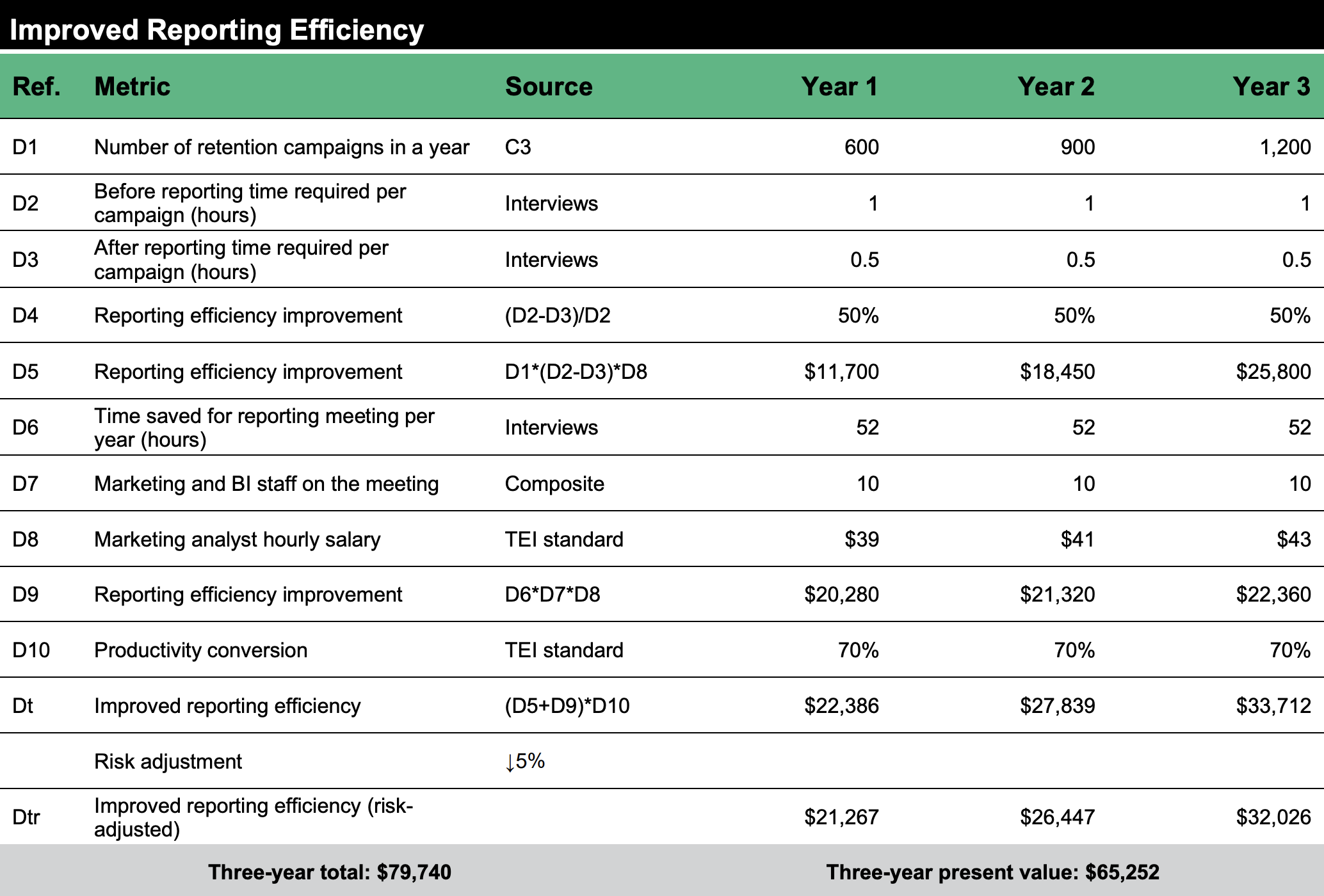
Evidence and data. After adopting Optimove, interviewees’ companies generated a single customer view and marketing campaign performance dashboards in real time.

  • Data analysis and reporting involved a lot of heavy lifting prior to Optimove. Marketing teams had to spend at least an hour to generate reports for campaign performance. The effort was significantly reduced after using Optimove.
  • The senior CRM at the gaming company also noted they had to schedule a weekly meeting to discuss data requirements with the business intelligence (BI) team and wait for reports in a few days. The meeting became unnecessary as the marketing team easily accessed campaign results through real-time dashboards after Optimove. 

“Four years ago, we were pulling data using simple queries, and it was really hard for us to answer business questions because it needed so much manipulation… Now, we have a lot of capabilities to build out custom reports.”
Director of marketing, CRM, and loyalty, retail

Modeling and assumptions. For the analysis, Forrester assumes the following about the composite organization:

  • It previously took one hour to generate a campaign report, which is reduced to 30 minutes after adopting Optimove.
  • Marketing, BI, and development teams used to hold a weekly meeting for reporting to generate more relevant reporting insights. These meetings involved 10 employees. The meeting is eliminated after adopting Optimove.

Risks. Several factors could impact the outcome of this benefit, including: 

  • Tools and marketing automation capabilities before using Optimove varies.
  • Salary and efficiency of marketing staff varies. 

Results. To account for these risks, Forrester adjusted this benefit downward by 5%, yielding a three-year, risk-adjusted total PV of $65,000.
Screenshot 2025-12-15 at 18.09.06.png

Sustem Cost Savings

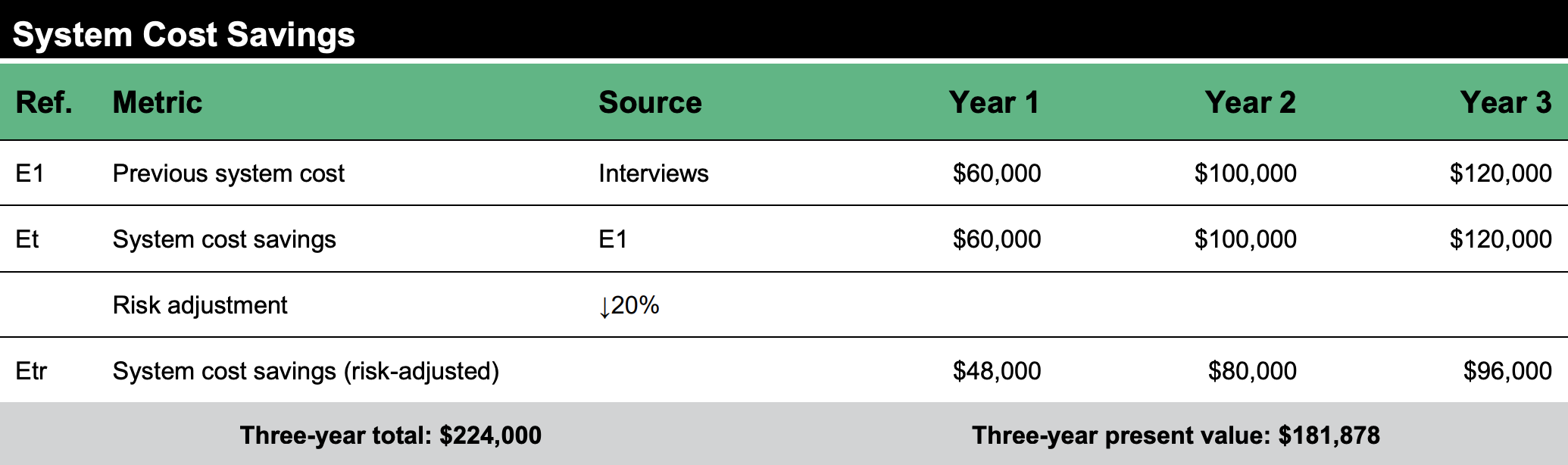
Evidence and data. Interviewees used disconnected point solutions for CRM and email automation. After onboarded Optimove, they phased out previous point solutions.

  • The head of communication at an insurance company claimed there was a 133% decrease in system cost from their previous email solution.
  • Other interviewees also acknowledged that using Optimove helped their organizations achieve system cost savings.

Modeling and assumptions. For the analysis, Forrester assumes the following about the composite organization:

  • The composite gradually integrates Optimove over three years.
  • From phasing out previous email and CRM solutions, the composite organization reduces costs of previous solutions by $60,000 in Year 1, eventually achieving cost savings of $120,000 in Year 3. 

Risks. Several factors could impact the outcome of this benefit, including:

  • System environments for each organization could vary.
  • Cost of previous solutions could vary (e.g., companies using Excel or internal tools would have limited system cost savings). 

Results. To account for these risks, Forrester adjusted this benefit downward by 20%, yielding a three-year, risk-adjusted total PV of $182,000.
Screenshot 2025-12-15 at 18.11.46.png

Unquantified Benefits

Interviewees mentioned the following additional benefits that their organizations experienced but were not able to quantify: 

  • Increased visibility of overall marketing plan and campaign orchestration. Optimove enabled marketing teams to not only generate more campaigns, but also stay on top of the large volume of campaigns generated. As VP of analytics at a telecommunications firm said, “Optimove allows us to manage the 70 markets we have to deal with on a weekly basis.”
  • Improved quality of marketing decisioning. Besides improving efficiency, interviewees acknowledged that the ability to make more informed marketing decisions was invaluable. The senior CRM manager from a gaming company said, “Optimove is invaluable in how it gives us the ability to figure out where something is wrong and how to fix it.”
  • Supported social media and search targeting. Though Optimove was strongest in supporting customer retention, the ability to easily generate audiences and segments also supported social media targeting. The director of marketing, CRM, and loyalty at a retail industry said, “We’ve used Optimove for creating target groups and lookalike segments that we can export and push into channels like Facebook, Instagram, and paid search.”
  • Improved efficiency of other channels, such as direct mail. Since direct mail was a much more expensive channel than email, using Optimove’s segmentation capabilities allowed the interviewees’ companies to be more selective in sending out direct mail. The head of communications at an insurance company said: “We need to be more selective with who we want to target through direct mails because we want to target higher-value customers. Within Optimove, we can easily access that data so we can just send out to customers above a certain value.”

“We’re continually expanding automations to create a map of how we engage with customers at different times via different channels.”
Head of communication, insurance

Flexibility 

The value of flexibility is unique to each customer. There are multiple scenarios in which a customer might implement Optimove and later realize additional uses and business opportunities, including: 

  • Getting a 360-degree view of the user base. With increased usage of Optimove, the level of complexity of data analytics could be improved further, enabling marketers to eventually obtain a 360-degree view of individual users.
  • Increasing the granularity of customer journeys to deepen customer understanding and engagement. The granularity of customer journey could be improved further, for example, personalizing based on customer preference besides purchase behaviors. The director of marketing, CRM, and loyalty from a retailer mentioned: “We are working with Optimove’s professional services team to define more customer journeys by product categories. By doing this, we hope to be a brand customers want to follow, engage with, and get excited by.”
  • Expanding to multiple channels. Optimove also has potential to increase performance of diverse channels, such as mobile messaging. However, this requires a longer-term plan and integration. The head of communication at an insurance company said: “We’re in the process of getting phone numbers into Optimove so that we can use SMS.”

Flexibility would also be quantified when evaluated as part of a specific project (described in more detail in Appendix A).
Analysis Of Costs

Screenshot 2025-12-15 at 18.17.12.png

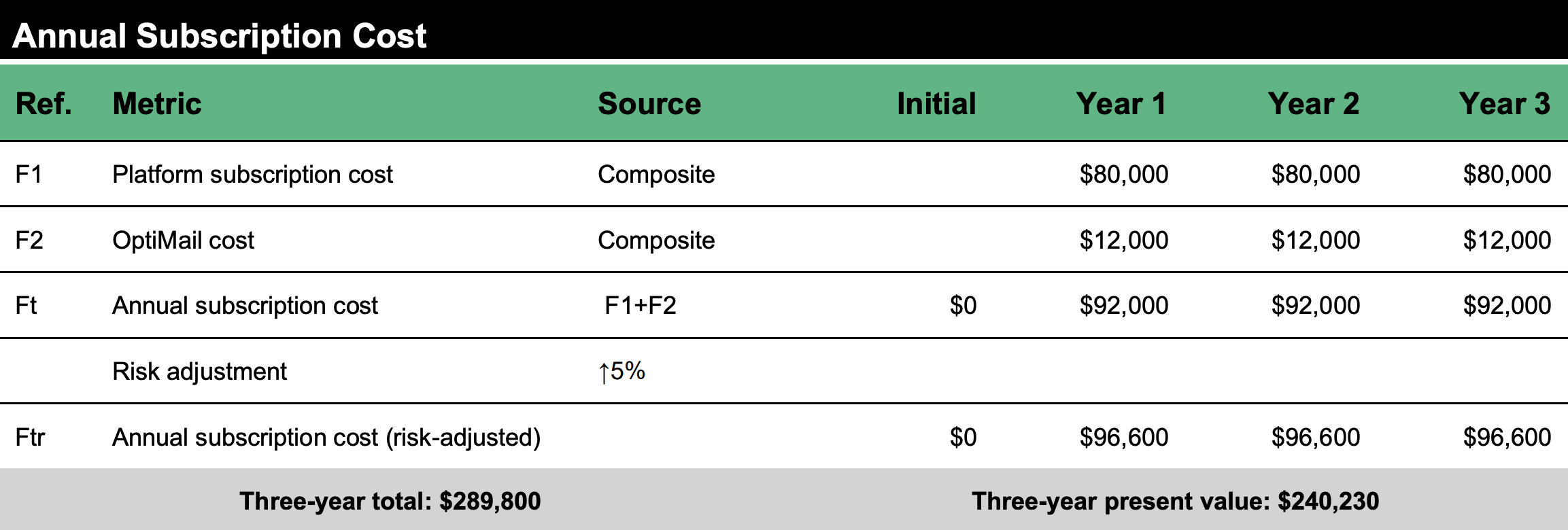
Annual Subscription Cost 

Evidence and data. The cost of the Optimove platform depended on the revenue and active customers of each interviewee’s organization. 

Modeling and assumptions. For the analysis, Forrester assumes the following about the composite organization: 

  • The composite organization pays an annual subscription fee of $80,000.
  • It adopts OptiMail to replace previous email point solutions, which costs $12,000 on top of the platform subscription. The cost of OptiMail depends on the total email quota per year. 

Risks. This model has taken the following risks into consideration: 

  • Potential pricing adjustments in the next three years.
  • Potential surge in email usage. 

Results. To account for these risks, Forrester adjusted this cost upward by 5%, yielding a threeyear, risk-adjusted total PV (discounted at 10%) of $240,000.
Screenshot 2025-12-15 at 18.19.26.png

Implementation Cost 

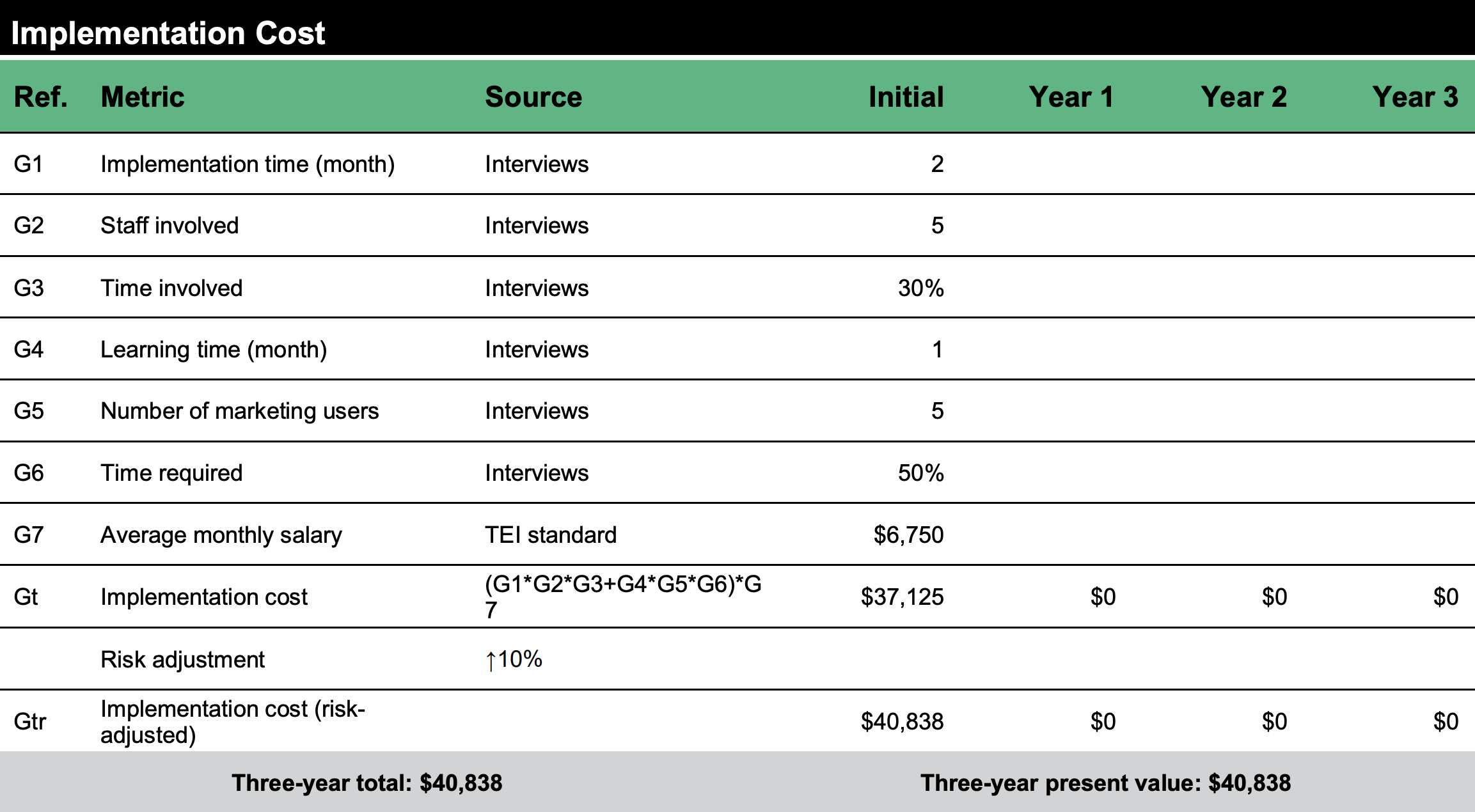
Evidence and data. Implementation costs included time and effort required throughout the implementation process and platform learning. To realize maximum value from the Optimove platform, users needed time to learn and explore its advanced functionality. Interviewees found the Optimove Academy and account managers were helpful throughout the learning process. 

Modeling and assumptions. For the analysis, Forrester assumes the following about the composite organization: 

  • For the composite organization, the whole implementation process takes two months. Data ingestion is the most time-consuming part of the process.
  • There are five employees from marketing and IT involved in the process, taking up 30% of their time during those two months.
  • On average, it takes a new employee one month to get familiar with the platform in the specific business context.

Risks. This model has taken into the following risks into consideration: 

  • Implementation time is highly dependent on each organization’s IT environment and data quantity.
  • Learning time could vary depending on individuals. 

Results. To account for these risks, Forrester adjusted this cost upward by 10%, yielding a threeyear, risk-adjusted total PV of $41,000.
Screenshot 2025-12-15 at 18.21.47.png

Ongoing Upgrade and Management 

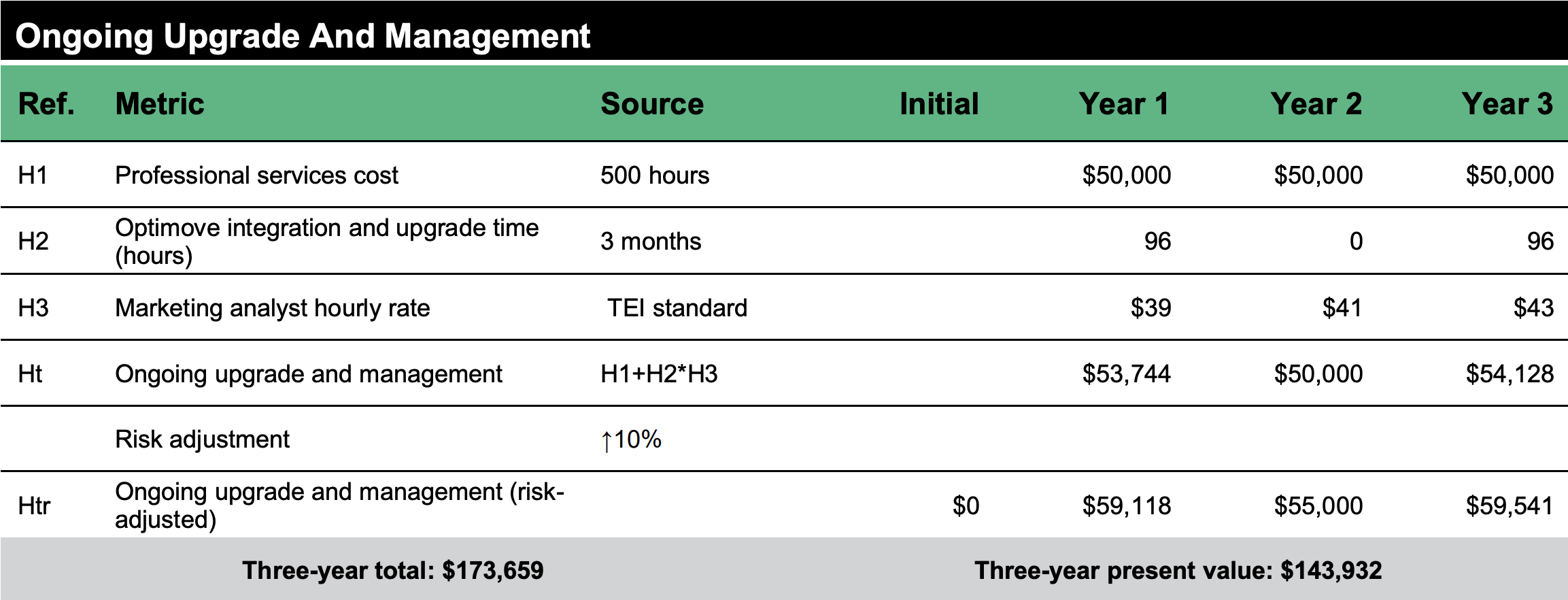
Evidence and data. Optimove required continual upgrading and management. The VP of analytics from a telecommunications firm mentioned: “What’s hard is all our custom integration points like our SMS platform, promo platform, and other proprietary solutions. It takes three to four months to get all of them tested and integrated.” 

Modeling and assumptions. For the analysis, Forrester assumes the following about the composite organization: 

  • The composite organization purchases 500 professional services hours to get support from Optimove to constantly improve analytics and segmentation capabilities.
  • Another part of ongoing cost is related to continuous data integration. As the customer database expands and new platforms are developed, the composite organization needs to refresh custom integration with other systems once every two years. 

Risks. This model has taken into the following risks into consideration: 

  • Needs for professional services could vary.
  • Integration effort could vary. 

Results. To account for these risks, Forrester adjusted this cost upward by 10%, yielding a threeyear, risk-adjusted total PV of $144,000.
Screenshot 2025-12-15 at 18.23.42.png

Financial Summary

Consolidated Three-Year Risk-Adjusted Metrics

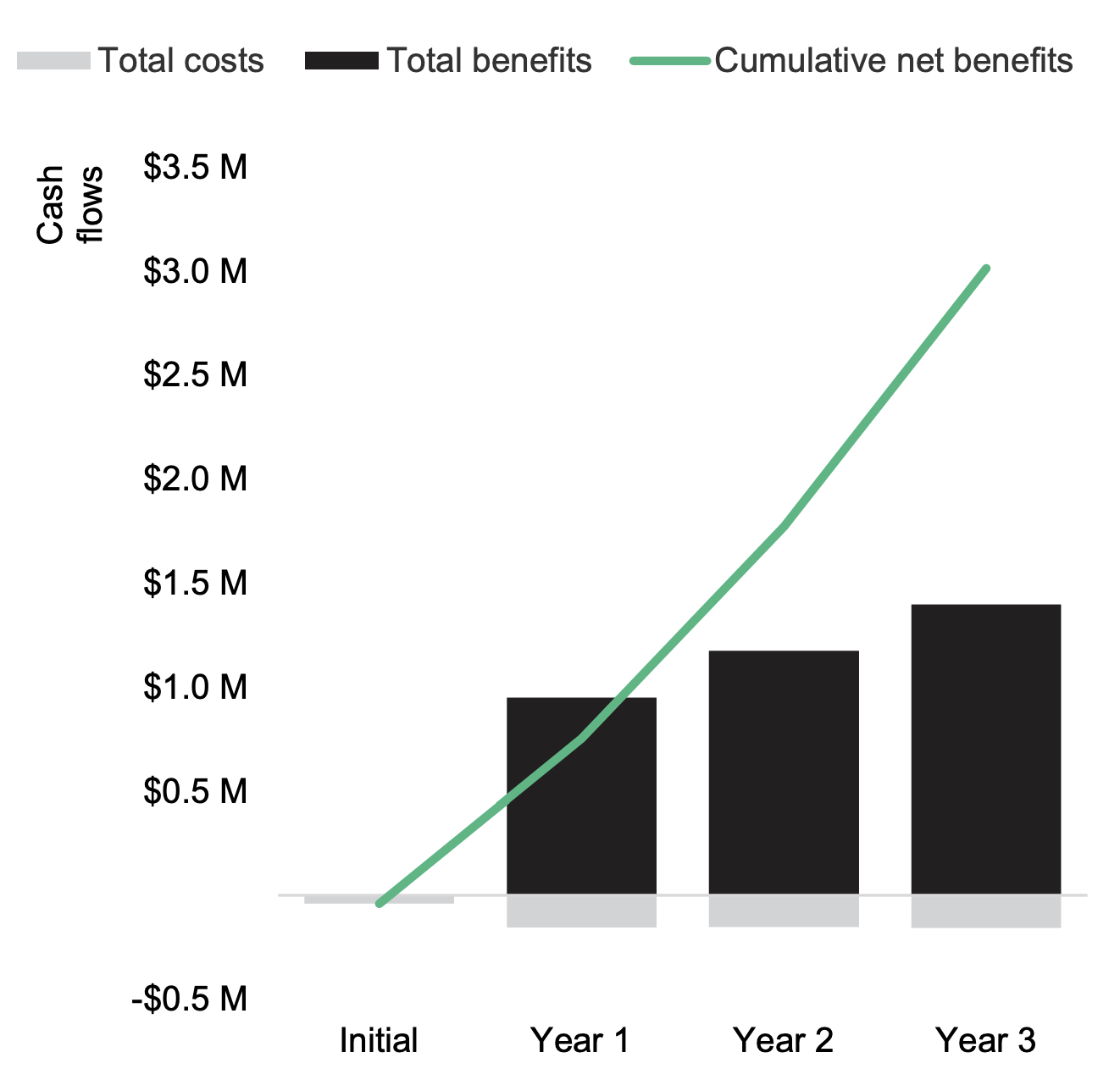
The financial results calculated in the Benefits and Costs sections can be used to determine the ROI, NPV, and payback period for the composite organization’s investment. Forrester assumes a yearly discount rate of 10% for this analysis.

Cash Flow Chart (Risk-Adjusted)
Screenshot 2025-12-15 at 18.25.30.png

These risk-adjusted ROI, NPV, and payback period values are determined by applying risk-adjustment factors to the unadjusted results in each Benefit and Cost section.
Screenshot 2025-12-15 at 18.26.42.png

Appendix A: Total Economic Impact

Total Economic Impact is a methodology developed by Forrester Research that enhances a company’s technology decision-making processes and assists vendors in communicating the value proposition of their products and services to clients. The TEI methodology helps companies demonstrate, justify, and realize the tangible value of IT initiatives to both senior management and other key business stakeholders. 

Total Economic Impact Approach

Benefits represent the value delivered to the business by the product. The TEI methodology places equal weight on the measure of benefits and the measure of costs, allowing for a full examination of the effect of the technology on the entire organization. 

Costs consider all expenses necessary to deliver the proposed value, or benefits, of the product. The cost category within TEI captures incremental costs over the existing environment for ongoing costs associated with the solution. 

Flexibility represents the strategic value that can be obtained for some future additional investment building on top of the initial investment already made. Having the ability to capture that benefit has a PV that can be estimated. 

Risks measure the uncertainty of benefit and cost estimates given: 1) the likelihood that estimates will meet original projections and 2) the likelihood that estimates will be tracked over time. TEI risk factors are based on “triangular distribution.”

The initial investment column contains costs incurred at “time 0” or at the beginning of Year 1 that are not discounted. All other cash flows are discounted using the discount rate at the end of the year. PV calculations are calculated for each total cost and benefit estimate. NPV calculations in the summary tables are the sum of the initial investment and the discounted cash flows in each year. Sums and present value calculations of the Total Benefits, Total Costs, and Cash Flow tables may not exactly add up, as some rounding may occur.

PRESENT VALUE (PV)

The present or current value of (discounted) cost and benefit estimates given at an interest rate (the discount rate). The PV of costs and benefits feed into the total NPV of cash flows. 

NET PRESENT VALUE (NPV)

The present or current value of (discounted) future net cash flows given an interest rate (the discount rate). A positive project NPV normally indicates that the investment should be made unless other projects have higher NPVs. 

RETURN ON INVESTMENT (ROI)

A project’s expected return in percentage terms. ROI is calculated by dividing net benefits (benefits less costs) by costs.

DISCOUNT RATE

The interest rate used in cash flow analysis to take into account the time value of money. Organizations typically use discount rates between 8% and 16%. 

PAYBACK PERIOD

The breakeven point for an investment. This is the point in time at which net benefits (benefits minus costs) equal initial investment or cost.

Appendix B: Endnotes

Source: “Now Tech: Customer Data Platforms, Q1 2022,” Forrester Research, Inc., February 4, 2022. 

Total Economic Impact is a methodology developed by Forrester Research that enhances a company’s technology decision-making processes and assists vendors in communicating the value proposition of their products and services to clients. The TEI methodology helps companies demonstrate, justify, and realize the tangible value of IT initiatives to both senior management and other key business stakeholders. 

Source: “Apply Your Data Deprecation Plan,” Forrester Research, Inc., February 1, 2021.

Learn more, be more with Optimove
Check out our resources
Discover
Join the Positionless Marketing movement
Join the marketers who are leaving the limitations of fixed roles behind to boost their campaign efficiency by 88%