

Unified Growth Solution
World-class tech needs world-class drivers. AI platform and expert services, unified
Read time 10 minutes


Optimove: Visionary Leader in Multichannel Marketing According to Gartner
Why it matters:
Marketers can use these insights to choose a CRM marketing platform for Analytics and Foundational AI that scales multichannel execution with real-time decisioning and measurable incremental impact.
Analytics and Foundational AI are what turn nonstop customer signals into clear decisions and scalable action across channels, so marketers can personalize faster without waiting on manual workflows.
Gartner’s rankings show which CRM marketing platforms are best equipped to turn customer data into predictive insights that improve targeting, timing, and channel decisions. Gartner’s rankings matter because they give brands an objective way to compare vendors on real capabilities that drive targeting, timing, and measurable campaign outcomes.

Key takeaways:
Optimove has been recognized as the leading provider in Analytics and Foundational AI capabilities in Gartner's 2025 Critical Capabilities for Multichannel Marketing Hubs report. This achievement reinforces Optimove's commitment to delivering AI-driven marketing solutions that empower brands to execute data-informed, personalized customer experiences at scale.
Optimove was evaluated by Gartner in the 2025 Critical Capabilities for Multichannel Marketing Hubs report and received rankings across multiple critical use cases. The report assessed 11 vendors and marketers can use this research to identify solutions to power effective multichannel campaigns and drive measurable outcomes. Here are the rankings:
According to Gartner, Analytics and Foundational AI capabilities are essential for optimizing program performance through targeted interventions and personalization. These capabilities include predictive models such as send-time optimization (STO) and recency-frequency-monetary (RFM) analysis for precise targeting.
Foundational AI (or non-generative AI) employs supervised and unsupervised learning algorithms to analyze historical data and make predictions using techniques such as clustering (e.g., k-means), decision trees, and support vector machines. These methods focus on interpreting existing data to derive actionable insights that drive marketing effectiveness.
Gartner evaluated 11 multichannel marketing hub vendors on their Analytics and Foundational AI capabilities. The rankings demonstrate how each CRM marketing platform delivers predictive modeling, customer journey analytics, and data-driven decision-making. Here are the vendors’ rankings for Analytics and Foundational AI Critical Capabilities:
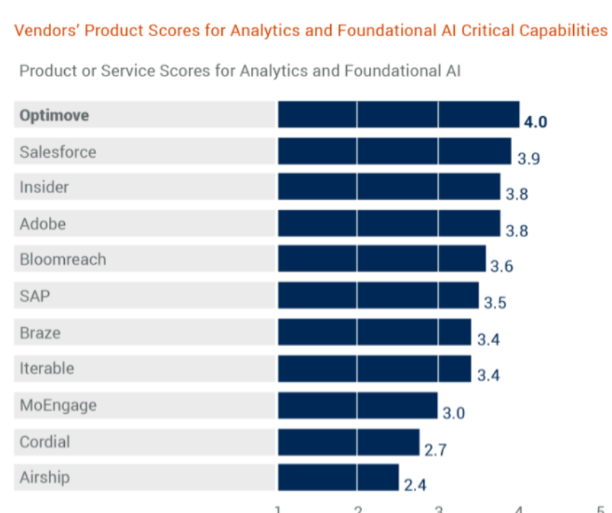
*Source: Gartner Critical Capabilities for Multichannel Marketing Hubs (September 2025)
Here are the rankings:
Gartner highlighted Optimove’s exceptional capabilities in Analytics and Foundational AI, noting that the platform enables marketers to import modeling scores and models directly for advanced, customized analysis. This capability allows marketing teams to leverage their proprietary data science work while benefiting from Optimove’s native AI-driven insights.
According to the report, Optimove's strongest use case is journey and campaign execution, where the platform excels at large-scale campaign management. Marketers can efficiently scale thousands of campaigns and moments with Optimove's self-optimizing campaign engine. The platform's AI agents personalize journeys with an always-on experimentation engine and real-time decisioning, leveraging any data source and AI to compare journey strategies while providing built-in, multitouch attribution and control group capabilities.
For Salesforce, Gartner observed that while the platform offers strong analytics capabilities, most advanced features, such as bring-your-own model and advanced algorithms, are powered by Data Cloud, a secondary product not included in Marketing Cloud Engagement. This architectural approach may require additional investment for organizations seeking comprehensive analytics capabilities.
Gartner highlighted that Insider's Analytics and Foundational AI capabilities include attribution modeling and customized performance reports for data-driven decision-making. The platform's Sirius AI accelerates marketing velocity and integrates customer service and marketing interactions through GenAI-powered chatbots. Insider's optimization and prioritization tools allow marketing teams to compare channel performance, attribute revenue by channel, and use AI-powered features such as Next Best Channel and Send Time Optimization.
Adobe's Analytics and Foundational AI capabilities deliver GenAI-powered insights, automated reporting, and predictive analytics. The platform integrates these capabilities across Adobe Journey Optimizer and Adobe Customer Journey Analytics, enabling marketers to leverage AI-driven decision-making throughout the customer journey. Gartner noted that Adobe excels at orchestrating adaptive, multistep journeys and campaigns with real-time data and AI-driven personalization.
Gartner noted that Bloomreach's Analytics and Foundational AI capabilities enable marketers to identify channels, detect anomalies to alert key stakeholders, and predict churn likelihood to optimize frequency caps and send times during campaigns. The platform's Loomi AI powers these capabilities, helping marketing teams make decisions based on customer behavior patterns. Bloomreach's GenAI-based analytics help marketers identify and activate campaign opportunities.
According to Gartner, SAP Emarsys recently released Joule AI Engagement Agents, a conversational AI marketing assistant that provides quick access to help documentation, campaign and segment suggestions, and the ability to query data. While the platform offers campaign performance dashboards and recommendations through Tactics, Gartner noted that it lacks native anomaly or opportunity detection for projects and tasks.
Gartner recognized Braze’s prediction modeling capabilities, including event correlation that compares different user groups and analyzes how a segment’s behaviors or attributes will perform. The platform’s predictive analytics suite enables marketers to see how interactions affect goals and identify likely drop-offs during journeys. Braze’s real-time streaming data architecture enables in-the-moment personalization and multichannel execution.
For Iterable, Gartner highlighted that marketers can leverage predictive modeling to build audiences likely to convert using no- or low-code schemas. The platform's Nova AI provides campaign performance tracking and actionable recommendations, while Brand Affinity insights alert users to campaigns and channels that drive the highest engagement. Gartner noted that Iterable's prescriptive insights provide visual data modeling and user flows by channel, helping marketers optimize channel selection.
Gartner observed that MoEngage offers Merlin AI segmentation, enabling users to easily create segments via natural language and build multistep customer journeys. The platform provides real-time data intake, unifies customer profiles from multiple sources, and offers multiple prebuilt integrations with two-way data flow. However, Gartner noted that the platform covers channel-level and data processing reporting but lacks predictive reporting capabilities.
According to Gartner, Cordial Edge AI's predictive attributes and no-code segmentation enhance targeting, personalization, and audience development, while journey analytics support next-best-action decisions. The platform leverages Cordial Edge AI for AI-driven message insights and autonomous content creation, with recent releases including AI product recommendations and predictive AI attributes to enhance real-time decisioning across channels.
Gartner noted that Airship's analytics capabilities support cross-channel campaign design and optimization. The platform's recently released Journeys AI enables customers to rapidly create multichannel journeys using simple prompts. However, Gartner observed that Airship offers basic visibility into usage metrics but lacks advanced forecasting and optimization capabilities in Analytics and Foundational AI compared to market leaders.
Analytics and Foundational AI are the backbone of effective Positionless Marketing that prioritizes customer needs and behaviors over predetermined marketing segments or rigid customer lifecycles.
According to Optimove, Analytics and Foundational AI are the core enablers of Positionless Marketing, removing fixed roles, static segments, and predefined lifecycle assumptions from marketing execution. Instead of forcing customers into fixed journeys, foundational AI continuously analyzes behavioral, transactional, and contextual signals to determine the most relevant next action for each individual customer.
Positionless Marketing empowers marketers to rely on predictive intelligence, not manual rules, to decide who to engage, when to engage them, and through which channel. Foundational AI enables capabilities such as propensity modeling, incremental lift measurement, control-group analysis, and real-time prioritization across campaigns and journeys. These capabilities ensure that marketing decisions are based on expected business impact rather than intuition or historical averages.
Without strong Analytics and Foundational AI, Positionless Marketing cannot scale. Generative tools may accelerate content creation, but it is foundational AI that determines whether a message should be sent at all, which experience should take precedence, and how to continuously optimize performance.
When evaluating vendors for Analytics and Foundational AI capabilities, marketers should ask these critical questions to ensure the platform can deliver measurable business impact:
1. Can I bring my own models and data science work into the platform?
Look for platforms that allow you to import custom modeling scores and proprietary algorithms. This capability ensures you're not locked into vendor-only AI and can leverage your team's specialized data science expertise alongside native platform intelligence.
2. Does the AI make decisions in real-time, or just provide recommendations I need to act on manually?
Distinguish between platforms that offer real-time decisioning (AI autonomously determines next-best actions) versus those that only surface insights requiring manual implementation. The latter creates bottlenecks that slow campaign execution and limit personalization at scale.
3. What predictive capabilities are included in the base platform versus paid add-ons?
Clarify which foundational AI features, such as propensity modeling, send-time optimization, churn prediction, and channel affinity, are native to the platform. Avoid solutions where critical AI capabilities require purchasing secondary products or premium tiers.
4. How does the platform handle experimentation and control groups at scale?
Ask whether the platform provides built-in capabilities for A/B testing, multivariate testing, incremental lift measurement, and automated control group management across thousands of campaigns simultaneously. Strong foundational AI should make experimentation systematic, not a manual project.
5. Can the platform prioritize conflicting campaigns based on predicted business impact?
Evaluate whether the AI can autonomously resolve conflicts when multiple campaigns target the same customer, prioritizing based on expected conversion, revenue, or lifetime value rather than arbitrary rules or manual intervention.
6. What types of data can the AI analyze beyond behavioral and transactional signals?
Determine if the platform can incorporate contextual data (weather, location, device), third-party enrichment, product catalog information, and real-time event streams. The breadth of data inputs directly impacts the accuracy and relevance of AI-driven predictions.
7. How transparent and explainable are the AI recommendations?
Understand whether the platform provides visibility into why the AI made specific recommendations—which signals it prioritized, what models it used, and how confident it is in the prediction. Black-box AI creates trust issues and makes optimization difficult when campaigns underperform.
Optimove's #1 ranking in this critical capability validates the platform's ability to help brands transition from traditional segment-based marketing to truly customer-centric, Positionless Marketing strategies that drive measurable business results.
Gartner’s 2025 Critical Capabilities for Multichannel Marketing Hubs report reinforces that Analytics and Foundational AI remain the most critical drivers of effective, scalable personalization. Optimove’s #1 ranking in this category reflects its strength in turning customer data into predictive intelligence, prescriptive recommendations, and measurable business outcomes.
By combining advanced analytics, foundational AI, and real-time decisioning within a single CRM marketing platform, Optimove enables brands to move beyond traditional segment-based marketing and adopt true Positionless Marketing. The result is faster execution, greater relevance, and marketing programs that continuously optimize themselves based on customer behavior and incremental impact.
Download the complete report.
For more insights, contact us to request a demo.
Gartner Ranks Optimove #1 in AI Capabilities
In this Gartner report, Optimove ranks #1 in AI capabilities that matter most. Gartner rankings validate the power of Positionless Marketing.


Writers in the Optimove Team include marketing, R&D, product, data science, customer success, and technology experts who were instrumental in the creation of Positionless Marketing, a movement enabling marketers to do anything, and be everything.
Optimove’s leaders’ diverse expertise and real-world experience provide expert commentary and insight into proven and leading-edge marketing practices and trends.