
Unified Growth Solution
World-class tech needs world-class drivers. AI platform and expert services, unified
Read time 13 minutes


Better, Smarter, Faster: How AI is Transforming CDPs

Executive Summary :
The 2026 holiday season presents a strong commercial opportunity. Most consumers expect to maintain or increase their spending, with gifting centered primarily on family and close relationships. However, larger budgets do not make purchase decisions automatic: shoppers still need help navigating recipients, products, prices, and competing priorities.
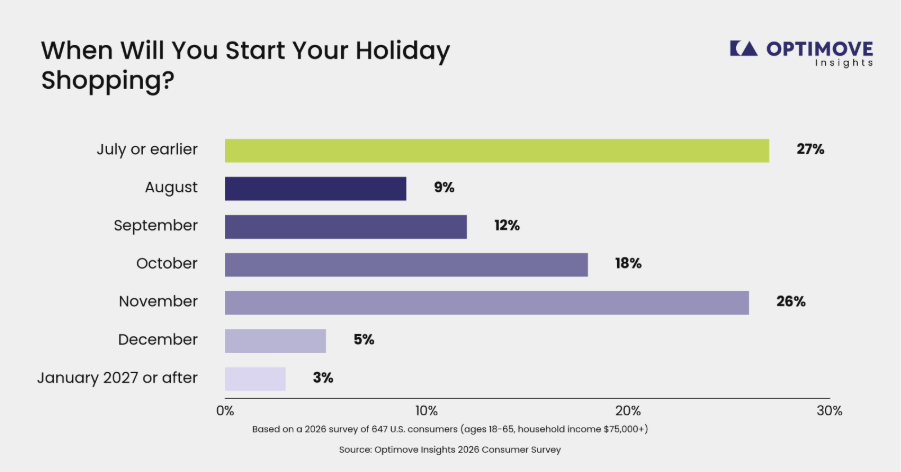
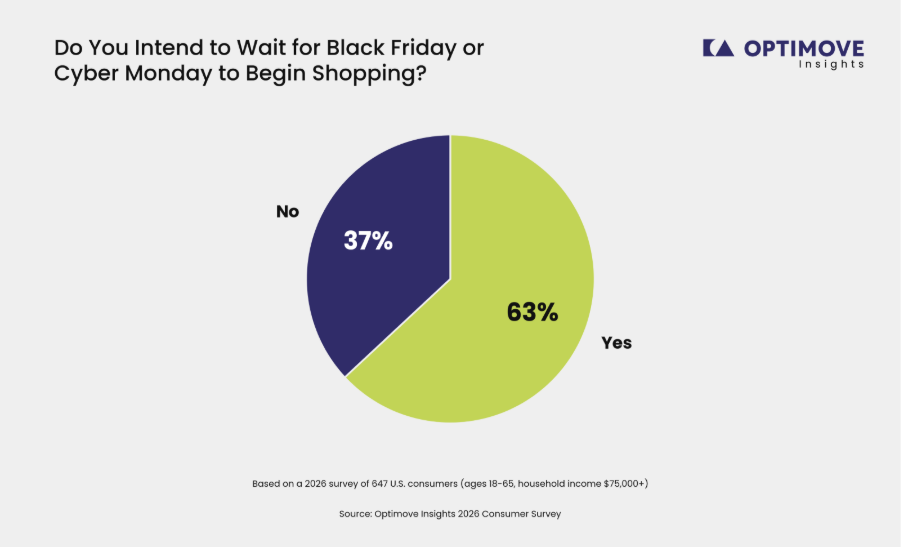
Although 66% appear willing to begin shopping before November, sixty-three percent (63%) say they may wait for Black Friday or Cyber Monday when asked directly about those events. Consumers can still be encouraged to act sooner through discounts, product availability, and delivery assurances, but marketers must balance early engagement with the risk of holiday message fatigue.
Familiar brands retain an advantage, yet nearly 50% of consumers remain open to discovery. Across both established and new brands, quality and price define value, while AI is increasingly shaping product discovery and gift recommendations.
Positionless Marketing teams will be able to respond to these varied behaviors by rapidly turning customer data into relevant segments, messages, offers, and experiences, without relying on slow, cross-departmental processes.
Methodology :
Optimove surveyed 648 U.S. consumers in Spring 2026, ages 18+, with household incomes of $75,000+. The analysis in this report focuses on shopping behaviors and attitudes, using both dedicated questions and related cross-survey data on discovery, decision-making, messaging, payments, and multichannel behavior.
Findings: Christmas dominates holiday shopping plans, selected by 92% of respondents, while smaller groups plan to shop for Hanukkah, Kwanzaa, or other celebrations.
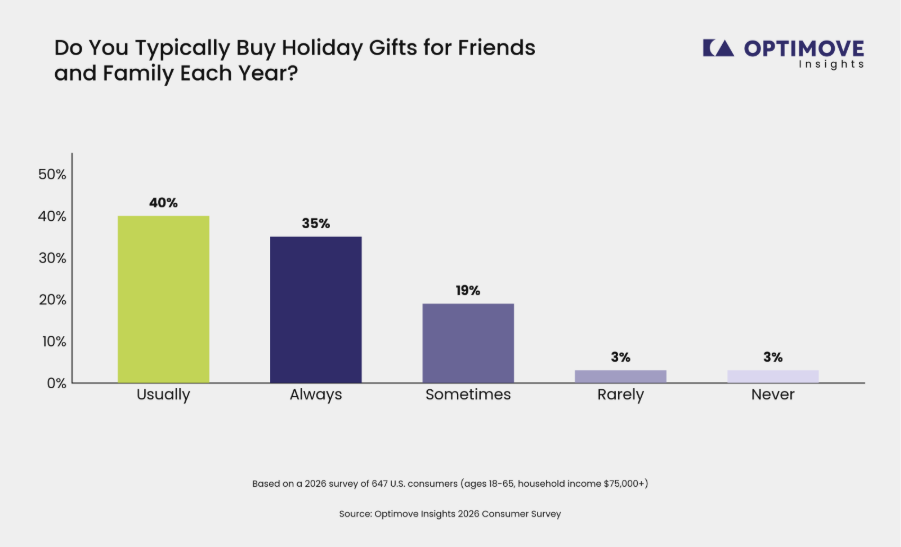
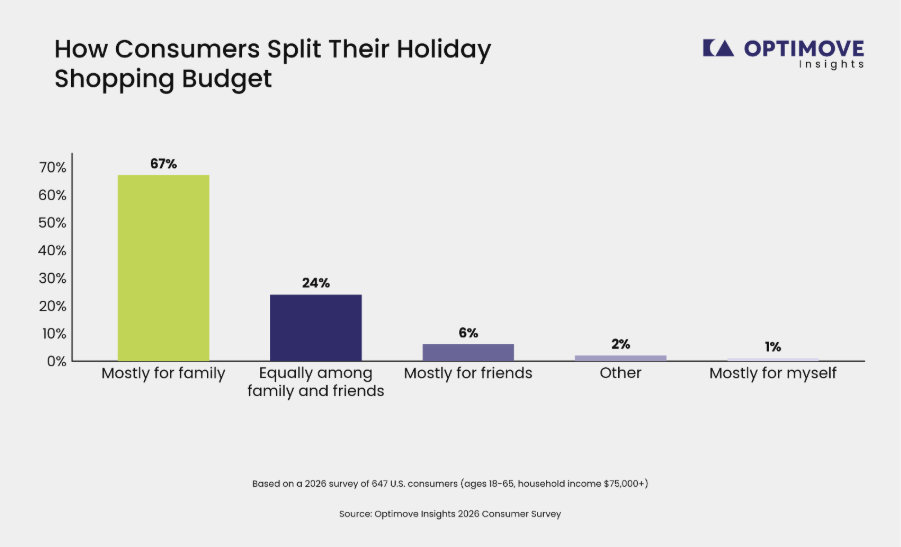
Gift giving is firmly established, with 75% saying they always or usually buy gifts. Sixty-seven percent (67%) will spend mostly on relatives, while 24% will divide their budgets equally between family and friends.
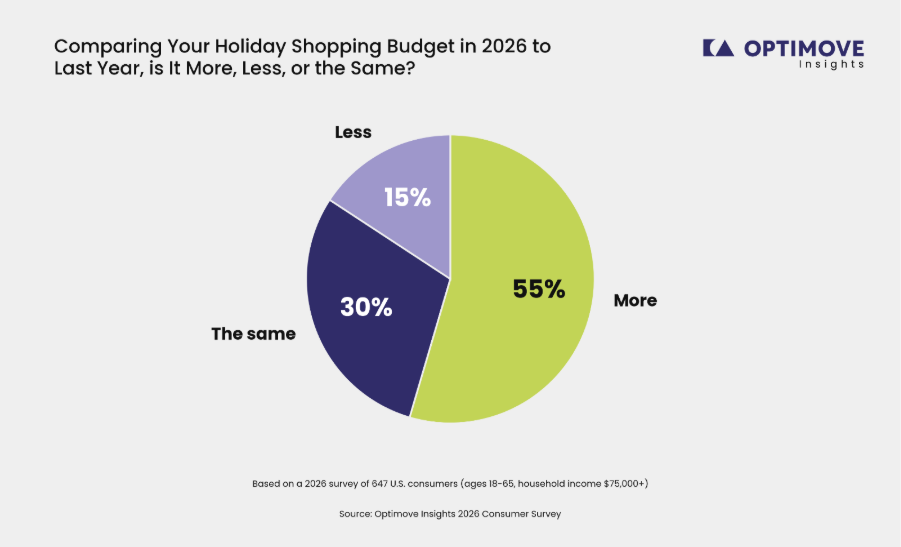
More than half of consumers (55%) expect to spend more than last year, and another 30% plan to maintain the same budget.
Insights
Holiday shopping remains deeply rooted in relationships and tradition. Family is a clear priority, shaping both purchase decisions and budget allocation. The results also point to a confident spending environment. With 85% planning to spend the same or more than last year, consumers are entering the season prepared to invest. However, larger budgets may also bring greater consideration as shoppers decide how to allocate their spending, as we will see in the next sections.
How Marketers Should Respond
Marketers should organize campaigns around gifting purposes, helping customers shop for different family members and friends. Gift guides, curated collections, and personalized recommendations can reduce decision-making friction while making larger holiday budgets easier to navigate.
Brands must also use customer data and behavioral signals to distinguish between shoppers increasing their spending and those maintaining or reducing their budgets. Premium recommendations, bundles, and early-access offers can engage higher-spending customers, while value-led messaging can keep more budget-conscious shoppers active.
With Positionless Marketing, teams can rapidly create and adjust segments, offers, and messaging according to each customer’s budget, needs, and holiday preferences. This enables more relevant experiences while reducing reliance on broad, one-size-fits-all holiday campaigns.
Findings: Consumer intentions around timing are less fixed than they initially appear. When asked generally when they will begin holiday shopping, 66% indicate they are willing to start between July and October, and only 26% indicate November as the starting month. However, when asked specifically about waiting for Black Friday and Cyber Monday, 63% say they intend to wait for these events before beginning to shop.
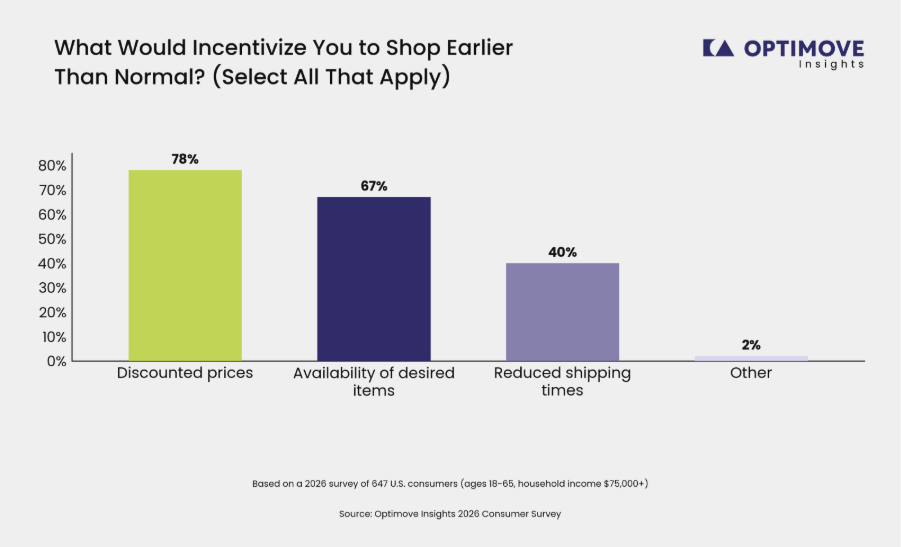
Retailers can still motivate earlier purchases: 78% cite discounted prices, 67% the availability of desired items, and 40% shorter shipping times as reasons to start shopping sooner.
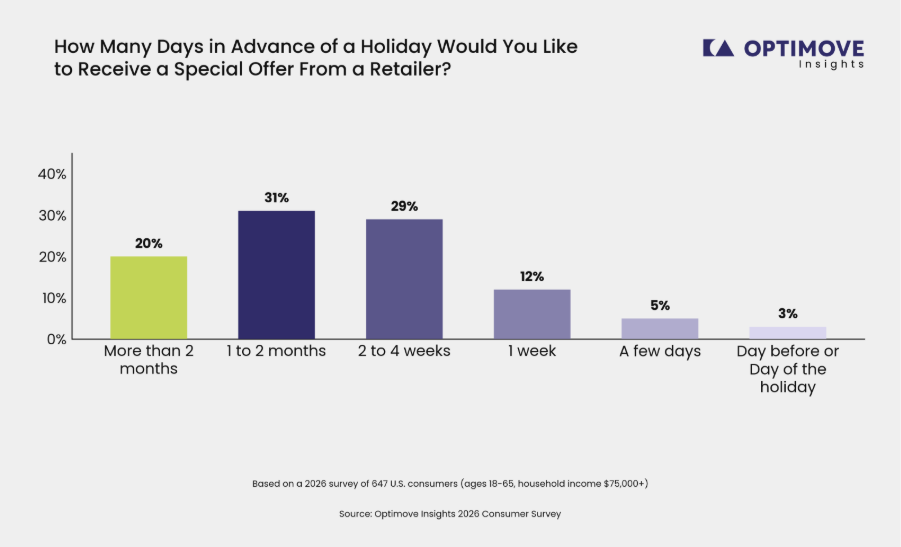
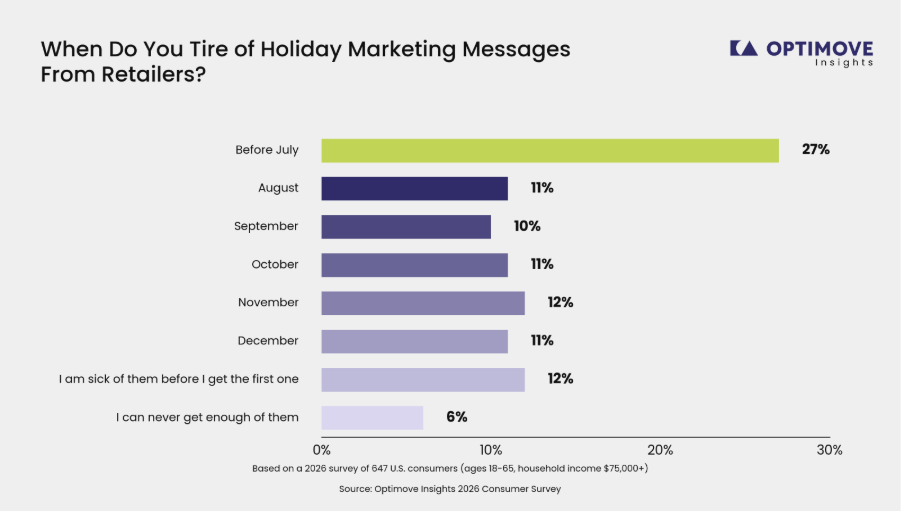
More than half of the respondents want to receive special offers at least one month before the start of the holiday season, while 27% say they are tired of marketing aimed at this period even before July.
 Marketing Fatigue, which we have reported in the past, remains an issue. By October, fifty-nine percent of respondents say they tire of holiday messages, and by November it is more than seven out of ten. This highlights that marketers must temper messages and make sure they are personalized and relevant.
 Insight
Holiday shopping marketing is highly dependent on context. Consumers may be open to browsing or making selected purchases earlier in the year (usually to get a deal), but the promise of major Black Friday and Cyber Monday offers can encourage them to postpone a larger portion of their spending.
This creates a long and uneven holiday journey. Early activity may focus on planning, discovery, and securing specific products, while November becomes a stronger conversion period for shoppers waiting for promotional reassurance.
Determining the moment of purchase is not the result of a single factor; it is something that can change as prices, inventory levels, and delivery conditions shift.
The data also reveal a tension between consumers’ interest in early offers and their sensitivity to marketing fatigue. Shoppers welcome relevant value and practical information well in advance, but repetitive or generic holiday communications can quickly lose their effectiveness.
How Marketers Should Respond
Marketers should distinguish between early consideration and purchase readiness. Early campaigns can focus on inspiration, product discovery, inventory availability, and gift planning, while stronger promotional messages can be reserved for customers showing signs that price is delaying conversion.
A Positionless Marketing approach can help teams respond to these different intentions by adapting segments, offers, and messages very quickly. This enables brands to remain relevant throughout the season while avoiding unnecessary communication that contributes to holiday fatigue.
Rather than communicating at the same frequency to everyone, brands should use behavioral signals to identify early buyers, those waiting for Black Friday, and last-minute shoppers. Discounts, stock alerts, and delivery assurances can then be activated according to what is most likely to move each customer forward.
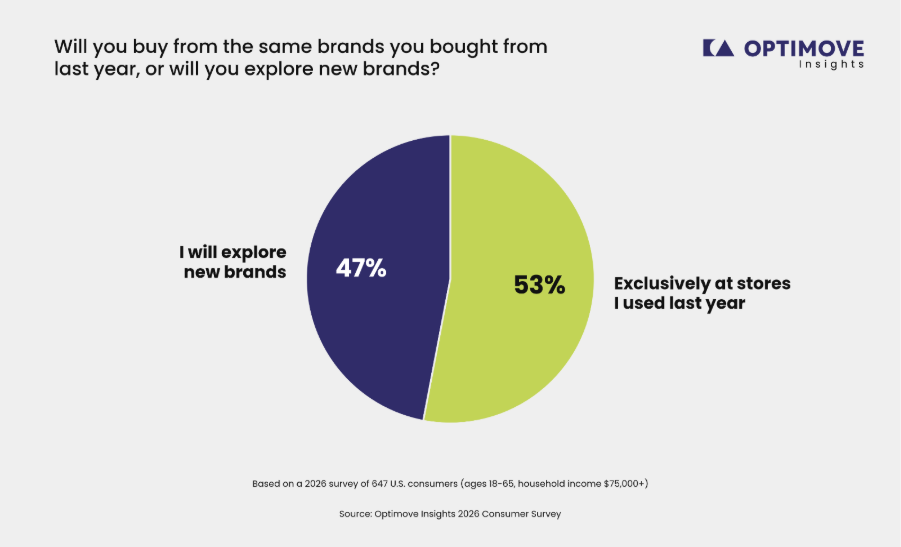
Findings: Holiday shoppers are divided between familiarity and discovery. While 53% plan to shop exclusively at stores they used last year, 47% expect to explore new brands during the season.
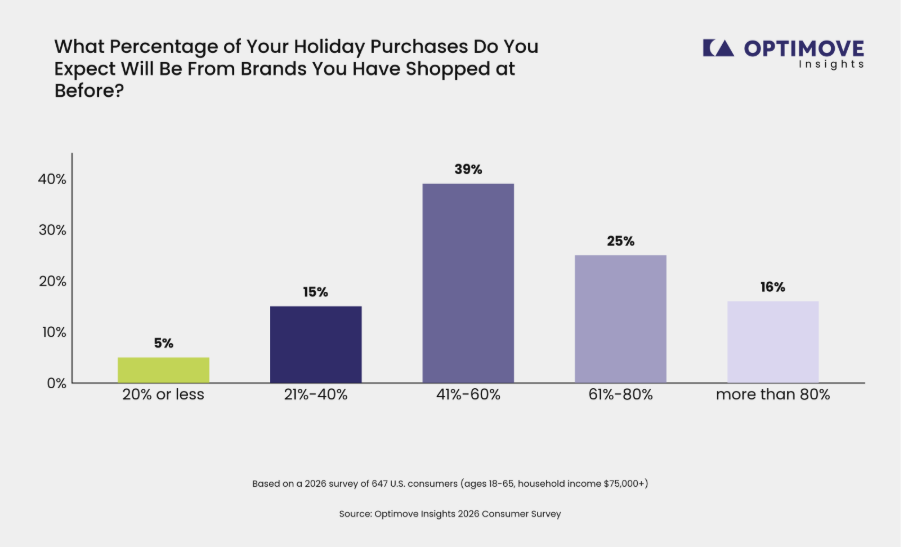
Other data show that almost 2 out of 5 Americans expect that 41% to 60% of their holiday purchases will come from brands they have shopped with before, while a little more than 2 in 5 expect that the percentage will exceed 60%.
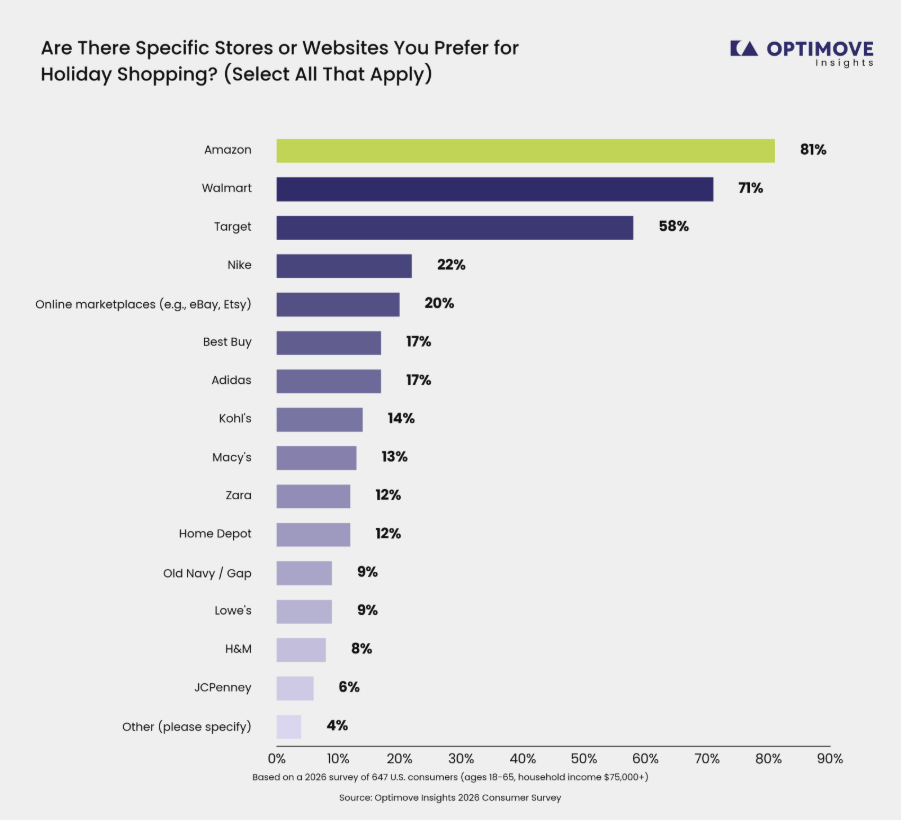
Large, multi-category retailers dominate consumer preferences. Amazon leads at 81%, followed by Walmart at 71% and Target at 58%, while most specialty retailers and marketplaces attract smaller but still meaningful segments of shoppers.
 Insights
Familiarity remains a strong advantage during the 2026 holiday season. Even when consumers are open to exploring new brands, most still expect established relationships to account for a significant portion of their purchases. This suggests that discovery will often complement, rather than replace, trusted retailers in the buying process.
This creates a balanced, competitive environment. Established brands have the opportunity to capture a larger share of holiday spending, pushing loyalty, while newer brands can be considered by shoppers. Offering relevant products, strong value, or a differentiated shopping experience matters.
Loyalty should not be treated as absolute, though. Consumers return to brands they know, while remaining open to alternatives. This means that past purchase behavior provides an advantage, not a guarantee of future spending.
The dominance of Amazon, Walmart, and Target also reflects the appeal of convenience and broad product selection. Yet the fragmented preferences beyond these leaders show that specialty brands can still compete by offering distinct products, stronger relevance, or expertise that large marketplaces may not provide.
How Marketers Should Respond
Brands should balance retention and acquisition at some level. A Positionless Marketing approach can help teams balance each by quickly turning customer insights into personalized campaigns without depending on multiple departments.
On one hand, marketers should use customer data to strengthen existing relationships through personalized gift recommendations and communications based on previous purchases and browsing behavior. Returning to the brand must feel easy, useful, and rewarding.
At the same time, acquisition campaigns should give shoppers a clear reason to try something new. Introductory offers, social proof, distinctive products, and transparent information can reduce uncertainty and help unfamiliar brands earn part of the holiday basket.
Brands can also work smarter here by profiling their existing loyal customers and using those patterns to identify which new shoppers are likely to become valuable. A first-time buyer who resembles a brand's best customers is worth more than a first-time buyer who does not, and acquisition spend should reflect that difference.
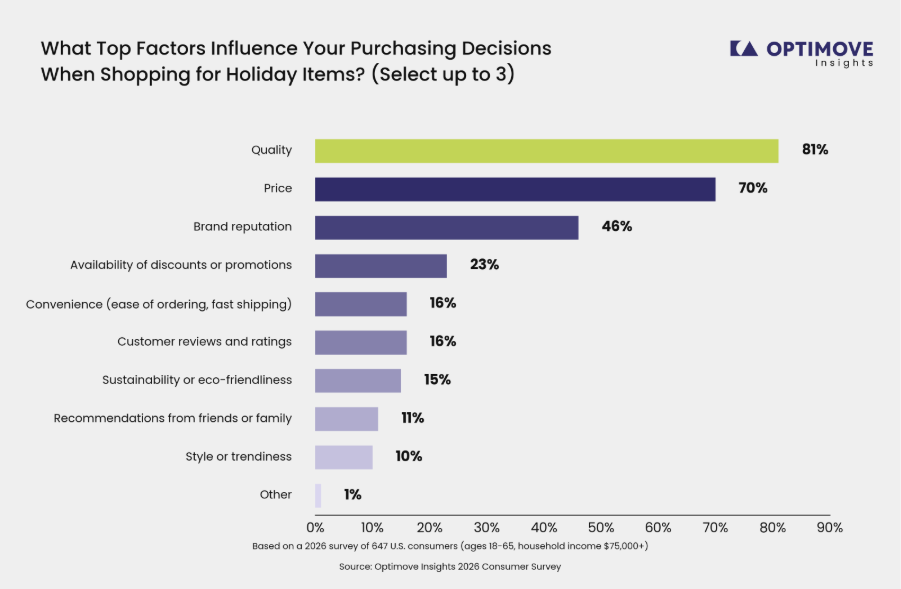
Findings: Quality of products and services is indicated as the main driver for holiday purchase decisions. When shopping for products, quality was selected by 81% of consumers, followed by price at 70% and brand reputation at 46%. Promotions rank much lower at 23%.
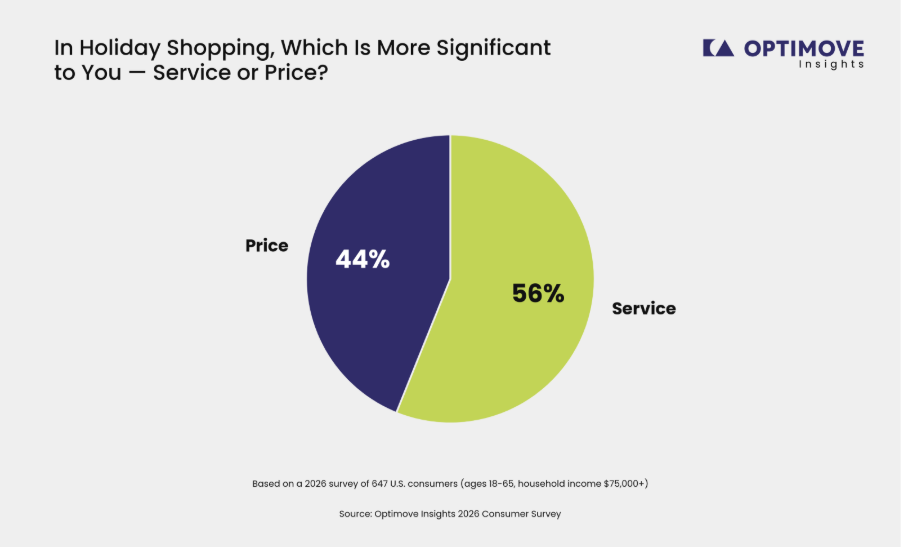
When asked to choose between good service and price, 56% prioritize service, compared with 44% who favor price, suggesting that shoppers consider overall value rather than discounts alone during the period.
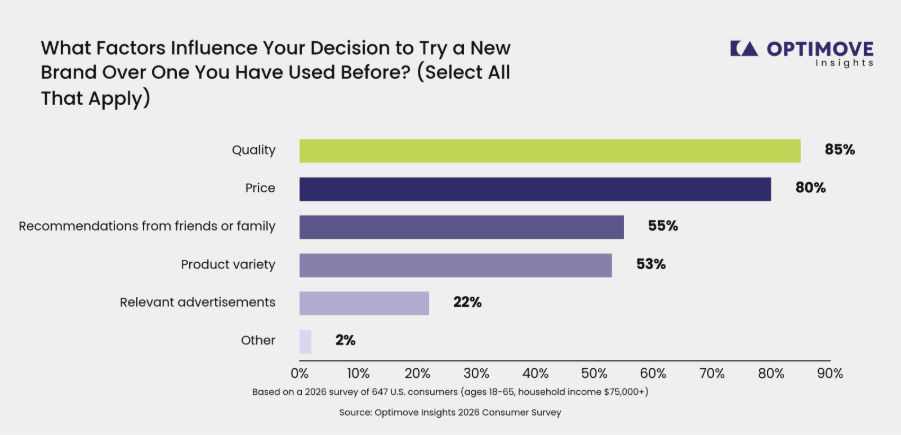
The same pattern shapes brand discovery. Quality would persuade 85% to try a new brand, while price would influence 80%.
 Insights
Holiday shoppers are highly price-sensitive, but they are not simply searching for the lowest-cost option. Quality consistently outranks price for both general purchasing and brand discovery, showing that consumers want products they consider worth the money they spend and suitable for the occasion
The preference for service over price reinforces this broader definition of value. During the holidays, good client service, support, ordering ease, delivery, and returns can be especially important. Purchases can be time-sensitive and can become very stressful for those who are in charge of buying.
For new and established brands, competitive pricing may attract attention, but quality provides the confidence required to convert.
How Marketers Should Respond
Marketers should lead with clear evidence of product quality and service reliability, including details such as materials, benefits, customer reviews, and delivery guarantees.
Price and promotions must support this message rather than replace it. Instead of relying only on broad discounts, brands should connect offers to quality through bundles, added services, free shipping, extended returns, or other benefits that strengthen perceived value.
A Positionless Marketing approach can help teams respond quickly to these different value drivers by turning customer preferences into personalized messages, offers, and experiences. This allows marketers to emphasize quality, service, or price according to each customer’s priorities and adjust campaigns as behavior changes throughout the season.
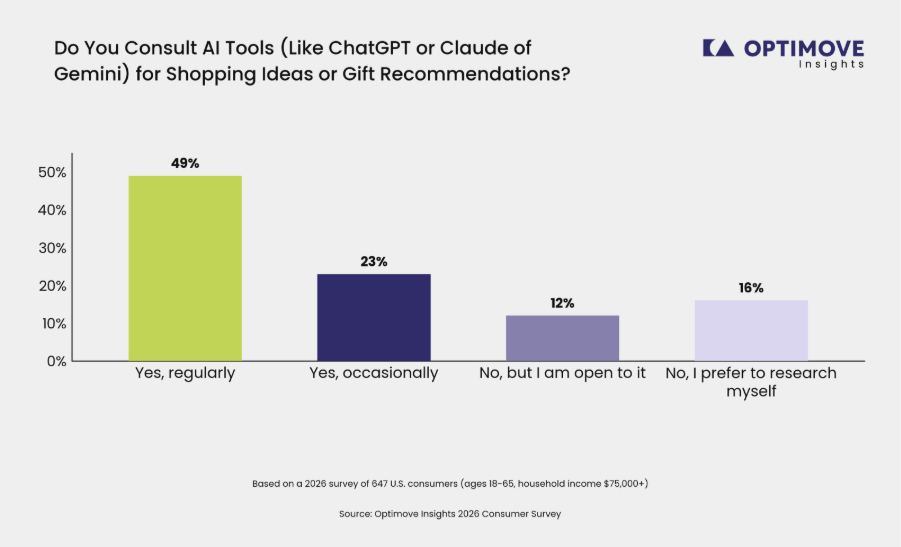
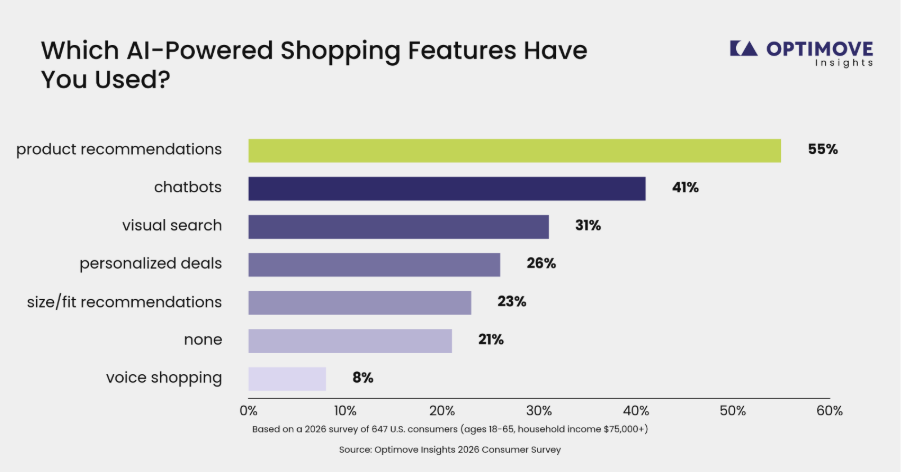
Findings: Seventy-two percent of consumers regularly or occasionally consult tools such as ChatGPT, Claude, or Gemini for shopping ideas and gift recommendations. The product recommendation AI feature was used by 55% of respondents, followed by chatbots at 41% and visual search at 31%.
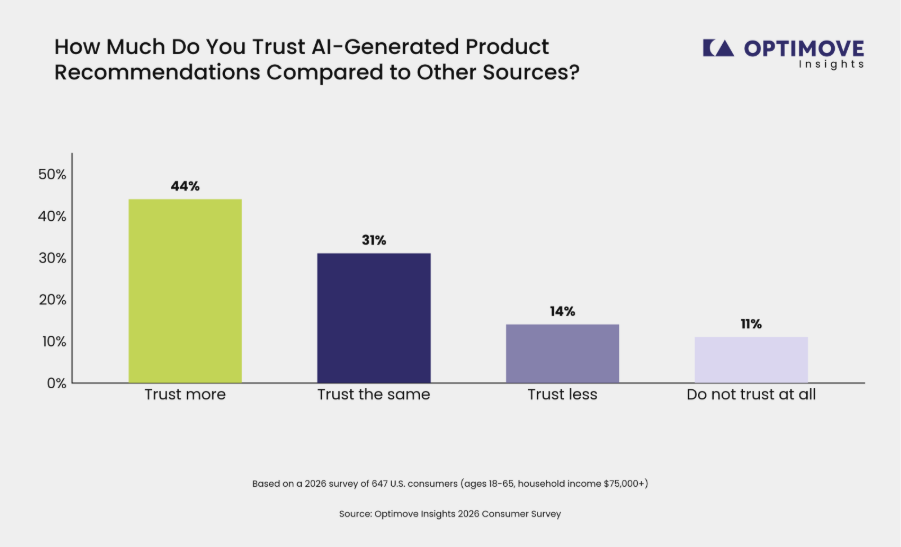
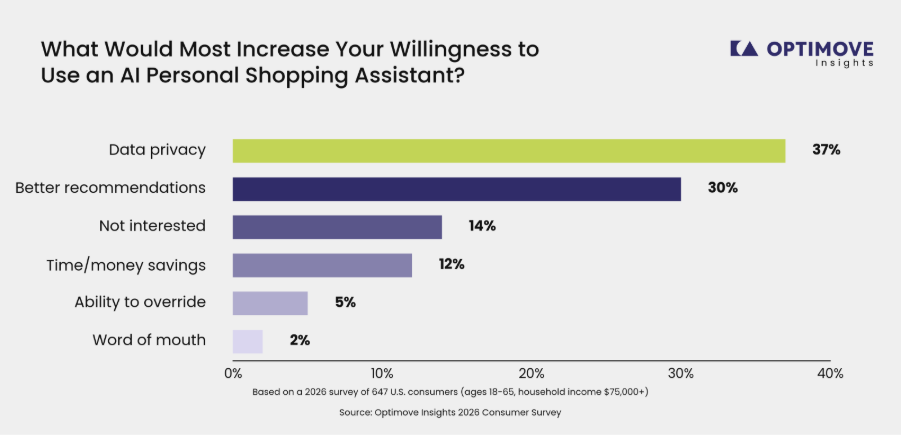
Three-quarters of consumers trust AI-generated recommendations as much as or more than other sources, but data privacy remains the leading factor that could encourage greater adoption, mentioned by 37%.
 Insights
Consumers are already using AI for shopping. Recommendation engines, chatbots, and visual-discovery tools are helping shoppers discover products, compare prices, features, and generate gift ideas. It is making AI an increasingly influential part of holiday consideration.
Trust is relatively strong; however, adoption does not remove the need for credibility: consumers still expect recommendations to be more accurate, relevant, and grounded in their actual needs.
Privacy is the clearest barrier to deeper engagement. This suggests that the next stage of AI adoption will depend less on novelty and more on transparency, usefulness, and responsible personalization.
How Marketers Should Respond
Marketers can use AI to reduce shopping friction through relevant recommendations, gift discovery, conversational assistance, and personalized offers. These experiences may help customers make decisions more easily rather than simply adding another layer.
Brands must also be transparent about how customer data is used and give shoppers confidence that personalization is both secure and beneficial. Clear privacy practices, preference controls, and explainable recommendations can strengthen trust and encourage continued engagement.
The 2026 holiday season combines stronger spending intentions with highly fluid consumer behavior. Family remains the main focus of gifting, but purchase timing can shift toward Black Friday, familiar brands compete with new alternatives, and shoppers define value through quality, service, and price. AI is also becoming part of the decision process, although privacy and relevance will determine how far adoption progresses.
Marketers should plan for a sequence of distinct shopping moments rather than one continuous campaign. Early communications should support discovery and planning, while later activity should respond to signals such as price sensitivity, stock concerns, and delivery urgency. Matching content and incentives to readiness will be more effective than increasing message volume across the entire audience.
Retention and acquisition should also be managed together. Existing customers can be encouraged to expand their spending through personalized recommendations and easier repeat purchases, while prospective customers need clear proof of quality, service reliability, and differentiated value. Discounts can support conversion, but they should reinforce, not replace the brand proposition.
Positionless Marketing provides the operating model needed to execute this approach. By giving teams faster access to customer insights, segmentation, creative activation, and campaign optimization, brands can adapt offers and experiences as behavior changes. The advantage will come from acting on context quickly, while keeping every interaction useful, credible, and appropriately timed.
Optimove, the creator of Positionless Marketing, frees marketing teams from the limitations of fixed roles, giving every marketer the power to execute any marketing task instantly and independently. Positionless Marketing has been proven to improve campaign efficiency by 88%, allowing marketing teams to create more personalized engagement with existing customers.
For two years running, Optimove has been positioned as a Visionary in Gartner's Magic Quadrant for Multichannel Marketing Hubs, recognized for its AI-driven decisioning, prescriptive insights, and proven ability to orchestrate thousands of personalized campaigns in real time across channels.
Its Positionless Marketing Platform includes Optimove Engage and Orchestrate for cross-channel campaign decisioning and orchestration; Optimove Personalize, a digital personalization engine; and Optimove Gamify, a loyalty and gamification platform.
All are powered by Optimove AI, the marketing AI suite that brings AI everywhere marketers work. Inside the platform through Native AI agents for decisioning, analysis, and creation, outside it to external AI tools like Claude and ChatGPT through the Optimove MCP, and into custom-built applications on top of the platform through Optimove Custom Apps. Optimove has embedded AI in its platform since 2012, paving the way for Positionless Marketing.
Today, its comprehensive AI-powered suite is at the leading edge of empowering marketers to streamline workflows from Insight to Creation and through Optimization. Optimove provides industry-specific and use-case solutions for leading consumer brands globally.
Optimove Insights is the analytical and research arm of Optimove, dedicated to providing valuable industry insights and data-driven research to empower B2C businesses.
See how retail marketers in the age of AI are empowered