
Unified Growth Solution
World-class tech needs world-class drivers. AI platform and expert services, unified
Read time 37 minutes


Introduction:
The Marketing Fatigue Report 2026, prepared by Optimove Insights, dove into what actually drives engagement, purchase, and long-term relationships between brands and consumers in an environment defined by complexity, choice, noise, and rising consumer expectations.
Divided into five complementary sections, this report examines how relevance, personalization, loyalty mechanics, channel execution, AI adoption, and data security intersect to shape modern customer behavior and brand performance.
The report begins with: 1) relevance and personalization as foundational drivers of engagement, 2) moves through the mechanics by which loyalty translates into revenue, 3) examines email as both a preferred and fatigue-prone channel, 4) explores the role of AI in shaping trust and purchase behavior, and 5) concludes with data security as a defining pillar of credibility. Each section builds on the previous one, illustrating how these elements function not in isolation, but as a connected system.
Across all findings, a consistent pattern emerges: consumers are not disengaging from marketing itself; they are disengaging from irrelevance, poor timing, repetition, and interactions that feel misaligned with their needs or expectations. Success depends on coordination: aligning data, decision-making, and execution in real time.
When marketing is accurate and clearly beneficial, consumers respond with trust, engagement, and increased willingness to purchase. When it is not, fatigue manifests quickly through inattention, opt-outs, and brand switching.
Optimove surveyed 1,034 customers in November-December 2025, ages 18–65, with household incomes of $75k+
Positionless Marketing reflects the operating shift required to deliver relevance, timing, and personalization at scale.
Consumers do not reward brands for sending fewer messages. They reward brands for sending relevant ones.
This report shows that relevance, not frequency, is the primary driver of purchase intent, trust, and long-term loyalty. When marketing aligns with customer needs and behavior, engagement increases, even as message volume rises. When it does not, value erodes quickly.
Irrelevance and repetition actively destroy value. Customers interpret repeated or generic offers as a signal that a brand is not paying attention. The result is not just annoyance, but disengagement, opt-outs, and lost revenue. Tolerance for irrele-vant messaging does not translate into buying behavior.
Timing is the difference between utility and irritation. Even the right message becomes noise when it arrives at the wrong moment. Poor timing is one of the clearest indicators that customer data is not driving decisions in real time.
The hidden lever most brands miss is coordination. When channels, teams, and messages are not orchestrated together, customers experience duplication, mis-timed offers, and fragmented journeys. Coordination is what turns personalization from intent into impact.
Positionless Marketing is how teams operationalize all of the above. By removing structural bottlenecks and enabling real-time decisioning and orchestration across channels, marketers can act on customer behavior in the moment, delivering relevance at scale without increasing fatigue.
Below are four key findings from this survey:
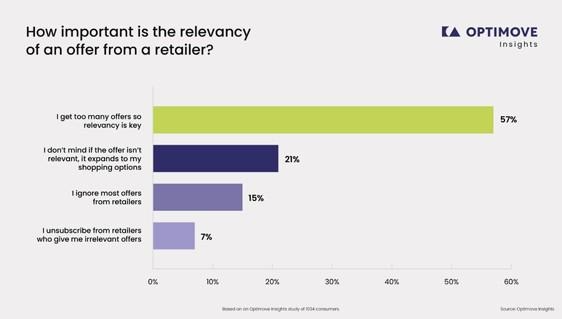
Findings: 57% say relevancy is essential; 21% say irrelevant offers occasionally broaden options.
Findings: 89% buy after multiple relevant offers vs. 65% after irrelevant ones.
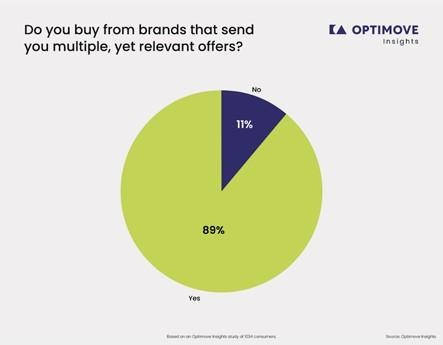
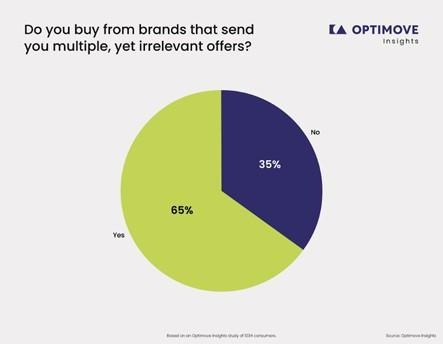
The data in this report show that, although some customers tolerate irrelevant offers (21%), this tolerance does not translate into purchase behavior. The 24% lift in purchase between relevant and irrelevant offers (89% vs. 65%) demonstrates a measurable, meaningful revenue gap.
That difference is real revenue that brands potentially miss out on when they send generic or poorly targeted offers. This reinforces that customers clearly prefer relevant offers, and their purchasing behavior confirms it.
Implementation:
Relevancy must be operationalized, not assumed. Brands should rank all promotions by predicted engagement and purchase likelihood, activating only the most relevant offer for each customer in real-time.
In practice, this requires marketing teams to move beyond calendar-driven campaigns and rigid role-based workflows. When insights, execution, and optimization are separated across teams or tools, relevance breaks down, and generic messaging fills the gap.
Teams that perform best operate with fewer handoffs and greater autonomy. Marketers can act directly on predictive insights, adjust offers as customer behavior changes, and orchestrate messaging across channels without delay.
This shift toward a Positionless Marketing operating model is what enables relevance at scale, allowing teams to respond to customer intent in the moment rather than after it has passed.
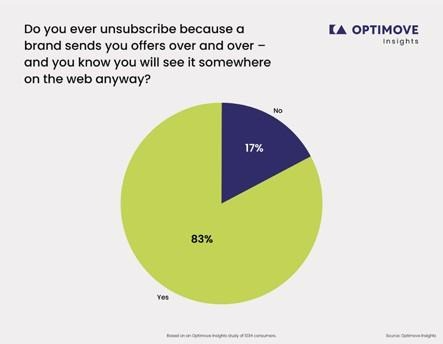
Findings: 83% unsubscribe due to repeated offers because they know they will see them again on additional channels.
Findings: 46% unsubscribe due to repeated promotions.
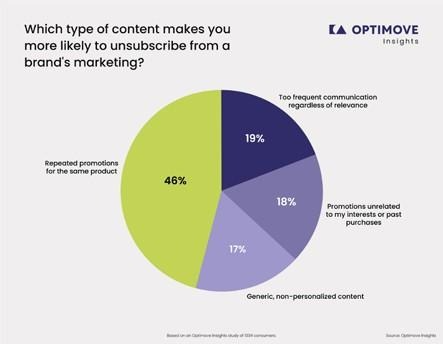
Customers interpret repeated messages as evidence that a brand is not paying attention to their personal preferences. Even valuable offers become noise when delivered without coordination, ultimately creating marketing fatigue and prompting customers to opt out entirely.
Implementation:
Preventing repetition requires more than channel-level controls. Every customer interaction must be coordinated across campaigns and channels so that messages work together rather than compete.
High-performing teams manage this by applying centralized orchestration that governs message prioritization, sequencing, and suppression. Instead of allowing each campaign to operate independently, they define which message takes precedence, when communications should pause, and how engagement on one channel influences outreach on another.
This shift moves teams from reactive cleanup, apologizing for overexposure after it happens, to proactively designing experiences that feel intentional and respectful. Customers receive fewer duplicate messages, clearer narratives, and content that progresses rather than repeats.
When orchestration is in place, customers engage with the right message, on their preferred channel, at the moment of highest impact, without feeling overwhelmed or ignored.
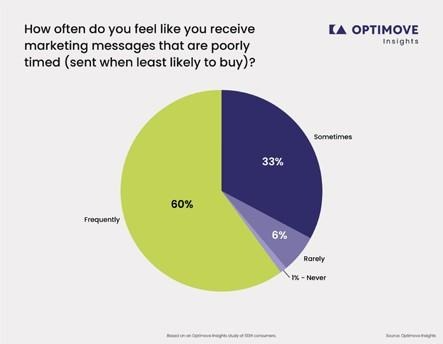
Findings: 93% experience poorly timed messages.
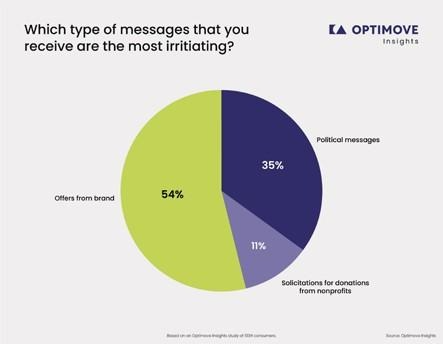
Findings: 54% find offers from brands the most irritating.
Poor timing is one of the clearest signals that a brand isn’t operating with real-time data. Even if the right message loses impact if it arrives at the wrong moment, for instance, after purchase, mid-issue, or disconnected from the original intent.
Irritation spikes when offers feel generic, unaligned with customer needs, and delivered on a fixed cadence. The problem isn’t that consumers hate marketing – it’s that they hate interruptions that add no value. Brands that adapt message frequency and scheduling based on behavioral data can reduce noise and increase relevance.
Implementation:
Effective timing requires marketing teams to move away from fixed schedules and batch campaigns and toward behavior-driven activation. Messages should be triggered by customer actions and context, not by calendar assumptions.
High-performing teams define clear readiness signals, such as recent engagement, purchase completion, or issue resolution, and activate communications only when those signals indicate relevance. Message frequency and timing then adjust dynamically based on how each customer responds.
This approach ensures communications feel contextual and helpful rather than interruptive. When teams can act on behavioral data in real-time and coordinate timing across channels, timing becomes a signal of customer-centricity instead of a source of irritation.
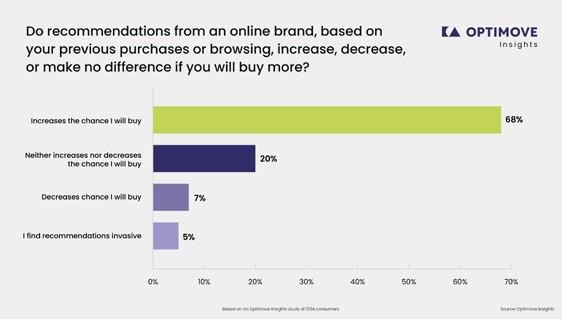
Findings: 68% of respondents say that product recommendations increase their likelihood of buying, while only 12% respond negatively to them.
Findings: 60% view personalization as helpful, while 22% see it as “creepy.”
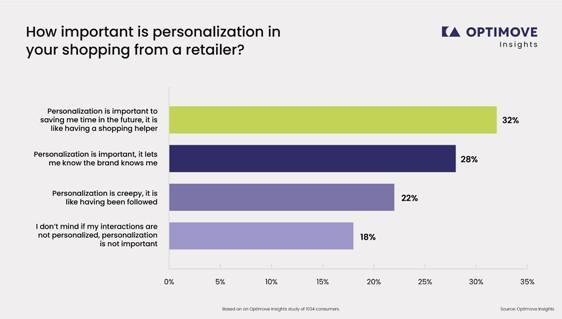
Most consumers find personalization useful when shopping, rather than invasive. This is especially true when it reduces time and effort and improves discovery.
In other words, recommendations work when they emulate live assistance, not surveillance.
The “creepy” segment is the warning label: personalization must be grounded in transparent, consent-based signals and clear value. When personalization feels intuitive, customers reward it. When it feels overly familiar, they withdraw.
Effective personalization starts with intent, not identity. Recommendations should be driven by what customers are actively doing, not by how much data a brand has collected.
High-performing teams design personalization to reduce effort and improve discovery. They rely on recent behavior, contextual signals, and demonstrated preferences to guide recommendations, ensuring each interaction feels helpful rather than intrusive.
To avoid crossing the “creepy” line, personalization should evolve progressively. As customers engage, recommendations become more specific. When engagement slows or context changes, personalization pulls back accordingly.
When personalization is orchestrated this way across channels, it feels like assistance that adapts in real time, strengthening trust while accelerating the path to purchase.
Marketing fatigue isn’t caused by too much marketing. It’s caused by marketing that ignores context, intent, and timing.
This report makes it clear: consumers reward relevance, not restraint. Repetitive, irrelevant messages erode trust and destroy value. Poor timing turns even great offers into interruptions. And personalization only works when it feels helpful, not invasive.
At the root of these failures isn’t a lack of data or technology. It’s a lack of coordination. When insights, execution, and optimization are split across teams, channels, and workflows, relevance breaks down. Generic messaging fills the gaps, and customers tune out.
The best-performing brands operate differently. They treat relevance as a real-time decision—not a campaign attribute. They let customer behavior dictate timing, frequency, and content. And they orchestrate every interaction, so messages build on each other instead of competing for attention.
That demands a shift in how marketing teams work. Fixed roles, sequential handoffs, and calendar-first campaigns are too slow for customers who expect responsiveness in the moment. Teams need to act directly on insight, adapt fast, and coordinate experiences across channels without friction.
Positionless Marketing reflects this shift. By removing barriers between insight and action, it enables relevance at scale and turns customer intent into measurable growth.
Loyalty has the power to drive sales when fueled by relevant, accurate communication
Loyalty in the digital era is neither automatic nor unconditional. This research shows that consumers actively choose the brands they remain loyal to, while loyalty does not exist in isolation; consumers expect brands to reciprocate their interest through relevant communication, meaningful offers, and consistent presence. Loyalty emerges as a two-way relationship sustained by both consumer intent and brand responsibility.
The findings also clarify the commercial impact of loyalty. Familiar brands benefit from reduced friction, higher confidence, and faster conversion, positioning loyalty as a direct driver of sales rather than a soft engagement indicator. When trust and familiarity are established, purchase decisions become simpler and more resilient.
Discovery remains a defining feature of digital behavior, but curiosity rarely translates into immediate purchasing. Conversion depends on multiple factors such as price, experience, and relevance, delivered consistently over time through well-orchestrated, personalized, and timely communication.
Communication volume is not a substitute for relevance. Excessive messaging actively undermines trust, while fewer, more targeted interactions accelerate loyalty.
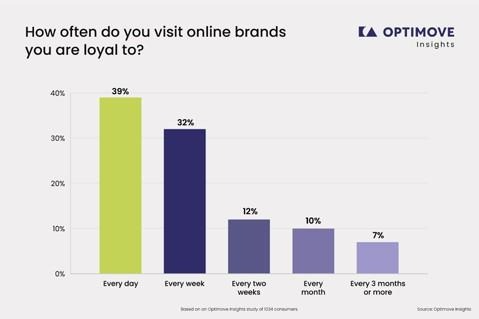
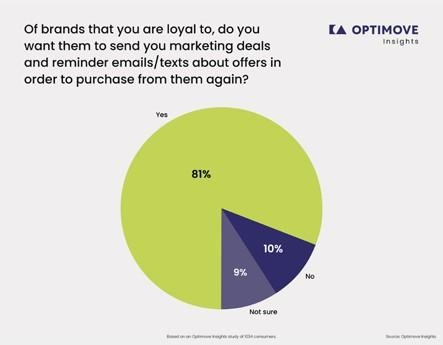
Findings: Loyal consumers demonstrate strong, self-initiated engagement, with 71% visiting brands they are loyal to every day or weekly. At the same time, 81% want those brands to actively send relevant deals and reminders, signaling that loyalty is reinforced through ongoing communication.
Interpretation:
Loyalty is not a static state, but an active relationship maintained both from the consumers’ side and the brand’s side. Frequent, spontaneous visits indicate that loyal customers are proactive, driven by accumulated value across experience, pricing, product relevance, and trust. This behavior reflects genuine autonomy rather than a simple reaction to the brand’s pushes.
On the other hand, consumers explicitly expect brands they trust to remain present through helpful, timely communication. The desire for reminders and offers suggests that loyalty thrives when brands consistently reinforce relevance, not when they assume affinity will persist on its own.
Implementation Approach:
Brands must treat loyalty as a two-way system that balances consumer-driven engagement with brand-led reinforcement. This requires aligning shopping experience, value, and product relevance with a communication strategy that delivers accurate, consistent, and timely messages. When brands actively support the relationship without overwhelming it, loyalty becomes durable, intentional, and self-sustaining.
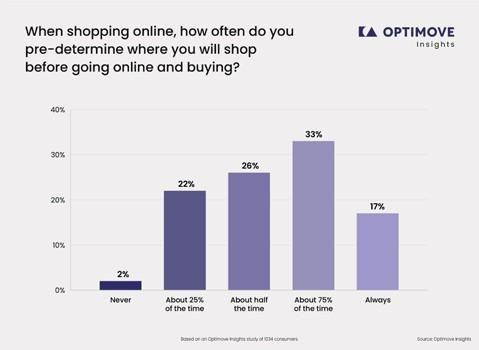
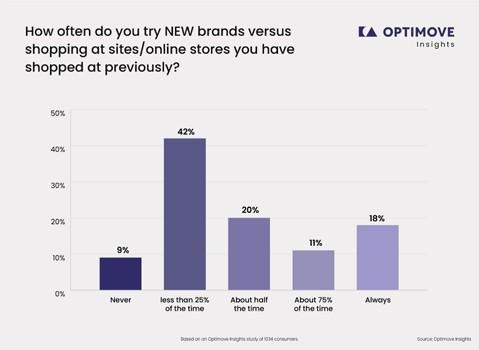
Findings: Most consumers enter shopping journeys with a brand already in mind, with 76% pre-determining where they will shop about half of the time or more. In addition, 51% try new brands about 25% of the time or less, signaling a strong preference for familiar retailers when making purchase decisions.
Interpretation:
The data indicates that loyalty plays a decisive role in where sales ultimately land. When consumers pre-determine where they will shop, competition effectively ends before the browsing session begins.
This behavior also explains why experimentation with new brands remains limited. While consumers may explore alternatives, the majority default to brands they already know and trust. Familiarity reduces perceived risk, simplifies decision-making, and accelerates conversion, making loyalty a powerful revenue driver rather than a soft engagement metric.
Implementation Approach:
To capitalize on loyalty-driven sales, brands must focus on sustained salience and consistency across the customer journey. This includes reinforcing brand value outside transactional moments, maintaining reliable experiences, and delivering communication that keeps the brand top of mind, sending relevant offers and information to the consumer. When loyalty is actively maintained, consumers’ purchasing decisions tend to be more assured.
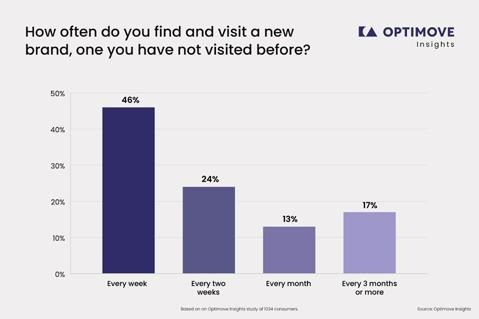
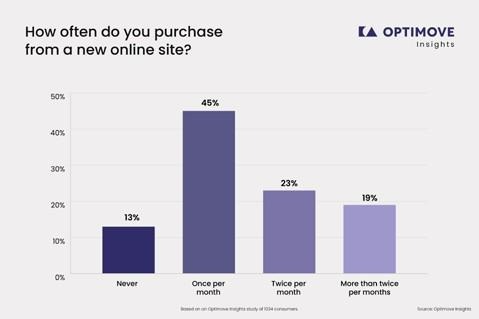
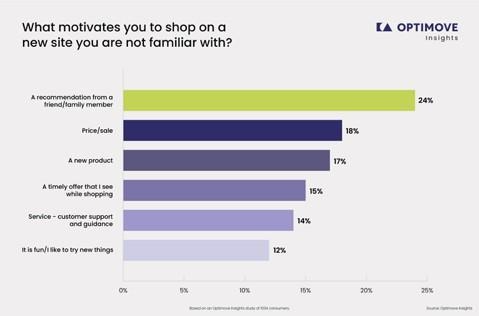
Findings: Consumers actively discover new brands, with 46% visiting a new brand every week, yet purchasing remains infrequent, with 58% buying from a new site only once per month or never. The main factors that lead people to try unfamiliar brands are almost evenly divided between promotions, timely offers, novelty, and good brand support, totaling 64% of responses.
Interpretation:
The gap between discovering new brands and actually buying them highlights a clear conversion barrier: consumers are willing to browse unfamiliar brands, but they commit cautiously and over time, with the right stimulus.
No single factor dominates the decision to try a new brand. The near-even distribution across promotions, timely offers, product novelty, and customer support indicates that conversion depends less on a single trigger and more on the cumulative perception of value, credibility, and reassurance delivered across multiple touchpoints.
That is why behavioral data is so important. Brands can ensure each message will be perfectly aligned with consumers’ interests, orchestrating relevance across every promotional, experiential, or service-driven interaction to contribute to a coherent trust-building journey.
Brands should approach acquisition as a staged trust-building process rather than a one-time conversion event. This requires orchestrating relevant, timely, and consistent communication that reinforces value beyond the first interaction. Consistency and coordination between campaigns can accelerate confidence, shorten the path from discovery to conversion, and transform fragmented interactions into a unified brand experience.
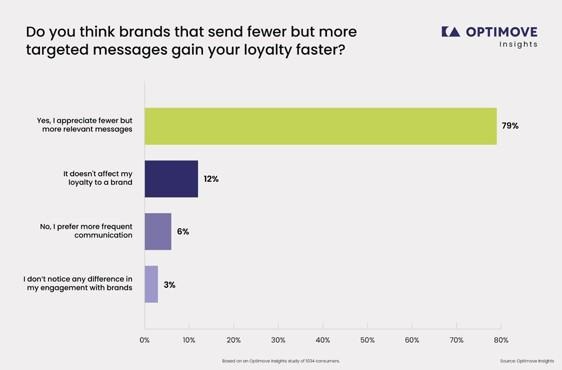
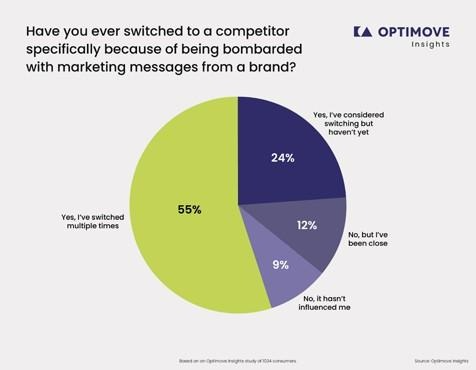
Findings: Message overload has tangible consequences, with 55% of consumers switching brands multiple times due to marketing bombardment, and an additional 24% considering switching. In contrast, 79% say brands that send fewer but more targeted messages gain their loyalty faster.
Interpretation:
Excessive communication is not a neutral inefficiency; it actively erodes brand relationships. When messaging prioritizes volume over relevance, consumers interpret it as a disregard for their preferences and attention. Switching behavior in this context becomes a rational response to protect time, focus, and a clear message to brands that insist on this kind of strategy.
The preference for fewer, but more relevant, personalized, and timely messages highlights what loyalty actually responds to. Consumers reward brands that demonstrate restraint, contextual awareness, and relevance. Loyalty accelerates when each interaction consistently proves that the brand understands the consumer’s needs and intent.
Implementation Approach:
Brands must shift from volume-driven outreach to relevance-led orchestration across all touchpoints. This requires unified decision-making that governs when not to communicate as deliberately as when to engage. By applying Positionless Marketing principles to control frequency, context, and personalization centrally, brands can replace noise with meaning and transform communication into a sustained loyalty driver rather than a source of churn.
These insights redefine loyalty as an active and consequential relationship. Consumers are not resistant to engagement, discovery, or personalization; they are resistant to noise, irrelevance, and perceive disregard for their time and preferences. Loyalty forms where brands consistently prove their value and their capacity to understand their customers and build a long-term exchange with them.
The data makes clear that loyalty concentrates demand and drives sales long before a transaction occurs. Brands that earn a place in consumers’ mental shortlist benefit from it, but to assume loyalty will persist without reinforcement risks accelerating disengagement.
Equally important is the path from discovery to conversion. Loyalty requires time, consistency, and accurate communication that reinforces relevance at every touchpoint. Each interaction either shortens or extends the distance between curiosity and commitment.
In this context, Positionless Marketing is not an optimization layer; it is a structural necessity. By removing silos between data, decision-making, and execution, brands can orchestrate relevance across channels, moments, and messages.
When communication becomes intentional rather than excessive, loyalty becomes a durable competitive advantage.
Why data-driven relevance, personalized cadence, and customer choice determine whether email becomes a high-performing channel.
Optimove Insights’ 2025 Marketing Fatigue Report on Email uncovers a striking contradiction at the heart of customer communication. Customers identify email as the channel most likely to capture their attention. It remains their preferred way for brands to connect with them, outperforming SMS, social ads, push notifications, and in-app messages.
Yet it is also the channel most likely to create fatigue and drive unsubscribes, not because customers dislike email, but because it often fails to deliver highly relevant, interest-based messaging.
This is exacerbated during peak shopping periods such as holidays or major retail events, inbox competition increases dramatically, making segmentation and relevance critical to avoid being ignored, marked as spam by sophisticated email service providers, or unsubscribed from.
Overall, this research shows that email remains a powerful channel, but poor execution can quickly erode that advantage. Using a Positionless Marketing approach, where messages adapt to each individual, brands can transform email from preferred to consistently high impact. This requires balancing behavioral personalization with segmentation to avoid over-contacting disengaged users and to protect long-term deliverability.
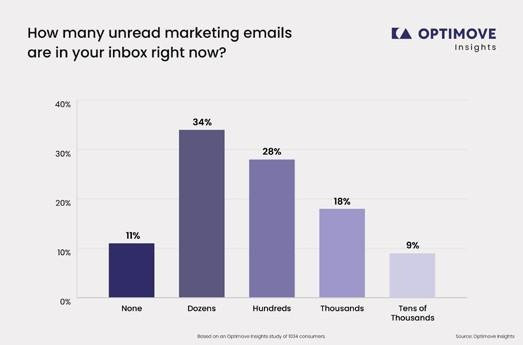
Finding: Email is the most preferred digital marketing channel, chosen by 60% of consumers. Yet only 11% report having no unread marketing emails, signaling that brands can be under-delivering on the elements consumers care about the most: relevance.
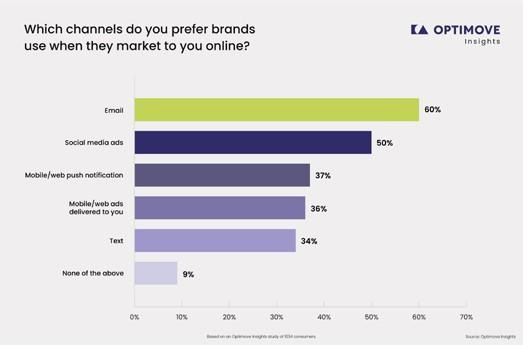
60% of Consumers indicate email as their preferred channel, outperforming social media ads (50%), push notifications (37%), and SMS (34%). However, inbox behavior indicates that 89% accumulate from dozens to thousands of unopened messages, indicating that preference alone does not guarantee engagement.
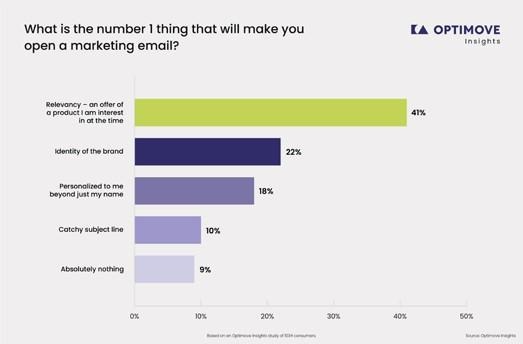
Relevance emerges as the main behavioral trigger. 41% percent say that receiving an offer tied to a product they have shown interest in is the number one factor that would make them open an email, while 18% value deeper personalization.
Implementation approach:
Brands should shift from maximizing email volume to maximizing relevance. Use behavioral and intent data to align content with real interests, recently viewed products, and active shopping signals. Trigger emails dynamically using precise segmentation and personalize beyond the surface to ensure messages consistently reflect what matters to each customer.
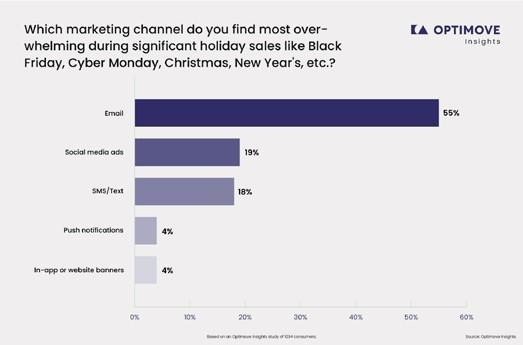
Finding: Email ranks both as the most (35%) and the least (40%) attention-grabbing channel. During peak shopping moments, 55% of consumers find email the most overwhelming channel.
While email leads as the channel most likely to catch attention, it also leads as the least likely to do so. This alleged contradiction can be an indicator that some consumers are still being oversaturated with too many irrelevant messages (as seen in section 1), while some may simply be receiving marketing messages on a channel they don’t prefer, and therefore it doesn’t catch their attention.
The oversaturation problem becomes especially visible during holidays (and other high-volume times of the year), as 55% of consumers say email overwhelms them, a number almost identical to the one that reports preferring email in the first place.
Generic, poorly segmented, repetitive, irrelevant messages can fill inboxes quickly, making it harder for high-quality messages to stand out.
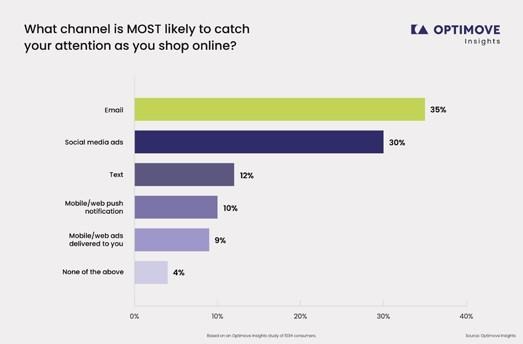
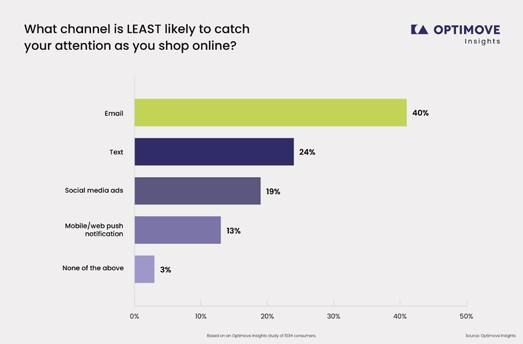
Email continues to be the preferred channel overall, but without personalization and segmentation of messages based on behavioral-driven triggers, brands risk losing visibility precisely when consumers are most ready to shop.
Implementation approach:
Preference or attention is not determined by email (or any channel) alone, but by the relevance of the message within it. Brands should personalize everything, using behavioral signals to tailor the best segmentation, timing, type of content, tone of message, and channel mix to each customer.
By distributing relevance, not just volume, across channels, brands maintain attention while reducing fatigue, decreasing inbox placement, and avoiding spam filtering.
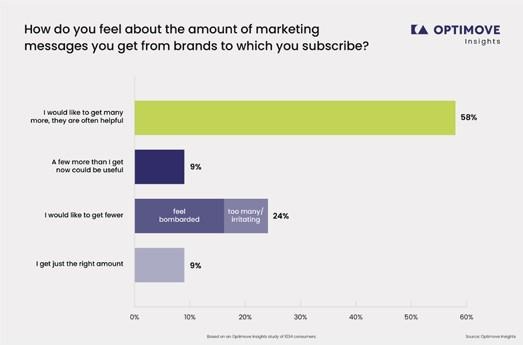
Finding: Among consumers who subscribe to brand communications, only 24% would unsubscribe due to receiving too many messages. In contrast, 58% say they would like to receive even more, because they find the messages useful.
The majority of opted-in consumers would welcome more communication, indicating that the subscription itself acts as a permissioned channel where customers expect ongoing, helpful contact. The minority who feels overwhelmed even when receiving relevant messages indicates that frequency tolerance varies by customer, and brands must also personalize cadence based on engagement signals rather than applying uniform frequency rules.
Achieving this level of personalization allows email to act as an ongoing conversation rather than a series of sales pushes, strengthening the customer’s sense of being seen and understood.
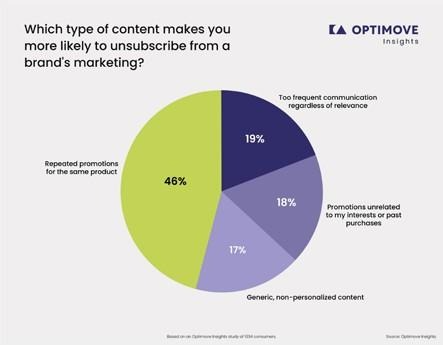
As the data show, most consumers disengage primarily when content becomes repetitive or misaligned, with 46% unsubscribing after seeing the same promotions repeatedly, 17% due to generic, non-personalized messaging, and 18% because of promotions not related to their interests.
Implementation approach:
In a nutshell, too-frequent communication or irrelevant messages can be mitigated by tailoring both the volume of messages and the type of offers each person receives, driving stronger engagement.
Users are more likely to engage when the interaction with the brand transforms into a highly individualized conversation. When they perceive that a relationship is being created between them and the brand, they are less likely to opt out, as they recognize that the brand sees them as individuals and not just one among thousands of customers. The bottom line is that every interaction should not be a transaction – instead, another step in deepening a relationship**.**
Finding: 59% of consumers would use a “message pause” feature immediately, and another 31% would use it occasionally. Meanwhile, 92% want the ability to decide the frequency and type of marketing messages they receive.
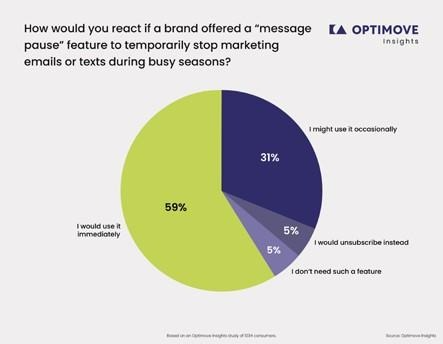
These results show that consumers do not simply want more or fewer messages; they want control. The strong interest in a temporary pause option signals a desire for flexibility, especially during busy seasons when attention is limited. Rather than unsubscribing, most consumers prefer tools that let them regulate the flow of communication without ending the relationship entirely.
At the same time, the overwhelming majority want to set their own frequency
and content preferences, reinforcing that marketing success increasingly depends on self-personalization. Consumers want brands to meet them halfway: use behavioral data to understand when communication should increase or decrease, while also allowing individuals to fine-tune cadence and content based on their own comfort levels and interests.
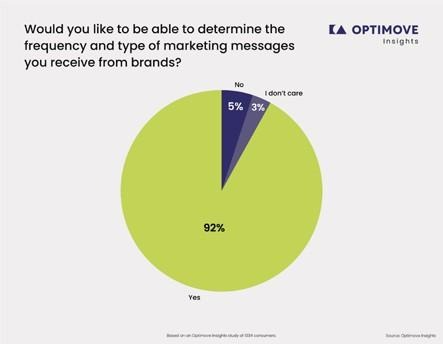
In practice, customers are demanding a shift from brand-led communication to consumer-led communication. This is perfectly aligned with the core principles of Positionless Marketing, where customer behavior and needs, not channels or schedules, dictate the strategy.
Implementation approach:
Brands should combine behavioral intelligence with consumer-driven controls. Use engagement data to anticipate when to scale messaging up or down, while offering features like frequency selectors, content preferences, and pause buttons. By aligning brand-driven personalization with consumer-driven choice, brands reduce email (marketing) fatigue and strengthen trust through respectful, adaptive communication.
Across all insights, one theme remains consistent: consumers prefer email as their primary marketing channel, but engagement depends entirely on relevance. Preference alone does not guarantee attention; inboxes are saturated, and customers increasingly tune out anything that feels generic or mistimed. The strongest behavioral trigger for opening a message is alignment with current interests, reinforcing that brands must use data to tailor content, timing, and context if they want to maintain visibility in cluttered environments.
Equally important is the understanding that subscribers are not fatigued by communication itself; they are fatigued by poor communication. While 58% of subscribers would welcome even more messages because they find them helpful, they unsubscribe when content becomes repetitive, non-personalized, or irrelevant.
Frequency tolerance varies by customer, and using engagement data to calibrate the right cadence is essential. The risks of retention come not from sending “too much,” but from failing to evolve messaging in line with each individual’s behavioral patterns and expectations.
Consumers are also signaling a strong desire for control. Most say they would use a “message pause” option, and an overwhelming 92% want the ability to choose the frequency and type of messages they receive. This shift toward self-personalization means brands must blend intelligent automation with consumer autonomy, allowing people to regulate their own experience while brands dynamically adjust content and cadence through behavioral insights.
By segmenting audiences thoughtfully and layering hyper-personalized content, recommendations, and storytelling, brands create emails that are individualized and conversational rather than transactional or intrusive.
The winning strategy is not more messages or fewer messages, but the right messages at the right moment, to the right person or group, delivered with respect for both data and consumer choice.
Understand how AI-driven Marketing is directly influencing consumer trust and purchasing behavior.
Optimove Insights’ 2025 Marketing Fatigue Report reveals a clear pattern: consumers are broadly comfortable with AI in marketing. Across multiple indicators, shoppers say they feel very positive about brands using AI, trust them more, and recognize the value of improved recommendations and personalized experiences. Awareness of AI usage is high, yet distrust remains low, demonstrating that AI is not a barrier to engagement.
Where concerns do arise, they stem from poor execution rather than technology. Privacy fears, over-personalization, irrelevance, or loss of human connection emerge only when AI crosses into intrusive or unhelpful territory. Overall, for most brands, AI becomes a trust-building tool when it enhances accuracy, supports discovery, and respects boundaries.
This research shows that AI-powered personalization is a powerful advantage, especially when deployed thoughtfully. When AI acts on real-time signals and adapts communication to each individual, brands can ensure relevance at every touchpoint while avoiding intrusive moments. To carefully guide AI in the marketing stack requires that human marketers manage the system. IT underscores the importance of a marketer being Positionless where they are able to manage a marketing program end-to-end, including data analysis, creative execution, and optimization.
For more insights about AI tools that can be used in marketing, please see our AI Marketing tools section of the Optimove website (click to visit site).
Finding: A striking 87% of respondents believe they can tell when a company uses AI in marketing. Yet this alleged awareness does not generate backlash, as 57% say they strongly trust and 17% trust to some extent in brands using AI in their marketing strategies. Only 5% strongly distrust brands using AI.
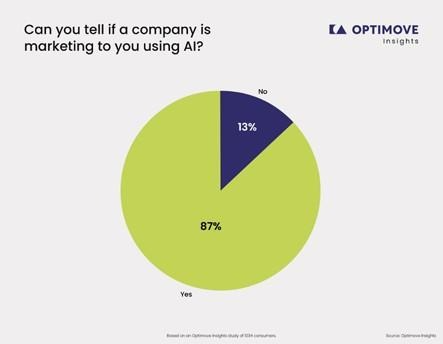
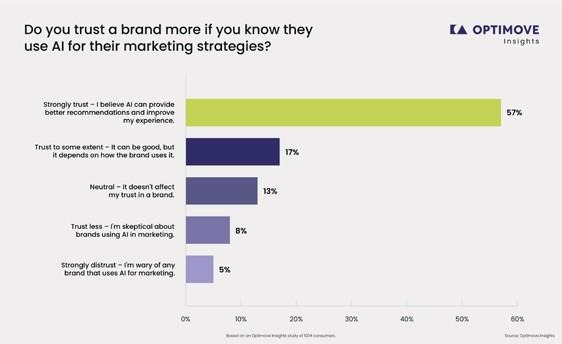
This suggests consumers aren’t worried about the presence of AI, only how it’s applied. If the shopper feels AI is improving the shopping experience, delivering better recommendations, faster solutions, and more relevant content, AI becomes a trust-building asset rather than a trigger for suspicion.
Effective, helpful applications drive confidence and strengthen relationships, and transparency around AI usage is considered beneficial. Trust rises when shoppers perceive AI as enhancing their decision-making rather than replacing human judgment.
Implementation approach:
Brands should be transparent about AI use while continually improving the quality of AI-driven experiences. Prioritize models that produce visibly better recommendations and more relevant messaging, reinforcing the value shoppers gain from AI. By ensuring applications are helpful, accurate, and aligned with customer intent, brands can convert awareness into trust and deepen loyalty across segments. And for those consumers who are skeptical or distrustful, empower them to control AI to improve the personalization and security of their data.
Finding: The majority of consumers respond positively to AI-driven marketing.
55% of the respondents feel very positive about companies that use AI to market to them, 56% feel very positive about AI-driven personalization because it enhances their shopping experience, and 57% say they trust brands more when they use AI
to communicate effectively
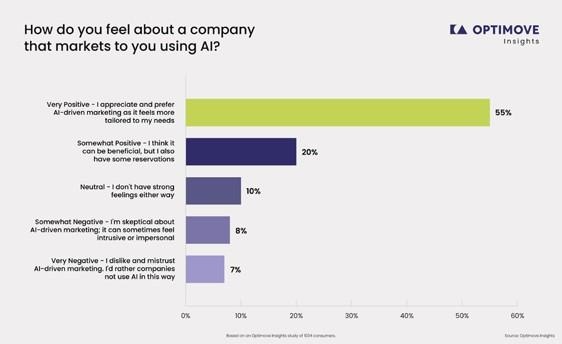
Consumers view AI as a value driver rather than a risk factor, especially when it delivers more accurate offers, better timing, and tailored content to their needs. Groups that show hesitancy (the 26% that fall into the “somewhat positive” or “somewhat negative” categories), primarily do so when AI-powered messages feel off-target or unhelpful.
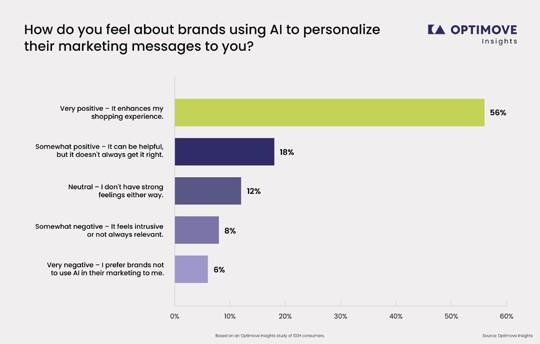
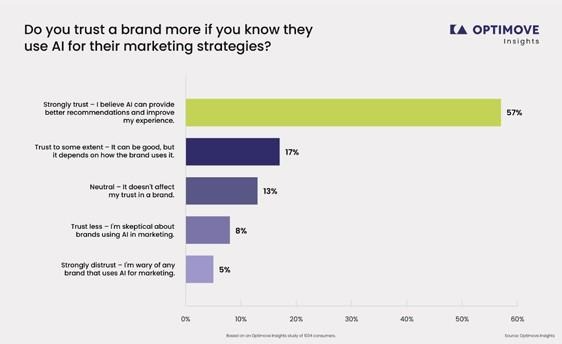
This indicates that ambivalence toward AI is rooted not in the technology itself, but in the quality and relevance of the marketing it produces.
When AI elevates personalization through precise segmentation, behavioral understanding, and improved message timing, consumer trust and positive sentiment rise.
Implementation approach:
Brands should always look for strong and trustworthy AI platforms that can effectively enhance marketing quality through personalization and relevance. Use behavioral data to refine segmentation, align timing with intent signals, and
improve the accuracy of personalized offers. When AI is used to leverage the relevance of messages, improve segmentation and timing, consumers become more trusting, satisfied, and open to buy.
Finding: Nearly three-quarters of consumers have made purchases influenced by AI. Seventy-three percent (73%) report buying either “many times” (54%) or “a few times” (19%) based on AI-generated personalized suggestions, which feel “right on the spot”.
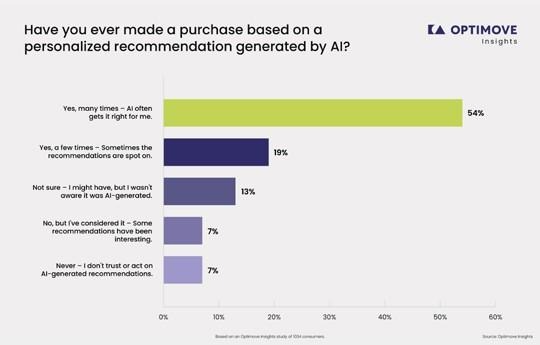
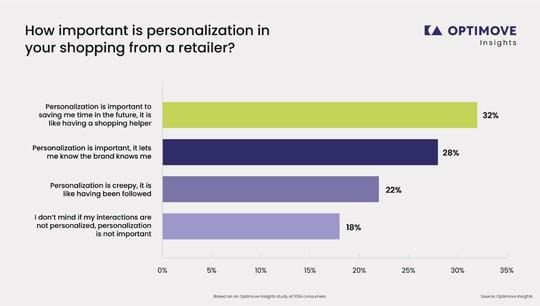
Given that 32% say personalization helps them save time and 28% feel it shows the brand “knows them,” AI personalization is not only shaping consumer sentiment; it is helping to convert both convenience and emotional seekers into buyers.
These data explain why only a minority rejects or distrusts AI recommendations. Consumers who perceive suggestions as timely, accurate, and aligned with their needs are significantly more likely to purchase and increasingly trust AI.
Implementation approach:
AI helps brands accurately meet customer needs. Use it (and make clear that you are doing so) to increase consumer trust. Use interaction across brand channels to constantly refine recommendations and show consumers that their preferences are at the heart of all your brand efforts.
Finding: Top worries include data privacy (34%), over-personalization (24%), inaccuracy (18%), and loss of human connection (16%).
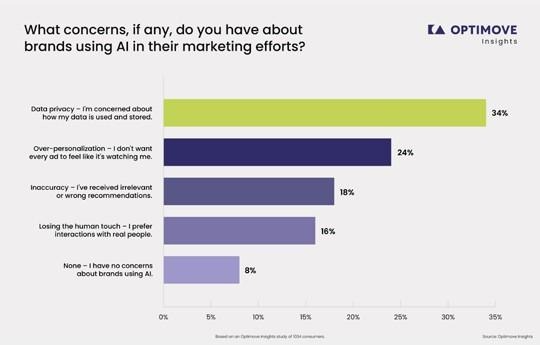
As with most technologies, AI isn’t the source of consumer discomfort; poor use by marketers causes discomfort. These concerns show that skepticism emerges when AI steps into the “creepy” or “careless” zones, using data without clarity, recommending irrelevant items, or acting overly intrusive. When cross-referenced with trust and purchase data, the picture is clear: consumers are open to AI when it stays firmly in the “helpful” zone.
AI can deepen human-like connections, reflecting values such as empathy, respect, and user control rather than just selling. Personalization must extend beyond hyper-targeted recommendations to include respectful frequency, message tone, and even the option for lighter-touch interactions.
Implementation approach:
AI is all about creating value without overstepping boundaries. Prioritize transparent data practices, calibrate personalization to avoid intrusive moments, and refine models to eliminate irrelevancy and build conversations over pushing sales. Offering consumers the possibility of choosing how they want marketing to be tailored is an opportunity for deeper personalization. By grounding AI in usefulness, respect, and choice, brands maintain trust while maximizing the benefits of intelligent personalization.
Across all metrics, AI in marketing is not a threat but an opportunity. Most consumers believe they can recognize AI usage, yet this awareness does not reduce trust; instead, trust increases when AI improves relevance and usefulness. Positive sentiment is highest when AI clearly enhances the shopping experience.
This confidence carries into behavior. Nearly three-quarters of shoppers have purchased based on AI recommendations, reflecting the power of accurate, timesaving, and personally meaningful suggestions. When AI feels helpful and aligned with intent, consumers feel understood. Concerns about privacy, over-personalization, or irrelevance arise only when execution fails, not because AI is inherently unwelcome.
The evidence shows that comfort with AI depends on responsible, high-quality implementation. Technology alone does not create value; the way brands use it does.
Positionless Marketing ensures that AI-driven insights translate directly into action, enabling marketers to respond to intent signals immediately rather than in batch cycles or rigid campaign calendars.
When AI supports relevance, respects boundaries, and delivers genuine utility, consumers respond with trust, engagement, and loyalty. Marketers must ensure AI is applied with usefulness, respect, and choice at its core.
Data control, transparency, and well-executed personalization shape trust in modern digital brand relationships
This research shows that consumers trust digital brands when they feel their data is handled responsibly and under their control. Across the findings, consumers consistently signal that control over their personal information is not optional; it is a baseline expectation.
Perceived misuse of personal data, and moments where personalization feels invasive are major triggers for disengagement and distrust. When brands demonstrate respect for boundaries, transparency, and user choice, confidence in digital interactions increases and engagement becomes more intentional and resilient.
Ultimately, personalization succeeds when it reinforces trust rather than undermining it. Consumers want relevant, timely experiences, but only when accompanied by visible control, clear rules, and respect for privacy. Brands that embed data transparency, preference management, and restraint into their engagement strategies position data use as a service, not a liability. In doing so, they transform data security and trust from risk factors into durable drivers of long-term reliability.
Delivery of these expectations requires more than better tools or internal policies; it requires an operating model that removes silos between data, decision-making, and execution. This is where Positionless Marketing enables brands to act on trust signals in real time, ensuring data is used responsibly, consistently, and with clear consumer benefit.
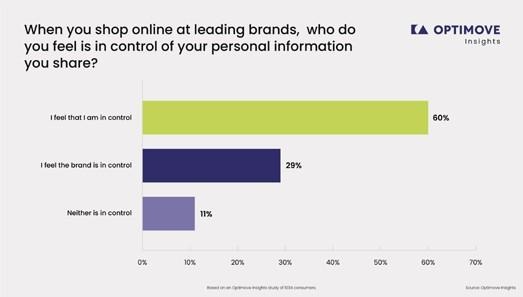
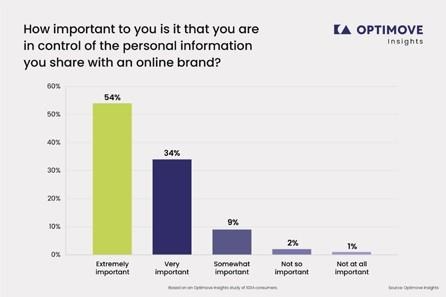
Findings: The majority of consumers (60%) feel they are personally in control of the personal information they share, while 88% say that being in control of this kind of data is extremely or very important.
This expectation of control extends to personalization of communication: 92% want the ability to determine the type and frequency of marketing messages they receive.
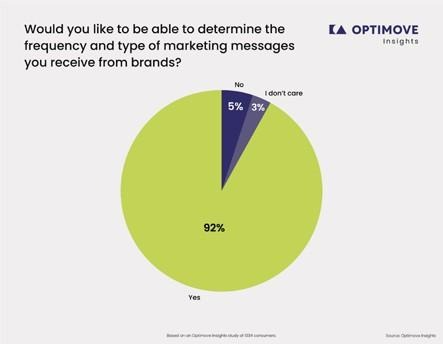
These findings indicate that data control is no longer a niche privacy concern; it is a core expectation shaping how consumers evaluate brands. Feeling “in control” functions as a trust signal, reinforcing confidence in digital interactions and reducing anxiety around data usage. When consumers believe agency sits with them rather than the brand, engagement feels safer and more intentional.
Importantly, control does not mean disengagement. Consumers are not rejecting personalization; they are asking for personalization that visibly respects their boundaries. The strong desire to manage message frequency and type shows that autonomy is a defining component of a positive personalization experience.
Implementation Approach:
Brands should treat control as a feature, not a compliance checkbox. Build personalization strategies that clearly surface preference management, communication controls, and data transparency within the customer experience.
When personalization actively demonstrates respect for choice by adapting to stated preferences and honoring limits, it reinforces trust while maintaining relevance and long-term engagement
Findings: An overwhelming 89% of consumers say they have unsubscribed from a brand because they felt their personal information was being misused.
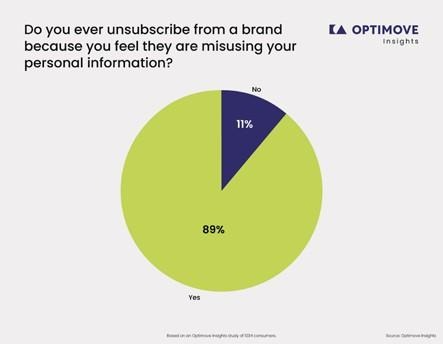
The data makes clear that perceived data misuse is not a marginal issue; it is a direct and powerful driver of disengagement. Consumers are actively monitoring how brands handle their information, and when trust is breached, the response
is swift and decisive. Unsubscribing becomes a protective action, signaling that relevance alone cannot compensate for perceived overreach or carelessness.
Importantly, this reaction is rooted in perception as much as reality. Even well-intentioned personalization can trigger backlash if it feels opaque, excessive, or poorly explained. When consumers sense that brands prioritize data extraction over respect and transparency, the relationship quickly shifts from engagement to avoidance.
Implementation Approach:
Brands must treat data trust as foundational to retention, not secondary to performance metrics. Clear communication about how data is used, visible safeguards, and consistent delivery of genuinely helpful experiences are essential.
Findings: While 68% of consumers say personalized recommendations increase their likelihood of buying, 85% report that brand marketing has felt invasive either often or intermittently.
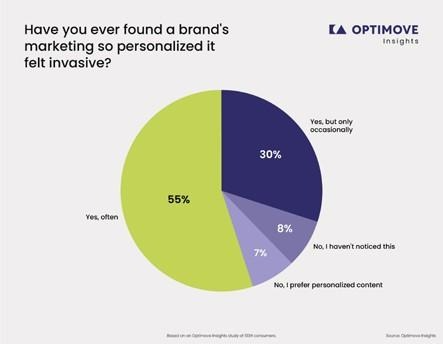
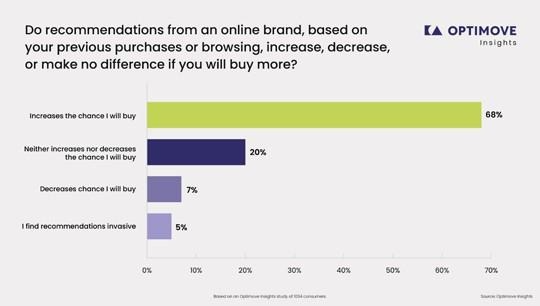
There is a clear tension at the heart of personalization. Consumers value relevance, accuracy, and convenience (evidenced by the strong lift in purchase intent
driven by personalization), but when personalization reveals an excessive level of awareness, it can shift from helpful to uncomfortable.
When brands demonstrate how much they can infer rather than how well they can serve, personalization begins to resemble surveillance. This reframing erodes trust, even among consumers who otherwise appreciate tailored experiences, making restraint as important as sophistication.
Implementation Approach:
Brands should design personalization to feel intuitive, not omniscient. Prioritize usefulness, timing, context, and relevance, while avoiding signals that expose details that seem invasive. By deliberately calibrating what is personalized and what is left implicit, marketers can maintain the value of personalization without crossing the line into perceived overreach.
Findings: Data privacy is the leading concern among consumers evaluating AI in marketing, cited by 34% of respondents, well ahead of over-personalization (24%) and inaccuracy (18%).
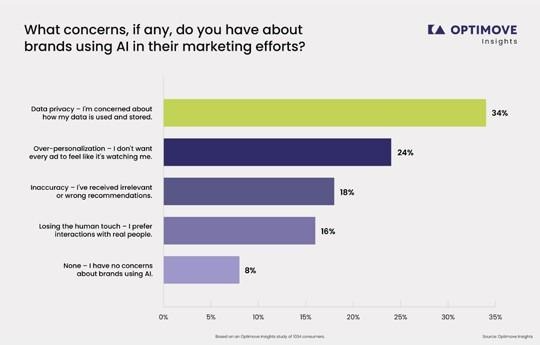
Consumer anxiety around AI is fundamentally rooted in how data is handled, not in the technology itself. Privacy concerns outweigh fears of relevance errors or loss of human connection, signaling that trust hinges on data stewardship before
experience enhancement. AI adoption is accepted, but only when it operates within clearly perceived boundaries.
Notably, secondary concerns such as over-personalization and inaccuracy are also data-related at their core. When personalization feels excessive, or recommendations miss the mark, consumers often interpret these moments as evidence of careless or opaque data use. Privacy, therefore, acts as the lens through which all AI-driven interactions are judged.
Implementation Approach:
Brands must anchor AI strategies in transparent, responsible data practices. Clearly communicating how data is collected, stored, and applied helps establish confidence. When privacy is treated as a foundational design principle rather than a regulatory afterthought, AI becomes a trust-building asset.
Trust in digital brand relationships is driven by how responsibly data is handled. This research shows that consumers are not resistant to personalization; rather, they are highly attuned to whether it operates within clearly perceived boundaries.
The findings also make clear that disengagement is rarely accidental. Perceived data misuse and the feeling of being invaded actively push consumers away.
These reactions are rooted in perception as much as intent, reinforcing that trust is shaped by how data use feels to the consumer, not only by how it is justified internally. Brands that fail to manage this perception risk turn personalization from a growth lever into a liability.
Ultimately, trust is sustained when personalization behaves like a service rather than a surveillance system. Brands that prioritize user choice, transparency, and relevance over volume create experiences that feel respectful and human.
In this context, Positionless Marketing emerges not as a new tactic, but as a structural response. By embedding data responsibility into the design of
engagement itself, organizations can transform trust and data security from defensive concerns into durable foundations for long-term reliability and loyalty.
Across all topics, one conclusion remains consistent: customer relationships are shaped by the intentions of a brand when communicating with its audience.
Relevance, timing, and respect are structural drivers of trust, purchase behavior, and loyalty.
Consumers actively choose where to focus their engagement and spending. Brands that earn customer’s engagement and spending remain present without being intrusive, helpful without being irritating, and personalized without crossing into discomfort.
Technology plays a central role when governed by clear intent and responsible data practices. AI-driven personalization, advanced orchestration, and real-time decisioning are key, and the research shows that consumers are comfortable with them when they actually improve relevance and preserve control. Distrust emerges from poor execution and lack of transparency.
Ultimately, marketing effectiveness depends on the organization’s ability to act on insight with the right message in the right channel at the right time. Fragmented workflows, fixed roles, and calendar-driven campaigns must not be misaligned with customer expectations that evolve in real time.
The path forward is not more messaging or more technology, but better coordination between insight and action. Brands that align relevance, loyalty, channel strategy, and data trust into a single operating model will not only reduce fatigue; they will build durable, scalable growth grounded in customer confidence.
If marketers are empowered to be Positionless, today’s AI agents can be enabled to generate, test, and optimize CRM Marketing messages in real time. Marketers can enable an AI decisioning layer that continuously determines the most effective content permutation for every customer, balancing performance optimization with brand integrity, at scale. – making connections with consumers, eliminating marketing fatigue.
Optimove, the creator of Positionless Marketing, frees marketing teams from the limitations of fixed roles, giving every marketer the power to execute any marketing task instantly and independently. Positionless Marketing has been proven to improve campaign efficiency by 88%, allowing marketing teams to create more personalized engagement with existing customers.
For two years running, Optimove has been positioned as a Visionary in Gartner’s Magic Quadrant for Multichannel Marketing Hubs, recognized for its AI-driven decisioning, prescriptive insights, and proven ability to orchestrate thousands of personalized campaigns in real time across channels. AI-led marketing is a hallmark of Optimove’s visionary leadership. By embedding AI directly into its platform as early as 2012, Optimove paved the way for today’s Positionless Marketing standard.
Its Positionless Marketing Platform includes Optimove Engage and Orchestrate for cross-channel campaign decisioning and orchestration; Optimove Personalize, a digital personalization engine; and Optimove Gamify, a loyalty and gamification platform.
Today, its comprehensive AI-powered suite is at the leading edge of empowering marketers to streamline workflows from Insight to Creation and through Optimization. Optimove provides industry-specific and use-case solutions for leading consumer brands globally.
Optimove Insights is the analytical and research arm of Optimove, dedicated to providing valuable industry insights and data-driven research to empower B2C businesses.