

Unified Growth Solution
World-class tech needs world-class drivers. AI platform and expert services, unified
Read time 14 minutes


Increase the Value of New Online Sports Players (Use Cases)
Download the report and discover proven methods to increase new player deposits, retention, and lifetime value when empowered by Positionless Marketing.

Executive Summary:
World Cup 2026 delivered substantial audience growth across the United States, Europe, and LATAM, but the scale and timing of that growth differed sharply by region. Across the full event, the number of bettors placing bets averaged 21% above the regular-season baseline in the US, 36% above it in Europe, and 53% above it in LATAM. First-time depositor growth was stronger still, confirming that the primary impact of World Cup 2026 was to bring more customers into sportsbooks rather than deepen the behavior of the average bettor.
LATAM was the clear growth leader. It recorded both the highest full-event increase in players placing bets and the strongest acquisition results, with first-time depositors averaging 314% of baseline and peaking at 381% during the Round of 16. Europe stood out for consistency, keeping the number of bettors placing bets between 131% and 152% of baseline at every stage. The US followed a more event-driven pattern: activity fell below baseline during the Semifinals before rebounding sharply for the Final.
The Final was particularly important for acquisition. First-time depositors rose from 139% to 257% of baseline in the US and from 217% to 254% in Europe, producing nearly identical Final results despite different patterns earlier in World Cup 2026. LATAM also recorded a major Final surge, from 242% to 351%, although its highest acquisition point had already occurred during the Round of 16.
This audience expansion did not translate into deeper individual behavior. Average bets per bettor declined by 8% in the US, 25% in Europe, and 35% in LATAM. Average wager per bettor also decreased, but by a smaller margin in most regions. The result is a clear breadth-versus-depth pattern: World Cup 2026 brought more bettors into the market, but the average customer participated less frequently and wagered less than during the regular season.
For sportsbook operators, the opportunity now lies in determining which part of that expanded audience can become sustainable. Post-World Cup 2026 strategies should prioritize smart segmentation, second-deposit conversion, repeat behavior, and migration into relevant leagues and sports rather than treating every acquired bettor as equally likely to remain active.
Key Findings at a Glance:
This report is based on aggregated data from leading sportsbook brands across the United States, Europe, and LATAM, covering an average of approximately 26 million active sports bettors per month between April and July 2026.
The analysis tracks the number of active sports bettors and first-time depositors across the Group Stage, Round of 32, Round of 16, Quarterfinals, Semifinals, and Final of World Cup 2026. Results are indexed to each region’s regular-season weekly average between April 1 and May 24, 2026, defined as a non-event, pre-World Cup 2026 baseline of 100%.
Full-tournament averages are also provided for the number of bettors placing bets and first-time depositors. Average bets per bettor and average wager per bettor compare activity across the entirety of World Cup 2026 with average daily performance during the same regular-season baseline period.
Each region is benchmarked against its own baseline rather than against a shared global average. The results therefore show the relative effect of World Cup 2026 within each market, not differences in the absolute size of the regional customer bases.
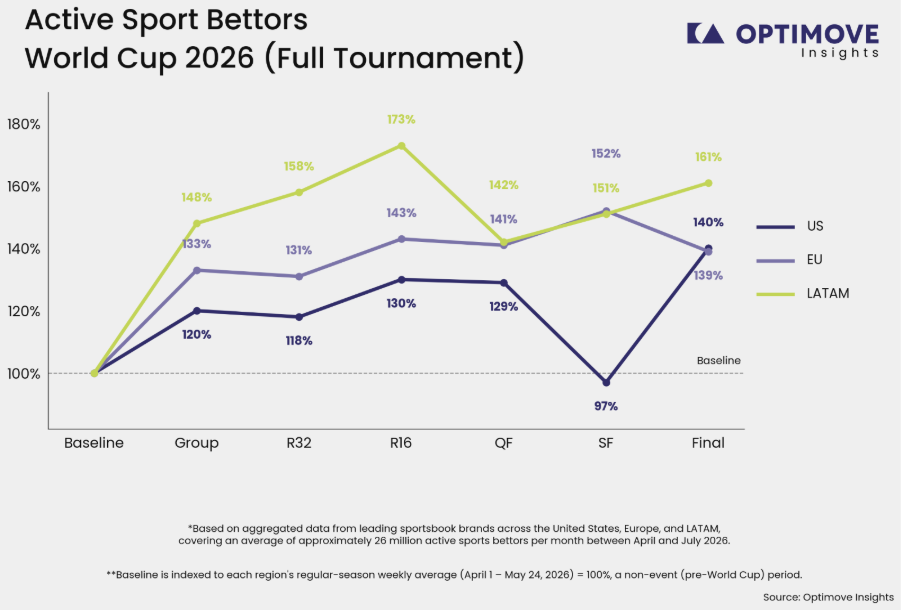
World Cup 2026 increased the number of bettors placing bets across all three regions, but the strongest moments occurred at different stages. LATAM generated the largest and most sustained uplift, Europe reached its high point during the Semifinals, and the US recorded its biggest increase during the Final after briefly falling below baseline.
LATAM stood out throughout most of World Cup 2026. The number of players placing bets rose to 148% of baseline during the Group Stage, increased to 158% in the Round of 32, and peaked at 173% in the Round of 16—the highest result recorded by any region. Although activity declined to 142% during the Quarterfinals, it remained well above regular-season levels and recovered to 161% for the Final. This suggests that LATAM’s growth was not dependent on a single match or stage, but reflected broader engagement across the tournament.
Europe delivered the most stable pattern. The number of bettors placing bets stayed within a narrow range throughout the tournament, from 131% to 152% of baseline, and reached its highest point during the Semifinals. Rather than producing a single dramatic spike, Europe maintained consistently elevated activity from the Group Stage through the Final.
The US showed the clearest event-driven behavior. The number of players placing bets increased gradually from 120% during the Group Stage to 130% in the Round of 16, before falling to 97% during the Semifinals, the only below-baseline result across any region or stage. Activity then surged to 140% for the Final, the strongest US result of World Cup 2026. The sharp rebound indicates that the Final acted as a distinct participation trigger rather than the conclusion of a consistently rising pattern.
The main regional highlight is LATAM, which combined the highest full-tournament average with the largest single-stage increase. Europe can be highlighted for consistency, while the US illustrates how major standalone moments, especially the Final, can reactivate bettors even after weaker engagement in the preceding stage.
The regional differences show that engagement during World Cup 2026 was not linear. LATAM generated the largest sustained audience expansion, Europe maintained the most consistent number of active bettors, and US activity was more concentrated around specific tournament stages.
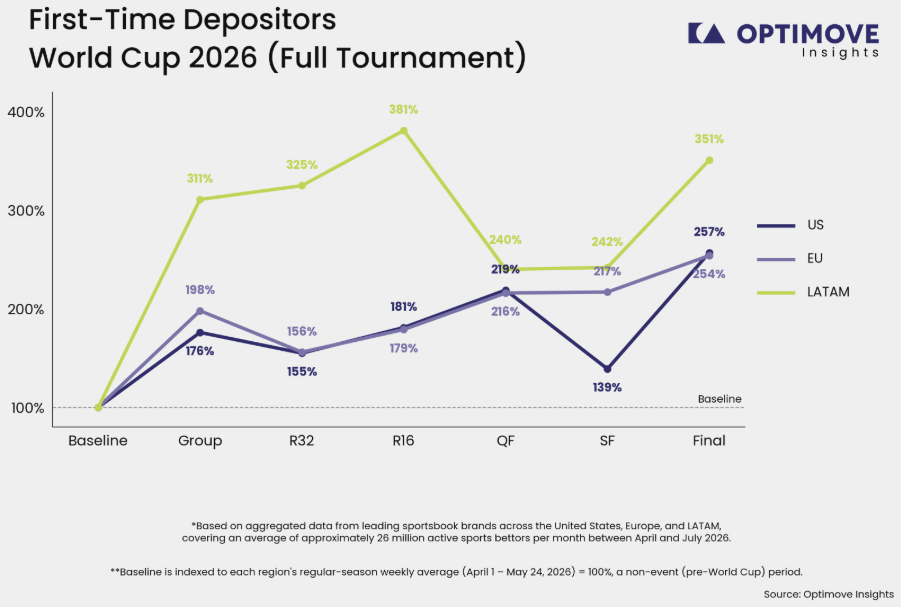
First-time depositors remained above regular-season levels at every stage of World Cup 2026, but the strongest acquisition moments differed by region. LATAM’s largest spike occurred during the Round of 16, while the US and Europe reached their peaks during the Final.
LATAM produced exceptional acquisition results from the opening stage. First-time depositors reached 311% of baseline during the Group Stage, increased to 325% in the Round of 32, and peaked at 381% during the Round of 16. Even after falling to 240% in the Quarterfinals and 242% in the Semifinals, acquisition remained more than twice the regular-season level. The Final then generated a second major surge to 351%.
Europe followed a more measured progression. First-time depositors reached 198% during the Group Stage before declining to 156% in the Round of 32. From that point, acquisition rose steadily: 179% in the Round of 16, 216% in the Quarterfinals, 217% in the Semifinals, and 254% for the Final. Unlike LATAM’s early spike, Europe’s strongest acquisition effect developed as World Cup 2026 progressed.
The US recorded the sharpest fluctuations. First-time depositors rose to 176% during the Group Stage, fell to 155% in the Round of 32, and then increased to 181% in the Round of 16 and 219% in the Quarterfinals. The figure dropped to 139% during the Semifinals before surging 118 percentage points to 257% for the Final.
The Final therefore acted as a powerful acquisition reset. The US and Europe arrived at almost identical results (257% and 254%, respectively) despite following different paths through World Cup 2026. LATAM remained well ahead at 351%, reinforcing both the strength of the Final and the region’s exceptional capacity to attract first-time depositors throughout the event.
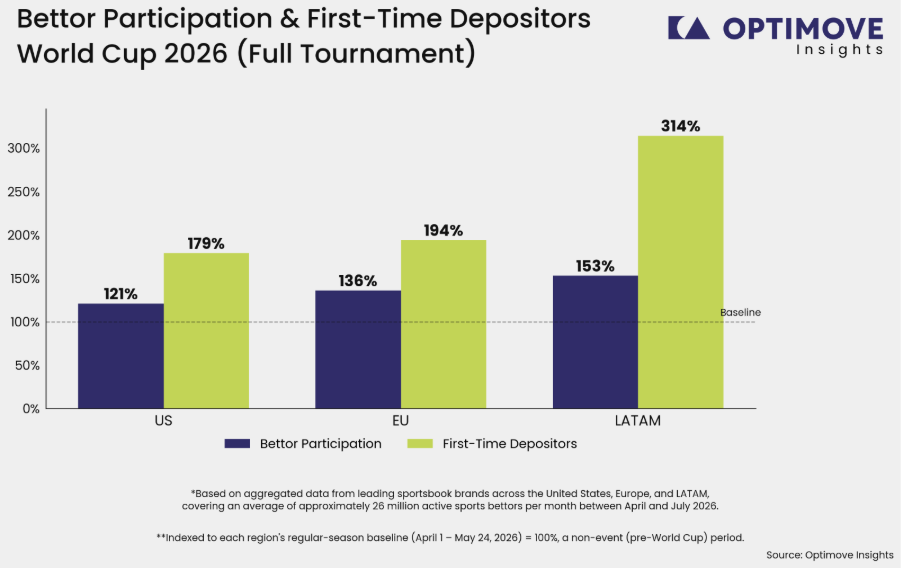
Across World Cup 2026, first-time depositor growth was stronger than the increase in the number of bettors placing bets in every region. This indicates that acquisition was a defining feature of the event.
In the US, the number of players placing bets averaged 121% of baseline, while first-time depositors averaged 179%. The 58-percentage-point gap shows that acquisition expanded more rapidly than the overall active audience, even though the US recorded the lowest full-event growth of the three regions.
Europe registered the same 58-point gap, but at higher overall levels. The number of bettors placing bets averaged 136% of baseline, compared with 194% for first-time depositors. Europe therefore combined stronger audience growth than the US with a similarly acquisition-led expansion.
LATAM was in a different category. The number of players placing bets averaged 153% of baseline, while first-time depositors averaged 314%, creating a 161-percentage-point gap. The region did not simply attract more bettors; it generated a disproportionately large increase in customers making their first deposits.
These indexed results do not show what percentage of the total audience consisted of first-time depositors, since each metric is compared with its own regular-season baseline. They do, however, show that World Cup 2026 had a much stronger relative effect on acquisition than on the overall number of active bettors, particularly in LATAM.
For operators, this creates both opportunity and pressure. A larger acquisition pool provides more potential customers to retain, but it also increases the cost of treating every new depositor as equally valuable. The next stage should focus on identifying which customers moved beyond their first deposit, returned across multiple stages, or continued betting without requiring repeated incentives.
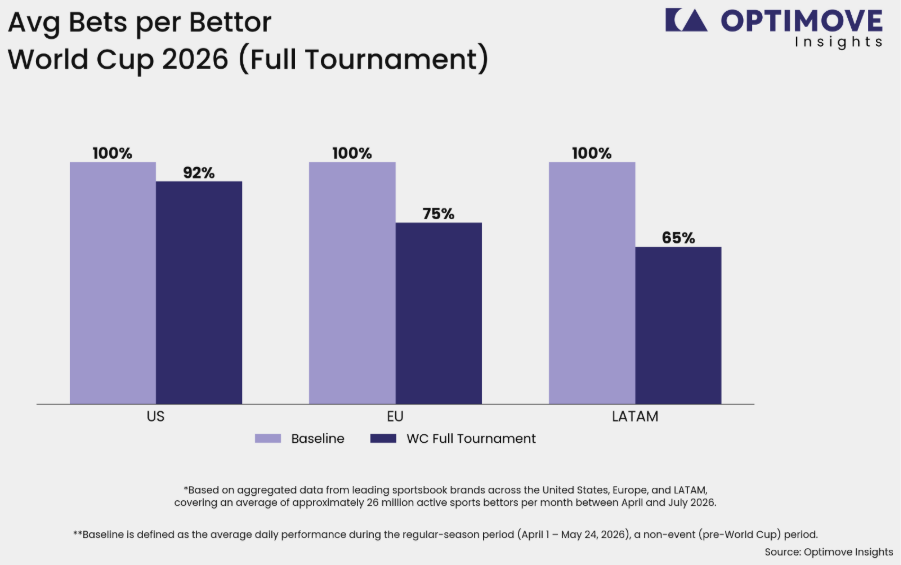
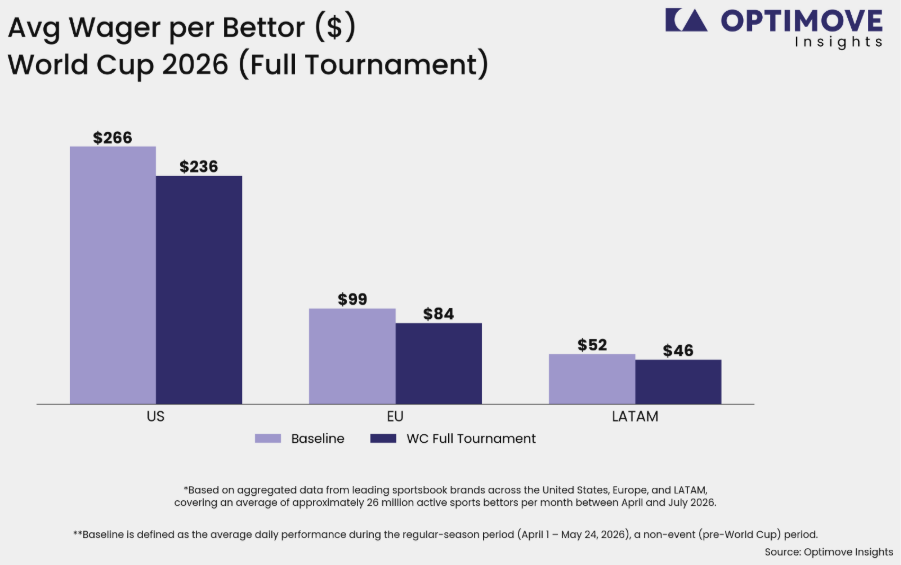
World Cup 2026 brought more players into sportsbooks, but the average bettor was less active than during the tournament. Average bets per bettor and average wager per bettor declined in all three regions, creating a clear disconnect between audience growth and individual betting depth.
The US preserved the greatest share of its regular-season behavior. Average bets per bettor reached 92% of baseline, representing an 8% decline. Average wager per bettor decreased from $266 to $236, a reduction of approximately 11%. The US therefore combined the smallest decline in frequency with the highest absolute average wager among the regions analyzed.
Europe experienced a more pronounced reduction in activity. Average bets per bettor fell to 75% of baseline, while average wager declined from $99 to $84, approximately 15%. The number of bettors placing bets remained consistently elevated, but each bettor placed materially fewer bets on average.
LATAM recorded the strongest audience and acquisition growth, but also the largest decline in betting frequency. Average bets per bettor fell to 65% of baseline, a 35% reduction, while average wager decreased from $52 to $46, approximately 12%.
LATAM’s contrast is particularly revealing. Although bettors placed substantially fewer bets, the decline in average wager was comparatively moderate. This suggests that the main change was fewer betting occasions per customer rather than an equivalent collapse in the amount wagered by each bettor. Europe showed a similar, though less extreme, pattern.
The overall conclusion is that World Cup 2026 was driven by breadth rather than depth. More people placed bets, but the expanded audience included many customers who participated selectively, around certain teams, matches, or stages, rather than adopting regular-season betting frequency.
World Cup 2026 should be viewed as a successful acquisition event, but not yet as a retention outcome. The number of bettors placing bets remained above baseline, and first-time depositors grew significantly faster than the total active audience. However, lower betting frequency and average wager show that much of the incremental volume had not developed into high-value behavior by the end of World Cup 2026.
The post-tournament priority should therefore be customer qualification rather than indiscriminate retention spending. Operators should be able to distinguish between first-time depositors who completed only an initial transaction, those who returned for multiple stages of World Cup 2026, customers progressing toward a second deposit, bonus-dependent players, reactivated customers, and established bettors whose activity intensified during the tournament.
The first weeks following the Final will provide a more meaningful indication of customer potential than acquisition volume alone. Continued logins, second deposits, activity outside World Cup 2026 matches, response to other sports content, and sustained betting without aggressive incentives can help identify customers whose engagement may extend beyond the tournament.
Regional strategies should reflect the different patterns in the data. In the US, the volatility between stages means operators should be cautious about treating the Final’s acquisition spike as a permanent expansion of the audience. New bettors should be connected quickly to the next relevant sports and betting occasions based on demonstrated preferences rather than receiving a generic post-World Cup 2026 journey.
Europe’s steadier number of active bettors provides a stronger foundation for continuity. Operators can focus on moving World Cup 2026 bettors into established football journeys, personalized club and league content, and cross-sell opportunities based on their behavior during the tournament.
LATAM presents the largest opportunity and the greatest qualification challenge. Its acquisition volume was exceptional, but betting frequency fell furthest below baseline. Operators should prioritize structured onboarding, early identification of repeat behavior, localized communications, carefully controlled incentives, and responsible gaming safeguards rather than attempting to retain the entire World Cup 2026-acquired audience at the same cost.
Positionless Marketing can help sportsbook teams respond to these differences quickly. AI-assisted workflows can identify developing customer segments, generate localized content, adjust offers, and activate post-World Cup 2026 journeys without depending on prolonged handoffs between analytics, CRM, creative, and operations teams. Budget, eligibility, risk, responsible gaming, and brand controls should remain embedded in every workflow.
The objective after World Cup 2026 is not to preserve every temporary increase. It is to identify the portion of the expanded audience capable of becoming consistent, profitable customers, and invest in those relationships before the attention generated by World Cup 2026 disappears.
Optimove, the creator of Positionless Marketing, frees marketing teams from the limitations of fixed roles, giving every marketer the power to execute any marketing task instantly and independently. Positionless Marketing has been proven to improve campaign efficiency by 88%, allowing marketing teams to create more personalized engagement with existing customers.
For two years running, Optimove has been positioned as a Visionary in Gartner's Magic Quadrant for Multichannel Marketing Hubs, recognized for its AI-driven decisioning, prescriptive insights, and proven ability to orchestrate thousands of personalized campaigns in real time across channels.
Its Positionless Marketing Platform includes Optimove Engage and Orchestrate for cross-channel campaign decisioning and orchestration; Optimove Personalize, a digital personalization engine; and Optimove Gamify, a loyalty and gamification platform.
All are powered by Optimove AI, the marketing AI suite that brings AI everywhere marketers work. Inside the platform through Native AI agents for decisioning, analysis, and creation, outside it to external AI tools like Claude and ChatGPT through the Optimove MCP, and into custom-built applications on top of the platform through Optimove Custom Apps. Optimove has embedded AI in its platform since 2012, paving the way for Positionless Marketing.
Today, its comprehensive AI-powered suite is at the leading edge of empowering marketers to streamline workflows from Insight to Creation and through Optimization. Optimove provides industry-specific and use-case solutions for leading consumer brands globally.
Optimove Insights is the analytical and research arm of Optimove, dedicated to providing valuable industry insights and data-driven research to empower B2C businesses.
Optimove Pulse. The iGaming Industry Benchmark Tool
Explore Optimove’s iGaming Pulse to instantly benchmark your performance against the rest of the industry.