
Unified Growth Solution
World-class tech needs world-class drivers. AI platform and expert services, unified
Read time 24 minutes


Increasing the Value of New Online Gaming Players
Download the report and discover proven methods to increase new player deposits, retention, and lifetime value when empowered by Positionless Marketing.

Executive Summary :
The Optimove Insights 2026/27 NFL Betting Intentions Report shows that fans overwhelmingly bet on their own team. Loyalty is the pull; player props and live betting sustain interest once the season stops mattering.
Bet size and total spend can move in opposite directions. Planned single-bet amounts could rise while overall season budgets fall for players. Any metric that blends the two will hide this. Therefore, average bet size, frequency, and total spend have to be tracked separately.
The regular season draws substantially more bettors than any individual postseason stage, and point spreads and moneylines (betting only on which team will win, regardless of the margin of victory) are still the leading wager types, both in what bettors did and what they say they will do.
Pre-game bets are the number one preference, yet most bettors intend to make live bets during the season.
Operators are competing for attention and wallet share throughout the season. Most bettors use more than one sportsbook, and ease of use is both the strongest factor in choosing a site and the leading reason to leave one.
Information is another part of that relationship: bettors consult personal, social, and expert sources before wagering, and more than half have paid for advice or tips. Most also describe their recent NFL betting results positively.
Bettors welcome promotions and new betting ideas, yet many of the communications they receive still fail to match their interests. The opportunity is not to send more, or to repeat what customers have already done, but to use behavioral, contextual, and channel signals to surface bets they haven't tried.
Positionless Marketing enables marketers to connect those signals to audiences, content, offers, and channels quickly enough to respond as each bettor’s interests evolve throughout the season.
Methodology :
The Optimove Insights NFL Betting Report is based on a survey of 926 U.S. adults who placed an NFL wager during the 2025/2026 season, conducted in August 2026.
The study examined respondents' previous NFL betting behavior, intentions for the 2026/2027 season, wager and budget patterns, sportsbook usage, information sources, and preferences around marketing communications and personalization.
Where applicable, the analysis compares reported behavior during the 2025/2026 season with stated intentions for the upcoming season.
Findings:
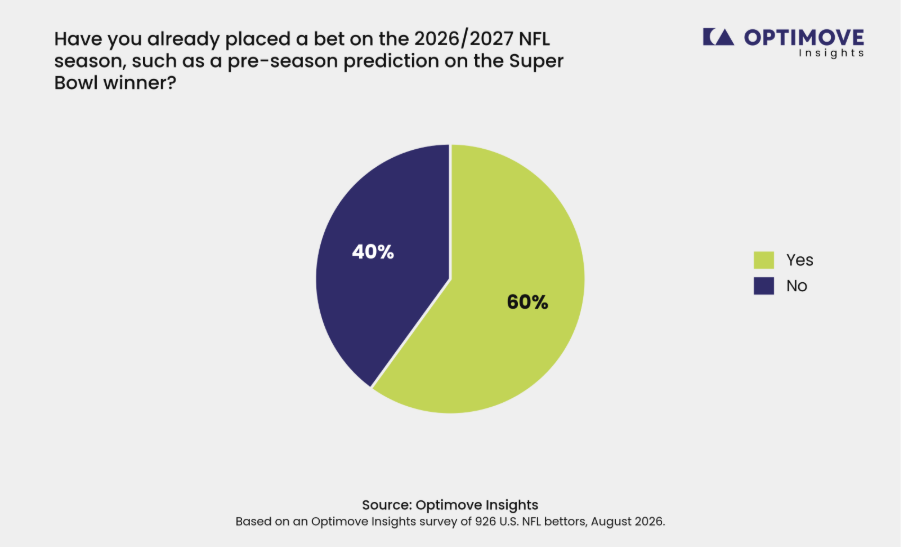
Among respondents, 41% said they bet on NFL games regularly, with 60% of bettors saying they have already placed a bet on the upcoming season, such as a preseason Super Bowl prediction.
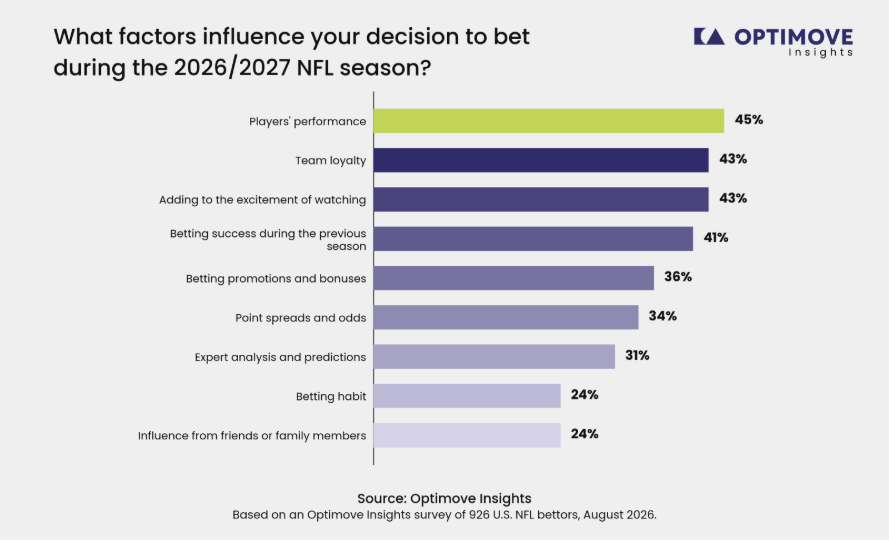
The strongest betting drivers for 2026/ 27 season are individual football player performance at 45%, followed by team loyalty and adding excitement to watching, both at 43%.
Motives related to the betting activity, like previous-season betting success, promotions and bonuses from iGaming operators, and odds, rank lower at 41%, 36% and 34%, respectively.
While 90% of bettors are certain or very likely to wager on a game involving their favorite team, nearly 78% would certainly or very likely continue betting if that team were eliminated.
Insights:
Team loyalty and player performance rank as top motivators, and both are rooted in emotional attachment rather than analysis. Bettors follow players the way they follow teams. The strongest betting moments are created by what is happening on the field and the bettor's relationship with the game.
Team loyalty is a powerful entry point, but the data shows it is not the limit of a bettor's interest. Bettors are highly likely to wager on their favorite teams, yet almost as many say they would keep betting after those teams are eliminated. Fandom starts the relationship; it does not contain it.
Past behavior carries forward into a new season. Six in ten bettors have already placed preseason wagers, and 41% say last season's results shape their decisions this year. The cycle begins well before kickoff. That creates an opportunity to treat the season as a continuation of the bettor's relationship rather than a fresh acquisition moment every September.
What Marketers Should Do:
Operators should build NFL engagement around the signals bettors themselves identify as important. They should treat those signals as a hierarchy, not a menu. Team loyalty is a key entry point. Player performance and game context drive in-the-moment relevance. Previous betting behavior and prior outcomes are the strongest predictors of what someone will do next and need to be leveraged.
Promotions can support that strategy, but the data suggests they should reinforce relevant moments rather than serve as the primary reason to communicate. A message that arrives because something happened on the field will outperform one that arrives because it is Tuesday.
Marketers should also plan for interest that outlasts a bettor's own team. Journeys can begin with favorite-team content and expand toward rivalries, standout players, playoff races, and league-wide events as the season develops. Because those signals shift week to week, the constraint is usually speed.
A Positionless Marketing approach lets a single marketer identify a changing signal, build the audience, and activate the campaign without handoffs between internal teams.
Findings:
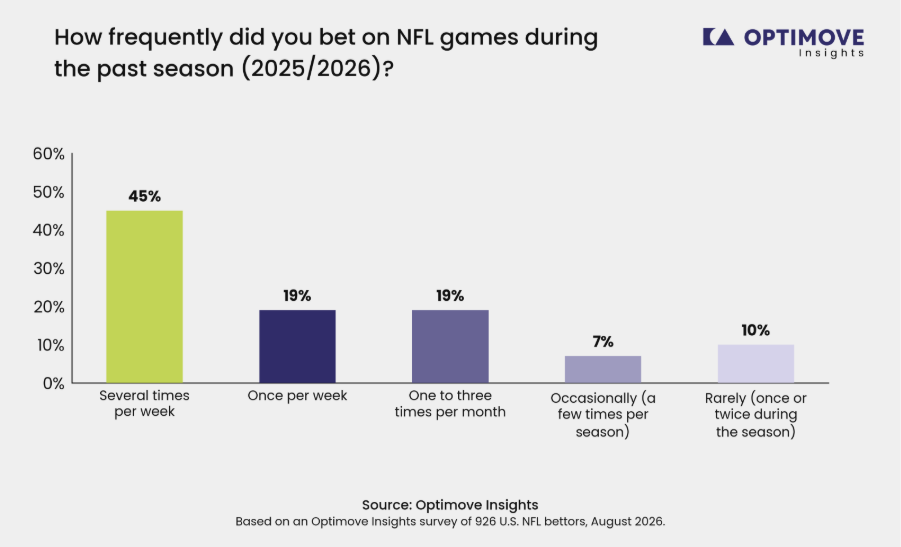
During the 2025/2026 season, the month-over-month bettor retention was high, with 64% placing bets once a week or more, and 19% placing bets at least once a month.
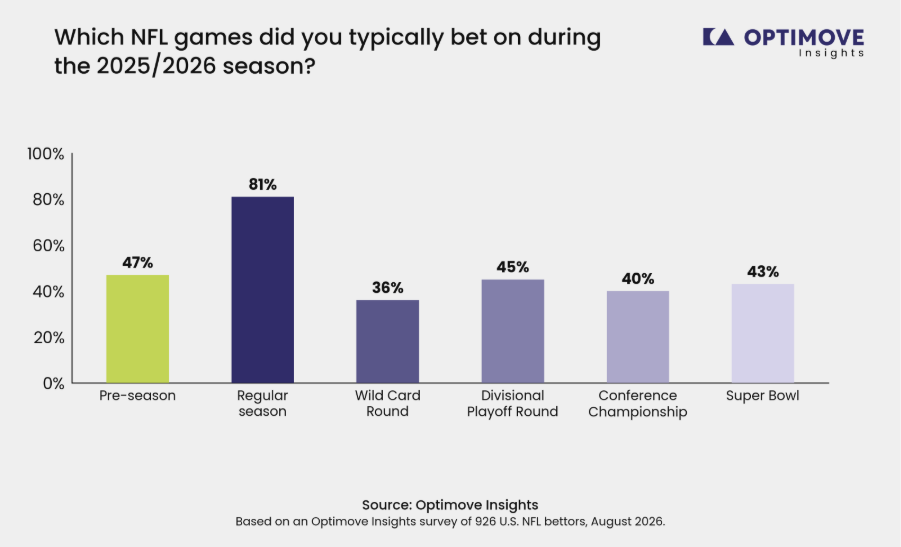
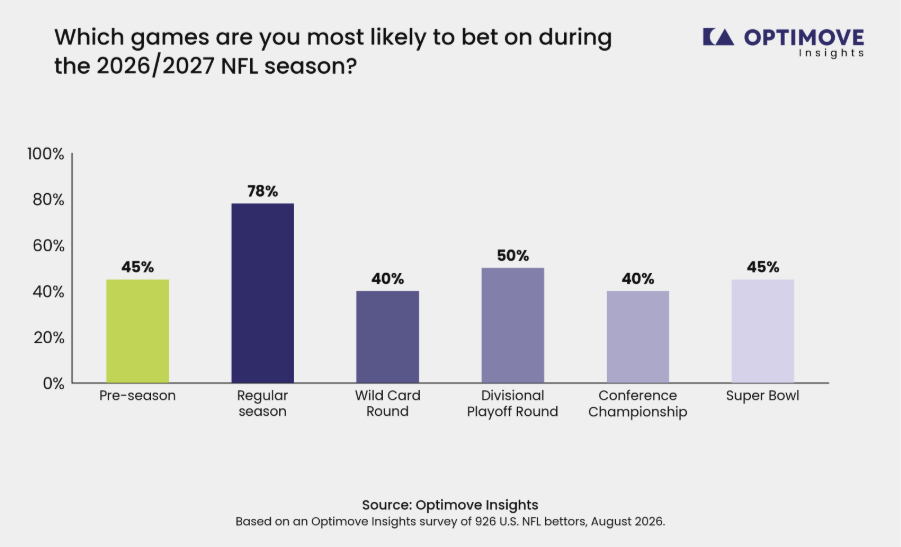
The regular season drew the highest participation at 81%, compared with 47% in preseason and 36% to 45% across individual postseason stages. Intentions for 2026/2027 follow a similar pattern: 78% expect to bet during the regular season, while postseason stages range from 40% to 50%.
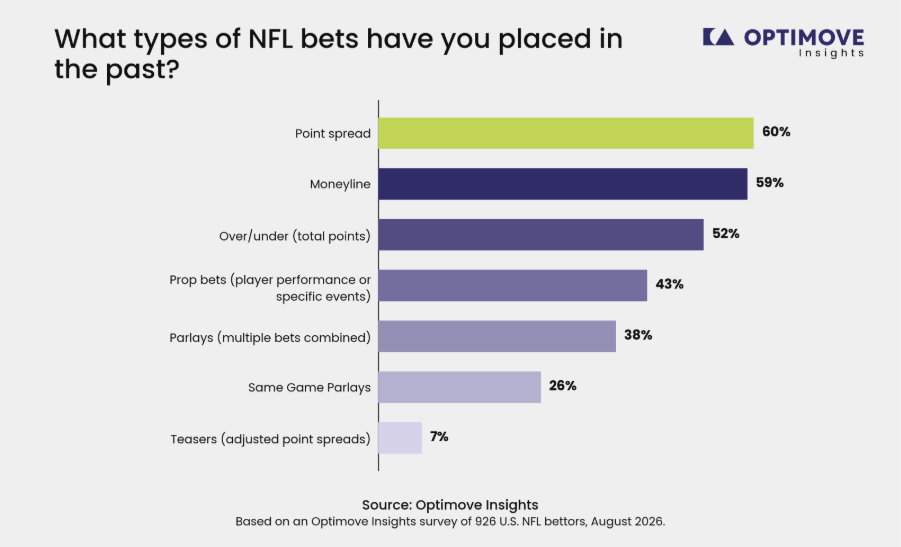
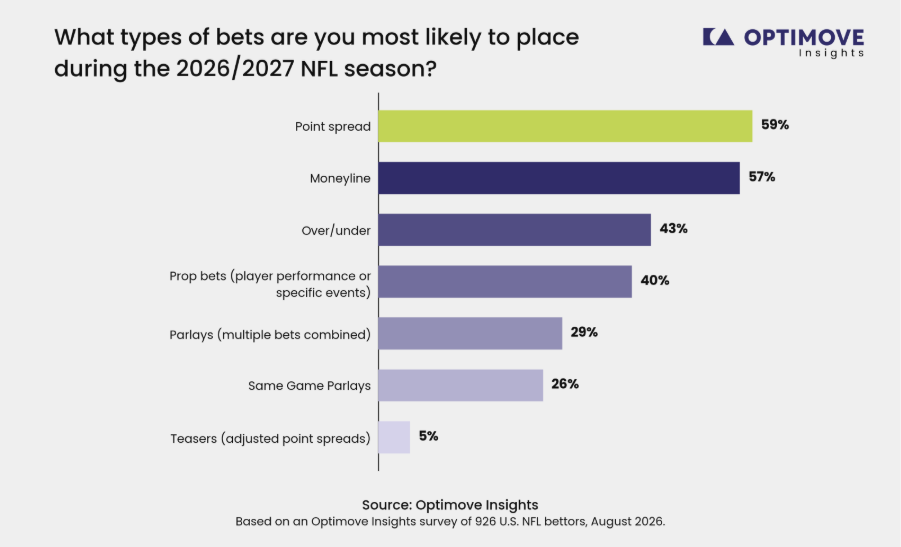
Bet types also show limited change between past behavior and future intent. Point spreads (60%) and moneyline bets (59%) led last season and remain the top planned choices for 2026/2027 at 59% and 57%, respectively. The largest declines in future intent appear for over/unders, from 52% to 43%, and parlays, from 38% to 29%.
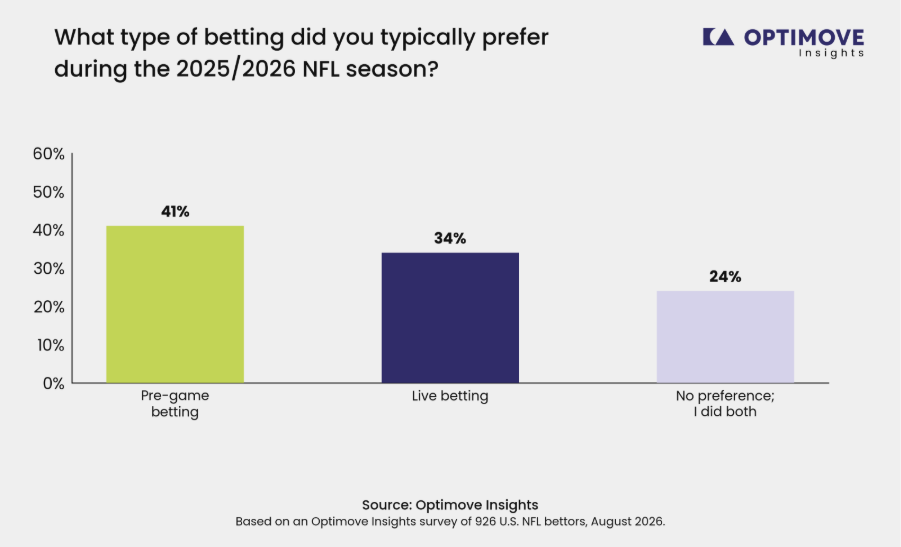
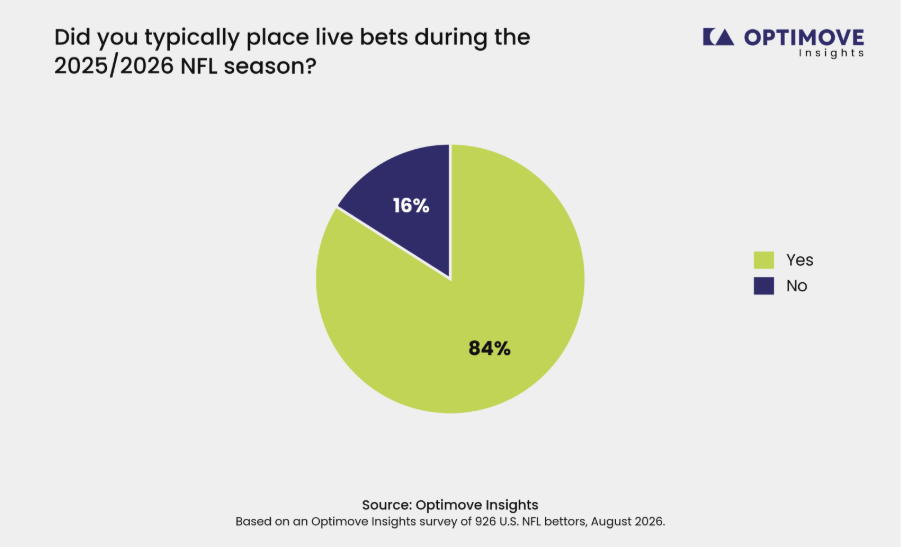
While 41% said they primarily preferred pre-game betting and 34% preferred live betting during the 2025/26 season, 84% say they typically did place live bets at some point during 2025/26 season. Preference and participation are not the same thing: most bettors who favor pre-game still bet live.
Optimove's NFL Betting Intentions vs. Actual Behavior 2025/26 report offers a useful check on that number. Last year, 31% said they intended to place live bets and 16% actually did. Intent on live betting has run well ahead of behavior, so operators should watch actual live-bet activity closely this season rather than plan against stated intent.
Insights:
The regular season is the engine of NFL betting participation, not merely the backdrop to marquee events. The playoffs and Super Bowl generate attention, but no single postseason round comes close to the regular season's interest. Operators should build engagement around the cumulative rhythm of weekly games and treat postseason campaigns as extensions of an established habit rather than the primary acquisition moment.
The stability of point spreads and moneylines reinforces the value of familiar, easy-to-understand offers. Their leading positions across both past behavior and stated intent indicate durable demand. Over/unders and parlays draw secondary but significant interest, and that is where operators have room to influence the betting mix; these categories are likely more responsive to promotions, education, game context, and personalized recommendations than the core markets bettors already choose by default.
Live betting is an opportunity, but the size of that opportunity should be read carefully. Bettors prefer pre-game wagers, yet 84% typically live bet at some point last season. Last year the same gap appeared and did not close: 31% intended, 16% followed through.
What the two figures together suggest is that live betting is opportunistic, triggered by momentum, odds movement, or in-play events, while pre-game remains the foundation. The value comes from combining the two rather than treating live as a standalone strategy, turning a planned wager into a longer, more continuous session.
What Marketers Should Do:
Operators should structure NFL engagement around the regular-season calendar and the bet types generating the highest participation. Point spreads and moneylines provide a stable base for campaign planning, while over/unders and parlays are where interest is most likely to shift as the season develops.
Marketers should also weigh observed betting behavior against stated preferences when shaping journeys. A bettor who describes himself as primarily pre-game may still bet live once games begin, and operators can see that in their own data well before a survey would show it.
Positionless Marketing helps marketers respond to those signals quickly, adjusting audiences, messages, and offers as activity changes through the season.
Findings:
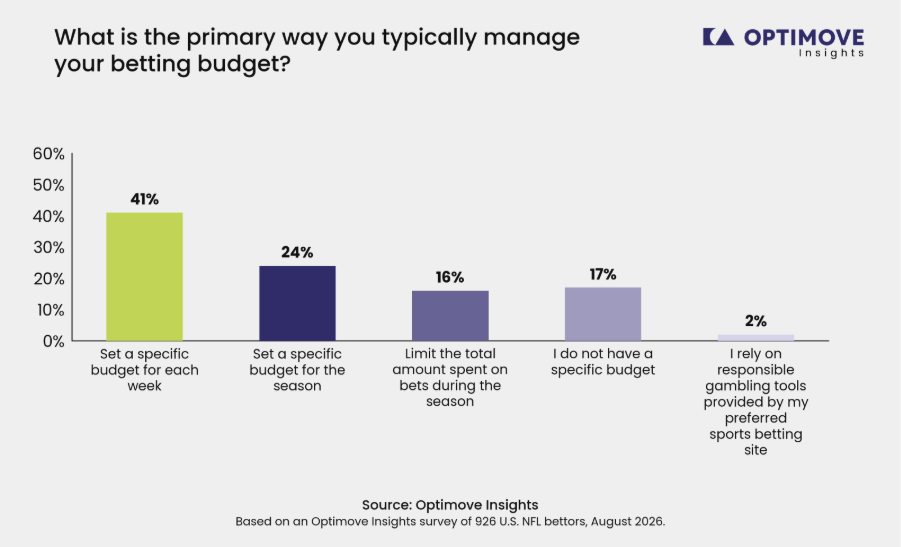
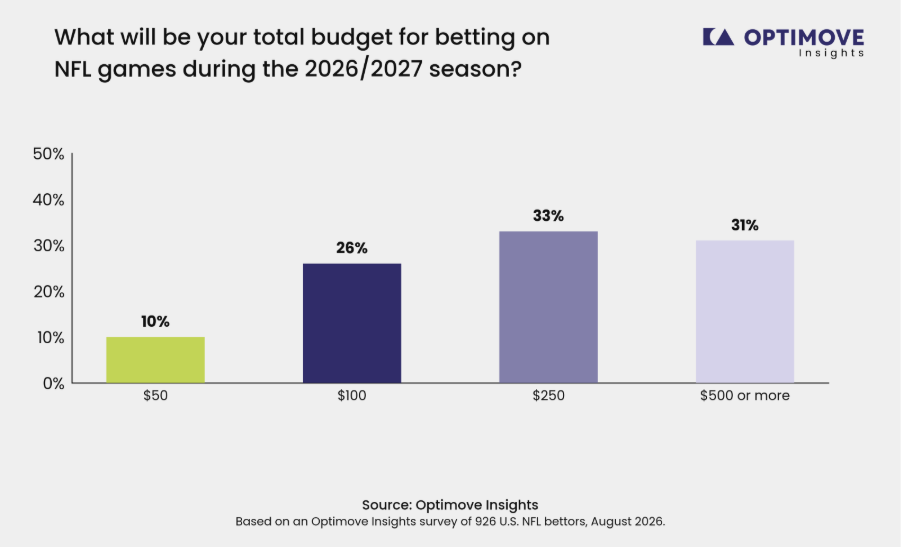
Eighty-one percent (81%) of bettors say they set a betting budget. Weekly budgeting is the most common management approach at 41%, followed by season budget at 24%, and 16% limit the total amounts spent on bets for the season. Seventeen percent (17%) say they do not have a specific budget.
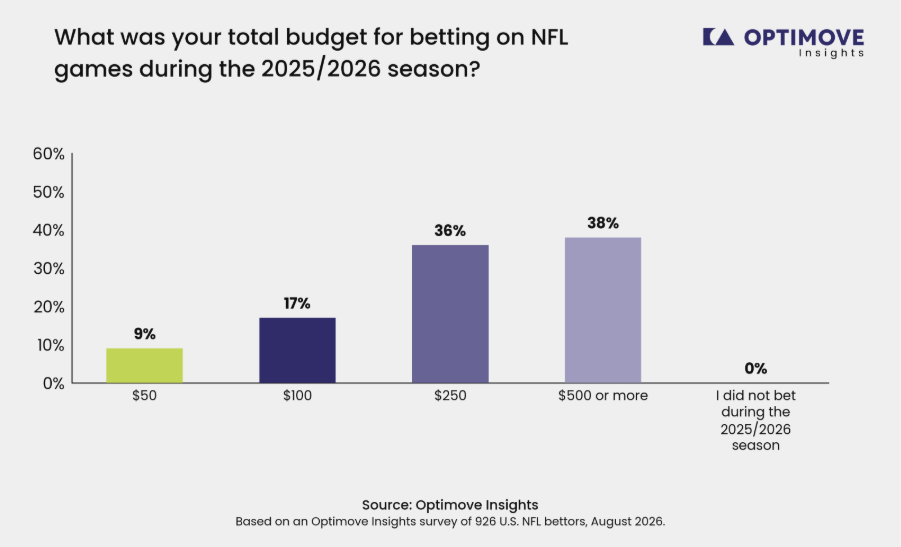
For 2026/27 season, total budgets seem to trend slightly down. Last season, 38% reported spending $500 or more and 36% had a $250 budget; for 2026/2027, those shares fall to 31% and 33%, while the $100 segment rises from 17% to 26%.
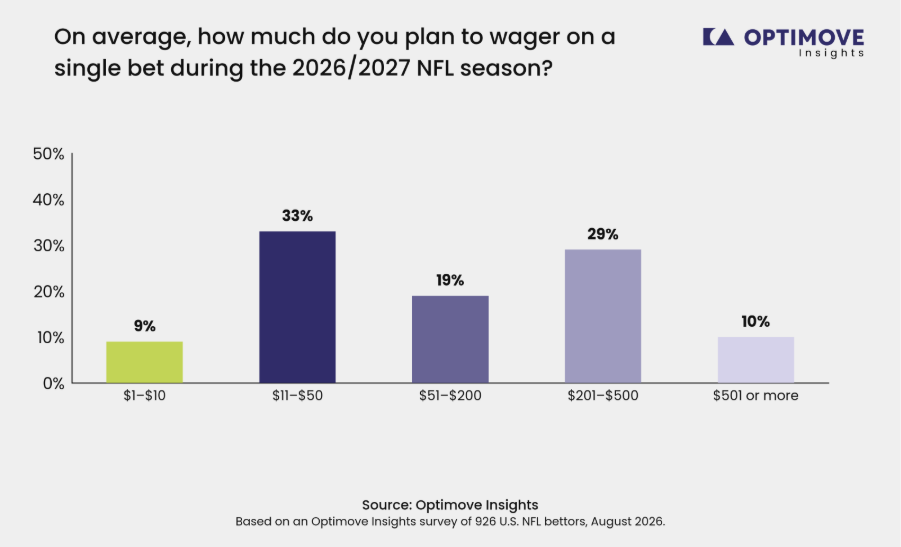
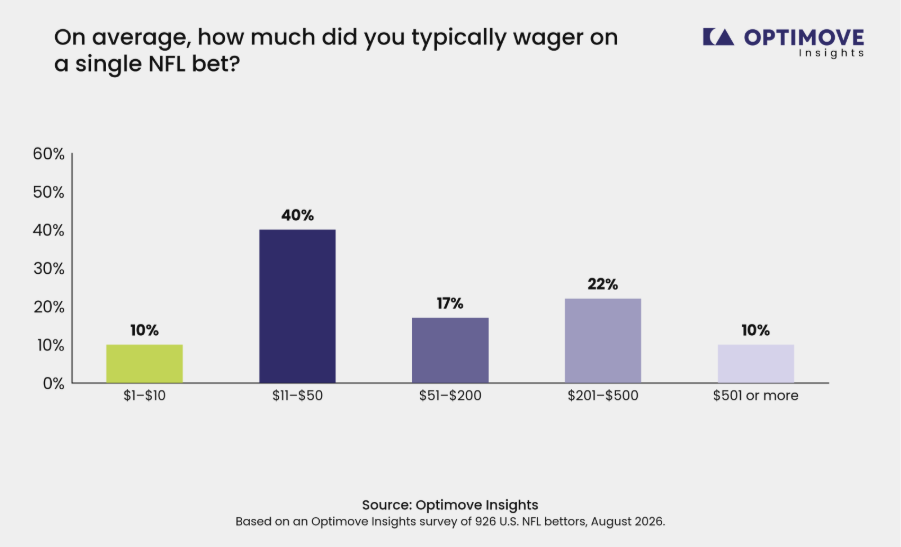
Planned wager sizes for 2026/2027, on the other hand, show a modest increase compared with last season. The share expecting to wager $201–$500 on a single bet rises from 22% to 29%, while $11–$50 declines from 40% to 33%. The $51–$200 range increases slightly from 17% to 19%, while the share wagering $501 or more remains unchanged at 10%.
Insights:
The comparison reveals an important distinction between occasional high-value betting and regular betting behavior. A bettor may be willing to place an occasional $201 to $500 wager while planning to spend less across the full NFL season than a more frequent bettor.
Bettors appear to fall into distinct patterns: some concentrate their activity around a small number of games, markets, or moments they consider especially compelling, while others place smaller wagers more consistently throughout the season. Operators should therefore avoid treating a larger individual bet as evidence of greater overall customer value or broader budget expansion.
The prevalence of self-imposed limits reinforces that interpretation. 81% of bettors already use some form of spending boundary, whether weekly, seasonal, or based on total expenditure. These limits are part of the decision framework through which many bettors determine when and where to participate. Because weekly limits are most common, the NFL calendar creates a recurring opportunity to earn consideration, but not an automatic trigger for increased spending.
Operators should read the signals bettors actually give them: betting frequency, preferred markets, and prior wager timing. Those signals indicate when a larger offer will land and when it will be ignored. The strongest strategy is not broader promotion but better timing. That means helping occasional bettors find the moments worth their larger wagers, and helping regular bettors stay consistent. Both work only within the limits bettors have set for themselves.
What Marketers Should Do:
Use wager size, frequency, and total spend as distinct signals rather than treating betting value as a single measure. Someone placing larger individual wagers may still be operating within a tighter seasonal budget, while another bettor may distribute a similar total across more activity. Segmentation should reflect those differences when determining message frequency, offers, and betting opportunities.
Marketers should also support the budgeting behavior bettors already demonstrate. Communications can align with weekly spending patterns and avoid pressure as customers approach their limits.
A Positionless Marketing approach lets marketers combine spend, frequency, and behavioral signals to adapt engagement across the season without waiting on handoffs between internal teams.
Findings:
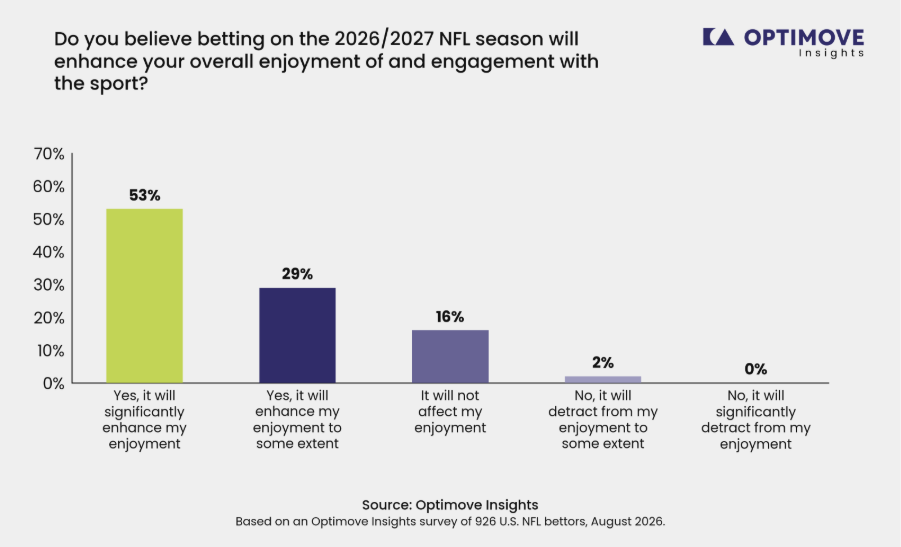
The majority of bettors (82%) state that betting increases their enjoyment and engagement with football, with more than 50% saying it does significantly.
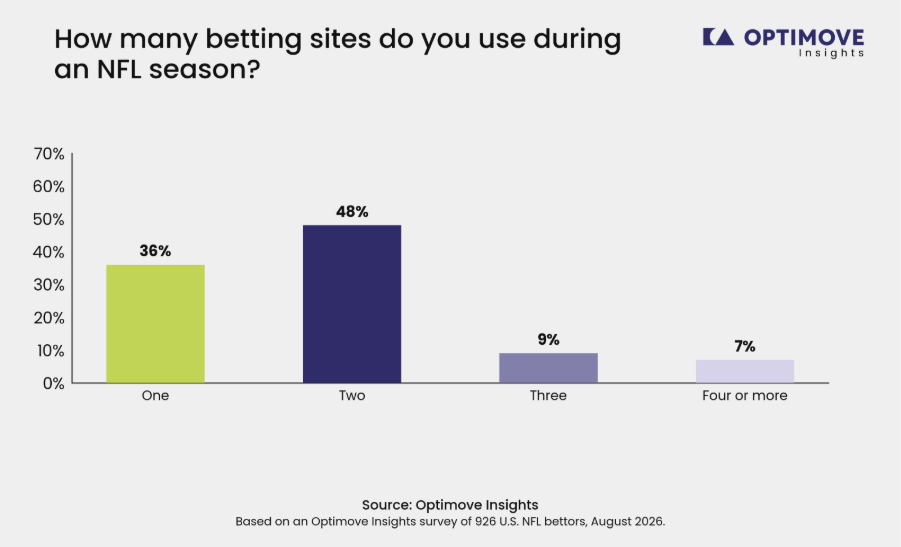
Most bettors do not only use a single operator: 64% choose two or more betting sites during an NFL season, with 16% using three or more.
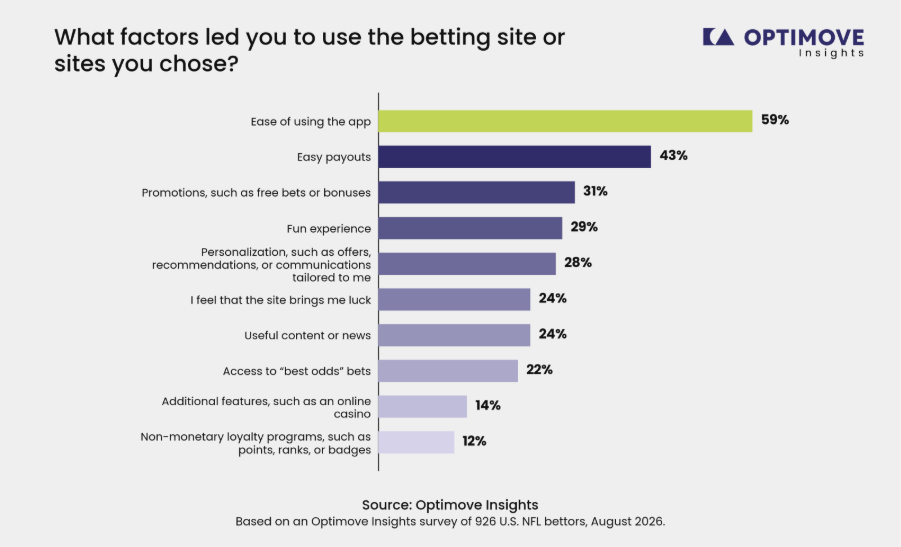
Ease of using the app is the leading factor in choosing a betting site at 59%, followed by easy payouts at 43%. Promotions rank third at 31%, while personalization influences 28%.
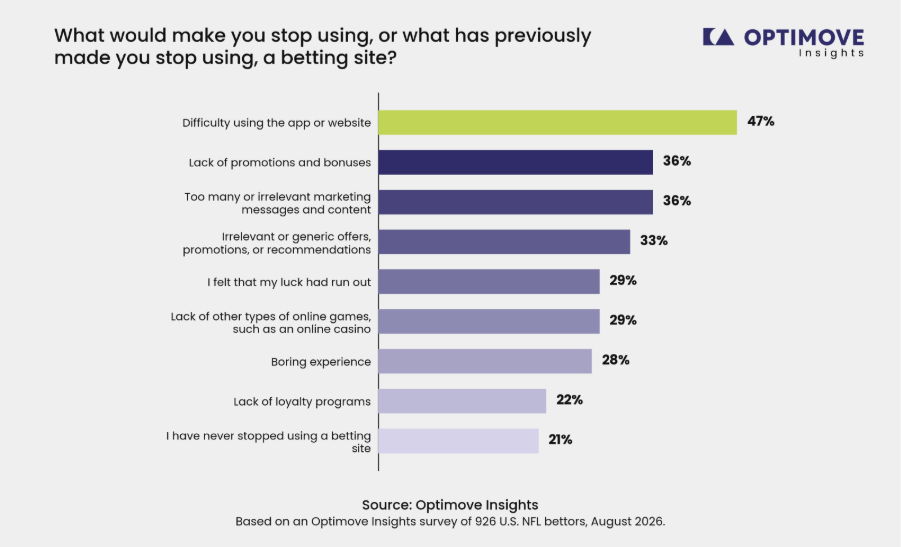
The same priorities appear in reasons for abandoning a betting platform: 47% cite difficulty using the app or website, while lack of promotions and too many or irrelevant marketing messages reach 36% each, followed by generic offers or recommendations at 33%.
Insights:
The data shows that user experience plays a major role in operator choice. Ease of use leads the selection factors and is also the most common reason bettors would stop using a site. Promotions matter, but they sit behind basic functionality and ease of accessing winnings when bettors decide where to play.
That 64% use more than one betting site means operators are competing for activity throughout the season, not simply for initial sign-up. Bettors already have alternatives in hand, so friction, poor communication, or irrelevant offers are easy to answer by shifting activity elsewhere. Retention depends on the quality of each interaction as much as on the reason a customer joined.
Promotions cut both ways. They rank third among reasons bettors choose a sportsbook, but 36% cite excessive or irrelevant communications as a reason to leave, and another 33% point to generic offers. Marketing fatigue is a real risk with NFL bettors.
Betting enhances NFL enjoyment for most respondents. The opportunity for marketers is to make communication contribute to that experience rather than interrupt it.
What Marketers Should Do:
Operators should treat usability, payouts, communications, and offers as connected parts of the customer experience. Marketing cannot compensate for friction elsewhere in the journey, and a strong product experience can be undermined by excessive messaging. Campaign strategies should therefore respond to customer behavior and context rather than maximize contact frequency.
Personalization should focus on relevance across the season, using preferred teams, markets, betting patterns, and engagement signals to determine when and what to communicate.
A Positionless Marketing approach connects those signals directly to execution, letting marketers adapt audiences, messages, and offers quickly. That speed is what reduces the generic and excessive interactions bettors identify as reasons to leave.
Findings:
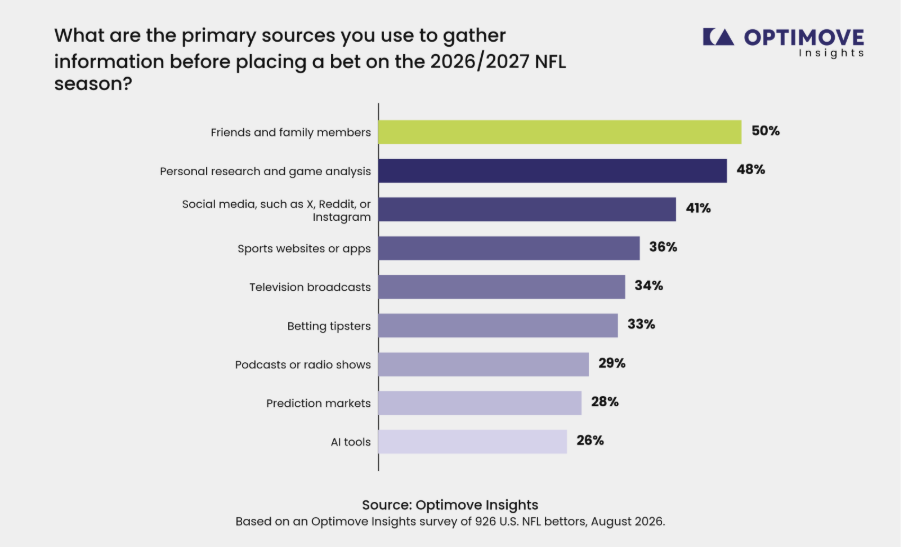
NFL bettors draw on a broad mix of sources before placing a wager. Friends and family are the most cited source at 50%, closely followed by personal research and game analysis at 48%. Social media influences 41%, while sports websites or apps reach 36%, television 34%, and betting tipsters 33%. AI tools are already used by 26% of respondents.
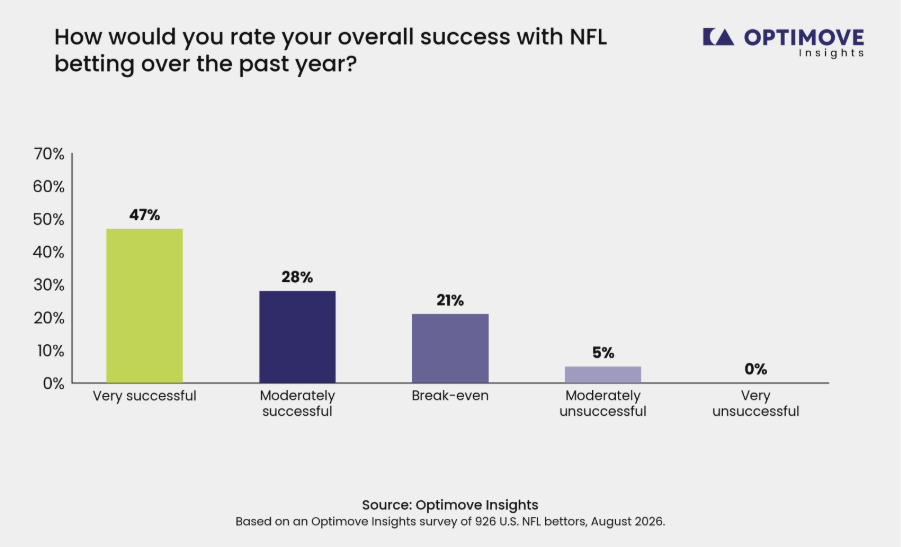
Paid information also plays a substantial role: fifty-five percent (55%) say they have paid for betting advice or tips. At the same time, bettors report high levels of perceived success. Three-quarters rate their NFL betting over the past year as either very successful (47%) or moderately successful (28%), while 21% say they broke even, and only 5% describe themselves as moderately unsuccessful.
Insights:
Betting decisions are informed by both personal judgment and outside influence. Friends and family narrowly lead the list, but personal research ranks almost equally high, while social media, sports platforms, television, and specialist sources all attract meaningful shares. The result is a decision process built across several types of information rather than one dominant source.
That 55% have paid for advice reinforces how much value bettors place on information, though paid sources supplement informal recommendations and independent analysis rather than replacing them.
Bettors are also confident in that process. 75% describe themselves as at least moderately successful, a self-assessment that matters more here than actual results: bettors who believe their method works will resist content that contradicts it. For operators, the opportunity is to support an existing decision process rather than push toward an outcome.
What Marketers Should Do:
Operators should treat useful information as part of the betting experience, while drawing a firm line: provide data, context, and analysis, never tips or advice on what to bet. Player and team data, game context, and timely content can help customers evaluate opportunities in the moments when they are already researching. Pointing bettors toward credible independent sources serves the same purpose without the operator taking a position on any outcome.
Because bettors draw on social, owned platforms, external media, and their own analysis, content strategies should account for movement between those sources rather than assume any one channel carries the decision.
Marketers should personalize that content to the bettor's interests and behavior rather than increase the volume of generic advice.
A Positionless Marketing approach lets marketers combine betting history, preferred teams, markets, and engagement signals to deliver relevant content at the right moment, supporting the bettor's decision process across the NFL season.
Findings:
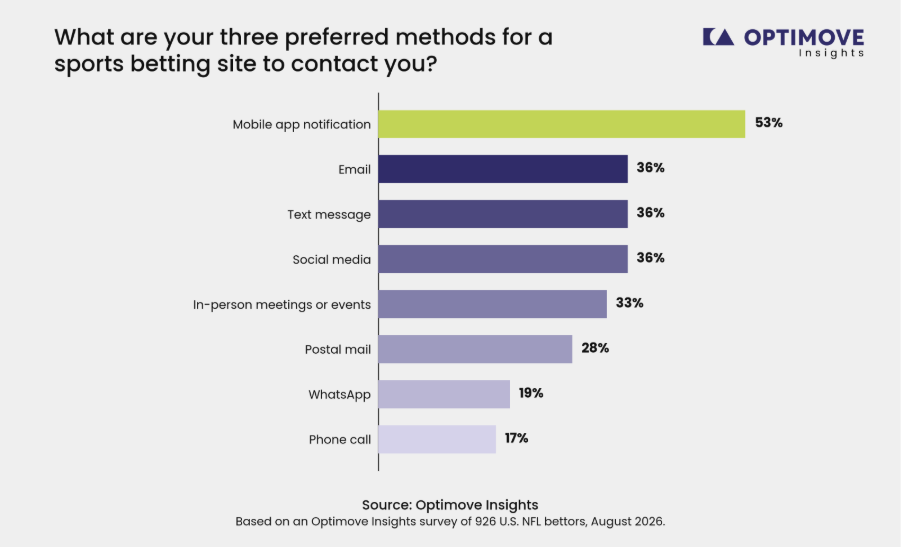
Mobile app notifications are the preferred way for betting sites to contact NFL bettors, selected by 53% of respondents. Email, text messages, and social media each follow at 36%, showing that no secondary channel clearly dominates.
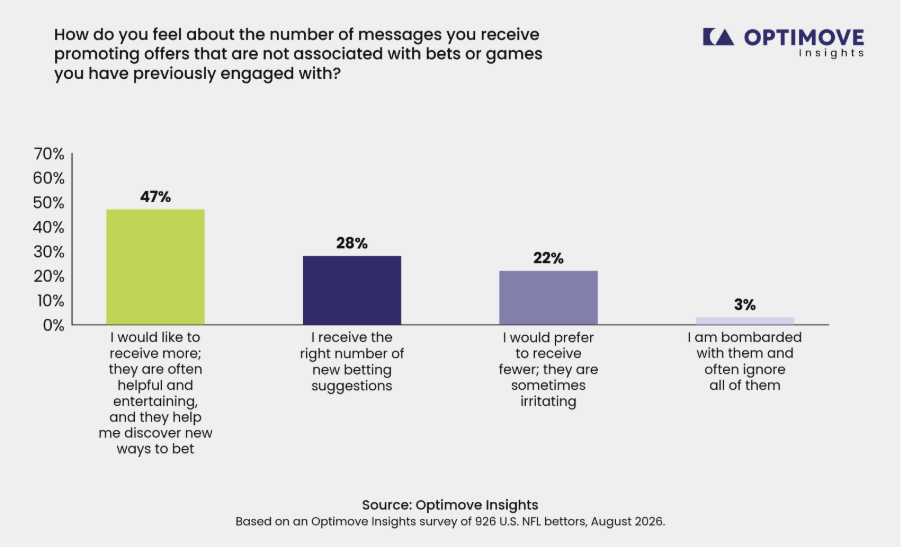
Forty-seven percent say they would like to receive more promotions related to bets or games they have previously engaged with because those messages help them discover new betting opportunities, while 28% say they currently receive the right amount.
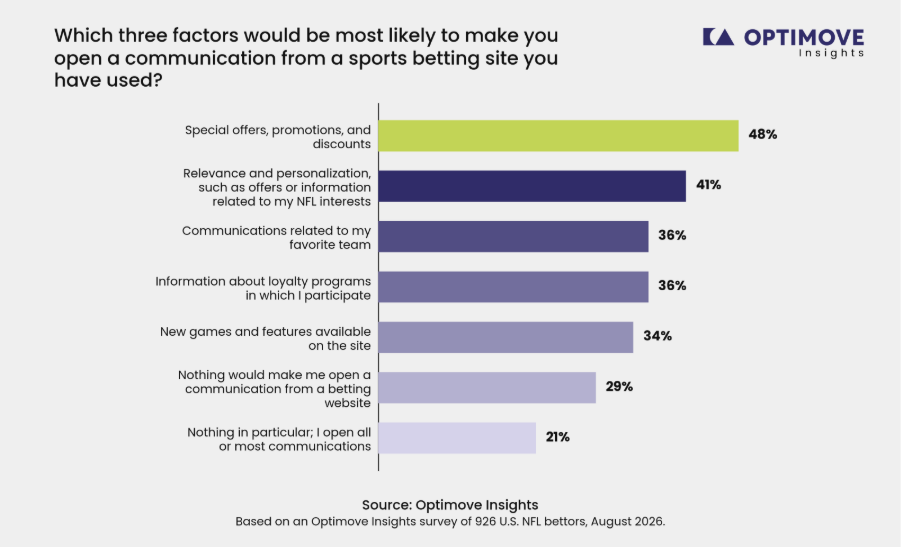
Special offers and promotions are the leading reason to open communications at 48%, followed by relevance and personalization at 41%, and communications related to favorite team at 36%.
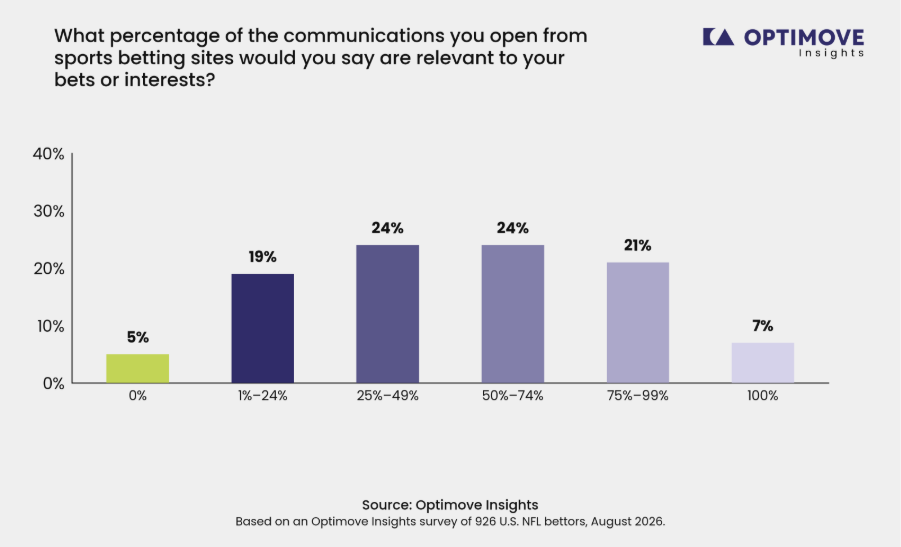
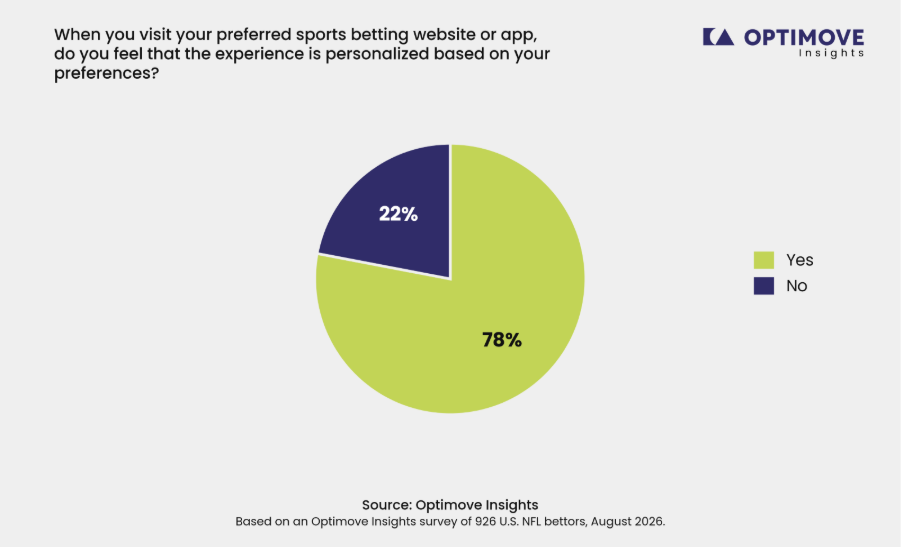
Only 7% say that all communications they have opened are relevant to their interests, while 48% say fewer than half are relevant. Despite that, most bettors perceive some degree of personalization on apps and websites: 78% say they feel that the experience is based on their preferences.
Insights:
The findings point to a strategic tension between reach, discovery, and trust. Mobile notifications are the leading contact preference, but the lack of a clear second channel suggests that bettors do not want a one-size-fits-all communication model. Operators that treat channel preference as a customer-level signal can make outreach feel more intentional, using mobile for timely prompts while reserving email, text, or social for customers who are more receptive in those environments.
Not all bettors are reachable through outbound channels, and personalization cannot depend on messages being opened. Almost half say fewer than half of the communications they open are relevant, and only 7% find all of them relevant. In-app and web personalization carries weight that outbound cannot: operators can tailor homepages, navigation, content modules, and offers within the environments customers already choose to visit.
The appetite for general promotions also challenges a narrow definition of personalization. Bettors are not asking operators to mirror their past behavior indefinitely; they are inviting them to act as guides to relevant new opportunities. This creates room for marketers to expand a customer's consideration set through adjacent teams, players, markets, and offers, provided those recommendations are explainable and connected to recognizable interests.
The larger risk is that personalization may be working at the experience level but overwhelming bettors in the inbox or notification feed. A bettor can feel that an app understands their preferences while still encountering too many messages that do not apply to them. That disconnect helps explain why irrelevant marketing and generic offers are linked to churn. Relevance should therefore be measured not only by whether a message is opened, but by whether it reflects the customer's current interests and earns continued permission to communicate.
The opportunity is to move from campaign-based personalization to an ongoing relevance system. Operators should use behavioral signals to determine what to recommend, channel preferences to determine where to deliver it, and engagement patterns to determine when to reduce, change, or stop outreach. That allows operators to broaden discovery without sacrificing the sense of control and usefulness that keeps bettors engaged.
What Marketers Should Do:
Operators should combine channel preference with the reason a bettor is likely to engage. App notifications remain the strongest overall channel, but email, text, and social media are each preferred by roughly a third of respondents, so no secondary channel should be overlooked. Offers and promotions are the leading reason bettors open communications, with relevance and personalization close behind. The objective is to select the right channel and content for each interaction rather than increase messaging volume.
Marketers should also distinguish relevance from repetition. Nearly half of bettors want promotions beyond the bets and games they have already engaged with, which means personalization should support discovery rather than only echo known behavior. Yet only about one in three say most of what they open is relevant. That gap is the opportunity: communications can introduce new betting opportunities while staying grounded in each bettor's teams, markets, behavior, and current context.
A Positionless Marketing approach connects those signals to channel, content, and timing decisions in real time, making personalization consistent across the full customer experience rather than confined to the betting site itself.
Every finding in this report points to the same operational problem: relevance in NFL betting is a weekly obligation, not a seasonal plan. Favorite teams get eliminated. Bettors who prefer pre-game markets move into live wagers mid-game. Weekly budgets reset and get spent. A marketing calendar built in August cannot anticipate what week eleven will require.
That is a volume problem before it is a strategy problem. An operator running relevance properly across an eighteen-week season is making thousands of small decisions about who to contact, with what, through which channel, and when to stop. Most marketing organizations are not resourced for that.
Gartner's May 2026 data found that CMOs allocate 15.3% of budgets to AI while only 30% of marketing organizations report mature AI readiness. The budget is there. The execution is not.
Optimove AI addresses that gap through three entry points, and NFL season work maps naturally onto them.
Native AI handles the decisions that repeat every week. AI Decisioning Studio lets a marketer set a strategy once and activate agents for journey, offer, send time, and content, then optimize across segments and channels from a single hub. For an operator managing the weekly rhythm of the regular season, this is where send timing against game windows and offer selection against budget cycles get handled without rebuilding campaigns each Sunday.
The Optimove MCP handles the in-week questions that a campaign calendar never anticipated. Because the MCP connects Optimove to AI tools like Claude and ChatGPT, a marketer can work in the surface they are already in: identify bettors whose favorite team was just eliminated, build the audience with channel preference data, draft the email and SMS variants, and generate the campaign in Optimove ready for review. Governance, frequency rules, and approvals stay intact, which matters in a category where 36% of bettors cite excessive or irrelevant messaging as a reason to leave.
Custom Apps cover workflows no off-the-shelf product handles, built on top of the platform for operator-specific needs such as multi-brand portfolio management.
The practical point is not that AI replaces marketing judgment. The findings in this report still have to be interpreted, and the boundaries still have to be set by people, including the line between providing information and advising on what to bet. What changes is the speed at which judgment reaches the customer. The work that typically waits in a queue between teams can instead happen while the signal is still current, which is the only speed at which in-season relevance is achievable.
NFL bettors are not static. They arrive with team affinities, previous experiences, preferred bet types, budgets, and established ways of researching decisions, but none of those characteristics fixes what they will do next. Favorite-team wagering expands into broader league engagement: 90% will bet on their own team, and 78% keep betting once that team is eliminated. Bettors who prefer pre-game markets still bet live. And 64% keep accounts with more than one sportsbook, so activity moves between operators as circumstances change.
The regular season is where that relationship is built. It draws 81% participation against 36% to 50% for any individual postseason round, which makes weekly games the repeated opportunity to earn consideration. But participation should not be confused with spending potential. Most bettors set a budget, weekly more often than any other cycle, and planned single-wager amounts are rising even as total season budgets fall. Operators compete for a share of a budget that is already fixed, and they win it by being useful at the right moment rather than by applying more promotional pressure.
Retention follows the same logic. Ease of use is both the leading reason bettors choose a sportsbook (59%) and the leading reason they leave (47%), while 36% cite excessive or irrelevant messaging and 33% cite generic offers. With alternatives already in hand, bettors do not need to complain. They simply shift activity. Product usability, payouts, offers, information, and messaging are one customer experience, and personalization has to extend past the homepage to what is communicated, through which channel, and when.
That is the harder problem this report surfaces. Bettors largely feel the product knows them: 78% say the experience reflects their preferences. The inbox tells a different story, where only 7% find everything they open relevant. Personalization is working at the experience level and failing at the communication level, and the second is where churn begins.
Closing that gap means treating relevance as a continuous obligation rather than a campaign setting. Betting history indicates preferred markets. In-game behavior reveals emerging interests. Budgets provide context for what is appropriate to send. Channel response shows when a customer wants more contact or less. And information should stay on the right side of a clear line: data, context, and analysis, never advice on what to bet.
Doing this manually does not scale. Weekly budget cycles, shifting live-betting behavior, and channel preferences that vary customer by customer produce more decisions than a marketing team can make by hand across an eighteen-week season. Operators heading into 2026/27 can use Optimove AI to close that gap, applying it to CRM audits, audience building, campaign drafting, daily reporting, channel performance checks, and reactivation planning. The work that typically sits in a queue between teams can instead happen in the moment, which is the only speed at which in-season relevance is achievable.
Positionless Marketing brings those signals together and lets a single marketer act on them without waiting on handoffs, moving operators from scheduled campaigns toward continuous relevance across the NFL season.
Optimove is the creator of Positionless Marketing and the #1 Player Engagement Solution for iGaming and sports betting operators. Positionless Marketing frees marketing teams from the limitations of fixed roles, giving every marketer the power to execute any marketing task instantly and independently. Positionless Marketing has been proven to improve campaign efficiency by 88%, allowing marketing teams to create more personalized engagement with existing customers.
For two years running, Optimove has been positioned as a Visionary in Gartner's Magic Quadrant for Multichannel Marketing Hubs, recognized for its AI-driven decisioning, prescriptive insights, and proven ability to orchestrate thousands of personalized campaigns in real time across channels.
Its Positionless Marketing Platform includes Optimove Engage and Orchestrate for cross-channel campaign decisioning and orchestration; Optimove Personalize, a digital personalization engine; and Optimove Gamify, a loyalty and gamification platform.
All are powered by Optimove AI, the marketing AI suite that brings AI everywhere marketers work. Inside the platform through Native AI agents for decisioning, analysis, and creation, outside it to external AI tools like Claude and ChatGPT through the Optimove MCP, and into custom-built applications on top of the platform through Optimove Custom Apps. Optimove has embedded AI in its platform since 2012, paving the way for Positionless Marketing.
Today, its comprehensive AI-powered suite is at the leading edge of empowering marketers to streamline workflows from Insight to Creation and through Optimization. Optimove provides industry-specific and use-case solutions for leading consumer brands globally.
Optimove Insights is the analytical and research arm of Optimove, dedicated to providing valuable industry insights and data-driven research to empower B2C businesses.
* Note: Figures may not sum to 100 percent because of rounding.
AI built for marketers.
Predict, create, and optimize — without waiting on data, dev, or design.