
Unified Growth Solution
World-class tech needs world-class drivers. AI platform and expert services, unified
Read time 9 minutes


See how retail marketers in the age of AI are empowered
Executive Summary :
AI is no longer an emerging layer of the shopping journey. Seventy-two percent of consumers say they regularly or occasionally consult tools such as ChatGPT, Claude, or Gemini for shopping ideas or gift recommendations, while AI-powered product recommendations, chatbots, and visual search are already being used across retailer experiences.
Consumers are also relatively comfortable with the recommendations AI provides. Forty-four percent say they trust AI-generated product recommendations more than other sources, and another 31% trust them equally. At the same time, adoption is uneven across applications: product recommendations lead usage at 55%, while newer behaviors such as voice shopping remain limited.
The opportunity now is less about convincing consumers to try AI and more about improving the experience around it. Data privacy is the single factor most likely to increase willingness to use an AI personal shopping assistant, followed by better recommendations. For marketers, that means AI must deliver genuine relevance while earning the right to use customer data. Positionless Marketing can help teams close that gap by enabling marketers to move quickly from customer insight to personalized recommendations, content, and experiences without relying on lengthy handoffs across data, creative, and execution teams.
Methodology :
This report is based on a 2026 Optimove Insights survey of 647 U.S. consumers between the ages of 18 and 65 with household incomes of $75,000 or more.
The research examines how consumers are using AI throughout the shopping journey, their trust in AI-generated product recommendations, and the factors that could encourage greater adoption of AI shopping assistants.
Findings
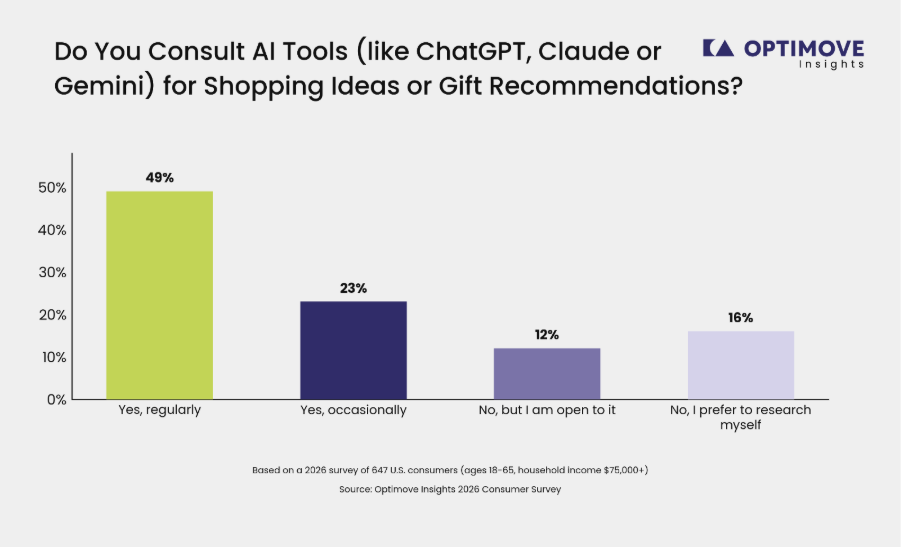
Nearly half of consumers, 49%, say they regularly consult AI tools such as ChatGPT, Claude, or Gemini for shopping ideas or gift recommendations. Another 23% use these tools occasionally, bringing total reported usage to 72%.
Only 16% say they prefer to research products entirely on their own. Another 12% are not currently using AI for this purpose but remain open to doing so.
The results suggest that AI-assisted shopping research has moved beyond experimentation for a substantial share of consumers. Regular users alone outnumber occasional users by more than two to one.
Findings
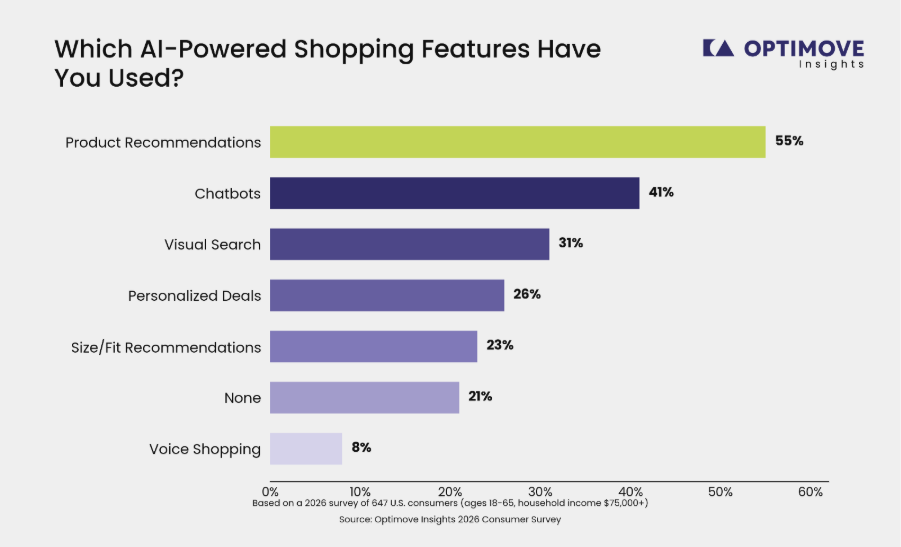
Product recommendations are the most commonly used AI-powered shopping feature, selected by 55% of consumers. Chatbots follow at 41%, while 31% have used visual search.
More personalized applications have also gained traction. Twenty-six percent have used personalized deals, while 23% have used AI-powered size or fit recommendations.
Voice shopping remains significantly less common at 8%. Meanwhile, 21% say they have not used any of the AI-powered shopping features listed.
The results show that adoption is strongest where AI helps consumers narrow choices, answer questions, or find relevant products. More autonomous or less familiar applications remain considerably less established.
Findings
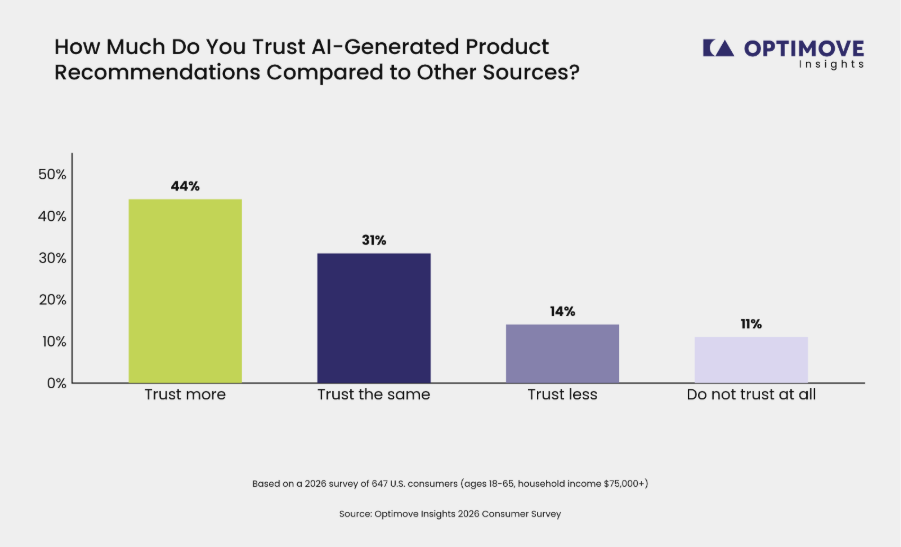
Forty-four percent of consumers say they trust AI-generated product recommendations more than recommendations from other sources. Another 31% trust them about the same.
Combined, three-quarters of consumers place at least as much trust in AI-generated recommendations as they do in alternative sources.
Skepticism remains present but represents a smaller portion of respondents. Fourteen percent say they trust AI recommendations less, while 11% do not trust them at all.
The balance therefore leans clearly toward acceptance: consumers are not simply using AI despite concerns about credibility; most report a level of trust comparable to or greater than other recommendation sources.
Findings
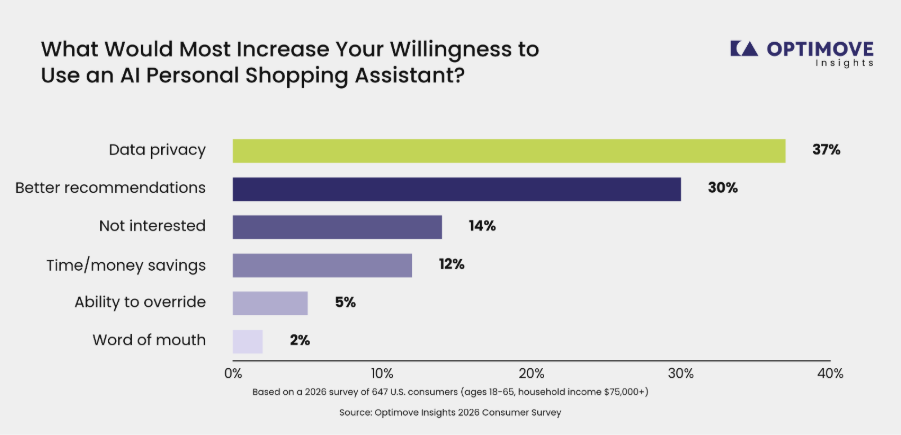
Data privacy is the factor most likely to increase consumers’ willingness to use an AI personal shopping assistant, selected by 37% of respondents.
Better recommendations follow closely at 30%, making privacy and relevance substantially more important than the other factors tested.
Fourteen percent say they are simply not interested in using an AI personal shopping assistant, while 12% would be encouraged by greater time or money savings. Only 5% cite the ability to override the assistant, and 2% point to word of mouth.
The findings suggest that resistance to AI shopping assistants is less about the concept itself and more about whether consumers believe the experience is useful enough—and whether they can trust how their information is handled.
With 72% consulting generative AI tools regularly or occasionally for shopping ideas and recommendations, AI now sits alongside traditional search mechanisms, marketplaces, retailers, social media platforms, and other discovery surfaces.
For marketers, this expands where product consideration begins. Product information must increasingly be structured, accurate, and distinctive enough to surface effectively through AI-mediated discovery, while owned experiences should make it easy for customers to continue the journey once AI directs their attention toward a product or brand.
The objective should not be to create an “AI campaign” in isolation. Brands should treat AI as another interface through which customers discover, evaluate, and eventually purchase products.
Three-quarters of consumers trust AI-generated recommendations as much as or more than other sources. That gives brands significant permission to use AI in the shopping experience, but it should not be interpreted as unconditional trust.
The same consumers who accept AI recommendations identify privacy as the largest opportunity for improving AI shopping assistants. Trust in the output does not necessarily equal comfort with the data required to produce it.
Brands should make the value exchange clear: what information is being used, why it improves the experience, and what control consumers retain. Strong AI personalization should feel useful enough to justify the data behind it, rather than simply more intrusive because more data is available.
After privacy, better recommendations are the factor most likely to increase willingness to use an AI shopping assistant. This is an important distinction. Adoption will not grow simply because retailers add more AI features.
The next competitive advantage will come from the quality of the recommendation itself. AI should understand customer preferences, current intent, previous behavior, context, and available products well enough to reduce the distance between a shopper’s need and the right choice.
This places customer data and decisioning at the center of the AI opportunity. Generative interfaces may change how consumers interact with brands, but the quality of those interactions will still depend on the intelligence underneath them.
AI-powered shopping increases both the amount of customer intelligence available to marketers and the speed at which that intelligence becomes relevant. A shopper can move from an AI-generated gift idea to browsing a product, asking a question, and considering a purchase within minutes.
Traditional workflows built around separate data, analytics, creative, and campaign teams can struggle to keep pace with that journey. By the time an insight moves through multiple handoffs, the customer may already have changed direction.
Positionless Marketing gives marketers the ability to move from insight to execution more independently: identifying an audience, understanding intent, creating relevant content, selecting an offer, and activating it across channels without waiting on a sequence of specialized teams.
For AI-powered shopping, this means marketers can respond to the signals AI helps generate while they still matter. The advantage is not simply using more AI; it is combining intelligence, creativity, and execution quickly enough to make every recommendation or interaction more relevant.
AI shopping has already crossed an important threshold. Most consumers in this research use AI tools for shopping research, product recommendations have become mainstream, and trust in AI suggestions is relatively high.
The next stage will be defined less by adoption than by quality. Consumers are signaling that they want recommendations that genuinely improve their decisions and experiences that protect their data while using it intelligently.
For marketers, the opportunity is to treat AI as part of the customer journey rather than as a standalone technology. Brands should build around assisted discovery, stronger personalization, transparent data practices, and customer control—using AI where it removes friction rather than simply where it can be added.
Positionless Marketing makes that strategy actionable. When marketers can independently connect customer intelligence with creation and execution, AI becomes more than a recommendation engine or interface. It becomes a way to recognize intent and respond with greater relevance at the moment the customer is ready to act.
About Optimove
Optimove, the creator of Positionless Marketing, frees marketing teams from the limitations of fixed roles, giving every marketer the power to execute any marketing task instantly and independently. Positionless Marketing has been proven to improve campaign efficiency by 88%, allowing marketing teams to create more personalized engagement with existing customers.
For two years running, Optimove has been positioned as a Visionary in Gartner's Magic Quadrant for Multichannel Marketing Hubs, recognized for its AI-driven decisioning, prescriptive insights, and proven ability to orchestrate thousands of personalized campaigns in real time across channels.
Its Positionless Marketing Platform includes Optimove Engage and Orchestrate for cross-channel campaign decisioning and orchestration; Optimove Personalize, a digital personalization engine; and Optimove Gamify, a loyalty and gamification platform.
All are powered by Optimove AI, the marketing AI suite that brings AI everywhere marketers work. Inside the platform through Native AI agents for decisioning, analysis, and creation, outside it to external AI tools like Claude and ChatGPT through the Optimove MCP, and into custom-built applications on top of the platform through Optimove Custom Apps. Optimove has embedded AI in its platform since 2012, paving the way for Positionless Marketing.
Today, its comprehensive AI-powered suite is at the leading edge of empowering marketers to streamline workflows from Insight to Creation and through Optimization. Optimove provides industry-specific and use-case solutions for leading consumer brands globally.
Optimove Insights is the analytical and research arm of Optimove, dedicated to providing valuable industry insights and data-driven research to empower B2C businesses.
Better, Smarter, Faster: How AI is Transforming CDPs