
Unified Growth Solution
World-class tech needs world-class drivers. AI platform and expert services, unified
Read time 6 minutes


Future Commerce's Positionless Marketing Guide
Why it matters:
This post shows how Optimove’s AI Journey Decisioning Agent determines the right campaign and journey for each individual customer, reducing marketing fatigue, preventing redundant touchpoints, and creating customer journeys that feel consistent and personal across all channels.

Key takeaways:
The short answer is conflict and campaign crossfire. Customers don’t experience channels separately, and marketers shouldn’t run them that way.
Here’s a scenario that shouldn’t feel familiar but probably does:
A customer browses a product on a website, abandons their cart, and receives a generic welcome email two hours later. A day later, they receive an SMS from that same brand offering a discount on the product they already purchased. Then they see retargeted ads on two different platforms for that same item they ended up buying. By the time a push notification arrives asking them to “complete their cart journey,” they’ve quietly unsubscribed from every channel.
In the scenario above, no single channel or journey failed. All of them did because no one was making sure they talked to each other. Email, mobile, SMS, web, push, and paid channels routinely operate in isolation across marketing teams in various organizations. The result is inconsistent timing, duplicated messaging, and experiences that feel irritable rather than well-thought-out.
It’s not a channel problem. It’s a coordination problem.
A siloed channel problem is when a brand’s channels are planned and executed in separate workflows with no shared customer context, so messages don’t talk to each other.
Though most brands use various marketing channels to target and retain customers, these channels are created in separate workflows, with no shared understanding of the customer.
SILO | Mobile SILO | SMS SILO | Web SILO | Paid SILO |
The impact is measurable. According to the Optimove Insights Marketing Fatigue Report (2026), 83% of customers unsubscribe due to repeated offers across channels, which is taken as proof that the brand simply isn't paying attention.
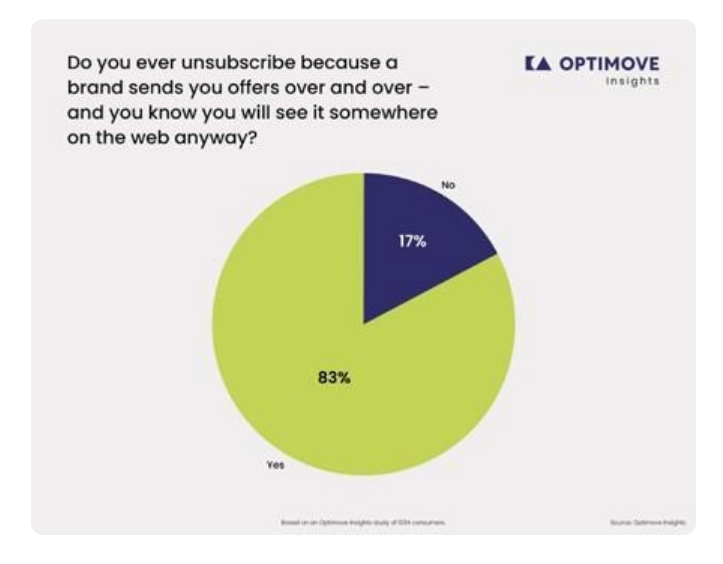
In addition, 46% unsubscribe due to repeated promotions for the same product. Even valuable offers become noise when delivered without orchestration, ultimately causing customers to leave.
AI-Driven Decisioning isn’t about sending more messages — it’s about making every message part of something larger. When segments, timing, content, and channel selection are coordinated by a single intelligence layer, what used to feel like noise becomes a conversation.
A properly orchestrated journey, driven by an AI Journey Decisioning, looks different at every step. The customer who browses a pricing page sees a tailored follow-up not because someone watched them, but because a next-best-action model predicted what they needed before they asked. Or when a lapsed user reopens an app, a re-engagement flow resumes exactly where their last interaction was left off.
When a journey is guided by AI Journey Decisioning – every touchpoint carries context, and nothing feels random.
The move from siloed campaigns to orchestrated journeys requires more than new software. It requires a fundamentally different way of thinking about customer engagement; one where the channel is a delivery mechanism, not the strategy itself.
Powering personalized journeys with AI Journey Decisioning across channels requires infrastructure that most point solutions can’t provide on their own. Optimove brings together the audience intelligence, channel integrations, and the AI Decisioning Studio to allow teams to build connected journeys, not just coordinated campaigns.
High-performing teams design personalized journeys to reduce effort and improve discovery. They rely on recent behavior, contextual signals, and demonstrated preferences to guide recommendations, ensuring each interaction boosts engagement.
When personalization is orchestrated using proper tools across all marketing channels, it feels like assistance that adapts in real-time, strengthening trust and loyalty while accelerating the path to purchase and also repeat purchase.
Having the right tools, though, means nothing if the team behind them is stuck waiting for other departments to move.
Positionless Marketing removes the bottlenecks. Marketers don't wait for data teams, approval chains, or IT tickets – they act on customer signals immediately.
Even when orchestration is the goal, execution often stalls. Data sits in one team, creative lives in another, and campaign logic requires waiting for a third team. By the time everyone aligns, the moment has passed, and the customer has moved on.
This is the operational bottleneck that Positionless Marketing is designed to remove. It gives marketers the freedom to move across strategy, execution, and optimization without waiting on siloed workflows or lengthy approval chains. The marketer closest to the customer insight shouldn’t have to file a ticket to act on it.
Positionless Marketing is built on three core pillars — Data Power, Creative Power, and Optimization Power — which together enable marketers to act instantly and independently by unifying data, execution, and AI-driven decisioning in a single framework.
The brands executing on this model aren’t just sending better messages. They’re operating at a pace their competitors can’t match because the friction that slows most marketing teams down has been removed.
The goal isn’t to replace human judgment; it’s to make human judgment faster and better-informed. When the AI handles channel routing, timing optimization, and content personalization, marketers can focus on the decisions that actually require creative, strategic thinking.
For many brands, the challenge is no longer access to marketing channels; it’s the ability to coordinate them effectively. Disconnected execution leads to poor, fragmented experiences that annoy customers. AI Journey Decisioning is how brands fix that.
The brands winning today are not just present in more channels — they are orchestrating those channels into a single, connected, personalized customer journey.
For more insights on AI Journey Decisioning, contact us to request a demo.
Free your marketing team from the bottlenecks of the assembly line


Dafna is a content marketing manager and writer who generates branded content for online industries, specializing in lead generation, SEO, CRM, and lifecycle stage marketing.
With over ten years of professional writing experience, she helps brands grow and increase profitability, efficiency, and online presence. Dafna holds a B.A. in Persuasive Communications from Reichman University (IDC Herzliya).
FAQ
AI Journey Decisioning is an intelligence layer that determines the next best campaign, message, timing, and channel for each customer, so every interaction feels connected instead of random.
Without AI Journey Decisioning, channels operate in silos—leading to duplicated offers, inconsistent timing, and customers who tune out or unsubscribe
Coordinating touchpoints across channels helps prevent redundant messages, limits repeated promotions, and ensures customers receive relevant communications based on recent behavior and context.
With the right platform, brands can start quickly. Optimove unifies customer data, channels, and decisioning in one place, making it possible to launch AI-orchestrated journeys in weeks instead of months.