
Unified Growth Solution
World-class tech needs world-class drivers. AI platform and expert services, unified
Read time 5 minutes


Make loyalty something they want to play
Why it matters:
This blog draws on Optimove Insights data from 2.4 million new bettors to explain exactly why new bettor drop-off happens mid-season and what drives it. Marketers will walk away with a clear framework for converting first-bet signals into personalized follow-up campaigns that turn one-time players into returning ones.
Key takeaways:
Every NFL season, sports betting platforms experience the same wave. New online sports bettors sign up, place a bet on opening weekend or a marquee event, and then, for most of them, that is it. The second bet never comes. The engagement evaporates as quickly as it arrived.
According to Optimove Insights, this pattern holds consistently across operators. The vast majority of new bettors placed only a handful of wagers throughout the entire 2025/26 season. Furthermore, a significant portion placed just one bet, never building enough betting frequency to become return players, no matter how long the season lasted.
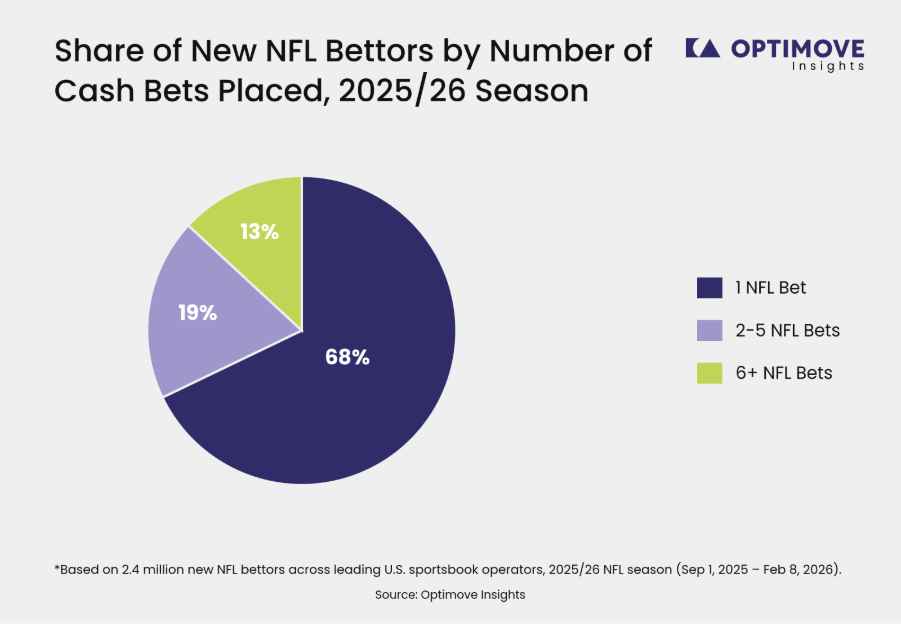
Among 2.4 million new NFL bettors in 2025/26, 68% placed just one cash bet all season. Only 13% placed six or more.
See chart below for more details:
The numbers raise a specific question: Is this a disengagement problem, or a follow-up problem?
The easy read on one-time bettors is that they were never really interested. The behavioral data pushes back on that. These players place moderate stakes, favor single bets over parlays, and grow more conservative as the season progresses. Nothing about how they bet signals disengagement. What is missing is a reason to bet again.
New bettors cluster around the biggest moments: Season openers, holiday games, the Super Bowl. These events handle the acquisition. Once the final whistle blows, there is nothing carrying players forward, no next moment, no prompt from the operator connecting what they just did to what comes next.
Early outcomes add pressure. A losing first bet significantly reduces the likelihood of a second, which means the window to turn an event-driven bettor into a returning one closes faster than most operators account for.
Most platforms treat the first bet as the goal. That is the wrong frame. The first bet is the moment the retention work begins. What happens in the days immediately after, specifically whether the operator shows up with something personalized, determines whether a new bettor returns or quietly disappears.
The instinct is to send a one-size-fits-all promotional campaign to everyone who registered an account. However, a player who just placed their first single bet on a Thursday night game does not need a generic bonus offer. They need something tied directly to what they just did, something that makes the next bet feel like a natural continuation rather than a cold start.
Cross-sell campaigns and precise segmentation are what close that gap. The data shows that smaller, more targeted audiences consistently outperform broad ones, often substantially. Knowing a player placed exactly one bet, preferred singles over parlays, and first wagered on a certain team shapes, what campaign they should receive next, and exactly when. Speed matters too; a follow-up that arrives three days after the first bet lands in a different context than one sent within 24 hours.
The conclusion from analyzing new bettor behavior is not that seasonal players are unreachable. The path from the first bet to ongoing activity is shorter than expected, and more navigable than most operators assume.
These players do not need to become high-frequency bettors overnight. They need to place a second bet, then a third. The data does not suggest they are resistant to coming back. It suggests they are not being guided back with enough precision or speed.
The 2026 NFL season opens September 9 and runs through Super Bowl LXI on February 14, 2027: 18 weeks of natural betting moments, each one a potential second-bet trigger. The operators ready to meet new players at that first bet, with a follow-up strategy already in place, are the ones who turn a seasonal surge into something that lasts.
The NFL season is the biggest new-player acquisition window in U.S. sports betting, and most operators lose the majority of those players after a single bet.
That is a retention problem operators can solve, not a behavioral one they have to accept. The players are showing up, and the gap is in what happens after they do.
Optimove Orchestrate gives operators the infrastructure to act on this by triggering personalized follow-up automatically based on specific first-bet signals, without waiting for a manual campaign build.
For more insights into player retention, contact us to request a demo.
Download the Increasing the Value of New Online Gaming Players report and discover proven methods to increase new player deposits, retention, and lifetime value when empowered by Positionless Marketing


Roni is a Marketing Research Analyst on Optimove’s Professional Services team.
As part of her role, she analyzes customer data to extract actionable marketing insights for retail and gaming clients. Roni is currently pursuing a degree in Industrial Engineering and Management at Tel Aviv University.
FAQ
New NFL bettors typically place their first bet around a high-profile moment, then stop. Without a relevant, timely follow-up message tied to their specific behavior, there is no trigger to return. A losing first bet reduces the odds of a second even further.
The engagement window closes quickly, and it is best to send a message within 24 to 48 hours. Operators who wait for the next marquee game to do the re-engagement work naturally often find the player has already drifted.
Precise segmentation aligns with the actual betting behavior: What was bet, how much, whether it won, which sport, which team, etc. The more specific the audience, the higher the response rate.
Yes, significantly. Data shows a losing first bet reduces the likelihood of a second. That makes the post-loss follow-up more critical, not less. A well-timed message after a loss can reframe the experience and keep the door open.
Operators prepare by building the segmented follow-up journeys before Week 1 kicks off. They also map out the logic for different first-bet scenarios (win, loss, single, parlay, etc.), set automated triggers to send within 24-48 hours of first activity, and test the messaging long before September 9.