
Unified Growth Solution
World-class tech needs world-class drivers. AI platform and expert services, unified
Read time 10 minutes


Executive Summary: :
Women’s March Madness has evolved from a single-star betting spike into a scalable, multi-year growth opportunity for sportsbooks.
In 2024, Caitlin Clark drove unprecedented betting concentration. Games featuring Clark saw a 540% average increase in bets during the NCAA tournament, with the championship game delivering a staggering 1,228% uplift versus the season average. The impact extended into the WNBA, where Clark-driven games generated a 380% betting increase.
In 2025, Paige Bueckers sustained the star effect, though at a more moderated level. Her championship game produced a 430% uplift versus baseline, confirming that star-driven engagement remains powerful even when the spike is less extreme.
The key insight is not just that stars move betting volume. It is that they expand participation. In 2024, Clark’s games brought in materially more unique bettors, not just heavier wagering from existing users. In 2025, Bueckers maintained incremental growth in reach across later tournament rounds.
The market signal is clear: women’s March Madness is transitioning from a single-event anomaly to a repeatable, multi-week betting engine.
Looking ahead to 2026, the opportunity broadens further. With multiple elite players — including Sarah Strong, Madison Booker, Mikayla Blakes, Azzi Fudd, and Olivia Miles — and iconic coaches such as Geno Auriemma, Dawn Staley, and Kim Mulkey, betting attention will no longer concentrate around one player or one team. It will distribute across more matchups, more narratives, and more rounds.
For sportsbooks, this changes the strategy.
Women’s March Madness should no longer be treated as a niche promotion tied to one superstar. It is becoming a sustained acquisition and engagement window capable of driving both betting volume and new bettor growth.
Winning operators in 2026 will:
However, capturing this growth requires operational speed. The sportsbooks that benefit most will be those whose marketing teams can move from insight to execution instantly by launching targeted campaigns, testing creative, and optimizing journeys in real time.
Positionless Marketing provides that advantage. By enabling marketers to analyze data, create campaigns, and optimize engagement without waiting on siloed teams, sportsbooks can convert breakout performances and tournament momentum into immediate revenue impact.
In 2026, the edge will not come from waiting for the next singular superstar.
It will come from sportsbooks that can execute at the speed of the tournament.
In 2024, women’s basketball forever changed with Caitlin Clark. She is a generational phenom who not only drove interest, television ratings and endorsements. but also lifted interest in betting on the sport. Our Optimove Insights' analysis of the 2024 NCAA March Madness tournament, showed a significant 540% average increase in bets on games featuring Caitlin Clark. That was followed by an analysis of May 2024 WNBA games that revealed a significant 380% average increase in bets on games featuring Clark.
One year later, Paige Bueckers led the University of Connecticut through the 2025 NCAA tournament. She too has star power, but not at the same magnitude as Clark.
The methodology for this analysis is based on data across the 2024 and 2025 March Madness tournaments. In 2024, our analysis covered over 2.7 million bets, while in 2025 we examined more than 2.6 million bets. We measured how betting activity changed in games featuring these two generational players. The impact of betting of games with Caitlin Clark and Page Bueckers were measured against overall average of betting activity and amounts of all rounds, which is the baseline of 100%.
The results show the star effect remained present in 2025 with Bueckers, though at a more modest scale compared to Clark’s 2024 run.
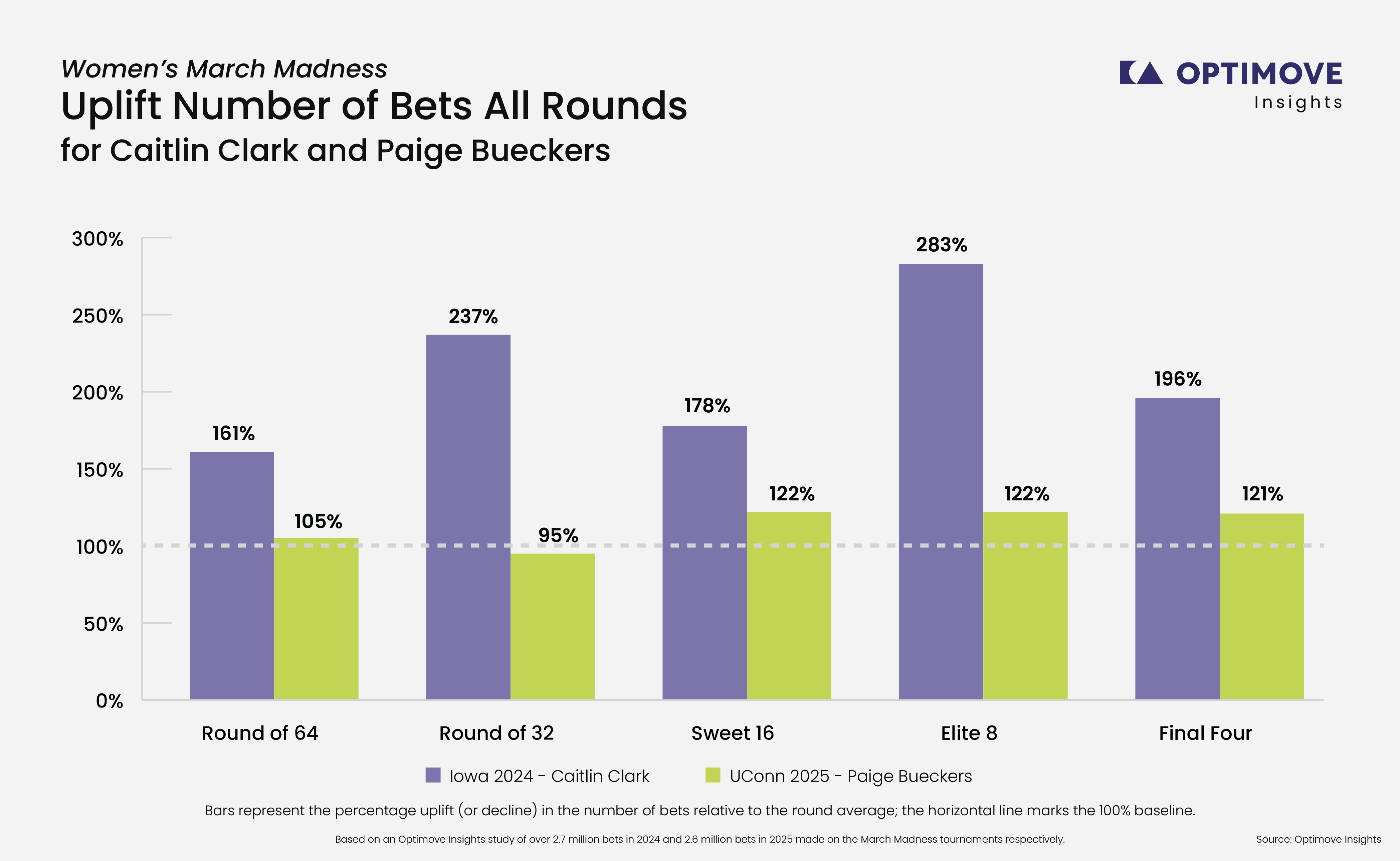
Analyzing betting activity across tournament rounds, Caitlin Clark’s effect in 2024 shows consistent outperformance versus the overall average of all rounds (the baseline at 100%), with the strongest lifts emerging deeper into the tournament. The Elite Eight stands out as the peak point of concentration with a 183% increase over the baseline, highlighting how Iowa games featuring Clark became disproportionately “must-bet” events as stakes rose.
In 2025, Paige Bueckers’ UConn run shows a steadier pattern: uplift is present, but generally closer to baseline across rounds (for example a 22% uplift over the baseline in the Elite Eight round), with the strongest performance clustering in the later stages of the tournament rather than spiking as sharply in a single round.
The takeaway: The star effect remains real but the shape of it changes. In 2024, it appears more explosive and concentrated, and in 2025, it remains meaningful but more moderated.
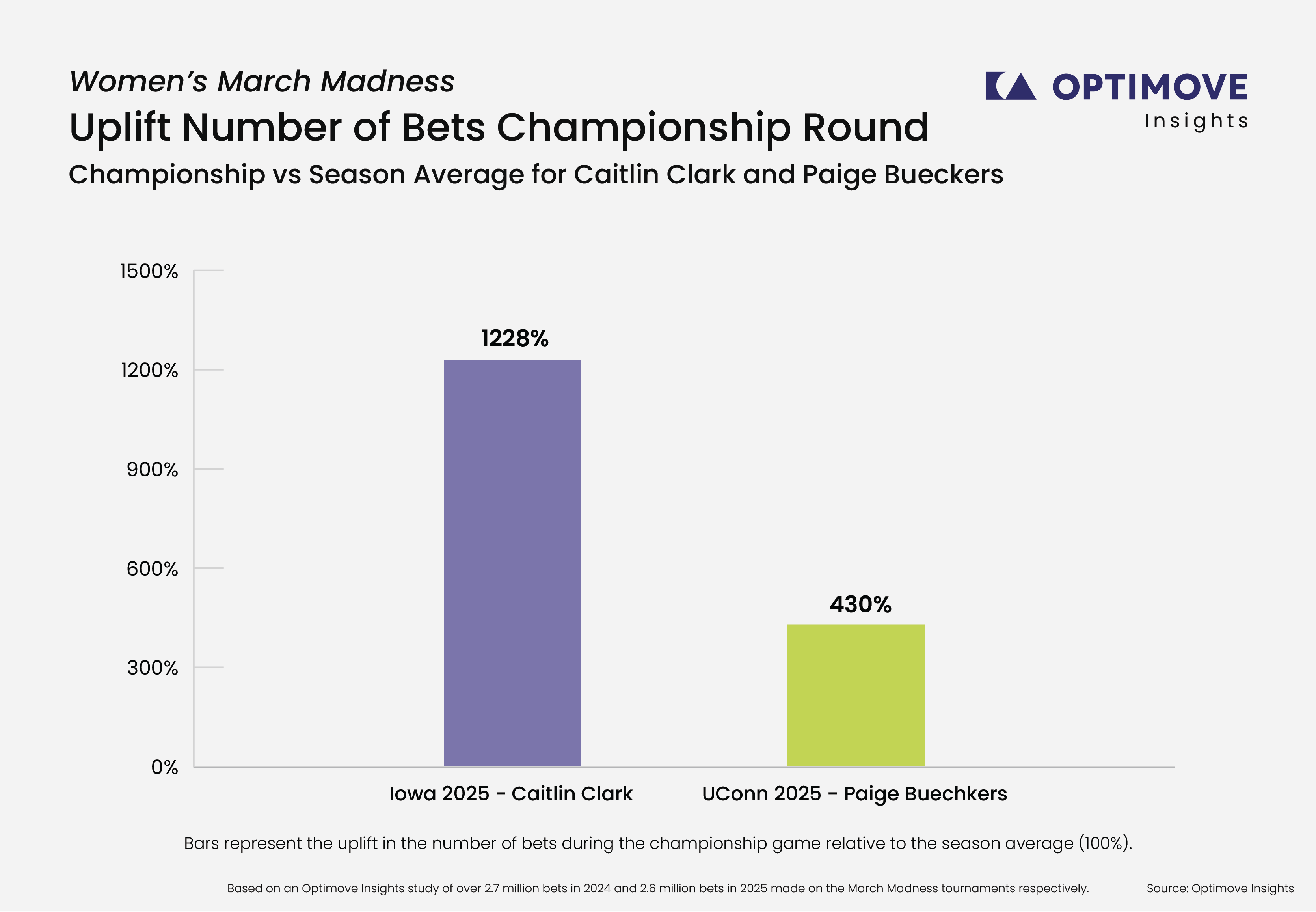
The championship comparison makes the difference in magnitude most visible. Benchmarking each title game against the season-wide average number of bets (100%), Iowa’s 2024 final delivered an extreme lift, while UConn’s 2025 final still shows a clear positive uplift but at a materially lower level than the 2024 peak.
In 2024, the Iowa vs. South Carolina championship game reached an extraordinary 1,228% uplift vs. the season average. In 2025, the UConn championship game featuring Paige Bueckers also delivered a clear spike, reaching 430% above the season average. While substantially lower than Clark’s peak, this still represents a dramatic concentration of betting activity relative to a typical women’s game.
This reinforces an important distinction: Clark’s run represents a particularly high watermark of concentrated betting attention, while Bueckers’ run demonstrates that the championship-stage star boost persists even when the overall spike is less extreme.
Confirming that star-driven betting interest remained firmly elevated as the torch was passed.
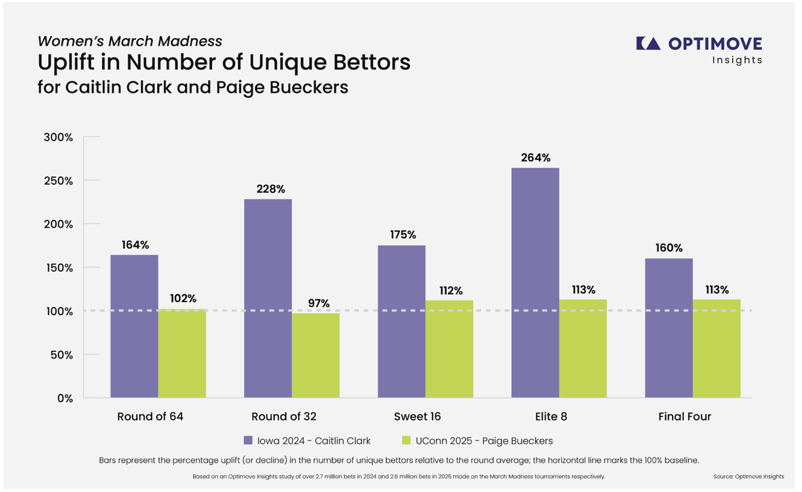
When shifting from total bets to unique bettors, the pattern becomes even more telling. In 2024, Iowa games featuring Clark consistently pulled in a broader audience versus the round average, with the later rounds again showing the strongest relative impact, suggesting that the Caitlin Clark effect wasn’t only about heavier betting by existing users, but also broader participation.
In 2025, UConn games show a more incremental uplift in unique bettors: generally above baseline in later rounds, but without the same level of outsized expansion seen in 2024. The participation effect is there, but it scales differently.
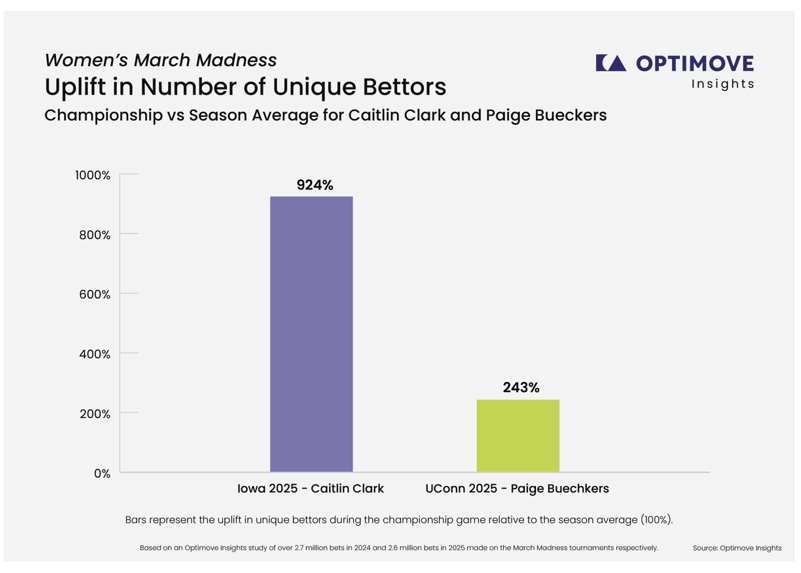
The title game comparison mirrors what we see in betting volume. Iowa 2024’s championship generated a massive increase in unique bettors versus the season average, while UConn 2025 still delivered a clear uplift, again smaller in magnitude, but definitively above baseline.
#Unique Bettors: the distinct number of bettors who placed at least one bet on the relevant games during that tournament round.
Caitlin Clark’s 2024 run produced the bigger spikes, especially as the tournament pressure built and each game started to feel like an event. In 2025, Paige Bueckers’ games also ran above baseline, but with a more measured profile - less “single explosive moment”, more steady pull as the tournament progressed.
That contrast also lines up with the tone around each player right now. Clark is often framed through the lens of anticipation and “unfinished business”, a resilient icon whose return to form storyline keeps attention high. Bueckers, meanwhile, is more frequently described as a culture setter a calm, leadership driven presence whose impact shows up as sustained interest rather than headline spikes.
Star power continues to shape betting behavior, even when the peak is lower, and women’s basketball now supports multiple forms of star impact, from singular peaks to more durable, repeatable engagement.
Top 5 college women players going into March Madness 2026 are the following:
In addition, the women’s college basketball has three iconic brand name coaches:
This list is just a starter and during the 2026 expect “surprise” interest in other players.
If 2024 was defined by one generational superstar, and 2025 showed a steadier but still meaningful star effect, 2026 signals something bigger: women’s March Madness is no longer dependent on a single player to drive betting interest.
With multiple high-profile athletes across top programs and nationally recognized coaches leading perennial contenders, attention is broadening across the tournament rather than concentrating around one team.
Women’s March Madness should no longer be treated as a niche or novelty moment driven by one breakout star. It is becoming a sustainable, multi-week betting window capable of attracting both higher volume and new bettors.
Operators that proactively lean into this shift can capture outsized gains.
To optimize bettor engagement, sportsbooks should:
The data is clear: when attention concentrates, betting follows.
But capturing that demand requires more than good ideas. It requires speed.
Sportsbooks must be able to move from insight to execution in hours, not days. They need marketers who can analyze audiences, launch campaigns, test creative, and optimize journeys without waiting on separate data, creative, or engineering teams.
That’s where Positionless Marketing becomes a competitive advantage for sportsbooks.
By equipping marketers with the data, creative tools, and automation to act independently, operators can react instantly to breakout performances, hot teams, and emerging storylines: turning real-time moments into real-time revenue.
In 2026, the edge won’t come from waiting for the next Caitlin Clark- or even Paige Bueckers-level spike.
It will come from sportsbooks that can execute at the speed of the game.
Optimove, the creator of Positionless Marketing, frees marketing teams from the limitations of fixed roles, giving every marketer the power to execute any marketing task instantly and independently. Positionless Marketing has been proven to improve campaign efficiency by 88%, allowing marketing teams to create more personalized engagement with existing customers.
For two years running, Optimove has been positioned as a Visionary in Gartner’s Magic Quadrant for Multichannel Marketing Hubs, recognized for its AI-driven decisioning, prescriptive insights, and proven ability to orchestrate thousands of personalized campaigns in real time across channels. AI-led marketing is a hallmark of Optimove’s visionary leadership. By embedding AI directly into its platform as early as 2012, Optimove paved the way for today’s Positionless Marketing standard.
Its Positionless Marketing Platform includes Optimove Engage and Orchestrate for cross-channel campaign decisioning and orchestration; Optimove Personalize, a digital personalization engine; and Optimove Gamify, a loyalty and gamification platform.
Today, its comprehensive AI-powered suite is at the leading edge of empowering marketers to streamline workflows from Insight to Creation and through Optimization. Optimove provides industry-specific and use-case solutions for leading consumer brands globally.
Optimove Insights is the analytical and research arm of Optimove, dedicated to providing valuable industry insights and data-driven research to empower B2C businesses.