

Unified Growth Solution
World-class tech needs world-class drivers. AI platform and expert services, unified
Read time 14 minutes


Optimove Ranked #1 for AI Capabilities
Why it matters:
These rankings help marketers evaluate what actually drives performance, moving beyond feature comparisons. Platforms with stronger Prescriptive Intelligence reduce manual work, speed up execution, and deliver measurable uplift through continuous optimization. For marketing teams under pressure to do more with less, that’s a direct competitive advantage.

Key takeaways:
CRM marketing platforms were evaluated by Gartner in the 2025 Critical Capabilities for Multichannel Marketing Hubs report and received rankings across multiple critical use cases. The report assessed 11 vendors and marketers can use this research to identify the platforms that will be best for their specific needs.
Here are the rankings for Prescriptive Intelligence:
Gartner’s August 2025 Critical Capabilities for Multichannel Marketing Hubs report shines a light on which platforms have the AI and analytics infrastructure to turn customer data into measurable marketing impact.
Gartner scored Prescriptive Intelligence across the 11 vendors evaluated, and the scores vary dramatically.
The gap between “We know what happened” and “We know what action to take” is where campaigns slow down, personalization stalls, and teams default to manual rules.
In this article, you’ll get a data-backed ranking of 11 CRM marketing platforms by Prescriptive Intelligence, a clear explanation of what Prescriptive Intelligence means day-to-day, and a practical buying framework for why it should be a top three evaluation criterion for marketing leaders choosing or switching platforms.
Marketing analytics has evolved in layers. Most platforms offer some combination of these three intelligence levels:
They’re drowning in dashboards and model outputs but still spending hours in meetings translating insights into action: building segments, writing rules, allocating budget, selecting channels, and guessing which variant will win.
That’s why Gartner’s framing matters: Prescriptive Intelligence is not a vague buzzword here – it’s a scored Critical Capability inside Gartner’s evaluation of Personalization Engines. In other words, Gartner is benchmarking how effectively each platform converts data into next-best-action decisioning and measurable business outcomes.
And it’s not an academic difference. In one documented case study, prescriptive analytics delivered a 32% increase in conversion rates by automating lead prioritization and optimizing channel spend allocation. That’s exactly the kind of “action translation” that most teams still handle manually.
Below is the ranking of 11 CRM marketing platforms based on Gartner’s Prescriptive Intelligence score from the August 2025 Critical Capabilities for Personalization Engines evaluation:
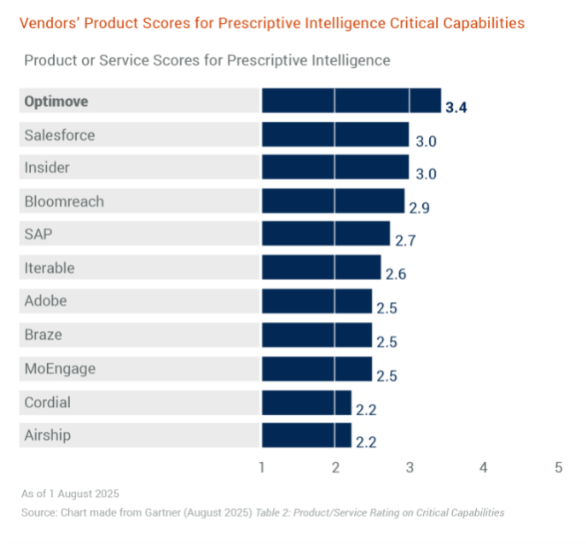
A quick editorial note: The 1.2-point spread from top to bottom indicates meaningful differentiation, not a crowded pack. In practice, scoring above 3.0 signals top-tier performance for this specific capability. Even a few tenths of a point can reflect substantial differences in how “hands-off” or “hands-on” the platform must be to deliver optimized, personalized action.
Source: Gartner, Critical Capabilities for Personalization Engines, [analyst names], August 2025.
Top-tier Prescriptive Intelligence doesn’t mean “the platform has AI features.” It means the platform can consistently answer questions like:
Platforms above 3.0 tend to have more of these qualities:
Here’s how the top performers in Gartner’s Prescriptive Intelligence scoring generally differentiate:
Here are the rankings and a short explanation as to what it means:
Optimove scored the highest across all 11 vendors. Its Prescriptive Intelligence is powered by AI Marketing Agents, spanning predictive, generative, prescriptive, and agentic capabilities. What that means operationally is that the platform is designed to reduce the burden of decision-making, so campaigns don’t stall in planning meetings or rely on static rules.
A direct embodiment of prescriptive AI is AI Journey Decisioning & Orchestration, where marketers create customer journey variations (different messages, offers, timings, channels), and the platform autonomously determines which combination each individual customer should receive to maximize their incremental uplift. Instead of guessing which experience “should” work, teams set guardrails and goals and then let optimization happen continuously.
Salesforce is a major enterprise player and a natural contender for organizations already embedded in the Salesforce ecosystem. Its prescriptive capabilities are closely tied to its broader data and application landscape, which can be a powerful advantage when data, identity, and execution are unified.
For many enterprises, Salesforce’s path to prescriptive value is best realized when AI outputs are tightly connected to activation across its clouds. The main question for evaluators becomes less “does it have AI?” and more “how quickly can our team operationalize the recommendations into measurable uplift?”
Insider is known for cross-channel experience orchestration and AI-native personalization. In practice, Insider often earns strong evaluations when teams want centralized journey orchestration and personalization driven by behavior and intent signals.
For marketing leaders, Insider’s top-tier score suggests it can support more “recommend-and-act” workflows, reducing reliance on manual segmentation and static business rules.
Bloomreach is frequently associated with commerce-focused personalization, where recommendations, browsing behavior, and product discovery are critical. Its score lands just below the top tier, which may reflect that commerce-strength doesn’t always translate perfectly into the broader CRM marketing requirement: continuously prescribing actions across a wider set of customer behaviors, lifecycle states, and channels.
For commerce-heavy brands, Bloomreach can be a strong fit—but Prescriptive Intelligence is still worth validating specifically against important use cases.
Mid-tier Prescriptive Intelligence scores often reflect platforms that can support personalization and automation but still rely heavily on human-built rules, manual orchestration, and operational effort to turn insights into actions.
These platforms can still be excellent choices depending on stack, budget, and needs. The key is understanding what you’re buying: a platform that assists decisioning vs. a platform that drives decisioning.
SAP’s marketing ecosystem offers enterprise-grade scale and integration, and Emarsys brings strong cross-channel marketing functions. However, Gartner’s scoring suggests prescriptive decisioning lags behind AI-native platforms.
For organizations that prioritize enterprise IT alignment and standardized suites, SAP can be a pragmatic choice. But marketing leaders should validate how “prescriptive” the platform is in practice: are recommendations clear and actionable, and do they improve over time without heavy manual upkeep?
Iterable is well-regarded for cross-channel messaging and lifecycle execution. A 2.6 prescriptive score can indicate that while teams can automate journeys and personalize at scale, they may still need to do more work themselves to determine the best next action, especially if optimization requires manual testing strategies and segmented rules.
If Iterable is on your shortlist, focus demos on decisioning depth: how does it recommend the next action, and what does it optimize automatically?
Adobe is frequently recognized for breadth, experimentation tooling, and experience execution. Yet Gartner’s 2.5 rating for Prescriptive Intelligence is a reminder that overall leadership and execution strength do not always translate into top performance in a specific AI decisioning capability.
For evaluators, the takeaway is simple: if prescriptive next-best-action decisioning is a priority, ensure it’s validated explicitly. Don’t assume broad suite strength automatically means stronger prescriptive automation.
Braze is known for real-time engagement and strong activation workflows. A mid-tier prescriptive score suggests that while teams can execute responsive campaigns, the “what should we do next?” layer may still be shared between the platform and the marketing team, rather than being deeply automated.
In evaluations, look for how Braze supports continuous optimization: does it guide decisioning across channel, message, timing, and frequency with measurable uplift, or does it primarily enable you to run what you already decided?
MoEngage is popular with mobile-first brands that value engagement speed and cross-channel messaging. A 2.5 score suggests competitive activation capabilities but room to grow in deeper prescriptive AI, particularly where autonomous optimization and next-best-action decisioning are required.
Lower-tier scores (below 2.5) signal platforms that provide execution infrastructure but limited AI-driven guidance so teams will do most of the work defining segments, choosing channels, and optimizing campaigns themselves.
Cordial offers solid cross-channel execution and real-time personalization capabilities, but Gartner's 2.2 score suggests its Prescriptive Intelligence remains underdeveloped. Marketing teams using Cordial will likely need to build most decisioning logic themselves, defining segments, setting rules, and manually optimizing campaigns rather than relying on platform-driven recommendations.
Airship is well-regarded for mobile app engagement and push notification expertise, but its 2.2 Prescriptive Intelligence score indicates limited AI-driven decisioning capabilities. While the platform excels at executing mobile-first campaigns, teams will need to provide most of the strategic direction, deciding who gets what message, when, and through which channel.
Key consideration: If your mobile engagement strategy relies on real-time behavioral triggers and you're comfortable building the decisioning logic in-house, Airship's execution layer is strong. But don't expect the platform to recommend or optimize the next best action autonomously.
Here’s the overall summary of rankings:
| Platform | Score | Tier | Key Strength |
|---|---|---|---|
| Optimove | 3.4 | Leader | Autonomous decisioning |
| Salesforce | 3.0 | Leader | Ecosystem + AI |
| Insider | 3.0 | Leader | Cross-channel AI |
| Bloomreach | 2.9 | Upper Mid | Commerce personalization |
| SAP | 2.7 | Mid | Enterprise scale |
| Iterable | 2.6 | Mid | Lifecycle messaging |
| Adobe | 2.5 | Mid | Broad capabilities |
| Braze | 2.5 | Mid | Real-time engagement |
| MoEngage | 2.5 | Mid | Mobile-first |
| Cordial | 2.2 | Lower | Limited AI |
| Airship | 2.2 | Lower | Limited AI |
Most marketing teams don’t need more dashboards or even more predictions. What they need is action at scale: Recommendations that remove friction from planning and help teams execute the best next move without weeks of analysis and cross-team dependencies.
That’s why Prescriptive Intelligence is increasingly becoming a top-three buying criterion. It supports the shift from:
In practical terms, Prescriptive Intelligence changes how marketing operates:
Prescriptive Intelligence matters in Positionless Marketing because it enables any marketer to execute, optimize, and scale campaigns without relying on specialized roles or manual decision-making.
Prescriptive Intelligence is a foundation for Positionless Marketing, the operating model where any marketer can execute any task independently because intelligence is embedded into every workflow, not trapped in specialized roles or teams.
By recommending (and increasingly automating) the next best action, like who to target, what to send, when, and on which channel, Prescriptive Intelligence removes the need for constant human orchestration.
When the platform can recommend what to do next (and increasingly act on it), marketers don’t need to wait for an analyst to build a segment, an ops specialist to configure a test, or a strategist to interpret outputs. They can move from idea → execution → optimization with far fewer handoffs.
In practice, this leads to:
Positionless Marketing has been shown to improve campaign efficiency by 88%, not just because teams work faster, but because they spend far less time coordinating and far more time generating what drives uplift.
If you want a deeper view into how AI agents are powering this model, check out: AI Agents for Marketing: How AI Agents Are Powering the Positionless Marketer
If you’re evaluating CRM marketing platforms, shift your vendor questions from feature checklists to outcome questions. Here are seven of the most important evaluation questions to ask and why:
The platform should provide clear next-best-action recommendations, not just dashboards or scores.
True Prescriptive Intelligence goes beyond “who to target” and covers the full decision stack.
Look for continuous optimization loops (test → learn → adapt), not one-time recommendations or static rules.
A strong platform doesn’t just suggest actions; it activates them across channels without requiring additional tools or manual workflows.
Prioritize platforms that measure real business impact (e.g., revenue lift, conversions), not vanity metrics like opens or clicks.
The more effort required to translate insights into campaigns, the weaker the prescriptive capability.
Speed to execution is a key indicator of whether the platform truly reduces operational friction.
The platforms that win the next era won’t be the ones that simply “support personalization.” They’ll be the ones that remove the operational burden of deciding, configuring, and constantly revising personalization at scale.
Gartner’s Prescriptive Intelligence scoring offers a rare, practical lens into which CRM marketing platforms are truly AI-native, and which ones have added AI features onto legacy architectures.
Across the 11 vendors evaluated, the differences are meaningful. Scores above 3.0 represent the top tier of prescriptive decisioning, and Optimove’s leading score of 3.4 reflects long-term investment in capabilities such as Self-Optimizing Journeys, AI Marketing Agents, and the broader Positionless Marketing framework.
If you’re choosing a CRM marketing platform, don’t stop at “does it have AI?” Ask whether it can consistently answer the only question that matters at scale: What should we do next, and can the platform continuously optimize that decision?
To see how Optimove’s Prescriptive Intelligence works in practice, explore the interactive resource built around Gartner’s Critical Capabilities: Optimove launches Business Fit Simulator based on Gartner's Critical Capabilities
Also see how Gartner scored the top 11 platforms for Analytics and Foundational AI, and why Optimove ranked #1 here too.
Finally, if you want more Gartner context, read: Optimove Named a Visionary in Gartner's 2025 Magic Quadrant™ for Multichannel Marketing Hubs
For more insights on Prescriptive Intelligence, contact us to request a demo
Gartner Ranks Optimove #1 in AI Capabilities
In this Gartner report, Optimove ranks #1 in AI capabilities that matter most. Gartner rankings validate the power of Positionless Marketing.


Writers in the Optimove Team include marketing, R&D, product, data science, customer success, and technology experts who were instrumental in the creation of Positionless Marketing, a movement enabling marketers to do anything, and be everything.
Optimove’s leaders’ diverse expertise and real-world experience provide expert commentary and insight into proven and leading-edge marketing practices and trends.
FAQs
Prescriptive Intelligence is an AI capability that goes beyond predicting customer behavior to recommending specific marketing actions, such as which customer to target, through which channel, with which message, and at what time.
Optimove received the highest score of 3.4 out of 5 in Gartner's August 2025 Critical Capabilities for Personalization Engines report, followed by Salesforce and Insider at 3.0.
Predictive Analytics forecasts what will happen (e.g., churn probability). Prescriptive Intelligence goes further by recommending what you should do about it, automating the decision layer that typically requires manual intervention.
The Magic Quadrant evaluates vendors on overall vision and ability to execute. The Critical Capabilities report scores vendors on specific technical differentiators. A vendor can be a MQ Leader while scoring modestly on individual capabilities like Prescriptive Intelligence.
Positionless Marketing is an operating model pioneered by Optimove where AI intelligence is embedded into every marketing workflow, enabling any marketer to independently execute tasks that previously required specialists, analysts, or cross-team dependencies.