
Unified Growth Solution
World-class tech needs world-class drivers. AI platform and expert services, unified
Read time 9 minutes


Why it matters:
Retail marketers need new ways to earn attention, extend engagement time, and drive measurable sales impact from campaigns. This post shows proven gamification formats and a practical playbook for launching a no-code experience that can drive loyalty, leads, and revenue.
Key takeaways:
You might think that applying gamification in retail requires hiring a team of experienced developers and paying them a ton of money. You couldn’t be more wrong.
Picture this: You go to a website and log in. Next, you select a campaign type and, using templates, adjust it to match your brand and style. Then you set up prizes, create a leaderboard, and publish your campaign. And that’s all! You’ve created a gamification experience for your customers!
Too good to be true? In this article, we will explain how it is entirely possible. Moreover, to inspire you, we will provide four real-life gamification examples that were highly successful. Let’s dive in.
Gamification in retail refers to using game-like elements, mechanics, and design in non-game settings to engage customers and create an enjoyable shopping experience. It involves incorporating elements of fun, competition, rewards, and challenges into the retail environment.
For example, you can launch quizzes for customized product recommendations or add gamification elements to your loyalty programs.
Using gamified elements in the retail industry can have several benefits. Here are a few:
• Engagement and experience: Gamification aims to increase customer engagement and create positive experiences with the store.
• Improving brand loyalty: Offering rewards, discounts, promotions, or other prizes to customers who participate in games or activities is an excellent way of increasing brand loyalty.
• Attracting and retaining customers: Gamification can attract new customers and retain existing ones by making the shopping experience more interactive and fun.
• Increasing sales: Incorporating gaming aspects into retail businesses can increase customer acquisitions and drive revenue.
All in all, e-commerce gamification can make online shopping more fun, increasing customer loyalty and boosting sales.
To prove that gamification in sales is one of the best marketing strategies possible, we have four inspiring stories:

Ādažu, a Latvian chip brand, wanted to bring its historical products back to stores. They created a limited edition of old chip flavors and used gamification strategies for promotion.
Their goal was to increase positive and nostalgic associations with the brand and win the local market, becoming the most popular chip brand. To do so, they decided to use a Tinder-like game called “Swipe,” where customers like or dislike an item shown to them.
Customers got excited about the campaign even before it was published. POS materials available in stores a couple of days before the game launch attracted massive attention.
On the first day of the campaign, the game got a whopping 3,836 votes. The same trend continued throughout each campaign week, and Ādažu gathered over 19,000 leads each week.
Customers loved that they could vote so easily and instantly see the general voting results after the game finished. By giving customers a fun, attractive way to express their voices, Ādažu significantly boosted customer engagement.

Each autumn, Kaubamaja, a large department store in Estonia, organizes a flash sale named “Shopping Race.” This time, they decided to use a gamification campaign to promote it.
Their choice was a Drop Game where customers collected falling objects representing items on sale. Each item they collected earned them points.
The brand captured its target audience's attention with prizes such as discounts on popular items and gift cards. It helped to generate excitement around the store and got people talking about the action.
On the game's first day, it engaged approximately 10,000 players. 99% of them completed the game, and the engagement time with Kaubamaja’s content reached 150 seconds per person. It is unbelievably higher than the average engagement time with social media ads.
As a result, during the sale, Kaubamaja experienced a significant boost in foot traffic and sales.
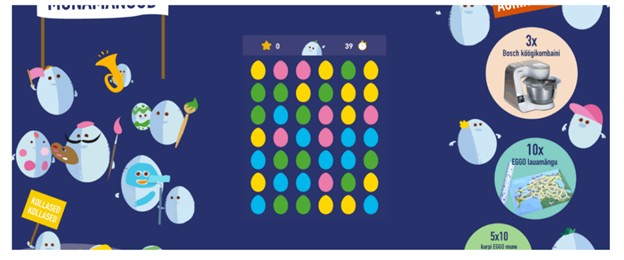
Brands use different gamification techniques to engage customers, each with its own aim. For example, Eggo, Estonia’s egg producer, created a campaign to engage its customers for as long as possible.
They launched an innovative marketing campaign called “Eggo World,” a type of well-known Candy Crush game where players matched eggs instead of candies. This digital campaign aimed to increase brand awareness, change people’s purchase behavior during Easter, and encourage them to choose Eggo eggs.
Eggo designed the game to encourage people to return and play it several times. Here are the results:
• Over three weeks, 4,500 people played the game more than 190,000 times.
• The most active player took part in the game over 4,900 times, which means the person engaged with the Eggo brand for over 80 hours.
• An average player participated in the game 38 times. Since the game lasted 60 seconds, that meant 38 minutes of brand exposure.
The sales numbers after the Easter season showed that this holiday campaign was a great success, and people chose Eggo eggs for their celebrations.
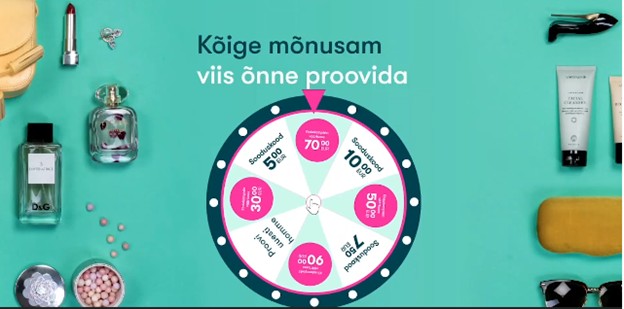
AS Tallink Grupp is a prominent company that provides passenger and cargo transportation services in the northern Baltic Sea region. The brand used gamification tactics to increase customer engagement and boost brand recognition among the younger audience.
For this purpose, they made a Wheel of Fortune with 5,251 coupons as rewards. Each user could try their luck only once a day.
The campaign ran for 1 week, and people played the game 5,315 times, with a 98.81% click-through rate. As a result, Tallink collected 3,238 unique leads.
So, how do you incorporate gamification strategies into your retail business? Here’s our step-by-step guide:
1. Choose a gamification platform
If you want to improve customer experience and increase user engagement through gamification, the first step is to choose a platform like Optimove Minigames.
Optimove Minigames allows users to create fully customizable interactive experiences for gamification marketing campaigns without writing a single line of code.
Optimove Minigames helps to bring results with gamification marketing, such as:
• 95% campaign completion
• 6+ days of retention
• 5x higher coupon redemption
• 20+ engagements per participant
2. Choose a campaign type
You know your target audience best, so choose a campaign type that encourages customers to participate in the game and helps you build brand awareness. Here are some of the campaigns you can launch with Optimove Minigames: Jeopardy, gamified survey, trivia game, match 3 game, puzzle game, Wordle game, personality quiz, scratch card online, "Guess Who" game, and battle game.
3. Customize your game
To increase the chances of engaging users with your game, you can customize it in multiple ways:
• Change the background color and the background of choices and topics
• Set your own branded image as a background
• Customize the design of the grid box, letter colors, and fonts to match your brand
4. Set up prizes
An essential part of creating gamification experiences is rewarding customers for their time and effort. It’s a natural human impulse to expect rewards, so don’t forget to choose prizes to ensure customers engage with your campaign. Here are a few ideas for prizes you can offer:
• A discount code for your online store
• Loyalty points
• Gift cards
• Early access privilege to sales
• Invitation to an in-store experience, like product launch parties
Make sure to choose a prize that will keep customers coming back for a chance of winning.
5. Create a leaderboard
The next step is to create a leaderboard that shows all game participants and their scores. A leaderboard is another motivation for users to take part in the game and compete.
6. Publish your campaign
Now it’s time to make your campaign available to online visitors. You have two possibilities:
• Publish the campaign through your own domain or
• Copy the code and integrate it into your website, email, sms, pop-up, and push.
You can also embed the game into any digital platform, such as social media sites or online banners.
7. Analyze the results
Optimove Minigames’ Campaign analytics allows you to:
• Track daily statistics
• See the number of games started over time
• Identify the most active players
• Track the average and the top score achieved by players
• Access detailed information for button pressed, traffic in and out
With this information, you can identify the areas where your campaign might need improvement and adjust it to bring even better results.
Many brands have achieved great success by applying gamification techniques in retail. Creating gamified experiences for your customers is easier than you might expect with Optimove Minigames, our gamified app. Sign up to Optimove Minigames and master retail gamification today!
Gamification in retail brings game mechanics—such as challenges, prizes, and leaderboards—into the shopping experience to boost engagement, loyalty, and sales. With no-code tools and clear measurement, brands can launch campaigns quickly, learn what works, and scale the formats customers love.
For more insights, contact us to Request a Demo

Writers in the Optimove Team include marketing, R&D, product, data science, customer success, and technology experts who were instrumental in the creation of Positionless Marketing, a movement enabling marketers to do anything, and be everything.
Optimove’s leaders’ diverse expertise and real-world experience provide expert commentary and insight into proven and leading-edge marketing practices and trends.