
Unified Growth Solution
World-class tech needs world-class drivers. AI platform and expert services, unified
Read time 5 minutes


Agents that let you act while others are still analyzing!
Why it matters:
This article shows how AI decisioning stays accountable through guardrails, strategy, and visibility, helping marketers to automate and scale decisions without giving up judgment and control.
Key takeaways:
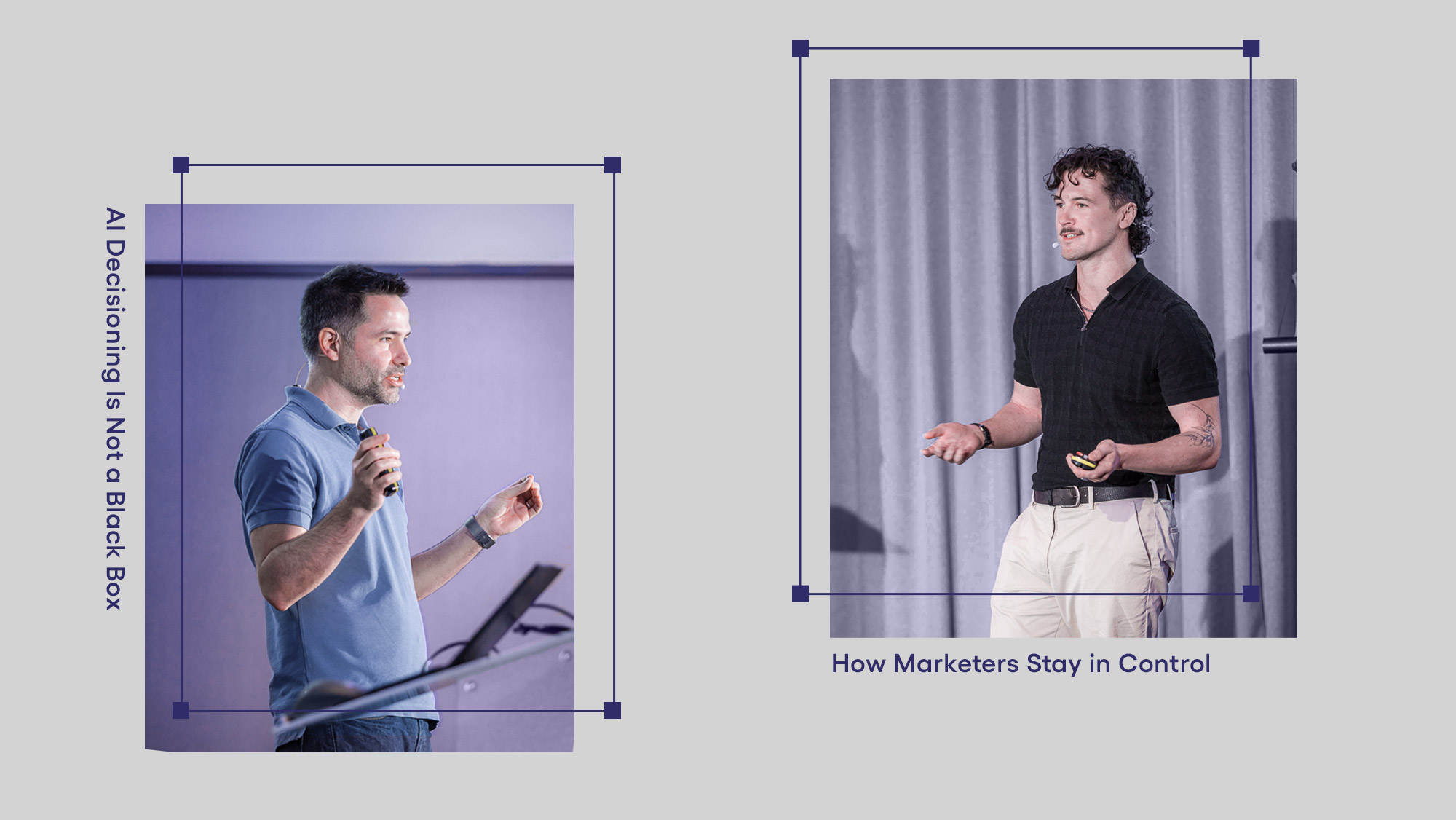
When we presented the topic AI Decisioning for CRM at Connect 2026, one concern sat underneath every conversation: control.
CRM Marketing is already complex. Many organizations still manage audience selection, journey prioritization, campaign optimization, and content testing in separate places. Once AI enters that environment, marketers worry that complexity will grow rather than shrink.
Marketers are open to automation when it improves execution, but they become less comfortable when they feel they aren't controlling how decisions are being made, what priorities are shaping them, or where business judgment still applies.
We addressed that directly in the presentation. Our point was that AI decisioning should connect CRM decisions, not hide them. It should help marketers determine the best next action for each customer while preserving the logic behind that action. It is exactly what Optimove offers.
The more decisions AI supports, the more important visibility becomes. Audience affects journey, which affects offer and timing. Those decisions shape the final content experience. Once those layers start working together, marketers need to have a full understanding of what is working well, where optimization is thin, and what should improve next.
That is why transparency matters so much.
AI decisioning standards should provide clear reporting on eligibility, exclusions, campaign collisions, prioritization outcomes, and performance. Marketers should always be able to review why one campaign took precedence over another, why some customers were redirected, and how optimization is performing against business goals.
In this context, Optimove's AI Decisioning Studio is the answer. It gives teams one place to see how journey decisioning, offer decisioning, send time optimization, and content decisioning are being used across campaigns. It also gives them a view into performance, uplift, and optimization coverage.
That helps marketers do more than activate AI. It helps them govern it.
We emphasized that guardrails are what make AI decisioning useful and trustworthy for marketers who want to do things right. For CRM teams, the most important guardrails include:
These will be responsible for shaping what AI can optimize and where it must stop. They define the boundaries of the system.
Optimove’s AI Decisioning model works exactly like that. It is enabling marketers to define the operating framework, including who is eligible for a campaign, which journeys have fixed priority, what budget limits apply, channels are available, howoften customers can be contacted, and which KPI should guide optimization, and more.
AI works inside that structure, processing outcomes, resolving tradeoffs, and improving execution at a scale no team could manage manually. But, it does not replace the strategic judgment that shapes the system.
The marketer owns the business logic. AI handles the analytical load underneath it.
No. Clear control makes AI more powerful and assertive. Without guardrails, every decision, including human-made ones, becomes less strategic and harder to scale across teams.
When guardrails are in place, AI decisioning starts to feel practical rather than theoretical. Marketers don't have to manually resolve every audience split, campaign collision, or send-time decision. The system can handle that work continuously, using observed behavior and business constraints together.
Speed comes from structure**.**
Marketers' role becomes more strategic. Teams spend more time defining strategy, rules, goals, and boundaries. They spend less time forcing mutual exclusivity, manually prioritizing journeys, or reviewing broad campaign-level winners that flatten customer differences.
That was one of the clearest points we wanted to make. AI does not reduce marketers' control when implemented properly. The work moves away from manual guesswork and toward managing a system that can carry strategy through execution with more consistency and much greater scale.
Optimove helps marketers stay in control of AI decisioning by combining:
The black-box concern around AI is valid, but manageable. Marketers need to know which rules govern the strategy, which priorities shape optimization, and how outcomes can be reviewed. Without that, trust breaks down quickly.
Optimove’s approach addresses that problem directly. AI decisioning works inside marketer-defined guardrails, stays aligned to KPI priorities, and gives teams visibility into performance and decision logic. That keeps strategy where it belongs while allowing AI to handle the analytical complexity beneath it.
The result is stronger CRM marketing execution without surrendering judgment. Marketers keep control over the business rules that matter, while AI helps them apply those rules with more precision, more consistency, and more scale.
For more insights, contact us to Request a Demo.
AI built for marketers.
Predict, create, and optimize — without waiting on data, dev, or design.


Writers in the Optimove Team include marketing, R&D, product, data science, customer success, and technology experts who were instrumental in the creation of Positionless Marketing, a movement enabling marketers to do anything, and be everything.
Optimove’s leaders’ diverse expertise and real-world experience provide expert commentary and insight into proven and leading-edge marketing practices and trends.