

Unified Growth Solution
World-class tech needs world-class drivers. AI platform and expert services, unified
Read time 7 minutes


Increasing the Value of New Online Gaming Players
Download the report and discover proven methods to increase new player deposits, retention, and lifetime value when empowered by Positionless Marketing.

Executive Summary :
Prediction markets are no longer a niche adjacent to sports betting. Eighty-four percent (84%) of U.S. NFL bettors say they have heard of them, leaving only 16% unaware. For a product class that sat outside mainstream consumer awareness a few years ago, that level of recognition is remarkable.
Awareness has also converted into intent. Sixty percent (60%) of the same bettors say they plan to trade, buy, or sell event contracts this year. The majority of the NFL betting audience is not evaluating prediction markets from a distance; they are planning to participate, and they will do so during the season, when betting attention, deposit activity, and share of wallet are at their annual peak.
For operators, the implication is competitive rather than educational. Budget spent explaining what a prediction market is will largely reach an audience that already knows. The advantage will go to the brands that win the first trade, make the second one easy, and build a retention program that treats event contract trading as a durable behavior rather than a seasonal experiment.
Positionless Marketing gives marketing teams the ability to act on those signals directly, moving from a behavioral trigger to a personalized, cross-channel response without waiting on handoffs between data, creative, and campaign teams.
Methodology :
This report is based on an Optimove Insights survey of 926 U.S. NFL bettors conducted in August 2026.
The research examines awareness of prediction markets among people who already bet on NFL games, and their stated intent to trade, buy, or sell event contracts on those markets within the year. Fielding took place immediately ahead of the NFL season, the period in which U.S. betting engagement is historically highest.
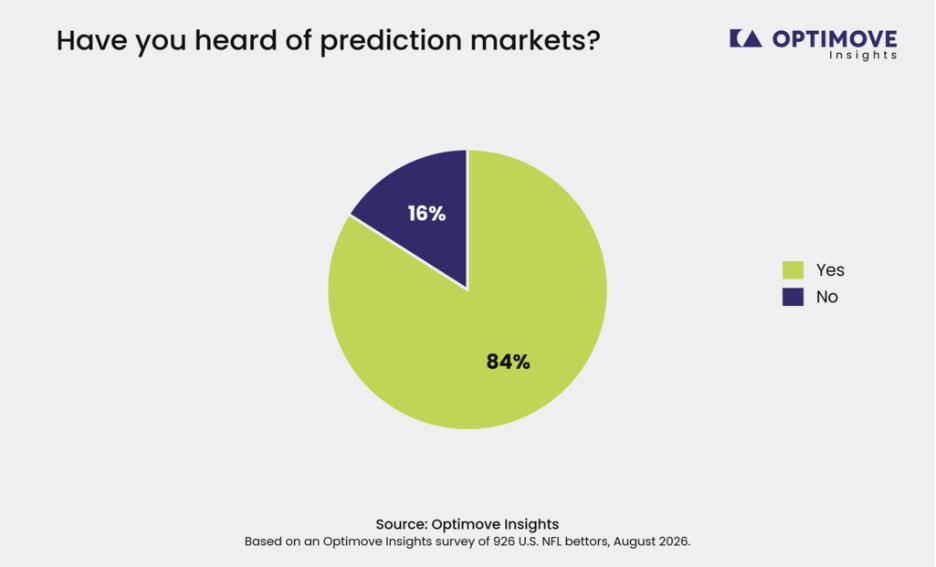
Eighty-four percent (84%) of U.S. NFL bettors report that they have heard of prediction markets. Only 16% say they have not.
Awareness at this level puts prediction markets in the same recognition tier as established betting verticals rather than in the category of emerging products. Among an audience of 926 bettors, roughly 778 already recognize the category by name.
The unaware group is small enough that it should be treated as a secondary segment, not a primary growth target. There is a limited pool of bettors left to introduce to the concept, which means top-of-funnel education is no longer where the largest opportunity sits.
It is worth noting what this measure does and does not capture. Awareness is recognition, not comprehension. A bettor who has heard of prediction markets may not understand event contract pricing, settlement, or how a position differs from a traditional wager. Intent data suggests that this gap is not preventing participation, but it does shape what onboarding needs to accomplish.
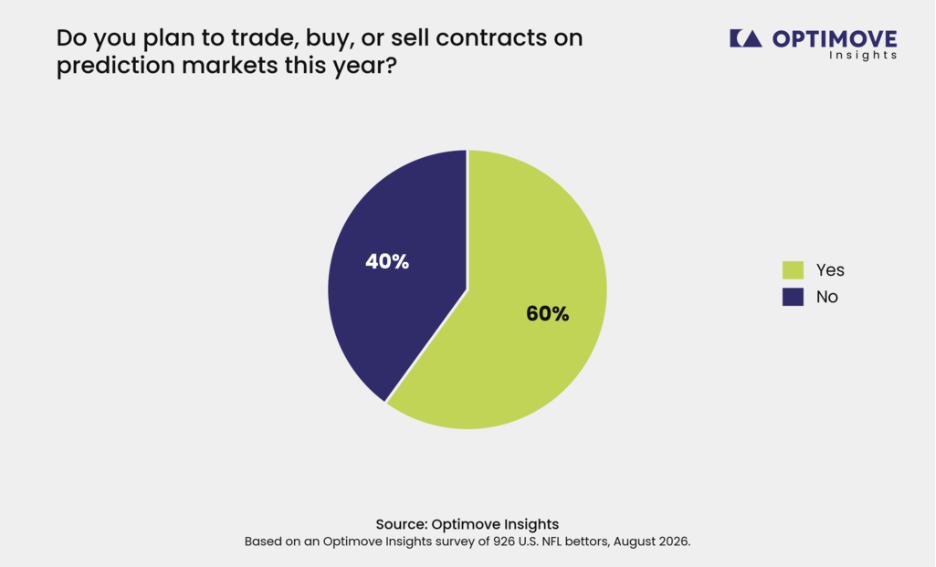
Sixty percent (60%) of NFL bettors say they plan to trade, buy, or sell event contracts on prediction markets this year. Forty percent say they do not.
Stated intent at 60% is a strong signal for a product category still establishing itself in the U.S. market. It indicates that prediction markets have moved past the trial stage for a majority of this audience and into planned behavior.
Intent is also not the same as behavior. Stated plans typically overstate action, and the share of bettors who actually place a trade this year will likely be lower than 60%. The practical value of the number is directional: it tells operators that the addressable population for prediction market products is already large, and that the constraint on growth is conversion and retention rather than demand.
With 84% awareness, campaigns built primarily around defining prediction markets will reach an audience that mostly does not need the definition. The more useful message is comparative and specific: what this market offers, why the pricing is better, what the experience feels like, and why it should be done here rather than elsewhere.
This does not eliminate the need for explanation entirely, but it relocates it. Explanation belongs inside the product experience—at the moment a user opens their first event contract, sees a price move, or holds a position through settlement—rather than at the top of the funnel.
For bettors in the 16% unaware group, education still applies. Treat them as a distinct segment with distinct creative rather than allowing their needs to dictate the messaging strategy for everyone else.
Intent at 60% is an opportunity that decays. A bettor who plans to trade this year and does not do so in their first session is unlikely to return with the same motivation, particularly during a season when competing products are aggressively bidding for the same attention.
The priority is compressing time to first trade. That means reducing friction between signup and a live position, surfacing markets connected to the games and teams the bettor already follows, and making the first event contract feel small, legible, and low-stakes.
The gap between recognizing a product and using it is where most of the 60% will be won or lost, and it is measured in minutes, not campaigns.
The NFL season concentrates both attention and risk. A bettor acquired in September on the strength of football markets may have no obvious reason to return in February. With an audience defined entirely by NFL betting, this is not a risk affecting one vertical among many—it is the central retention question for every customer in this sample.
Operators should plan for the transition before it arrives: building the habit of trading across market types, introducing non-sports event contracts to bettors who show breadth, and identifying which behaviors during the season predict retention beyond it. A first trade is an acquisition event. A second trade in a different market is the beginning of a customer.
Segment early on trading frequency, market variety, and position size rather than deposit alone. Those signals identify durable participants well before revenue does.
Prediction markets generate a dense stream of behavioral signal. A user watches a market without trading. A position moves against them. An event contract settles. A related market opens. Each is a moment where a relevant message would matter and where a late or generic one would not.
Traditional marketing workflows struggle with this pace. By the time an insight moves from analyst to marketer to creative to deployment, the market has often settled and the moment has passed.
Positionless Marketing gives marketers the ability to close that loop themselves: identifying the segment, understanding what the behavior indicates, creating the message, and activating it across channels without a sequence of handoffs. In a category where relevance has a shelf life measured in hours, that speed is the difference between a message that lands and one that arrives after the outcome is known.
Prediction markets have crossed the threshold that most new categories struggle to reach. NFL bettors know what they are, and a clear majority intend to use them this year.
That changes what winning looks like. When 84% of an audience is aware and 60% intends to participate, the scarce resource is not attention or understanding—it is the first trade, the second one, and the reason to come back after the season ends.
The operators that treat prediction markets as a retention business rather than an acquisition story will be the ones still holding these customers next year. Positionless Marketing makes that possible in practice, giving marketing teams the ability to recognize a behavioral signal and respond to it while it still means something.
Source: Optimove Insights. Based on an Optimove Insights survey of 926 U.S. NFL bettors, August 2026.
Optimove Pulse. The iGaming Industry Benchmark Tool
Explore Optimove’s iGaming Pulse to instantly benchmark your performance against the rest of the industry.