Part 1: How Email Abuse Causes Marketing Fatigue
This section highlights the dual nature of email as both the most preferred and most overused marketing channel.
- Email Dominance: Fifty-nine percent (59%) of respondents prefer email over all other channels for marketing messages, far outpacing social media (18%). Additionally, fortyeight percent (48%) notice email more than any other channel when shopping online.
- Risk of Overuse: Thirty-seven percent (37%) of consumers find email the most annoying channel when overwhelmed with excessive messages. Seventy percent (70%) of respondents unsubscribed from at least three brands in the last three months due to message overload, with 36% unsubscribing from six or more.
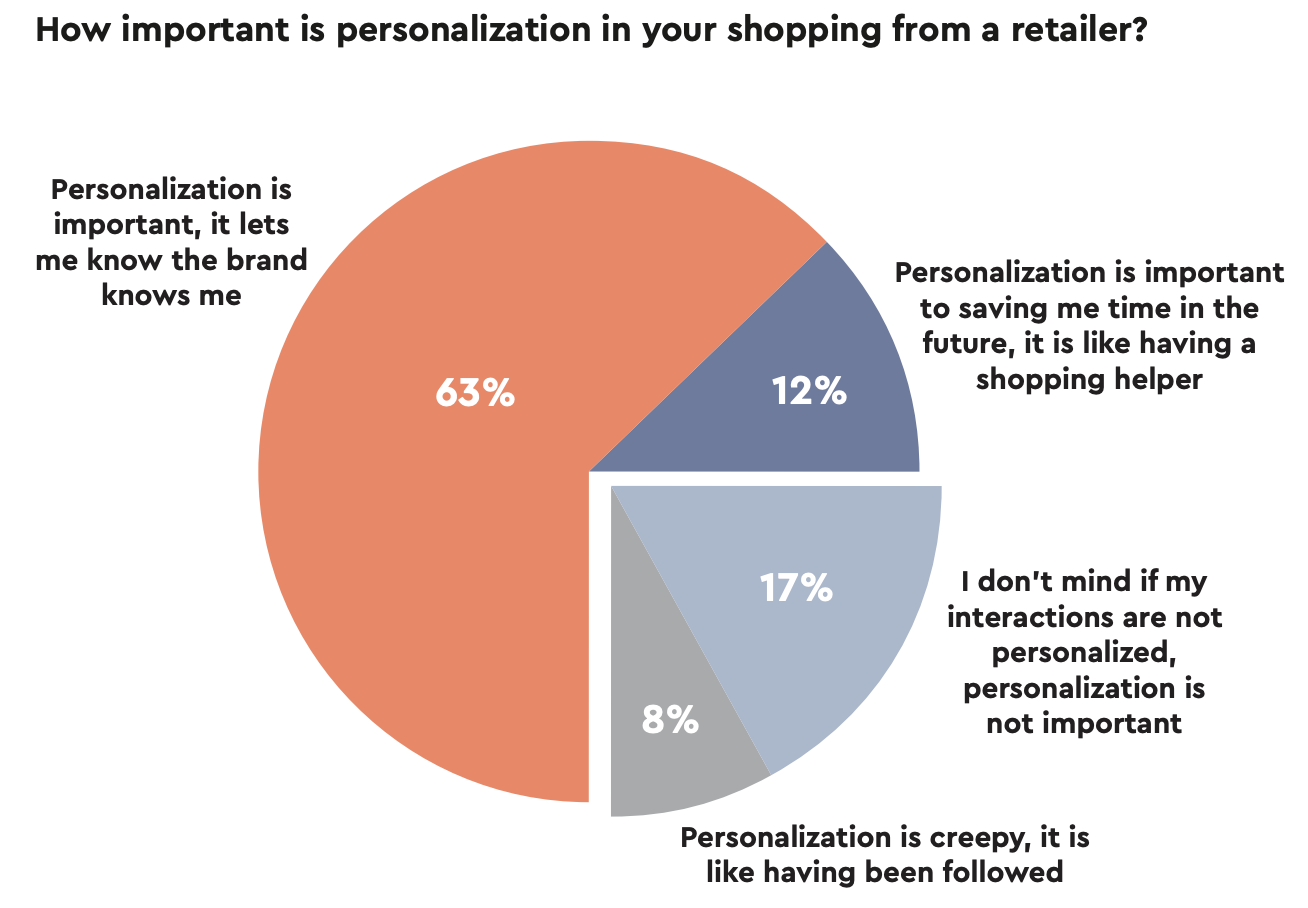
- Personalization Matters: Eighty-one percent (81%) of respondents are more likely to open an email tailored to their interests, while 75% believe personalization is essential—a sharp increase from 54% last year.
Part 2: Customer Loyalty Cannot Be Taken for Granted
This section examines consumer loyalty dynamics, highlighting the balance between brand allegiance and openness to new options.
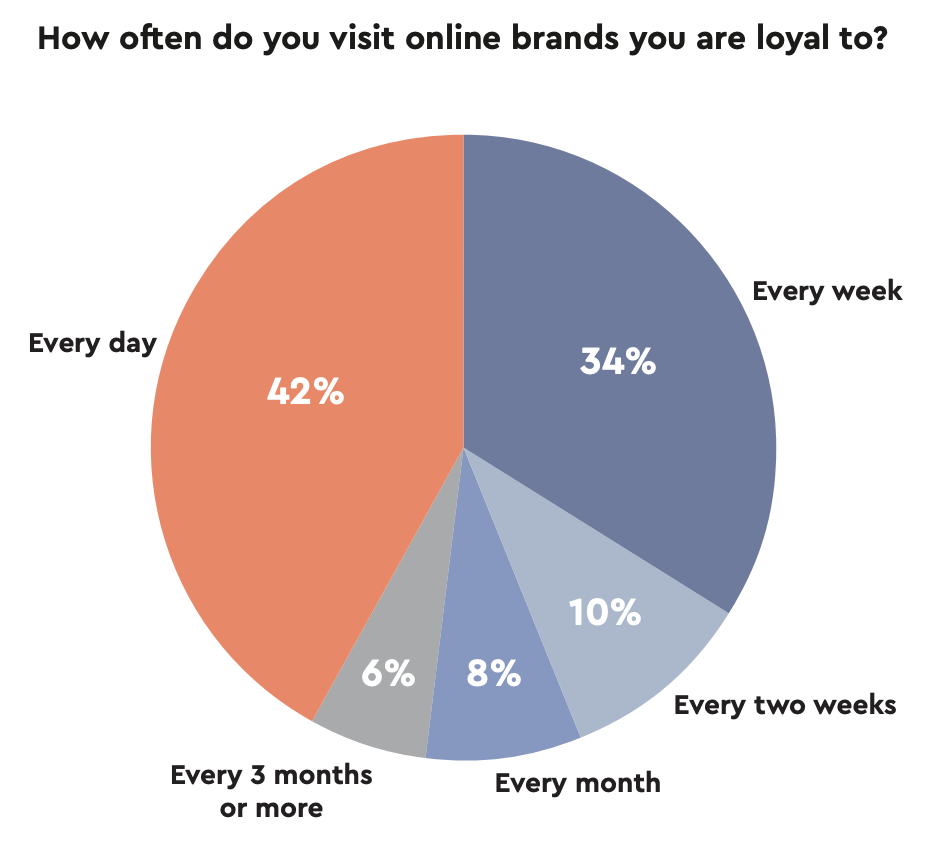
- Frequent Engagement: Seventy-six percent (76%) of respondents visit their preferred brands weekly, with 42% visiting daily.
- Exploration of New Brands: Forty-seven percent (47%) of respondents try a new brand weekly, driven by competitive pricing (41%) and recommendations from friends or family (31%).
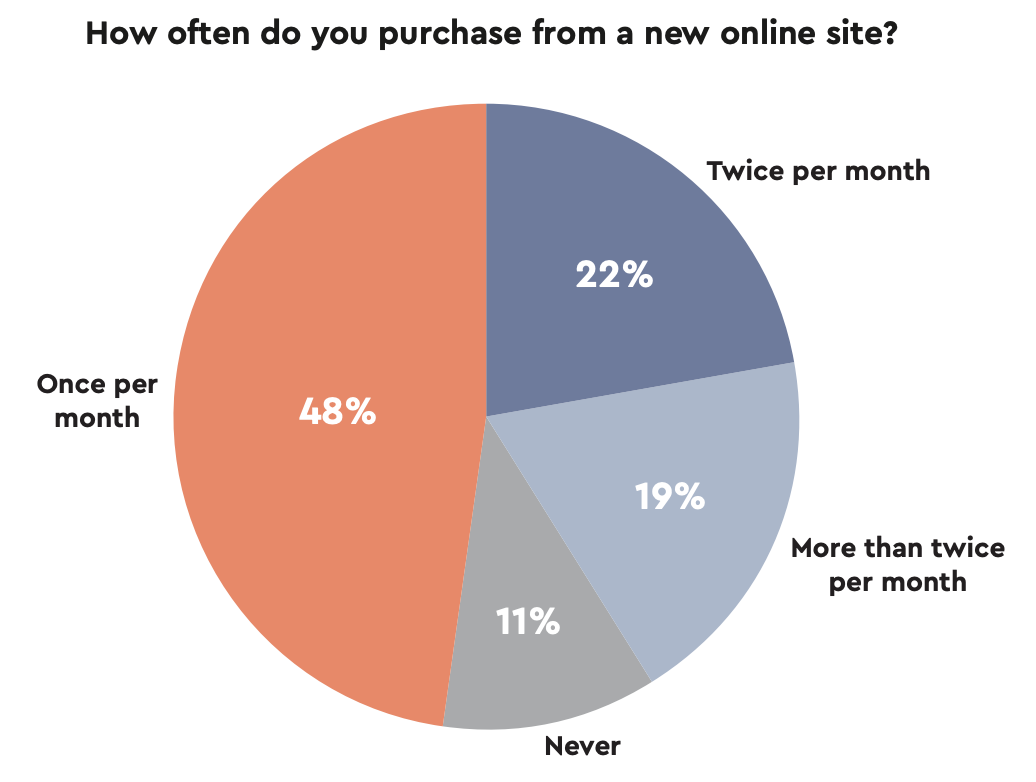
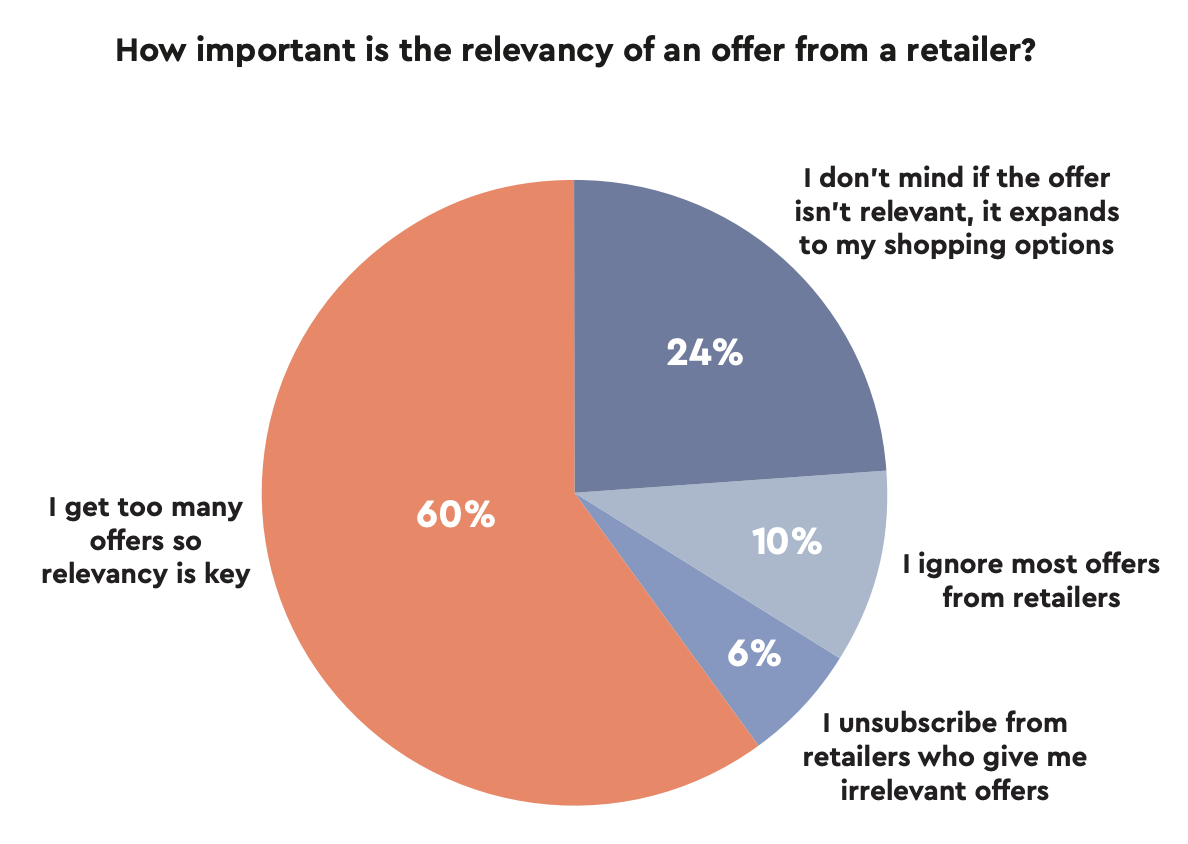
- Retention Risks: Eighty-nine percent (89%) of respondents unsubscribe due to repetitive offers, and 48% purchase from new sites monthly, underscoring the need for personalized retention strategies.
Part 3: Why Message Personalization and Relevancy Is an Antidote to Marketing Fatigue
This section underscores the importance of relevancy and personalization in mitigating marketing fatigue and driving engagement.
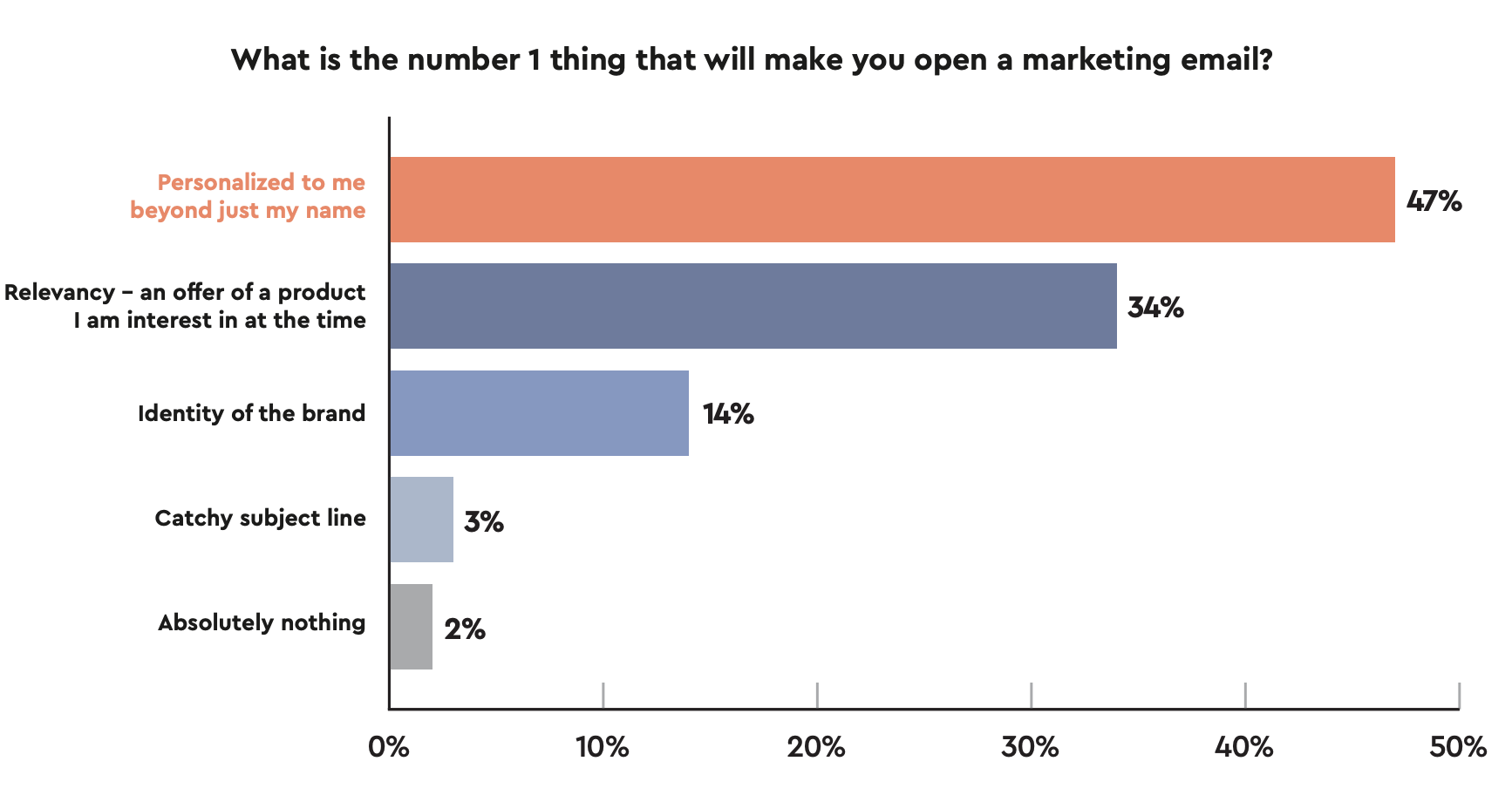
- Personalization Drives Engagement: Forty-seven percent (47%) of consumers open emails because they’re personalized to their needs, while 34% are motivated by relevant offers tailored to their interests.
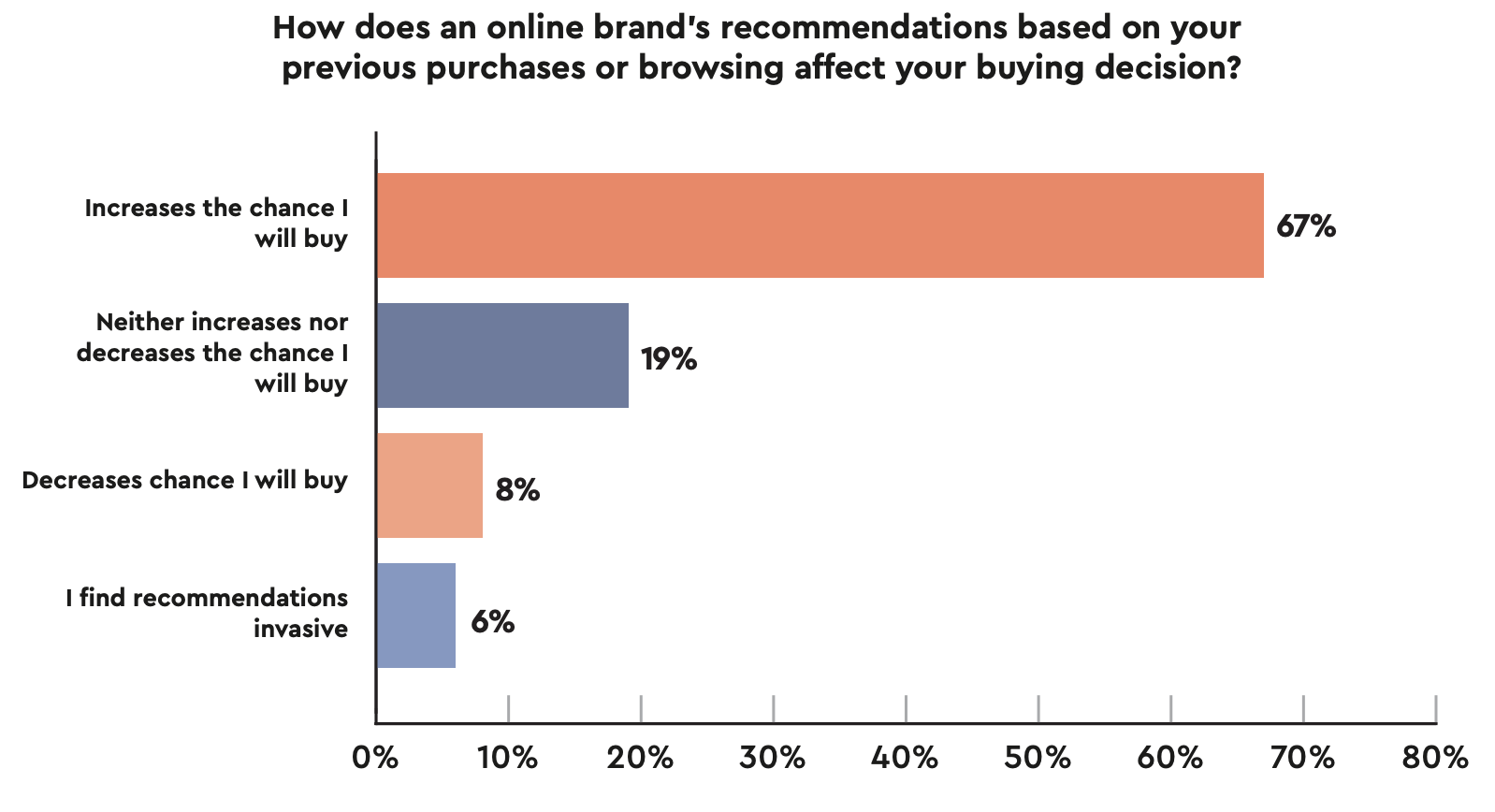
- Relevancy Boosts Conversions: Sixty-seven percent (67%) of respondents are more likely to purchase from brands offering recommendations based on past purchases.
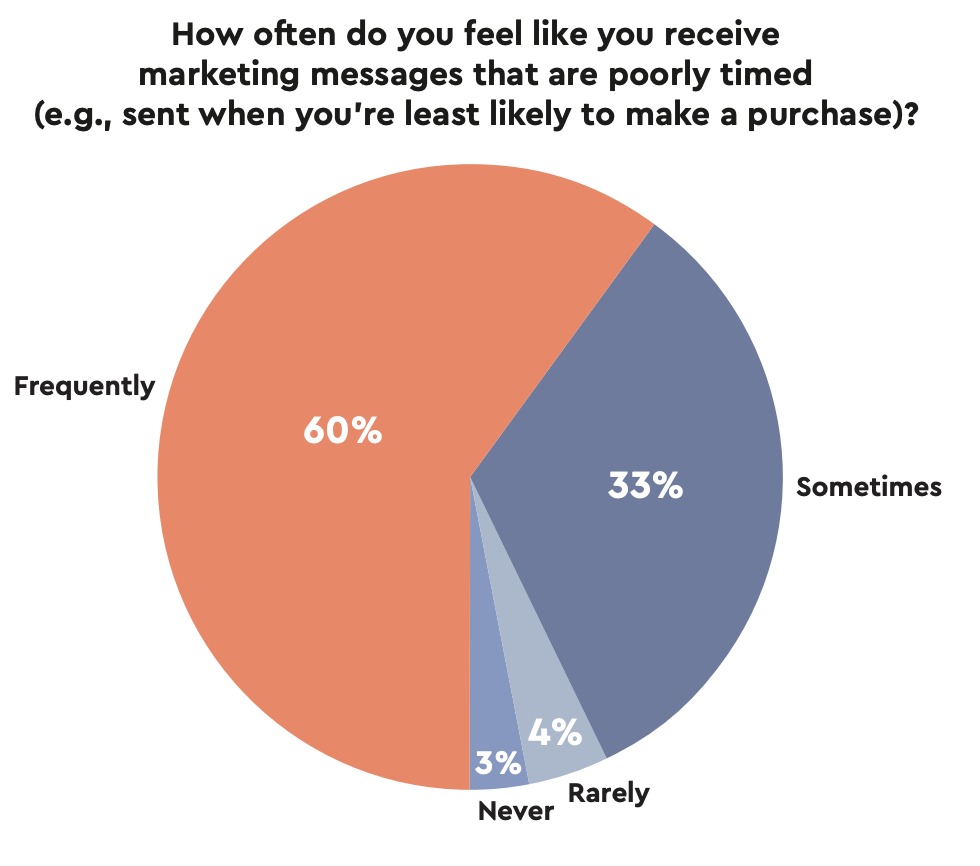
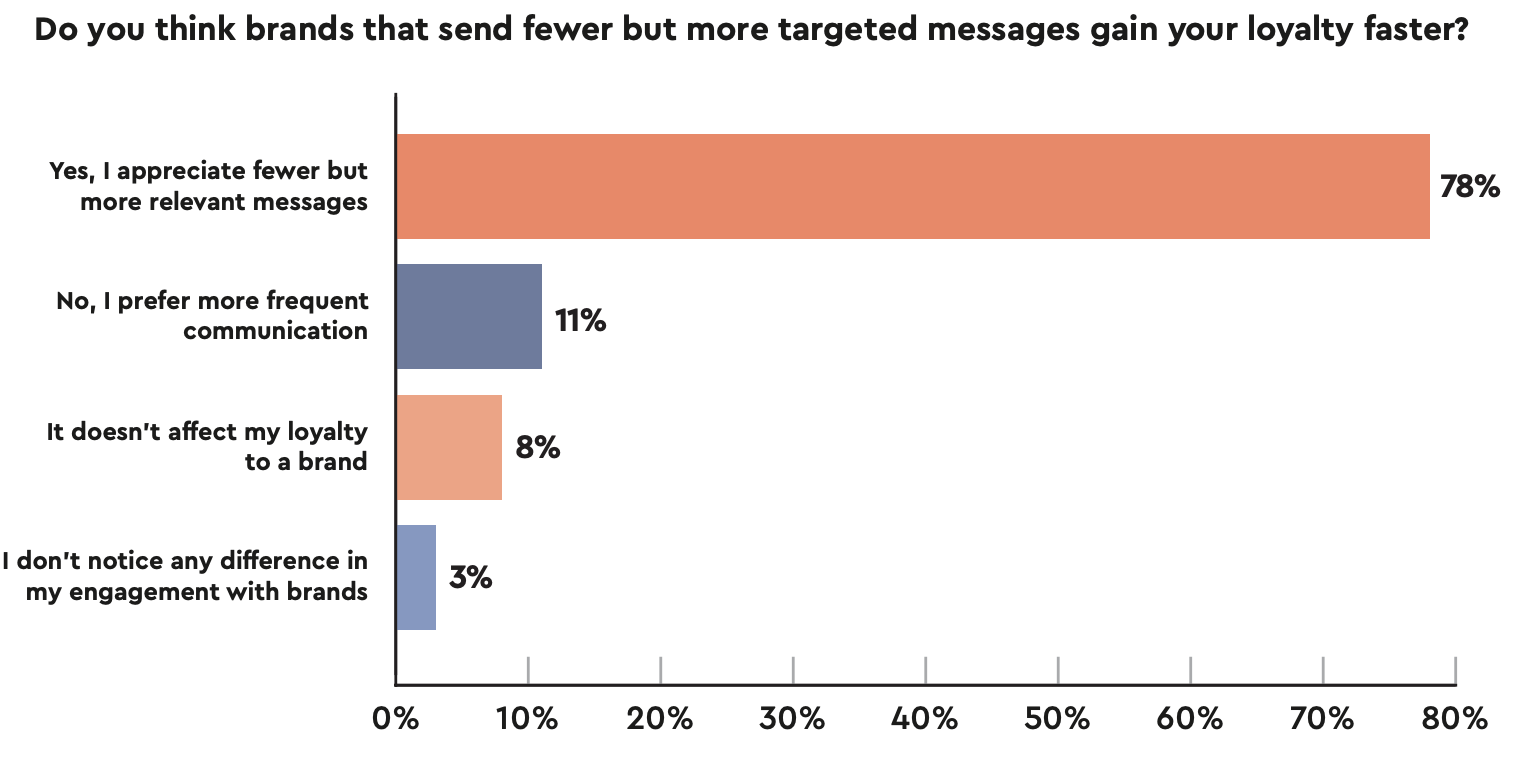
- Timing Matters: Sixty percent (60%) report receiving poorly timed emails, while 78% appreciate fewer but more targeted messages.
Part 4: Why Marketers Must Use AI for Personalization, Not Intrusion, to Combat Marketing Fatigue
This section explores the role of AI in creating personalized and relevant marketing while addressing consumer concerns about data privacy.
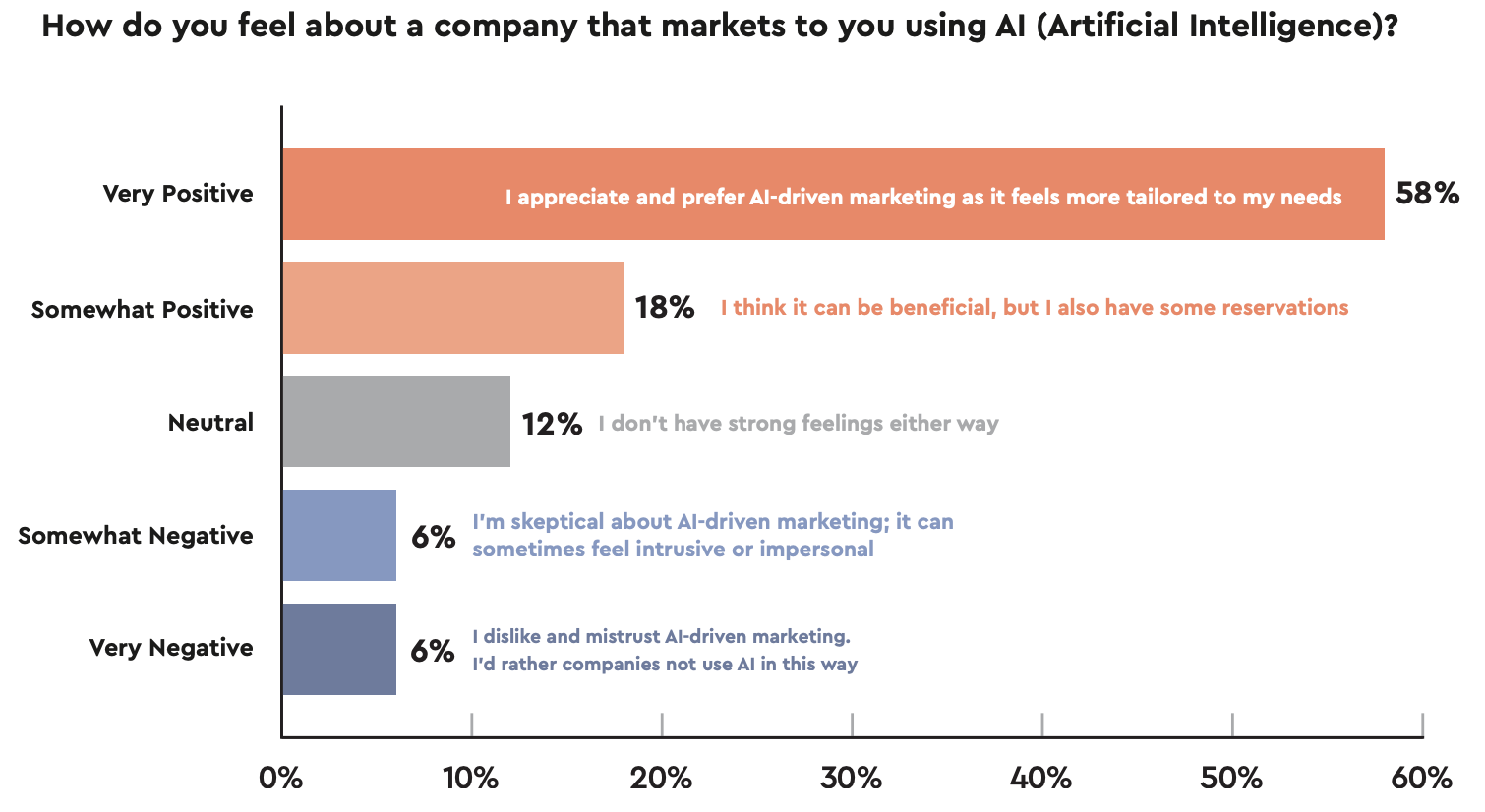
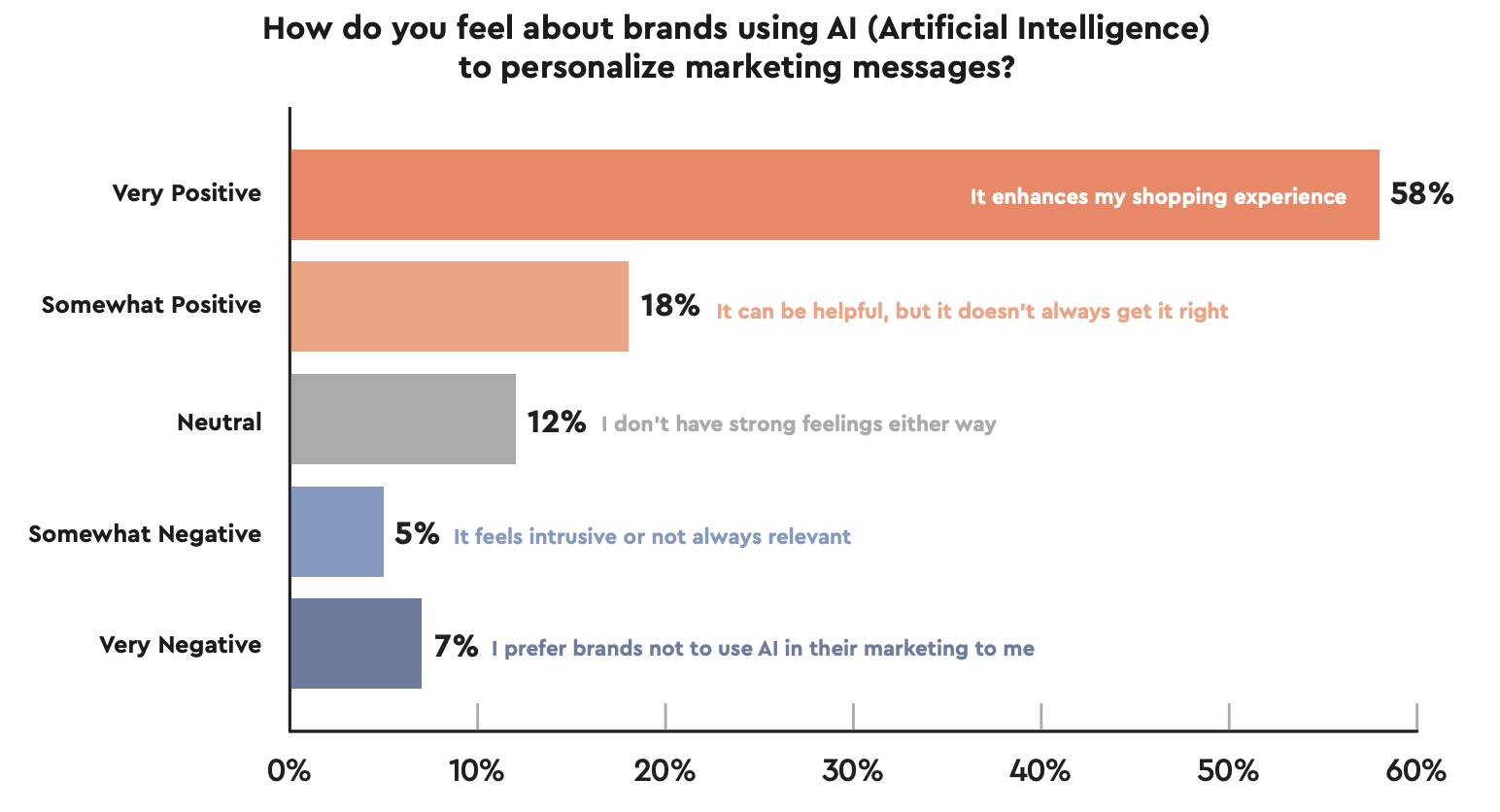
- AI Drives Positive Perceptions: Fifty-eight percent (58%) of respondents appreciate AI-driven marketing for its ability to tailor messages to their needs.
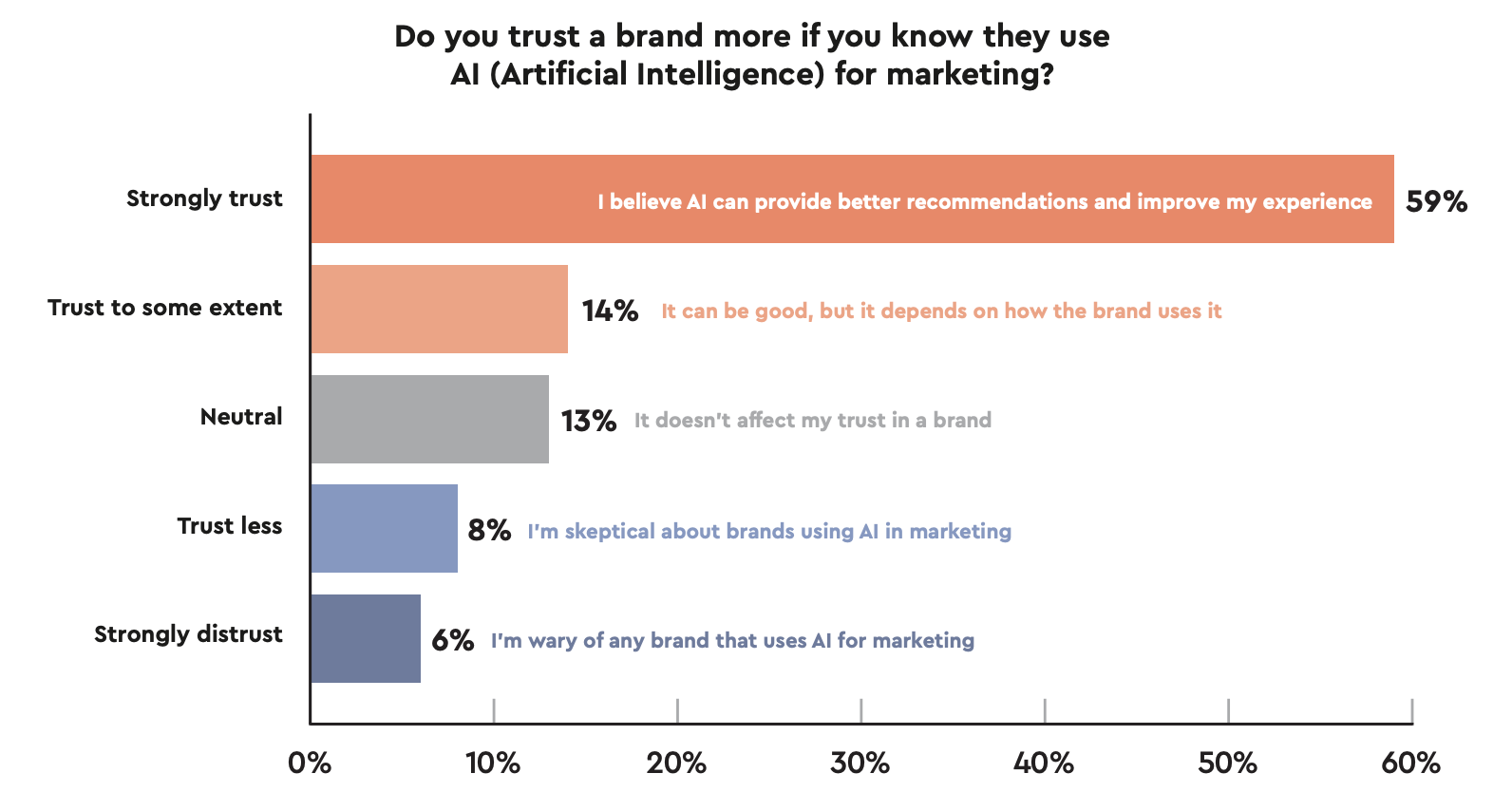
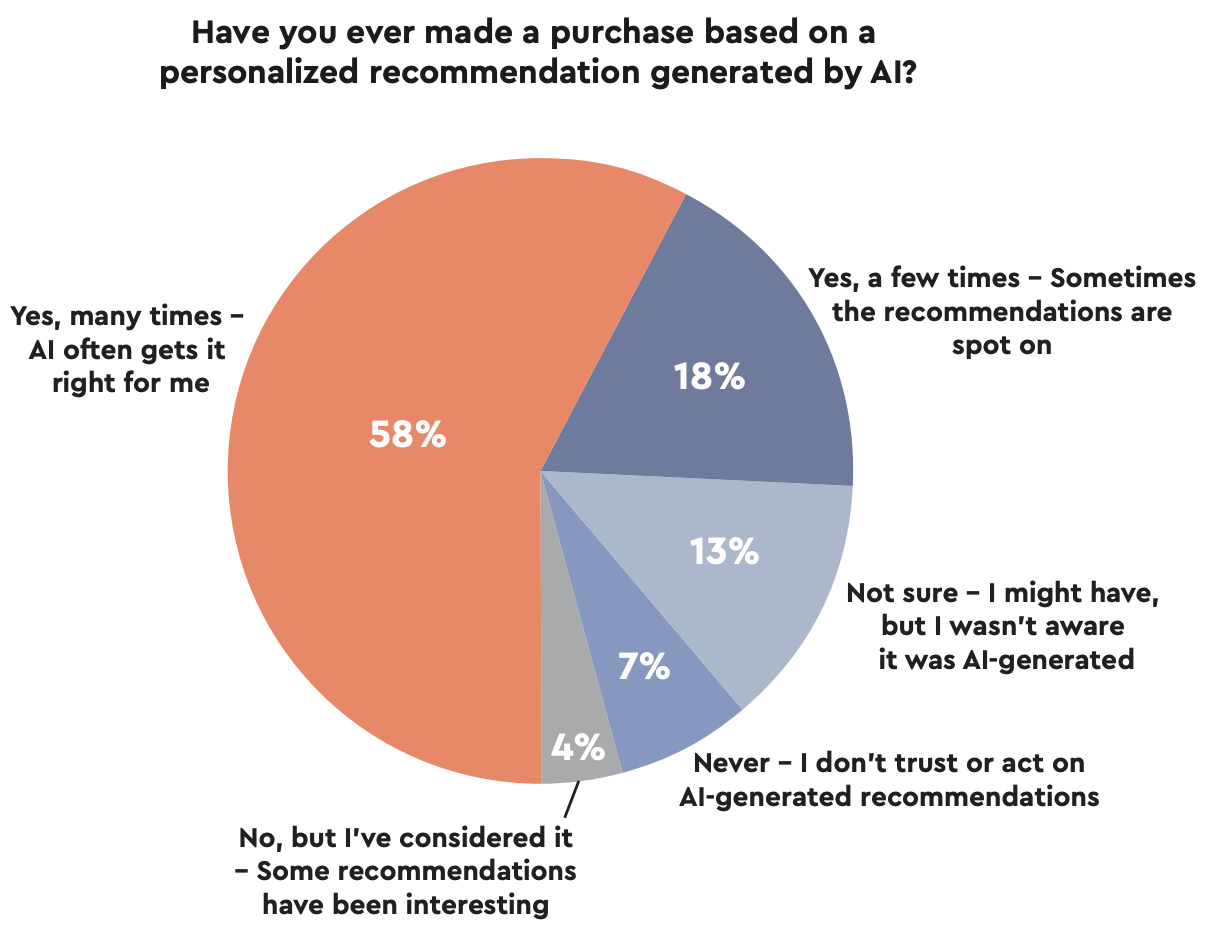
- Trust and Engagement: Fifty-nine percent (59%) trust brands using AI in marketing, and 58% have made purchases based on AI-generated recommendations.
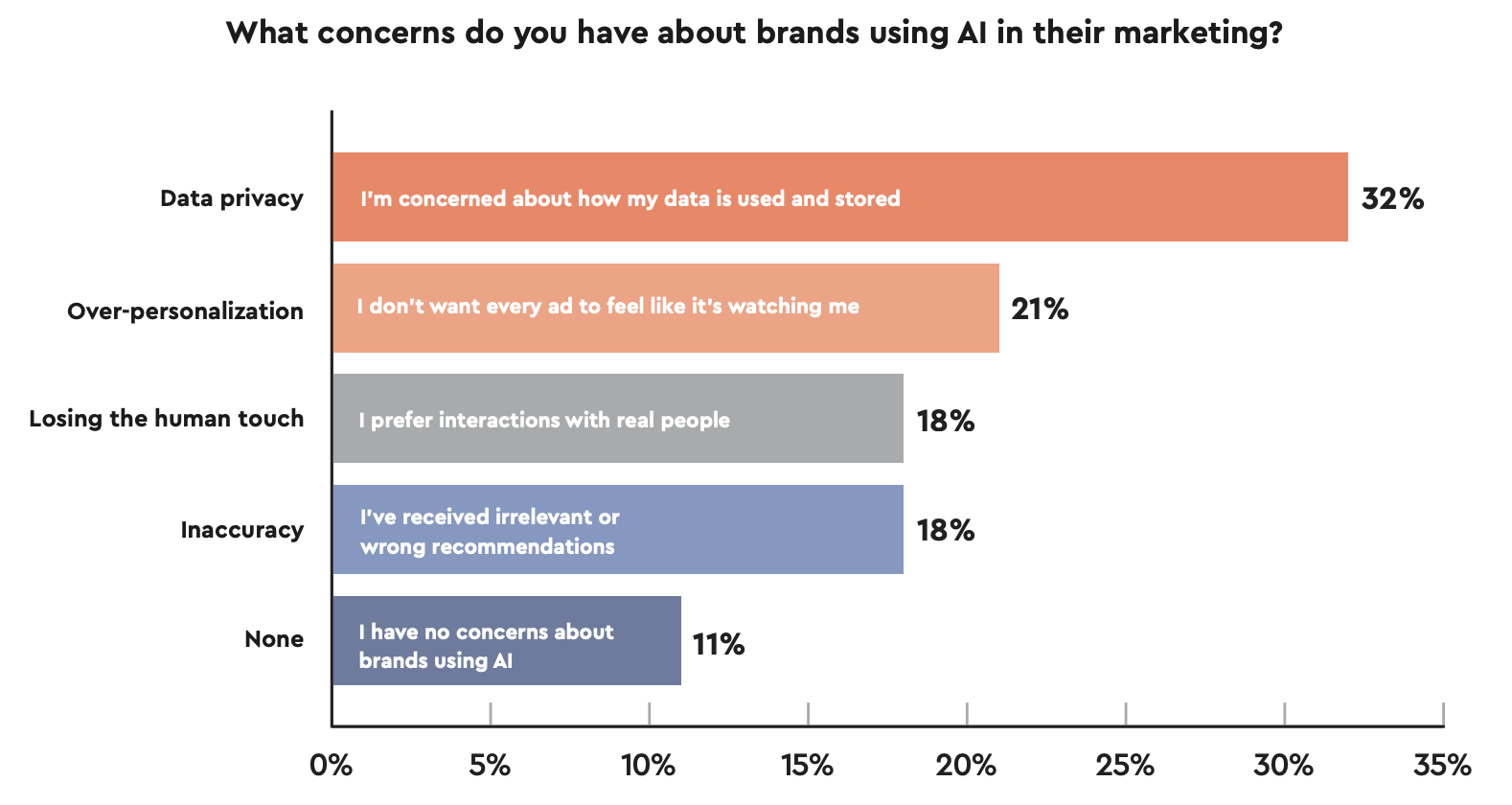
- Concerns About AI: Data privacy is the top concern (32%), with 21% worried about feeling overly monitored.
Methodology
The 2025 Optimove Insights Report Marketing Fatigue, Consumer Perspectives queried 329 U.S. citizens, ages 21 to 64, with household incomes $75,000+ in November/December 2024. Respondents were 49% male and 51% female (no respondents were non-binary or declined to answer).
Summary
Across its four parts, the report emphasizes the critical need for brands to strike a balance between personalization, relevancy, and frequency to combat marketing fatigue. By leveraging AI and advanced analytics responsibly, marketers can build trust, improve engagement, and deliver tailored experiences that resonate with consumers. Personalization, transparency, and consumer control are the keys to navigating the future of marketing successfully
Part 1: How Email Abuse Causes Marketing Fatigue
Executive Summary
Part 1, How Email Abuse Causes Marketing Fatigue, reports on the importance of email, personalization, and brands ensuring that the customer is in control.
The findings in Part 1 underscore key opportunities and risks for marketers aiming to optimize their email strategies.
Key Findings:
- Email reigns supreme:
- Fifty-nine percent (59%) of respondents prefer email as their primary channel for receiving marketing messages, surpassing social media (18%) by over 3.5x.
- When shopping online, forty-eight percent (48%) notice email over other channels, nearly double the attention paid to social media ads.
- The risk of email overuse:
- Thirty-seven percent (37%) of consumers find email the most annoying channel when bombarded with excessive messages.
- Fifty-seven percent (57%) of respondents have switched to competitors due to being overwhelmed by marketing messages.
- Seventy percent (70%) have unsubscribed from at least three brands in the last three months due to excessive messaging, with 36% unsubscribing from six or more.
- Personalization is essential:
- Seventy-five percent (75%) of respondents consider personalization important, a significant jump from last year’s 54%.
- Eighty-one percent (81%) are more likely to open an email tailored to their interests rather than just including their first name.
- Timing and relevance matter:
- Sixty percent (60%) of respondents report receiving poorly timed emails, reducing their engagement and relevance.
- Customer control drives engagement:
- Ninety percent (90%) of respondents want the ability to customize the frequency and type of messages they receive.
- For loyal customers, eighty-four percent (84%) are more likely to repurchase after receiving reminders or deals, up from 60% last year.
Detailed Survey Results
Below are survey questions and charts
Email is still king
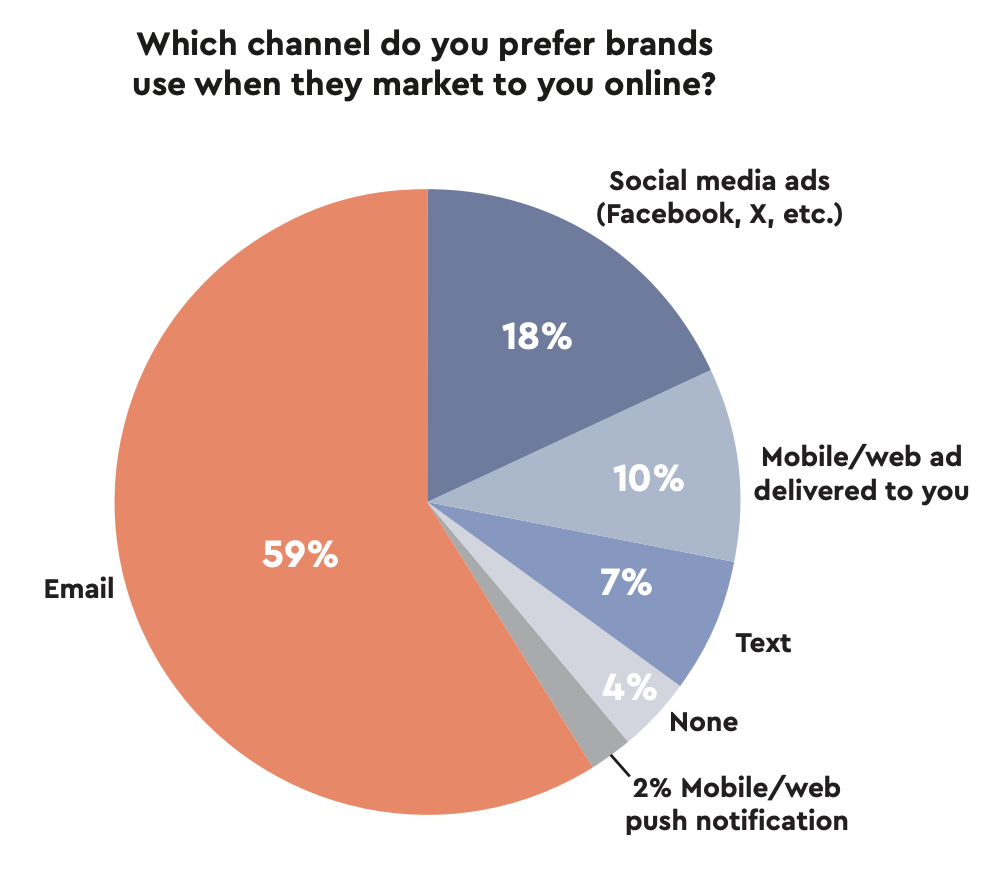
59% of respondents prefer email when brands market to them online, nearly 3.5X more than the 18% who prefer social media (in the #2 spot)
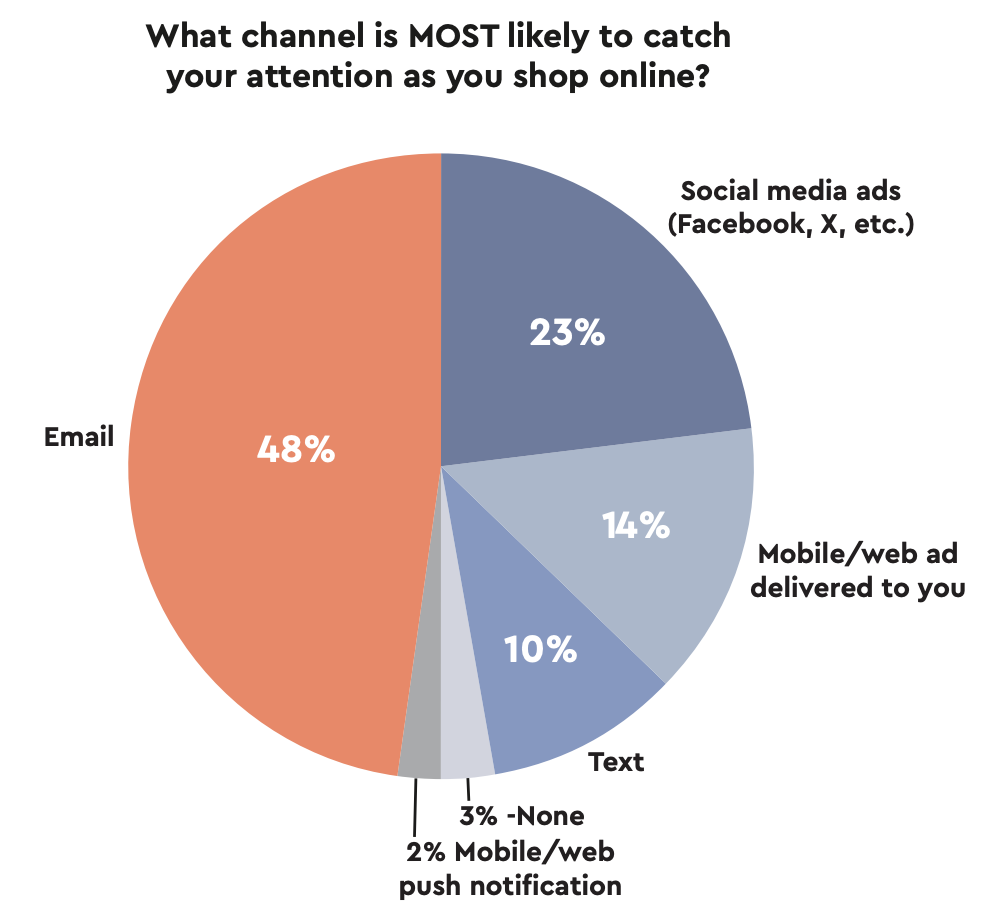
48% of respondents notice emails over any other channel when shopping online, at ~2X social media ads, 3.5X push by mobile or web, and ~4.8X text
Sending in high volumes is perceived as email abuse
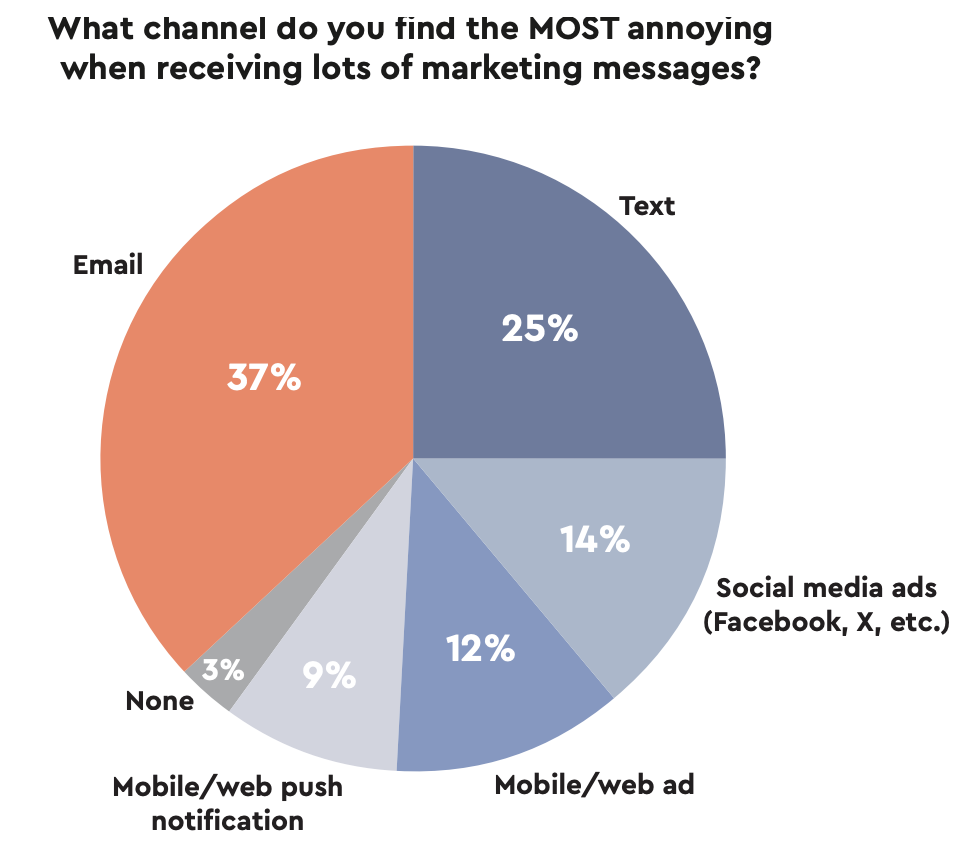
Email is the most annoying channel when receiving a lot of marketing messages, in the #1 spot at 37%
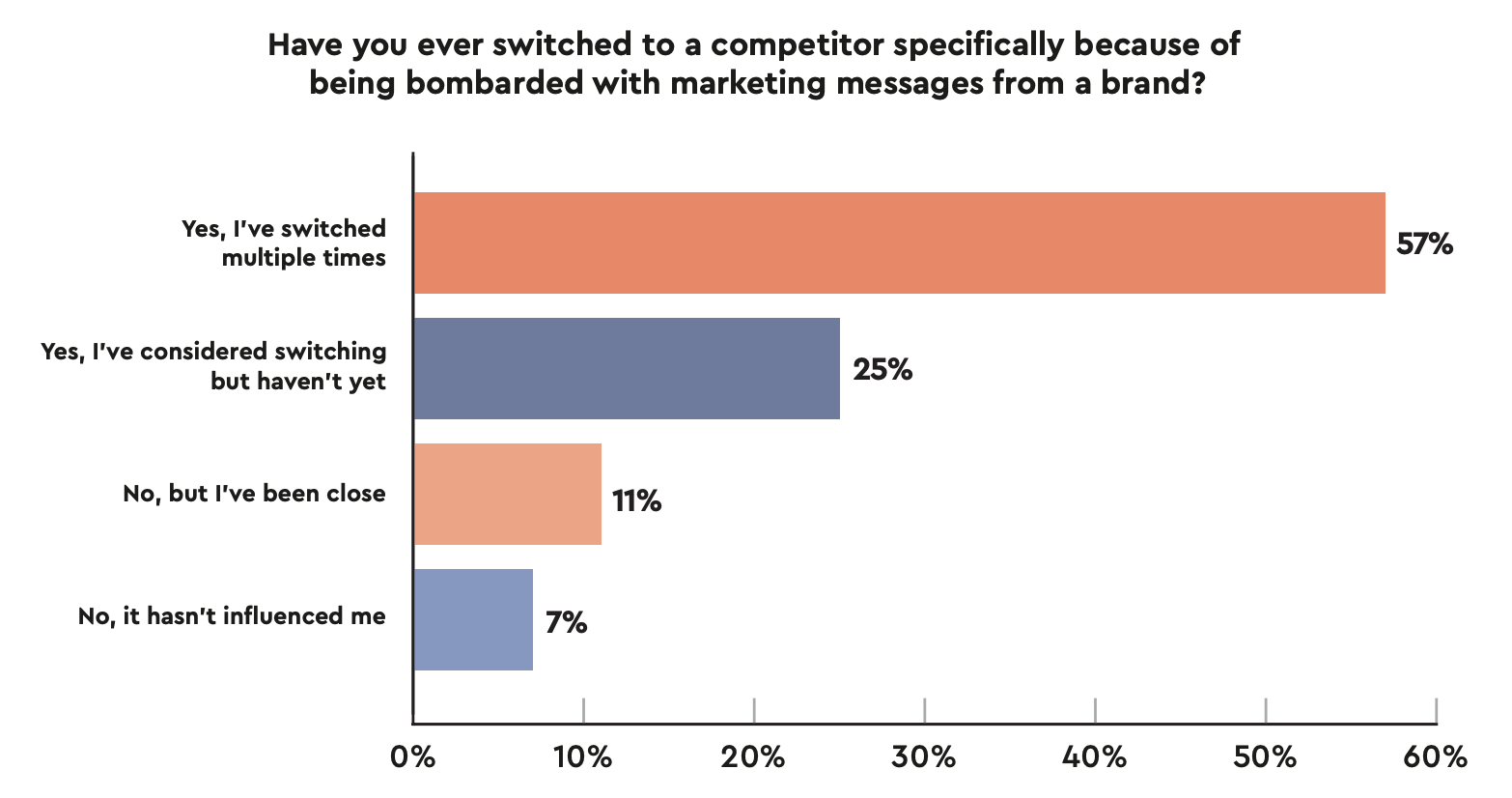
57% of respondents have switched to a competitor multiple times because of being bombarded by a brand
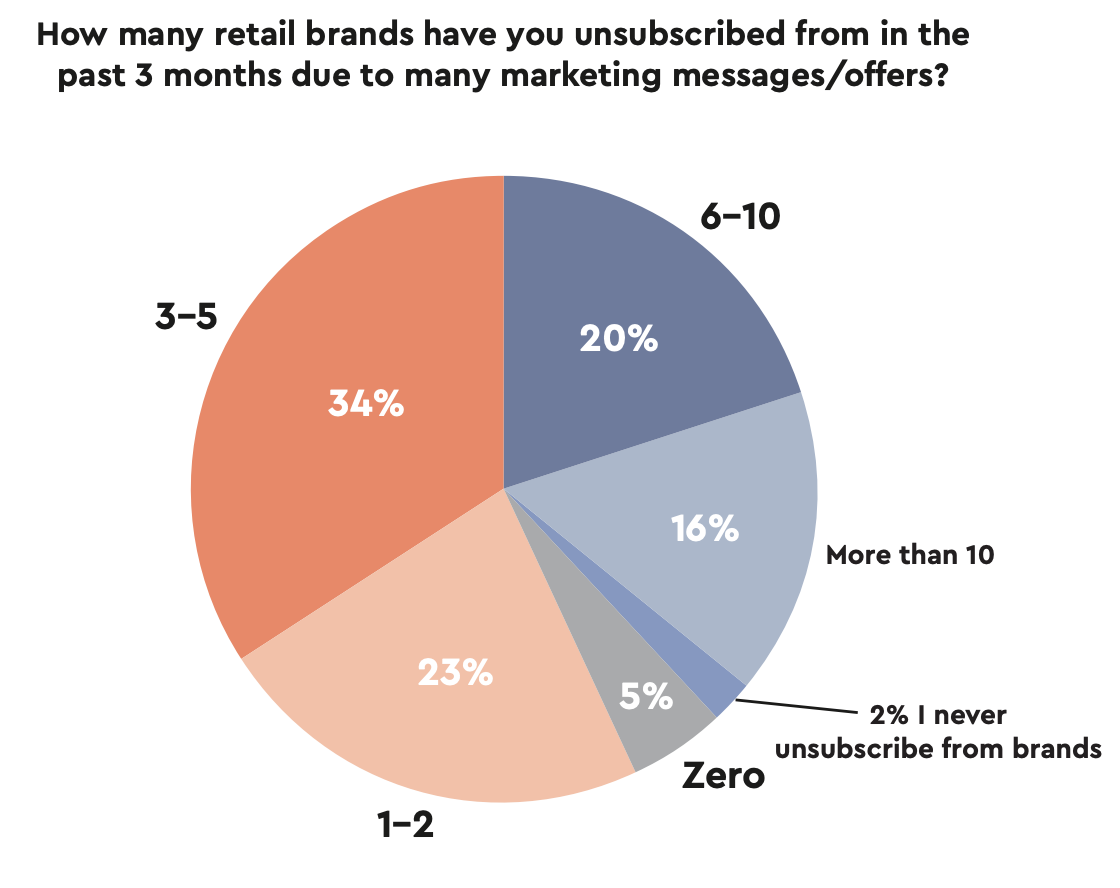
70% have recently unsubscribed from at least 3 brands due to too many messages or offers, and more than 1 in 3 (36%) from at least 6 brands
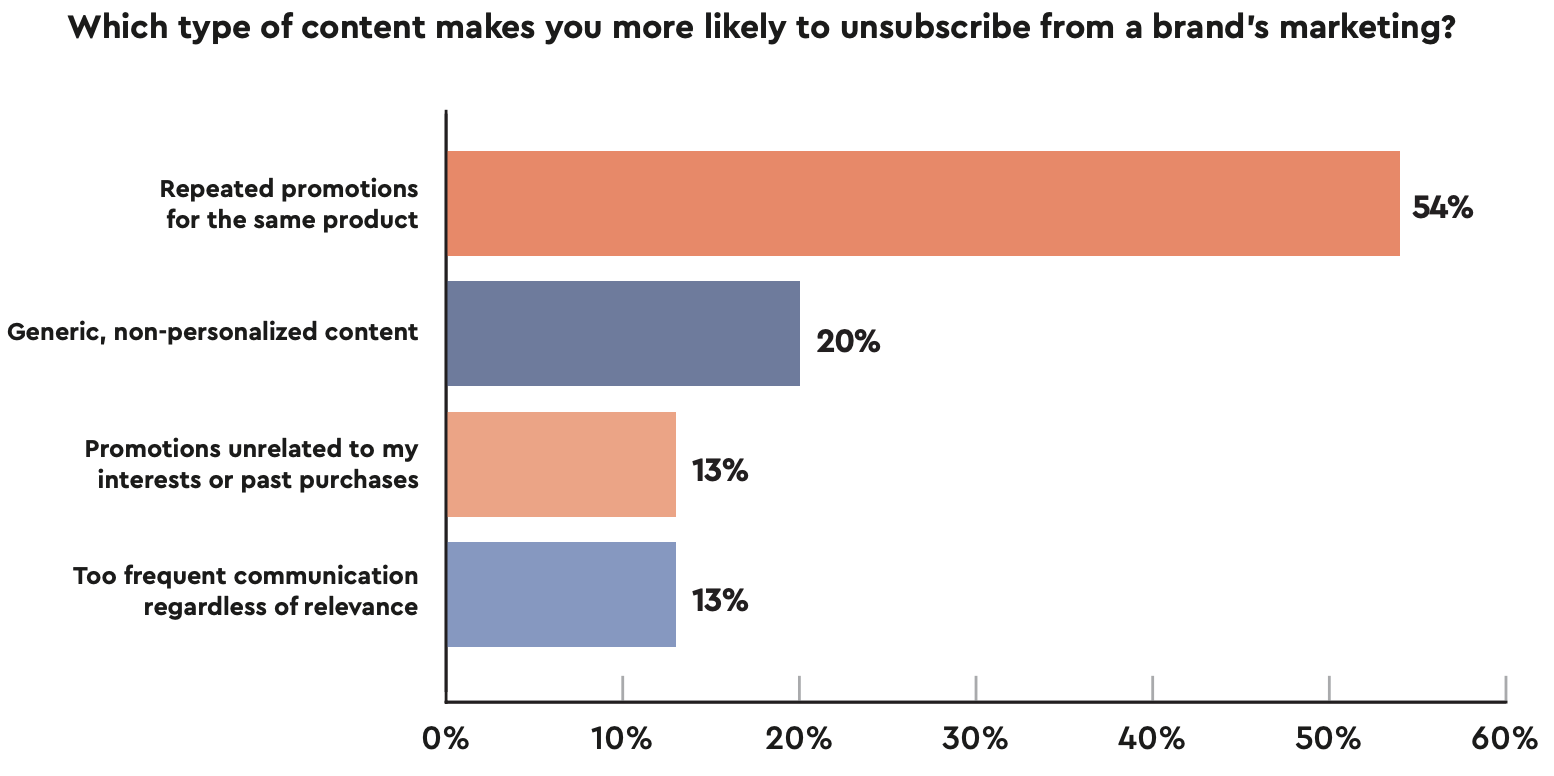
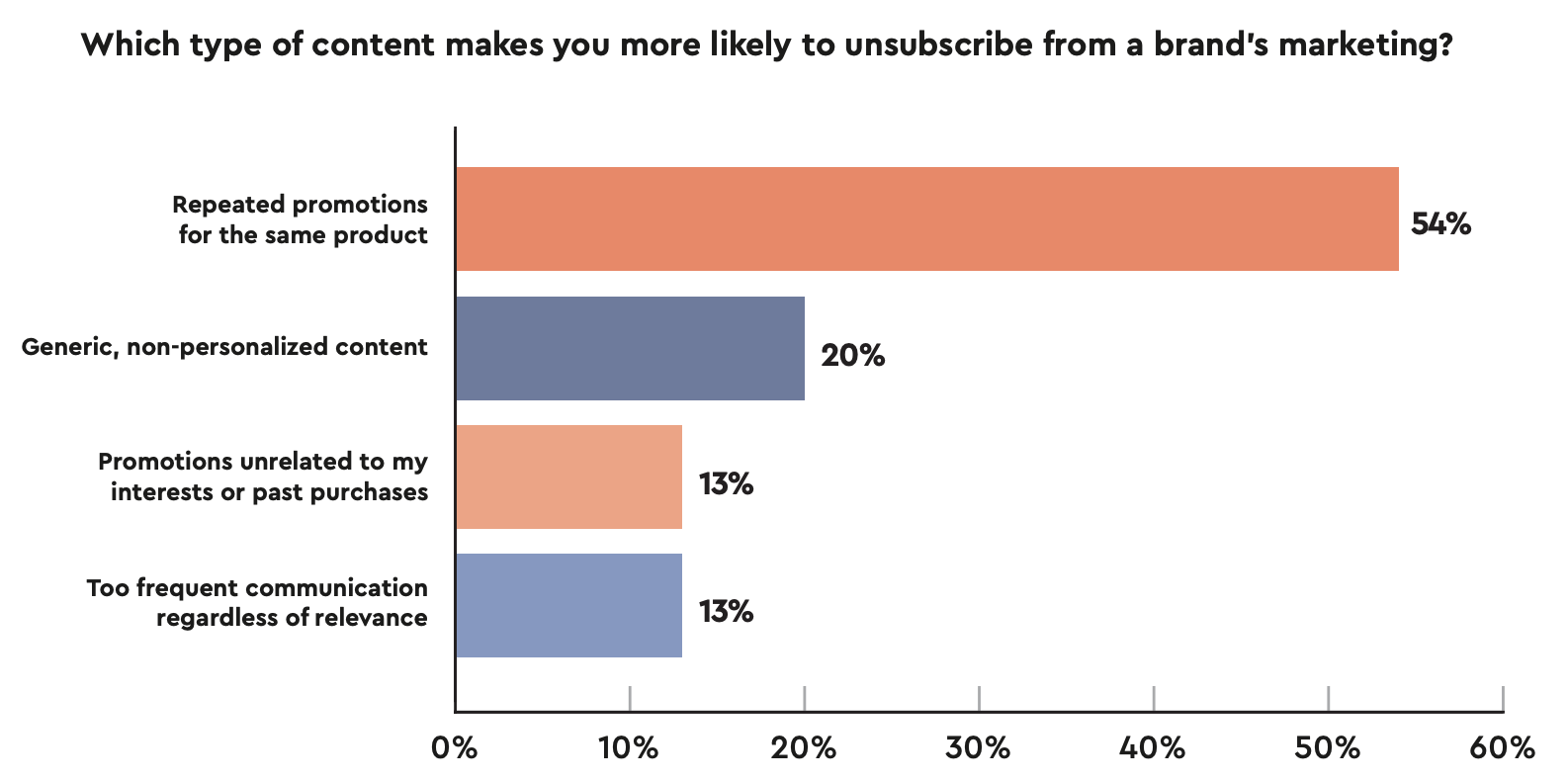
54% of respondents unsubscribe because they are bombarded by a brand with repeated promotions for the same product
Poorly timed emails can lead to disengagement
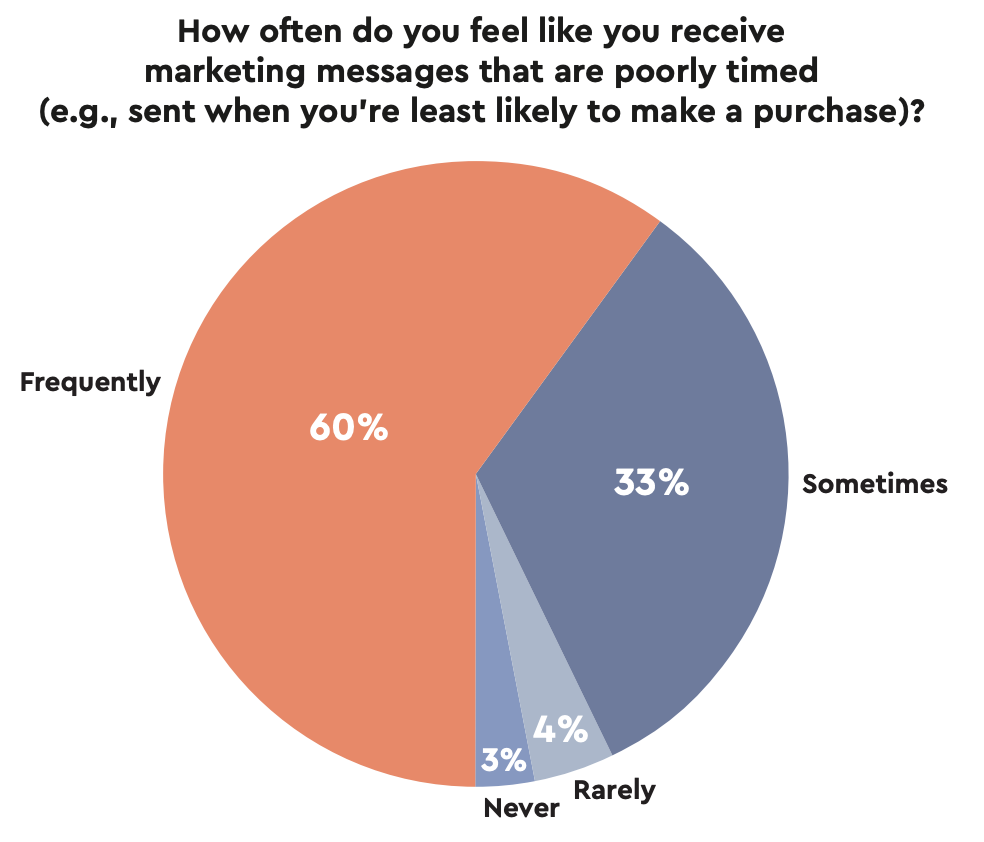
60% of respondents receive emails from brands when they’re not relevant to their real-time needs, objectives, readiness, or preferences
Personalization is very important to customers
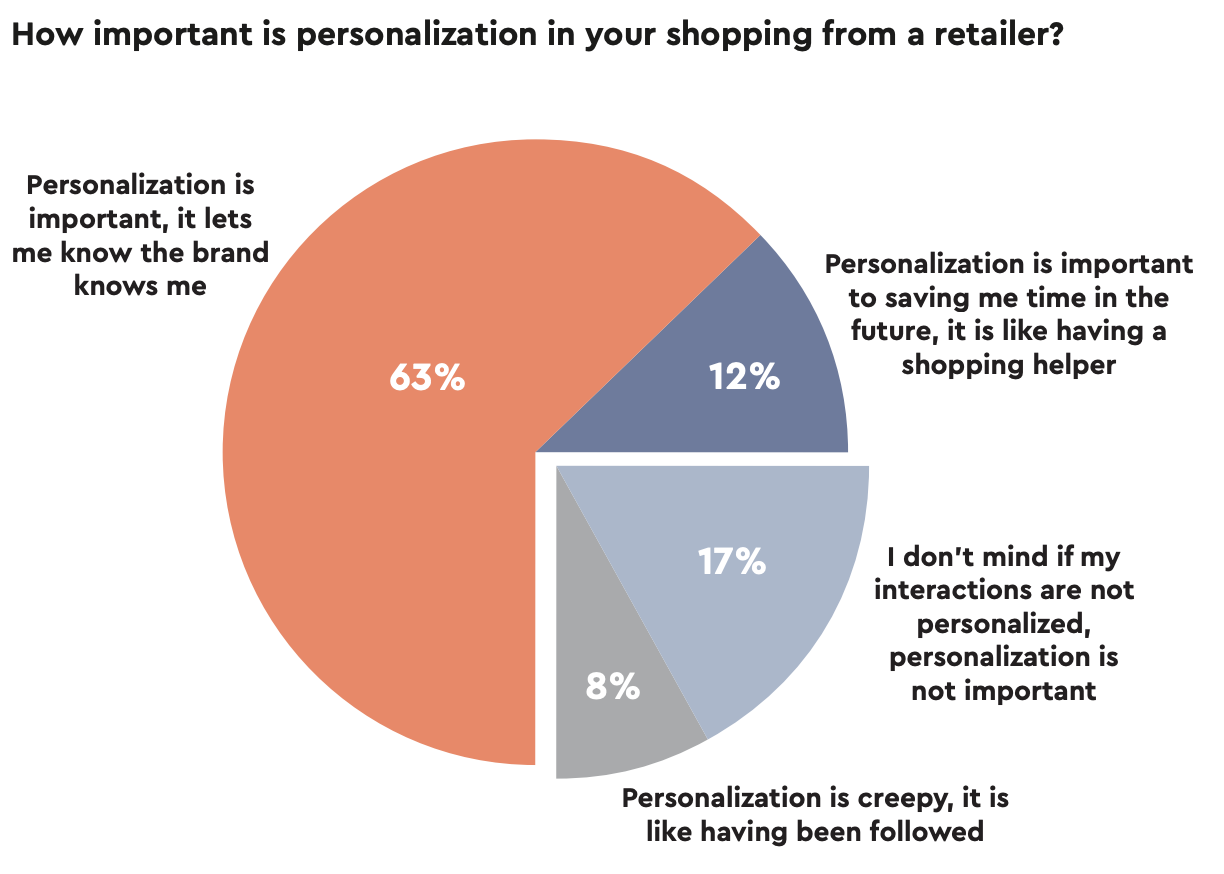
Personalization is more crucial than ever, with 75% of respondents highlighting its importance, at a significant increase over last year’s 54%
Customers want brands to personalize their marketing messages beyond their first name
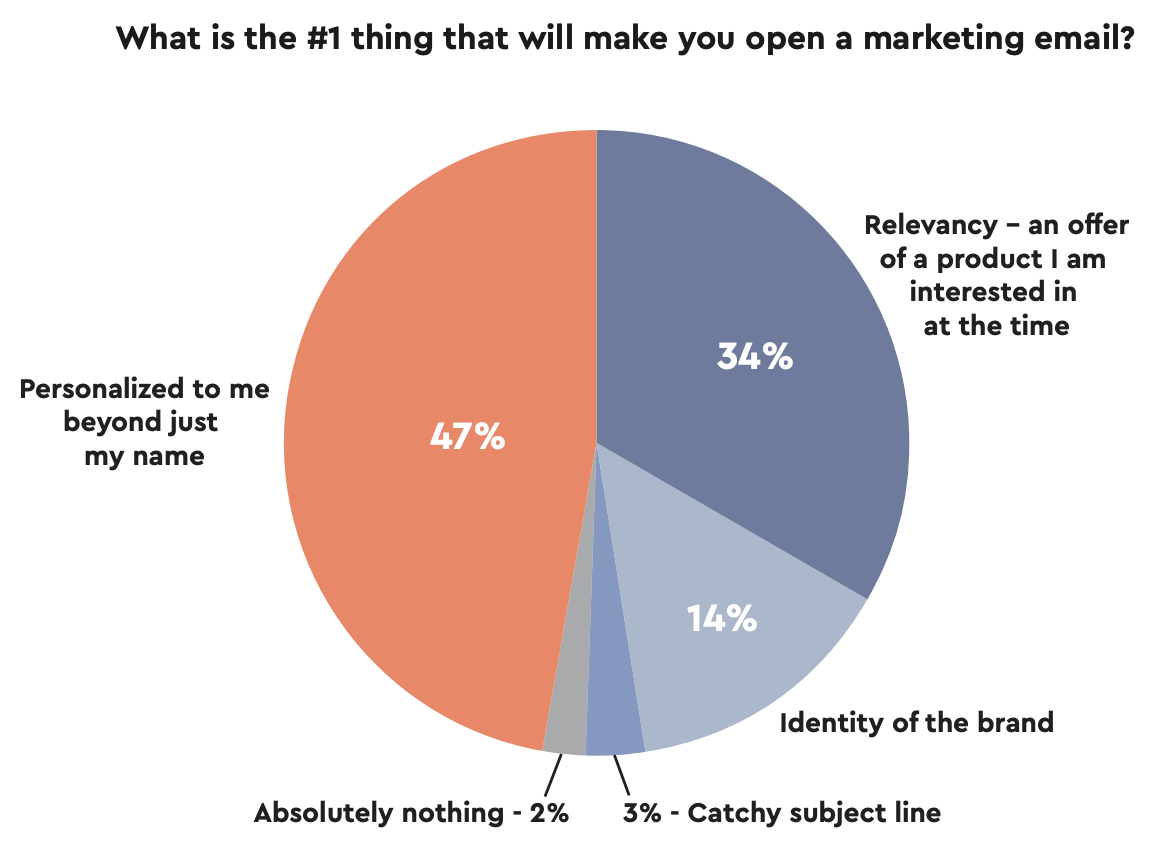
81% of respondents will open an email that is tailored to them, whether it’s personalized beyond their first name (at 47%) or relevant to a product they’re interested in (34%)
Customers want control over frequency, timing, and content
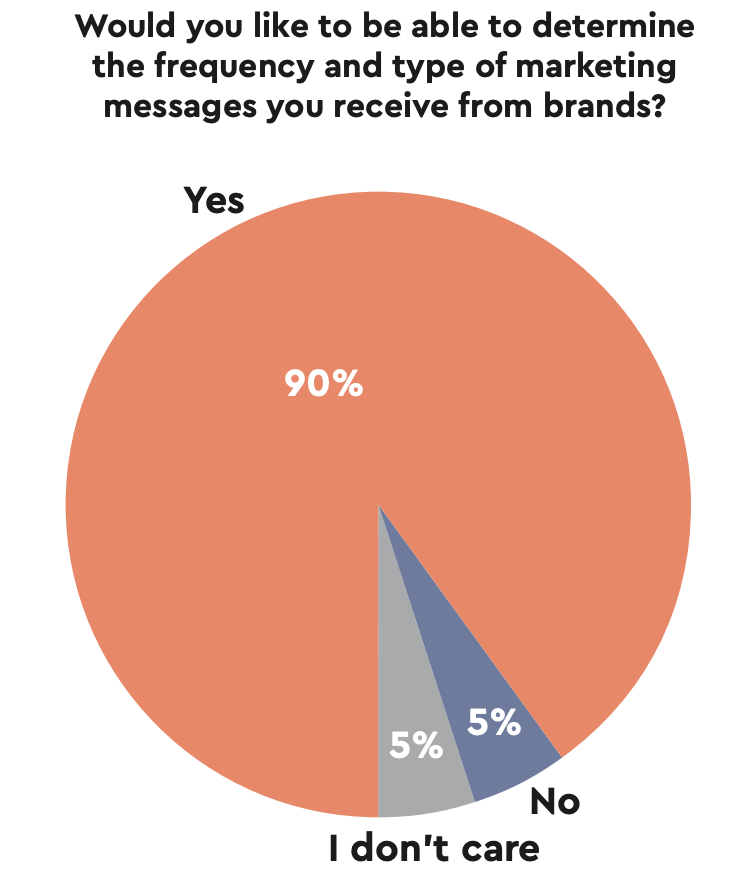
An overwhelming 90% of respondents want brands to give them control over how often and what type of messages they receive
Brands that nurture loyalty boost engagement with marketing messages
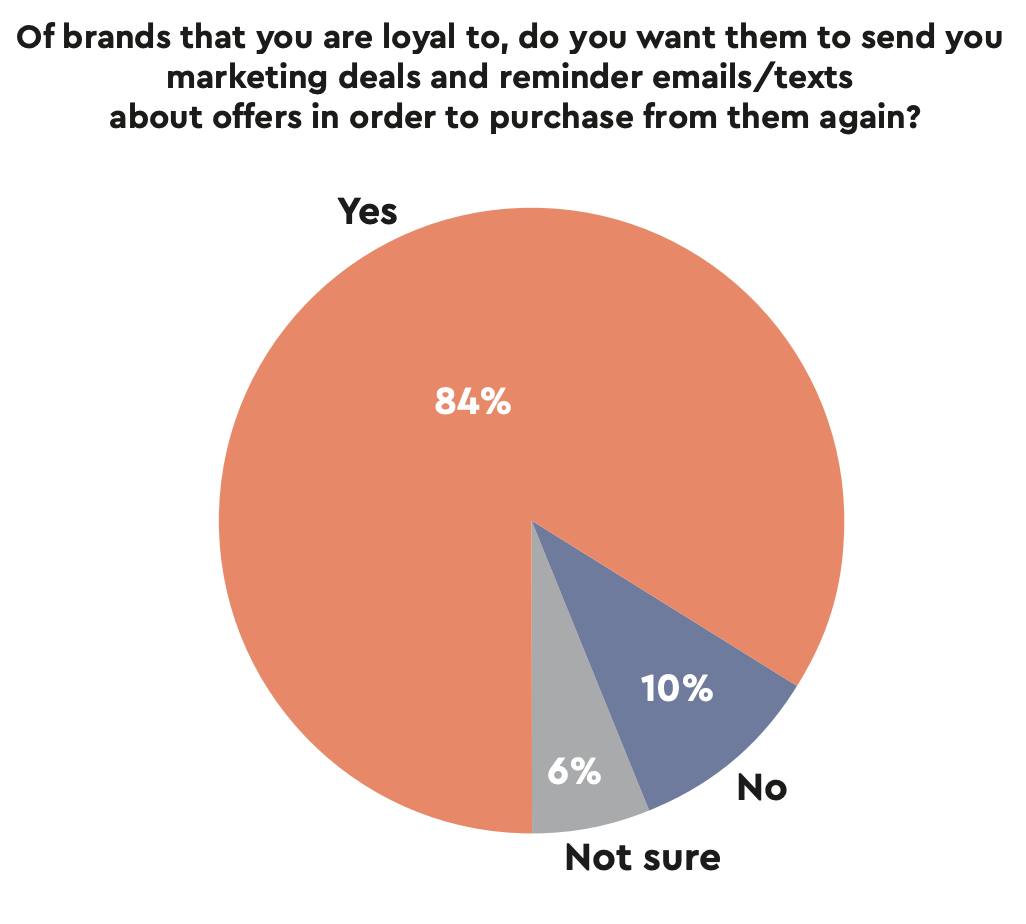
A whopping 84% will buy again after they receive a marketing email with a reminder from a brand they are loyal to, at a notable increase over last year’s 60%
Recommendation for Marketers
Optimizing Email Campaigns: Turning Insights into Action Email remains a vital channel for customer engagement, but poor execution risks customer disengagement and brand erosion. With advanced technology, such as CRM-integrated email platforms, marketers can craft hyper-personalized campaigns that drive loyalty, boost lifetime value, and build stronger customer relationships. Below are best practices powered by today’s tools:
- Manage email volume, frequency, and timing
- Key challenge: Seventy percent (70%) of consumers unsubscribe due to excessive messaging, while poorly timed emails result in disengagement.
- Solution with technology:
- Monitor engagement indicators: Use analytics to track opens, clicks, and spam complaints.
- Automate timing: Leverage AI to send emails at optimal moments based on customer behavior.
- Gradual scaling: Incrementally adjust frequency to avoid ISP spam flags.
- Shift from transactional to relational campaigns
- Key challenge: Traditional "spray and pray" approaches fail to build meaningful relationships.
- Solution with technology:
- Real-time content updates using dynamic email templates.
- Automated triggers for milestones (e.g., loyalty anniversaries, replenishment reminders).
- Align campaigns with specific audience needs using multi-brand management tools.
- Personalize every message
- Key challenge: Generic emails alienate customers; 81% prefer tailored messages.
- Solution with technology:
- Use personalization tags for location-based offers and past purchase recommendations.
- Employ predictive modeling to suggest next-best actions.
- Automate personalized product recommendations for higher relevance.
- Empower customers with control
- Key challenge: Ninety percent (90%) of customers want control over email frequency and content.
- Solution with technology:
- Create preference centers to allow customers to select frequency and content types.
- Use if/then/else logic to dynamically adjust content to customer preferences.
- Foster loyalty with predictive and proactive campaigns
- Key challenge: Loyal customers are 84% more likely to repurchase when reminded of relevant offers.
- Solution with technology:
- Segment VIP customers and tailor loyalty rewards.
- Automate replenishment reminders and personalized offers.
- Test and refine continuously
- Key challenge: Email campaigns need to stay relevant amidst changing consumer behaviors.
- Solution with technology:
- Perform A/B/n testing on subject lines, timing, and content.
- Use real-time analytics to adjust campaigns for maximum impact.
- Address email fatigue
- Key challenge: Thirty-seven percent (37%) of customers find email annoying when overwhelmed with irrelevant messaging.
- Solution with technology:
- Build campaigns with zero-party data insights.
- Use dynamic templates to adapt messaging to each customer’s journey.
Summary
Marketers must embrace a relationship-first approach to email marketing. By leveraging advanced CRM-integrated email platforms, brands can deliver personalized, timely, and meaningful messages that resonate with their audience. Every email should strengthen the bond between brand and customer—because meaningful engagement drives lasting loyalty.
Part 2: Customer loyalty cannot be taken for granted
Executive Summary
Part 2, Consumer Loyalty Cannot be Taken for Granted, reports that while a significant percentage of consumers maintain strong loyalty to their favorite online brands, the data also highlights the ease with which customers are willing to explore alternatives.
The findings in Part 2 underscores that marketers must carefully balance fostering loyalty with engaging new audiences while avoiding overcommunication that can lead to churn.
This report also outlines actionable recommendations for marketers to optimize retention strategies, enhance customer engagement, and reduce the risk of losing customers to competitors.
Customer dual behavior: loyalty and exploration
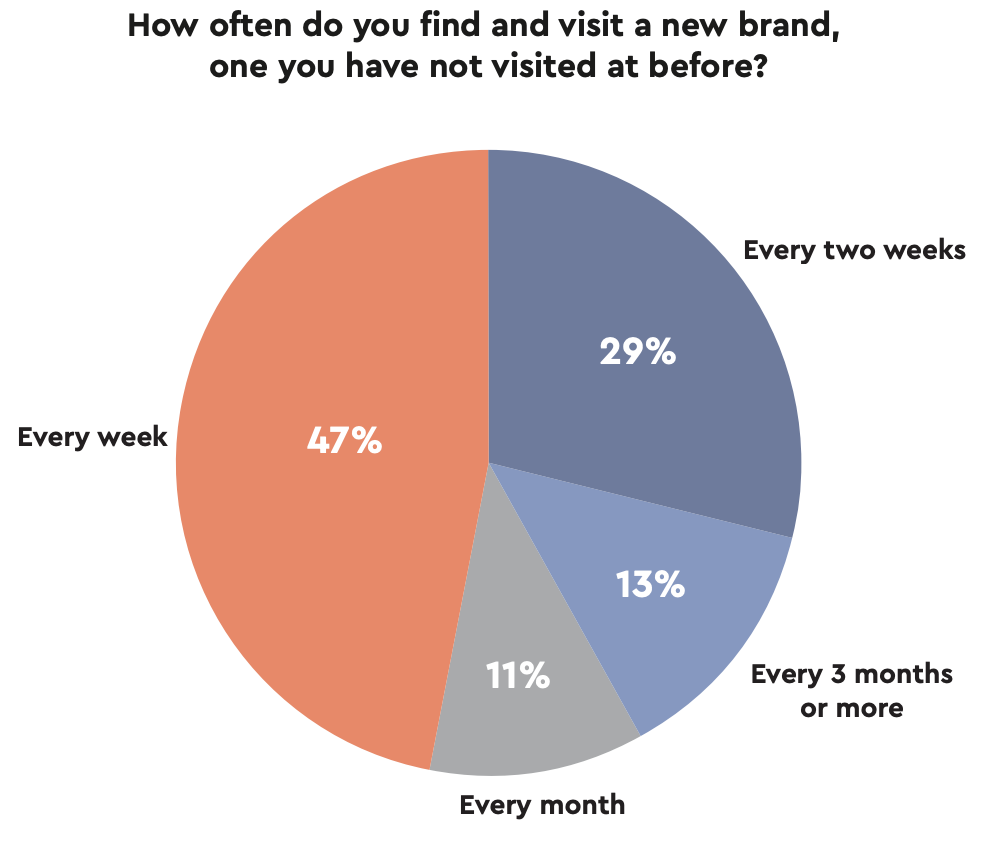
Today, customers exhibit a dynamic relationship with online brands, balancing loyalty with a willingness to explore new options. While a significant majority—76% of respondents— remain loyal to preferred brands, visiting them at least once per week (and 42% daily), they also show a strong inclination to try new brands, with 47% exploring a new brand weekly. This behavior is often driven by competitive pricing (41%) and recommendations from friends or family (31%).
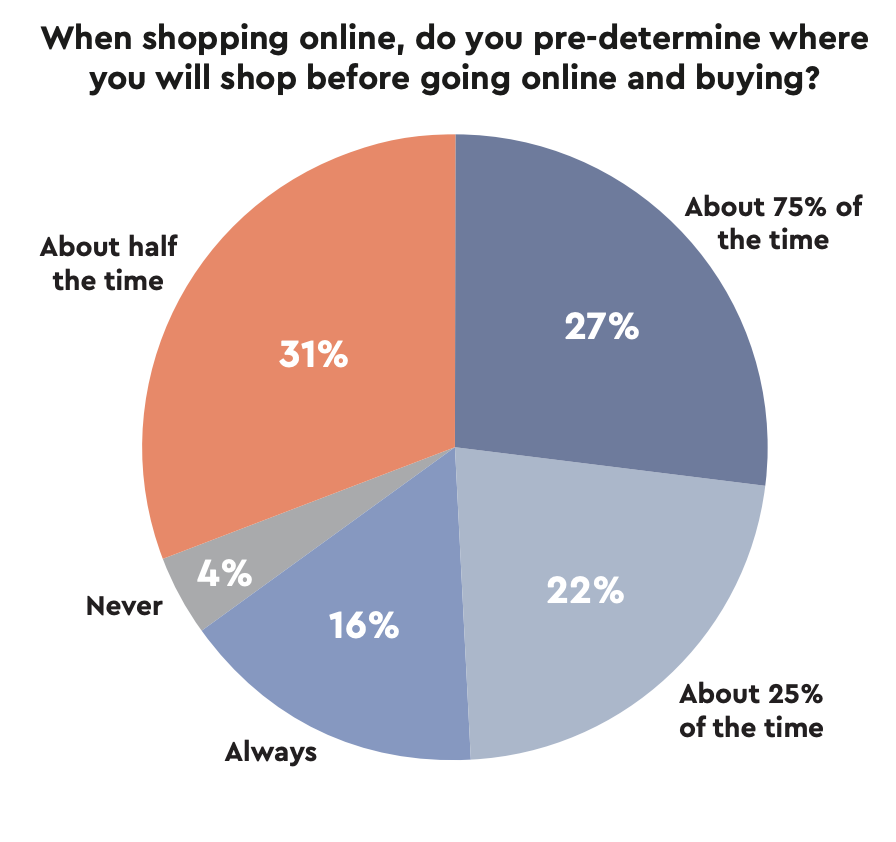
This dual behavior underscores the critical importance of personalized marketing and maintaining relevance. Additionally, 58% of consumers decide where to shop before going online, showcasing the value of brand influence in pre-determined shopping habits.
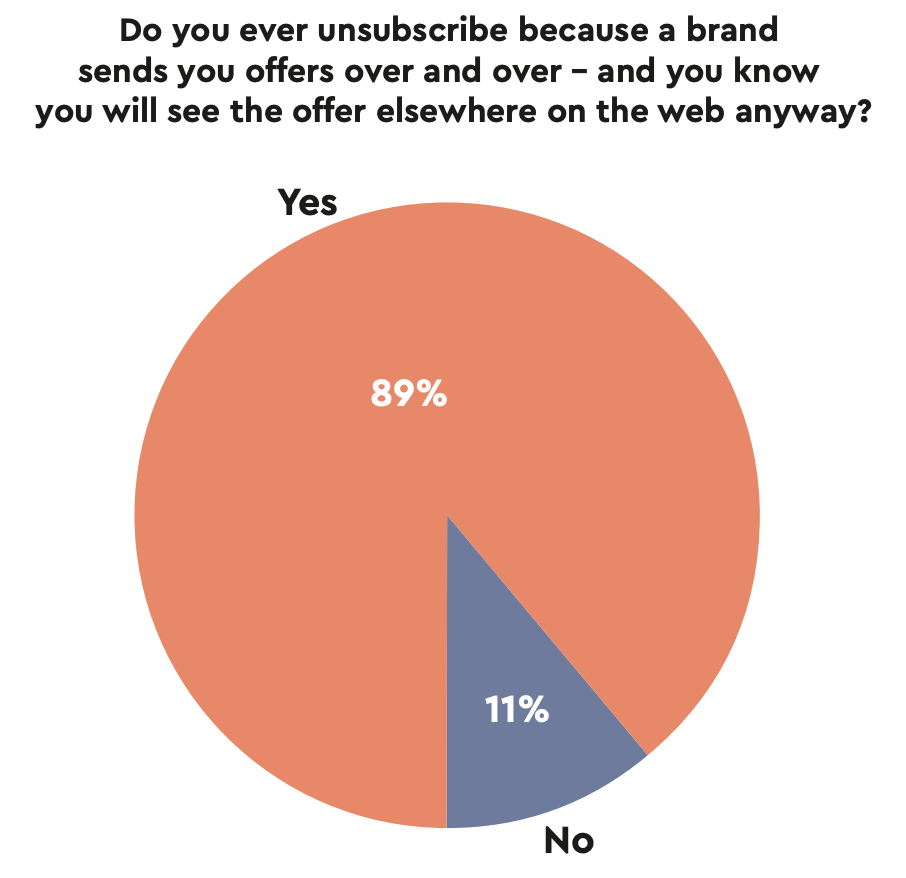
However, the 89% of respondents who unsubscribe from repetitive offers highlight the ever-present risk of customer fatigue, making it essential for brands to strike a delicate balance between retaining existing customers and attracting new ones in an increasingly competitive landscape.
Detailed Survey Results
- Loyalty to Online Brands
Frequent engagement:
- Seventy-six percent (76%) of respondents visit their preferred brands at least once per week.
- Forty-two percent (42%) visit these brands daily.
Marketing engagement:
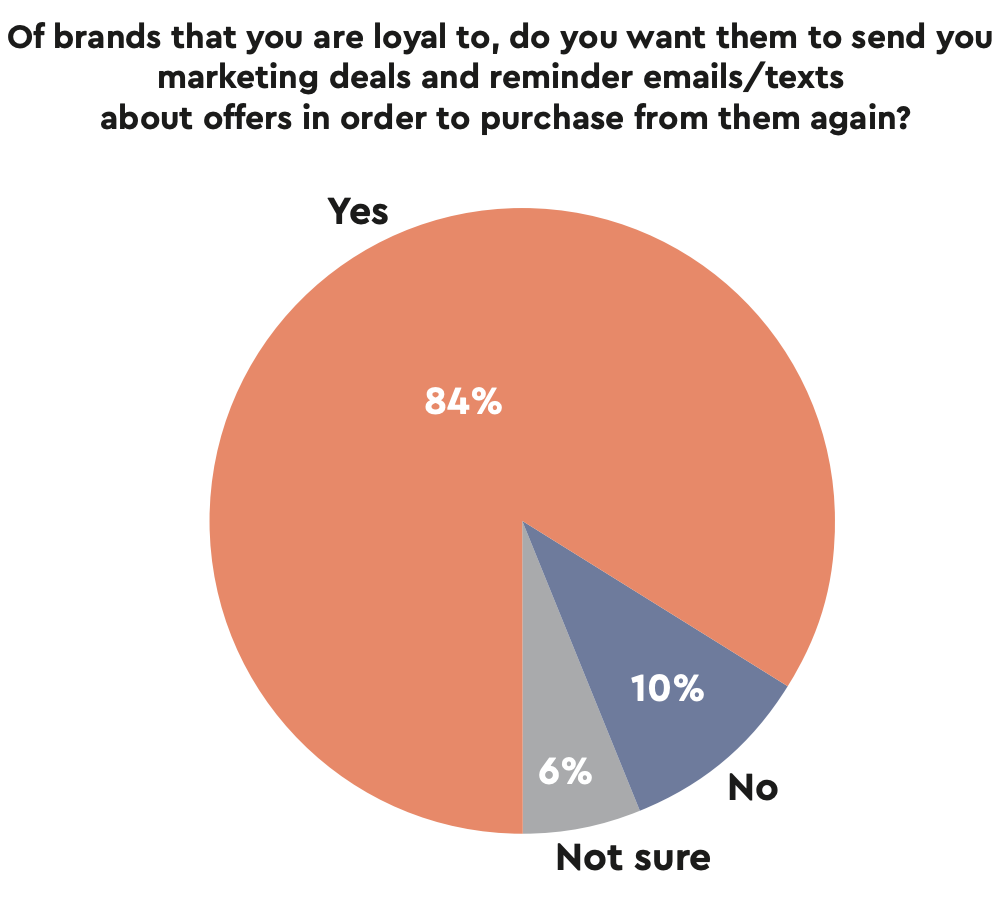
- Eighty-four percent (84%) of respondents welcome marketing deals and reminders from brands they are loyal to.
2. Open to New Brands
Frequent exploration:
- Forty-seven percent (47%) of respondents visit a new brand every week.
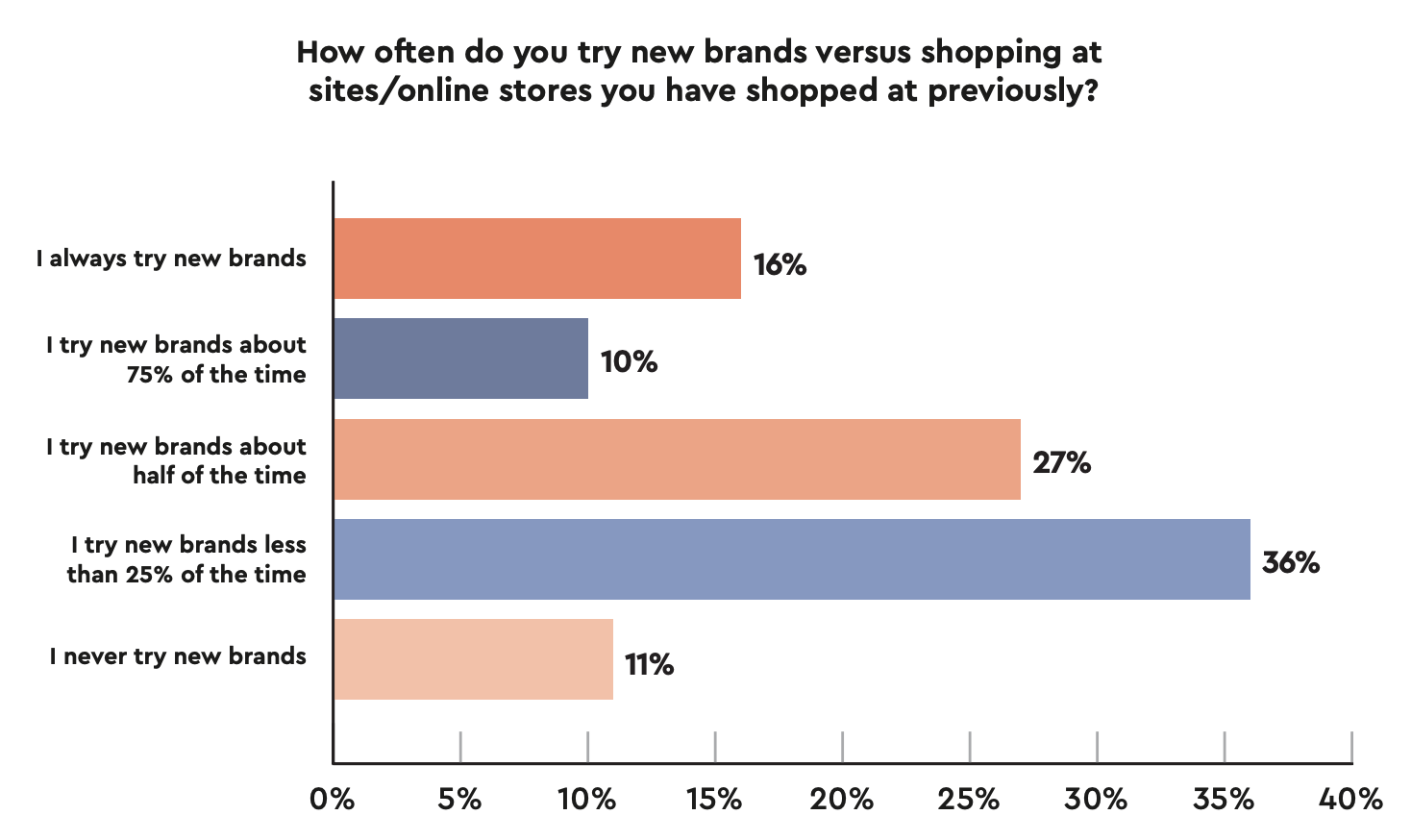
- Fifty-three percent (53%) try new brands half the time or more, while 23% do so more than 75% of the time.
- Only 11% never try new brands.
3. Pre-Determined Shopping
Seventy-four percent (74%) of respondents decide where to shop before going online half the time or more. And 16% pre-determine where they will shop all the time. This shows the importance of prior brand influence.
4. Customer Fatigue Unsubscribe behavior:
- Eighty-nine (89%) of respondents unsubscribe from brands that bombard them with repetitive offers.
Retention risk:
- Nearly 89% of consumers purchase from new sites at least once a month, with 22% shopping at new platforms twice monthly, signifying high retention risk.
Recommendation for Marketers
- Prioritize personalization
- Tailor marketing efforts: Use advanced customer data platforms (CDPs) to personalize offers based on individual preferences, shopping history, and behavioral data.
- Segment audiences: Target loyal customers with exclusive rewards and targeted campaigns while crafting specific outreach for new customers.
- Focus on retention
- Loyalty programs: Build robust loyalty programs that offer tiered rewards, early access to sales, or exclusive discounts to retain high-value customers.
- Proactive re-engagement: Identify at-risk customers using predictive analytics and deploy personalized campaigns to win them back before they churn.
- Optimize marketing communication
- Limit frequency: Avoid overwhelming customers with excessive emails or promotions. Instead, focus on high-value, meaningful messages.
- Dynamic content: Use AI-driven tools to ensure the timing and content of communications are relevant, avoiding repetitive messaging that leads to unsubscribe actions.
- Attract new customers strategically
- Competitive pricing campaigns: Highlight sales and special discounts, as pricing is the top motivator for trying new brands.
- Referral incentives: Leverage the power of recommendations by creating referral programs where existing customers can earn rewards for bringing in new buyers.
- Embrace omnichannel strategies
- Integrated experiences: Provide seamless shopping experiences across platforms, ensuring customers can engage both online and offline.
- Click-and-collect options: Enable customers to make online purchases and pick up in-store, catering to their convenience.
- Leverage data for precision marketing
- Behavioral insights: Analyze customer behavior to predict shopping patterns and identify the optimal timing for campaigns.
- Real-time adjustments: Monitor campaign performance and adapt dynamically to ensure maximum effectiveness.
- Build trust through communication
- Transparency: Communicate clear value in marketing messages, focusing on how offers or deals meet customer needs.
- Reduce churn: Use unsubscribe data as a feedback loop to refine strategies and address areas of improvement in messaging frequency or content.
Summary
The data underscores the dual challenge marketers face: nurturing loyalty among existing customers while staying competitive enough to attract new ones. Personalization, retention-focused strategies, and responsible communication are essential for maintaining customer trust and engagement. By leveraging data-driven insights and striking the right balance between loyalty-building and acquisition, marketers can navigate a competitive landscape while ensuring long-term growth and customer satisfaction.
Part 3: Why message personalization and relevancy is an antidote to marketing fatigue
Executive Summary
These findings in Part 3: Why message personalization and relevancy is an antidote to marketing fatigue, provide critical insights into consumer preferences regarding marketing messages focusing on the importance of personalization, relevancy, and timing. The results reported here underscore the need for marketers to adapt their strategies to meet consumer expectations, driving both engagement and loyalty.
Key Findings
- Personalization Drives Engagement
Personalization remains a cornerstone of marketing success:
- Forty-seven percent (47%) of consumers open emails because they are personalized to their needs.
- Thirty-four percent (34%) are motivated to read emails (and other messages) by relevant offers tailored to their interests.
- Combined, eighty-one percent (81%) of consumers open emails based on personalization or relevancy, underscoring the critical importance of tailored communication.
Additionally, sixty-three percent (63%) of respondents value personalization as it signals that the brand “knows them,” making it an essential component of building trust.
2. Relevancy Enhances Purchase Likelihood
Relevance is not only key to engagement but also to driving conversions:
- Sixty-seven percent (67%) of consumers are more likely to purchase when brands make recommendations based on past purchases.
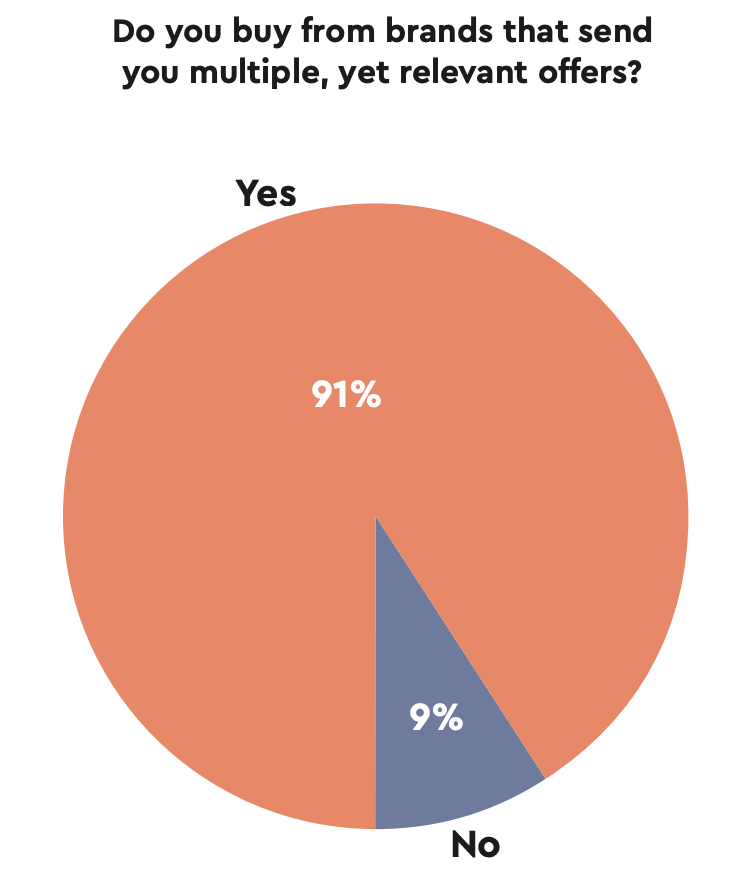
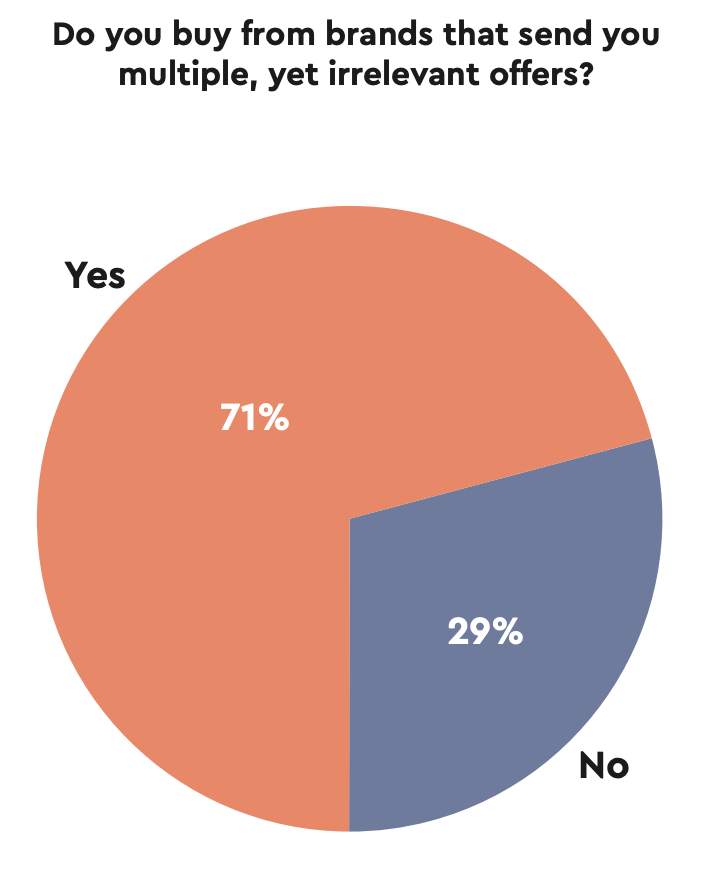
- Ninety-one percent (91%) buy from brands that send multiple, yet relevant, offers.
However, poorly executed campaigns harm relationships.
- Fifty-four percent (54%) of respondents unsubscribe due to repeated offers for the same product.
- Twenty percent (20%) unsubscribe due to generic, non-personalized content.
3. Timing Matters
The timing of messages is as important as their content:
- Sixty percent (60%) of consumers frequently receive poorly timed messages, while another 33% experience this occasionally.
- Seventy-eight percent (78%) of respondents prefer fewer but more targeted messages, noting this earns their loyalty faster.
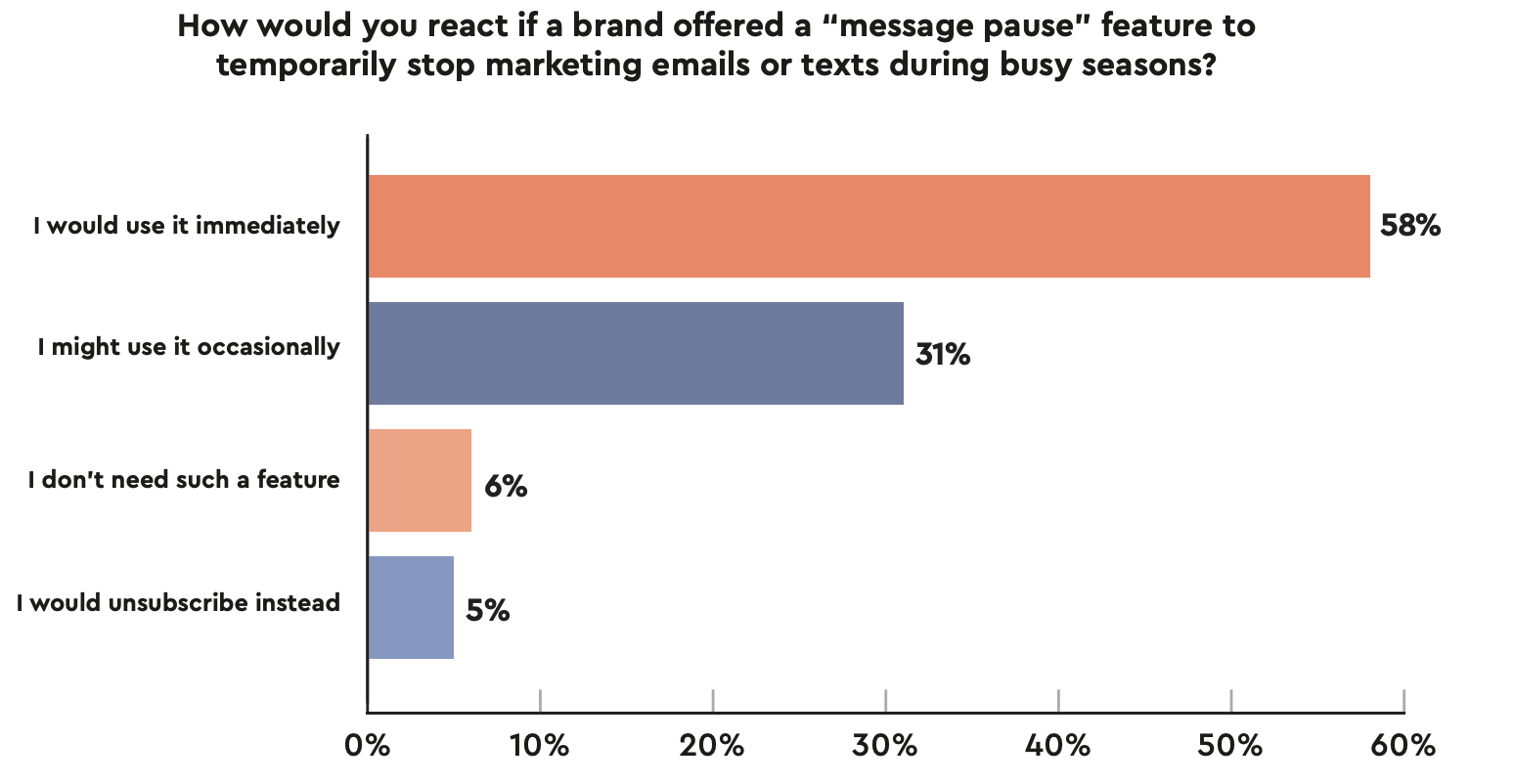
- Fifty-eight percent (58%) of consumers would welcome a "message pause" feature to reduce marketing fatigue.
Recommendation for Marketers
- Prioritize Personalization and Relevance
- Use customer data platforms (CDPs) and AI-driven analytics to create personalized campaigns that go beyond generic tactics, incorporating purchase history and preferences.
- Develop targeted campaigns with dynamic content that adapts to each customer’s unique journey.
- Avoid Marketing Fatigue
- Eliminate repetitive promotions and ensure offers feel fresh and relevant.
- Use real-time data to build campaigns that align with customers’ immediate needs and interests.
- Optimize Timing and Frequency
- Leverage predictive analytics to identify the best times to engage customers.
- Implement customer-controlled features like message-pause options to avoid overwhelming recipients.
- Build Loyalty Through Meaningful Communication
- Focus on fewer, higher-quality messages that deliver value and resonate with customers.
- Highlight personalization and relevancy as core pillars of your brand strategy to foster deeper connections.
Summary
Personalization, relevancy, and timing are not just trends—they are essential for successful marketing. Marketers who embrace these strategies will not only boost engagement but also build stronger, long-term relationships with their customers.
By aligning with consumer expectations and leveraging advanced tools like AI and predictive analytics, brands can transform their marketing from noise to meaningful engagement, ensuring they stand out and drive results.
Part 4: Why Marketers Must Use AI for Personalization, Not Intrusion, to Combat Marketing Fatigue
Executive Summary
Part 4 of The 2025 Optimove Insights Consumer Marketing Fatigue Report, Why Marketers Must Use AI for Personalization, Not Intrusion, to Combat Marketing Fatigue, focuses on the role of personalization and the importance of balancing innovation with consumer trust.
The survey highlights the dual nature of AI in marketing: While consumers value AI’s ability to deliver personalized and relevant experiences, they also demand transparency and data privacy from brands. This underscores the need for marketers to balance the power of AI-driven engagement with responsible data practices. By prioritizing trust and addressing privacy concerns, brands can leverage AI to build deeper connections and foster long-term loyalty.
Key Findings
AI-Driven Marketing is Widely Appreciated
- Fifty-eight percent (58%) of respondents appreciate and prefer AI-driven marketing, citing its ability to tailor messages to their needs.
- Only 12% expressed negative feelings toward AI in marketing, primarily due to concerns about intrusiveness or mistrust of AI.
AI’s Impact on Consumer Trust and Purchasing Behavior
- Fifty-nine percent (59%) of respondents trust brands that use AI in marketing, believing it enhances recommendations and improves their overall experience.
- Fifty-eight percent (58%) have made purchases based on AI-generated recommendations, with 18% noting that the suggestions were “spot on.”
Personalization Enhances Shopping Experiences
- Fifty-eight percent (58%) believe AI-driven personalization enhances their shopping experience, while 18% feel it’s helpful but occasionally inaccurate.
Consumer Concerns About AI
- The top concern (32%) is how personal data is used and stored.
- Twenty-one percent (21%) worry about feeling overly monitored through ads and interactions.
- Only 11% of respondents expressed no concerns about AI in marketing.
Awareness and Control Over Personal Data
- Eighty-seven percent (87%) of respondents reported they can tell when a company uses AI in its marketing efforts.
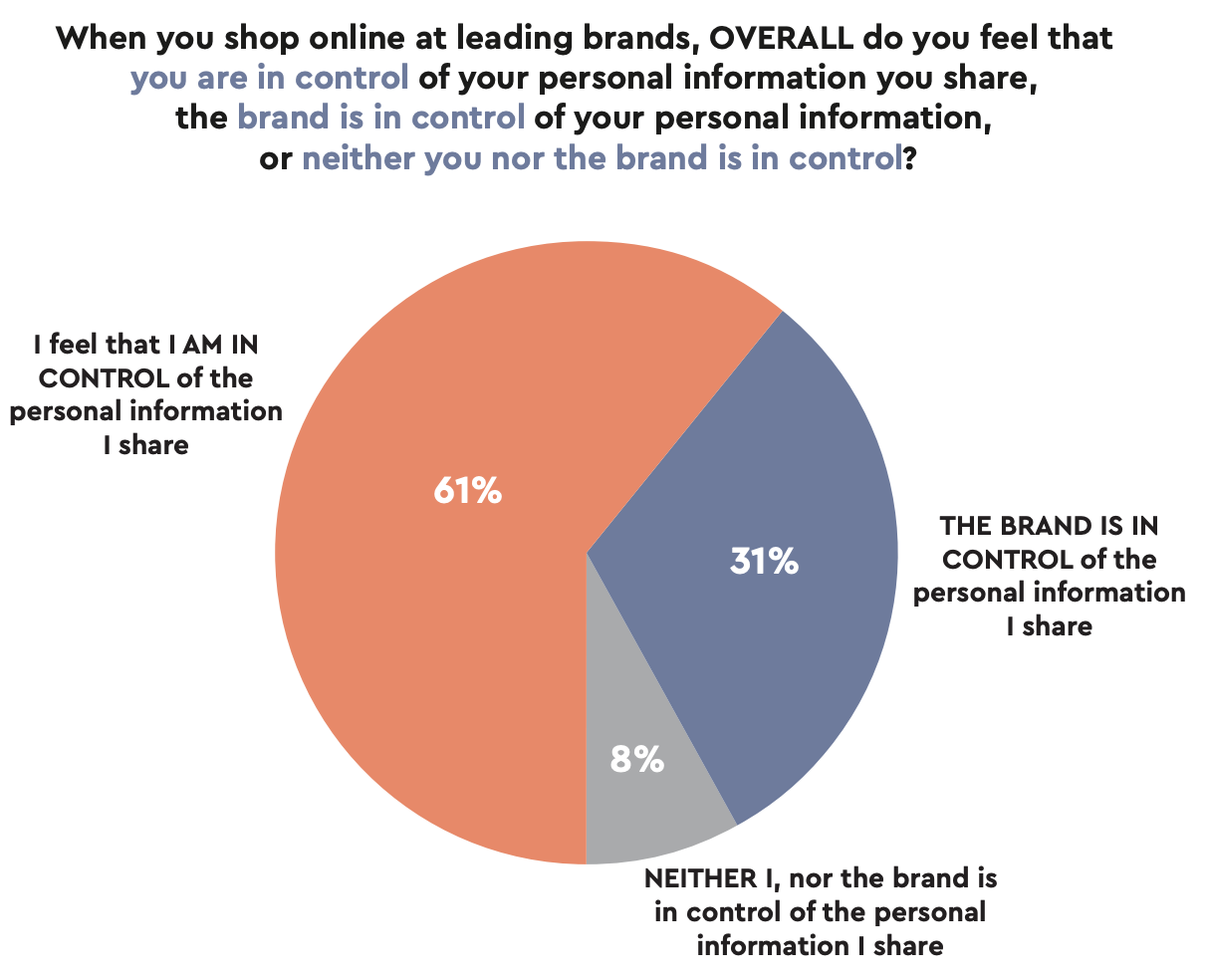
- Sixty-one percent (61%) feel in control of their personal data, while 31% believe brands hold control.
- Ninety percent (90%) said it is extremely or very important to have control over their personal data.
- Eighty-eight percent (88%) have unsubscribed from brands due to concerns about data misuse.
Implications for Marketers
Key strategies for brands to be perceived as helpful, but not intrusive with personalization include:
- Ensure transparent communication about how data is collected and used.
- Deliver only relevant, non-intrusive messaging tailored to individual preferences.
- Prioritize privacy and providing consumers with control over their data.
Summary
As AI-driven marketing evolves, it offers brands unparalleled opportunities to deliver tailored experiences. However, to avoid intrusion and marketing fatigue, transparency, privacy, and relevance must remain at the forefront. By leveraging AI responsibly, brands can foster trust, optimize customer lifetime value, and ensure their marketing strategies connect with discerning consumers.
Report Conclusion: Avoiding Fatigue and Elevating Loyalty Through Personalization and Relevancy
The 2025 Optimove Insights Consumer Marketing Fatigue Report highlights a critical challenge for marketers: message bombardment. Consumers are increasingly fatigued by irrelevant, repetitive, or excessive communications. Brands that fail to adapt risk losing engagement and loyalty. The days of a one-size-fits-all marketing strategy are over. Today’s consumers expect every message they receive to be both personalized and relevant to their unique preferences and needs.
Fortunately, advancements in CRM marketing technology have made it possible for brands to meet these rising expectations. With tools powered by AI, predictive analytics, and hyper-personalization capabilities, marketers can deliver meaningful, timely communications tailored to each individual consumer. This approach not only combats fatigue but also fosters deeper connections with customers, ensuring that every interaction strengthens the relationship.
Strategies for Deeper Engagement and Unwavering Customer Loyalty
To optimize customer lifetime value and create lasting loyalty, brands should adopt these key strategies:
- Embrace Personalization Beyond the Basics: Move beyond simple name-based personalization. Leverage customer data to craft tailored messages that reflect past behaviors, preferences, and purchase histories.
- Deliver Relevant and Timely Communications: Use real-time analytics and predictive modeling to send messages when they matter most, such as during pivotal shopping moments or after key customer interactions.
- Prioritize Quality Over Quantity: Resist the urge to over-communicate. Focus on fewer, higher-quality messages that provide genuine value, ensuring customers don’t feel overwhelmed.
- Offer Consumers Control: Empower customers to customize the frequency and type of messages they receive through preference centers. This builds trust and reduces the likelihood of disengagement.
- Leverage Predictive Analytics for Retention: Identify at-risk customers and proactively re-engage them with personalized offers or loyalty rewards that address their specific needs.
- Foster Loyalty Through Meaningful Rewards: Build robust loyalty programs that celebrate milestones, provide exclusive offers, and create a sense of belonging for high-value customers.
- Continuously Optimize Campaigns: Test and refine messaging strategies using real-time insights to ensure maximum relevance and engagement for every campaign.
The Path Forward
By adopting these strategies and leveraging the latest advancements in CRM Marketing, brands can transform their interactions from intrusive to invaluable. Personalization and relevancy are no longer optional—they are essential for earning and retaining consumer trust. The ability to deliver meaningful messages, at the right time and place, will differentiate the brands that thrive in today’s competitive landscape from those that fade into irrelevance.
When executed thoughtfully, these approaches not only combat marketing fatigue but also unlock unprecedented opportunities for deeper engagement and unwavering customer loyalty.
About Optimove
Optimove is the first Customer-Led Marketing Platform. Its solutions ensure that marketing always starts with the customer instead of a campaign or product. Customer-led marketing has been proven to deliver brands an average increase of 33% in customer lifetime value.
Recognized as the Visionary Leader in Gartner’s 2024 Magic Quadrant for Multichannel Marketing Hubs, Optimove also continues as a global leader in journey orchestration in Gartner’s companion Critical Capabilities report.
Being a visionary leader is a hallmark of Optimove. It was the first CRM Marketing Platform to natively embed AI with the ability to predict customer migrations between lifecycle stages in 2012. Today, its comprehensive AI-powered suite is at the leading edge of empowering marketers to optimize workflows from Insight to Creation and through Orchestration.
Optimove provides industry-specific and use-case solutions for leading consumer brands globally. For more information, go to Optimove.com
About Optimove Insights
Optimove Insights is the analytical and research arm of Optimove, dedicated to providing valuable industry insights and data-driven research to empower B2C businesses.