
Unified Growth Solution
World-class tech needs world-class drivers. AI platform and expert services, unified
Read time 6 minutes


Let AI decide the next best action.
Why it matters:
CRM marketers reading this will leave with a concrete way to optimize their content. They’ll be able to determine if they have a creation issue, or a decisioning issue. That distinction determines which campaigns will actually move engagement and loyalty, and which ones will just add more noise to an already saturated inbox. This post also explains why AI-generated content, without the right delivery layer, actively accelerates churn rather than preventing it.
Key takeaways:
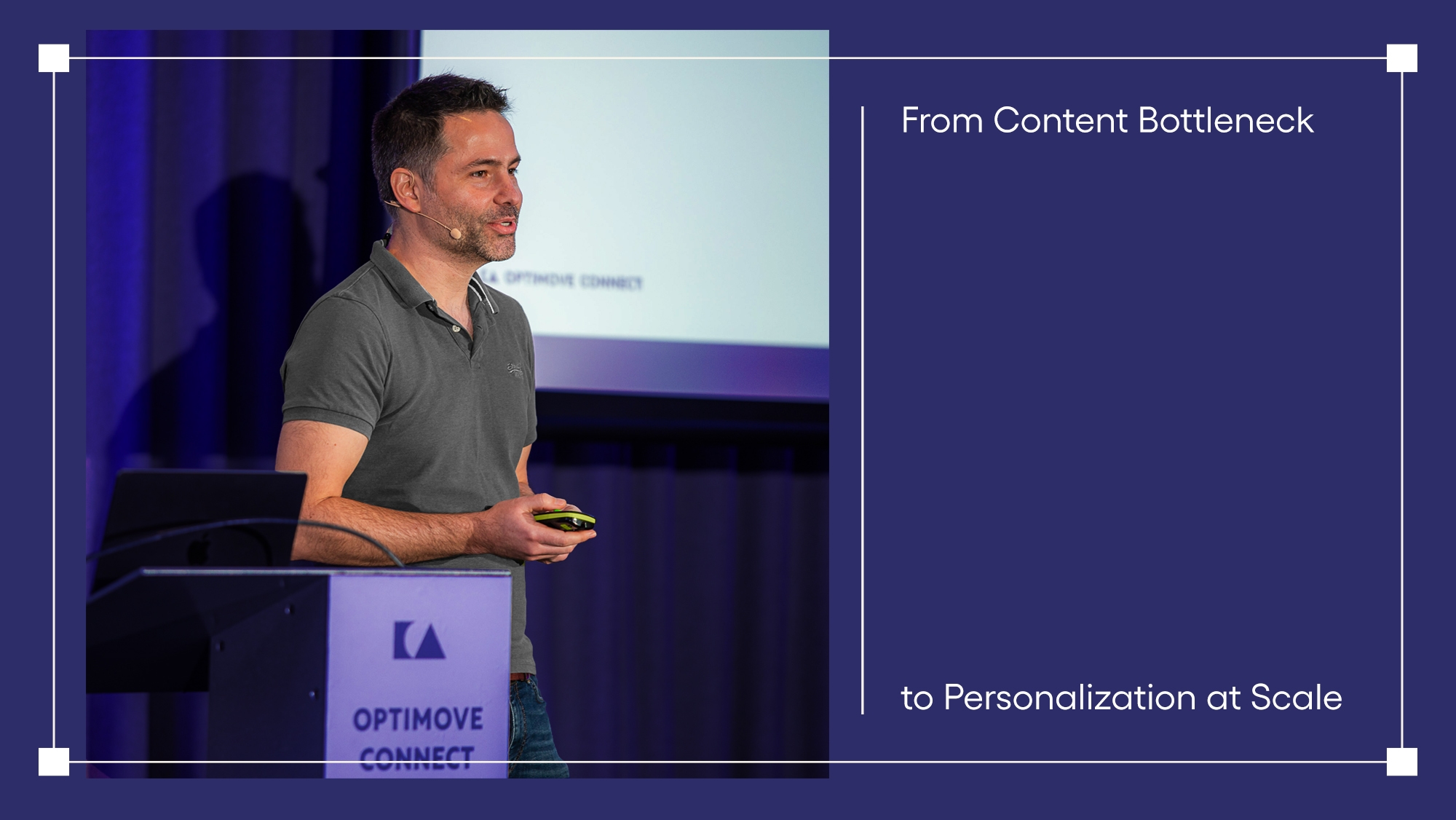
In this Optimove Connect 2026 session, Rob Davis, Senior Product Director at Optimove, shows what it takes to move from content creation to personalized content at scale:
AI just made content free and easy. It can turn out to be an expensive thing in marketing programs, costing brands customer loyalty.
For years, the content bottleneck was a production problem. Creative teams were overloaded; briefing cycles took weeks, and every new campaign variant meant more handoffs, more approvals, and ultimately more waiting.
Marketers wanted more content, faster, and cheaper. Now they can create it. Large language models (LLMs) can generate dozens of email variants, push notifications, and SMS messages in minutes, with almost no human involvement. The bottom line is near zero cost.
The problem is what happens next? When every brand can produce infinite content cheaply, the result is a flood of content. And customers can drown.
Here’s how brands can fix it before they lose loyalty.
Inbox overload is at an all-time high. Nearly 393 billion emails are sent and received every day in 2026 (Radicati Group, Email Statistics Report 2024-2028). Customers are not passively ignoring the volume but are actively cutting ties.
Optimove's 2026 Marketing Fatigue Report shows some relief: 70% of consumers unsubscribed from brands in the last three months due to overwhelming message volume, and 83% say the reason is repeated, irrelevant offers, not the frequency itself.
Customers are not asking for fewer emails. They are asking for relevant, more personalized ones.
AI did not eliminate the cost of content. It just shifted where that cost lands.
Before AI, the cost was internal and took time, creative resources, agency fees at times, approval cycles, etc. Those were real and painful, but contained. The customer never saw them.
With AI, the cost falls on the customer. It shows up as irrelevant messages, repeated offers, and the slow accumulation of feeling like a brand does not actually know them. A complete loss of humanization.
In the same Optimove Insights 2026 Marketing Fatigue Report mentioned above, the loyalty data reflects this: 55% of consumers have switched brands multiple times due to marketing bombardment, and a further 24% have seriously considered it. Meanwhile, 79% say brands that send fewer but more targeted messages earn their loyalty faster. This means volume is not just ineffective, it is actively working against retention.
Content was always meant to be the vehicle for relationship-building. When it becomes an undifferentiated volume, it signals to the customer that the brand sees them as a segment or target group, rather than a real person with personal preferences. That signal erodes trust quietly and consistently, long before it shows up as churn data.
Content production is no longer the constraint. The constraint is now AI Content Decisioning, or figuring out, at scale and in real-time, which of your many content variations should reach which customer, through which channel, at which moment. That is a fundamentally different problem, and the AI generation of content alone cannot solve it.
When a single email campaign becomes 20 variants with different tones, offers, and Calls to Action (CTAs), a human team cannot manage who sees which version. And if the platform sending those variants has no context about the customer, no understanding of their past behavior, preferences, or current lifecycle stage, the personalization is cosmetic. A different subject line in the same irrelevant message.
This is where Optimove Orchestrate's AI Journey Decisioning Agent changes the dynamic. Rather than sending every campaign to a predefined customer segment, the decisioning layer evaluates each customer in real time, using their behavior, their history, and the brand's Key Performance Indicators (KPIs), to determine which campaign is most likely to resonate.
By tagging content with tone, type, and category using Optimove Engage's content intelligence layer, the decisioning system knows how to use new campaigns without waiting to learn from customer behavior. The platform does not need a learning period to start performing, as it already has context.
The brands earning customer loyalty in a saturated content environment are sending better messages, not more. More relevant, more timely, more attuned to where each customer is in their individual journey.
Optimove's research is consistent on what this delivers: 81% of consumers open emails tailored to their interests, and 67% are more likely to purchase when recommendations reflect their past behavior. In addition, 71% of loyal consumers visit their favorite brands daily or weekly, with 81% actively expecting those brands to send them relevant deals and reminders.
Therefore, the opportunity is here. The audience is engaged, and the gap is in what gets sent to them.
That gap is a decisioning problem. Volume is no longer the constraint, as most marketing teams can produce more content than they can usefully and effectively deploy. What determines whether that content drives loyalty or drives unsubscribes is whether the right piece reaches the right customer at the right time.
That is a decisioning problem, and it is one that requires AI to solve at scale.
AI has transformed content creation, making it faster and cheaper than ever. But quantity alone is no longer enough. Endless campaigns can overwhelm customers, destroying trust and loyalty. Optimove’s research shows that customers aren’t asking for fewer emails. They want relevant, personalized content.
The real challenge today is AI Content Decisioning. Brands need to figure out which message should reach which customer, through which channel, and at what moment. Platforms without context risk sending content that looks personalized but is superficial, turning potential engagement into fatigue.
By combining content intelligence and real-time decisioning, brands can ensure every message is meaningful. The result is more opens, more purchases, and stronger loyalty. In a world of content abundance, precision, not volume, is the true driver of customer trust.
For more insights, contact us to request a demo.
The most advanced orchestration engine, ever.
Unified data, AI decisioning, and Self-Optimizing Journeys — all in one.


Dafna is a content marketing manager and writer who generates branded content for online industries, specializing in lead generation, SEO, CRM, and lifecycle stage marketing.
With over ten years of professional writing experience, she helps brands grow and increase profitability, efficiency, and online presence. Dafna holds a B.A. in Persuasive Communications from Reichman University (IDC Herzliya).
FAQ
Marketing fatigue occurs when customers feel overwhelmed by the volume, frequency, or irrelevance of brand communications. It is intensifying because AI has dramatically reduced the cost of content production, leading many brands to increase message volume without a corresponding improvement in relevance or precision.
50% of consumers report they can recognize AI-generated content and engage with it less. When AI is used to scale volume rather than improve relevance, it accelerates the fatigue it was meant to solve. The issue is not AI itself. It is AI deployed without context or decisioning layered on top.
Content creation is the process of generating messages, offers, and assets. Content decisioning is the intelligence layer that determines which of those assets reaches which customer, through which channel, at which moment. In an era of content abundance, decisioning is what separates signal from noise.
CRM marketers use personalization to build loyalty through genuine customer data, including behavioral signals, lifecycle stage, and past engagement patterns, rather than surface-level customization. Personalization that reflects what a customer actually cares about builds trust over time. A name in a subject line does not.