

Unified Growth Solution
World-class tech needs world-class drivers. AI platform and expert services, unified
Read time 4 minutes


Optimove Pulse. The iGaming Industry Benchmark Tool
Why it matters:
This report helps marketers benchmark the US market’s sports bettor growth against global performance to understand whether changes are seasonal volatility or true momentum shifts. It highlights where the US is underperforming so marketing teams can prioritize smarter retention and reactivation strategies going into 2026.

Key takeaways:
This Optimove Insights analysis examines key performance indicators (KPIs) in the online gaming sector, comparing the United States market against the global market. The data is based on a 12-month average of 3.2 million active players per month in the US and 21 million globally. The period analyzed spans from January 2025 to January 2026. The insights cover player growth, deposit amounts, betting volumes, retention rates, and player activity.
The US market experienced volatility early in 2025, likely tied to major sporting events like the Super Bowl and March Madness; it dropped to 75% in February before soaring to 116% in March. From mid-2025 onward, the number of US sports bettors trended downward, ending the year below the baseline.
The global market, while also experiencing a dip in mid-summer (reaching a low of 90% in June), maintained a much more consistent growth trajectory in the latter half of the year. In the most recent comparison, the US saw a marginal increase from 81% in December to 82% in January 2026, while the global market grew more robustly from 106% to 109%.
See chart below for more details:
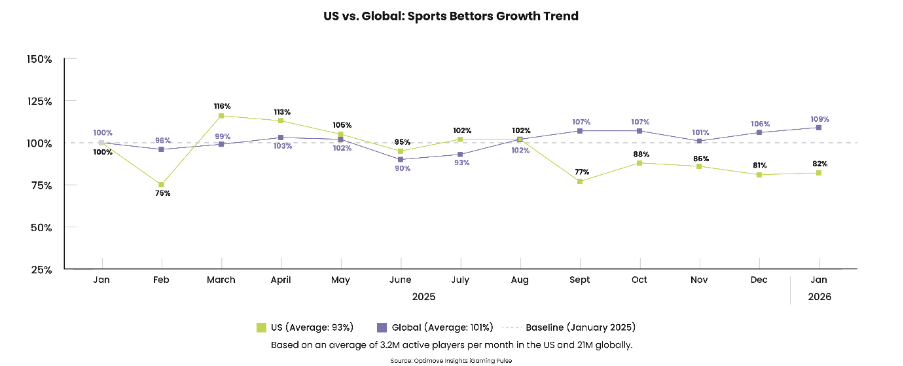
US: January 2026: 82% of baseline
12-Month Trailing Average: 93% of baseline
Global: January 2026: 109% of baseline
12-Month Trailing Average: 101% of baseline
Definition of Sports Bettors Growth Trend: The growth of the number of active sports bettors over the last 12-month period. It uses the first month of the analyzed period as a baseline (100%) and shows the percentage change in the number of active players each subsequent month for both the US and global markets.
Below are five strategic recommendations to consider for smart planning according to this data:
From January 2025 to January 2026, the US sports bettors’ growth trend showed sharp event-driven volatility early in the year and a sustained decline from mid-2025 onward, finishing January 2026 at 82% of baseline. Over the same period, the global market remained steadier and ended stronger at 109% of baseline, signaling healthier momentum heading into 2026.
For a closer look at the data behind these trends, visit Optimove’s iGaming Pulse Report.
For more insights into player behavior, contact us to request a demo.
iGaming Pulse: The daily benchmark for iGaming Operators


Roni is a Marketing Research Analyst on Optimove’s Professional Services team.
As part of her role, she analyzes customer data to extract actionable marketing insights for retail and gaming clients. Roni is currently pursuing a degree in Industrial Engineering and Management at Tel Aviv University.