
Unified Growth Solution
World-class tech needs world-class drivers. AI platform and expert services, unified
Read time 8 minutes


See how retail marketers in the age of AI are empowered
Why it matters:
Most retail CRM teams have content personalization in place, but the next layer of revenue sits in journey and offer decisioning: which campaign each customer receives and what incentive level is actually needed to convert them. This post gives CRM marketers a clear maturity model, a diagnosis of where most teams are today, and two documented case studies showing what the step from Accelerating to Cruising actually produces in business results.
Key takeaways:
Note to readers: Shai Frank, GM Americas and SVP Product at Optimove, and Sam Zerfoss, VP Customer Success at Optimove, took the stage at CRMC 2026 with a direct message for retail CRM marketers. Journey and offer decisioning are here; they are attainable, and the results are already documented. As they put it, this is not a moonshot. It is within reach. This post recaps their session to help retail CRM teams understand what these capabilities are, what they deliver, and how to get started.
Walk into most retail CRM teams today and you will find the same infrastructure: dynamic email templates, product recommendation carousels, behavioral triggers, segment-level content variants. The tools are mature, the playbook is established, and personalized content has become the baseline expectation rather than the differentiator.
The revenue left on the table is not in the content. It is in the decisions above it.
Which campaign should each customer receive when they are eligible for several at once? What offer level actually moves them to convert, without giving away margin to customers who would have bought anyway? These are the questions content personalization was never designed to answer. And they are where the gap between a solid CRM program and a high-performing one quietly lives.
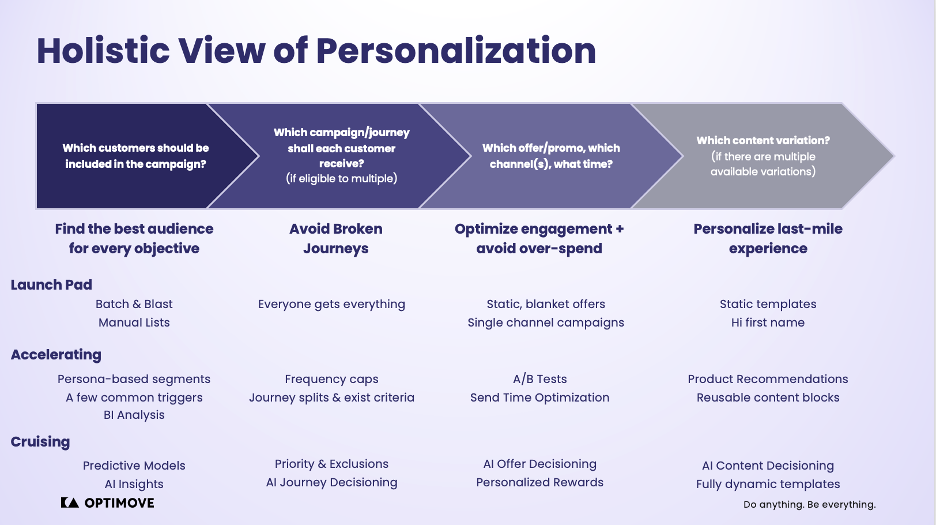
Most retail CRM organizations sit at the same point on the maturity curve. They have moved past batch-and-blast and one-size-fits-all promotions. Triggered journeys are running. Product recommendations are personalized at the segment level. A/B tests determine which content variant performs better.
This is what Optimove calls the Accelerating tier: triggers and recommendations, content personalization, basic journey logic. It is a real improvement over manual, broadcast-era CRM. It is also where most teams plateau.
The Cruising tier -- layered AI Decisioning across audience, journey, offer, and content all optimized together in real time -- looks like a different category of capability. For many CRM leaders, it has felt like aspirational infrastructure: the kind of thing large enterprises with large data science teams eventually get to.
The retailer results below make the case that it is not. The path is defined, the results are documented, and the gap between Accelerating and Cruising is narrower than it appears from the outside.
Content personalization answers one question: given that a customer is receiving this campaign, what should the message say? That is a meaningful question. It is also a downstream one.
The upstream questions are harder and more valuable:
The first is journey decisioning. Retail CRM teams routinely run 10 to 20 concurrent campaigns. Promotional programs across categories, lifecycle triggers, cross-sell journeys, reactivation sequences. Most customers are eligible for several at once. The typical resolution is a marketer-defined priority rule: campaign A wins over campaign B when they conflict. This is deterministic, manageable, and wrong for a significant portion of the customer base, because the campaign that wins the priority rule is not always the campaign that would have had the greatest impact on that individual customer.
The second is offer decisioning. Traditional A/B testing identifies a winning offer variant and applies it to everyone. A retailer testing 15% versus 20% discount will find that 20% wins at the group level. What that result conceals is that a meaningful segment of customers would have converted at 15%, they just received an extra 5% discount for nothing. Over a large customer base, that margin leakage compounds into a material number.
Marketing budgets declined 9.1% in 2023 and 7.7% in 2024, according to Gartner. Offer efficiency is not a nice-to-have in that environment. It is a budget survival issue.
Staples runs promotional campaigns across multiple product categories simultaneously: tech, furniture, office supplies, print and marketing services. Most customers are eligible for several at once. Before AI Journey Decisioning, the solution was manual: complex exclusion rules and marketer-defined priorities determined which campaign each customer received when conflicts arose.
The question Optimove put to the team: what if, instead of customers receiving whichever campaign won the priority rule, every customer received the campaign most likely to have the greatest impact on them individually?
AI Journey Decisioning replaced the manual priority logic. Instead of one campaign winning for everyone in a conflict, the AI evaluates all eligible campaigns for each customer and selects the one predicted to drive the highest impact on that customer's lifetime value. The result is one campaign per customer per week - the right one, per person.
The results from resolving campaign conflicts with AI Journey Decisioning versus manual prioritization:
The +37% figure is worth examining closely. It is not the revenue from the campaigns themselves, those were already running. It is the additional revenue generated by resolving the same conflicts better. The campaigns did not change. The decisioning did.
An enterprise beauty retailer was running a cross-sell journey to move existing customers into haircare products. Their A/B test setup: 15% off versus 20% off. The 20% variant won. The standard next step is to roll out the winner to everyone.
The problem with that step: a test that produces one winner for the full group conceals a distribution of responses underneath it. Some customers convert readily at 15%. Others need 25%. Others respond to 30%. When the 20% variant wins, the customers who needed only 15% get an extra 5% discount, and the customers who needed 25% or 30% may not convert at all. The winning variant is wrong for both groups.
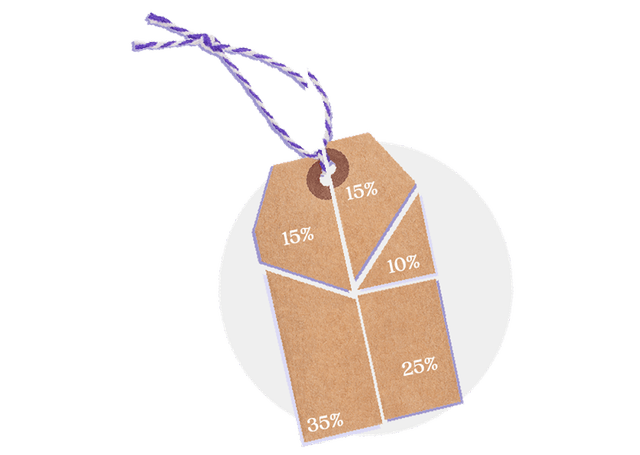
Optimove introduced AI Offer Decisioning across four discount tiers: 15%, 20%, 25%, and 30%. Instead of picking a winner for the group, the AI identified the optimal discount level for each individual customer within the campaign, optimizing for net revenue rather than gross sales.
Results from the 6-week cross-sell campaign:
The near-even distribution across tiers is significant. When no variant clearly dominates, the winner-takes-all A/B testing model is structurally unsuited to the situation. Different customer segments responded to different offers. The AI found those segments. A standard A/B test would have missed them.
Staples and the enterprise beauty retailer are not exceptional outliers. They are retail CRM teams that identified a defined next step and took it.
The path Optimove uses with clients follows three stages. At the Launch Pad tier, Optimove's services team builds the first programs end-to-end: the AI infrastructure, the journey frameworks, the offer decisioning setup. The client team observes and learns. At the Accelerating tier, the client team takes the lead on program development while Optimove's team stays alongside. At the Cruising tier, the client team runs scaled CRM programs independently, with the AI handling the decisioning that previously required manual intervention.
The AI enables the independence. Services ensure the transition is practical rather than aspirational.
For most retail CRM teams, the honest diagnostic is that they are running well at Accelerating. Content is personalized. Triggers are firing. The campaigns are good. What the maturity model surfaces is that the next revenue lift is not in better content, it is in better decisions about which campaign to send and what offer to attach. Those decisions are now automatable. The results from the teams that have made the transition are documented and specific.
Content personalization is the foundation. Journey and offer decisioning are where the next revenue is.
To learn how AI Decisioning can help your retail CRM team optimize journeys and offers, request a demo.
Get the Report: AI and the Future of the Retail Marketer
Discover how AI is accelerating Positionless Marketing

Writers in the Optimove Team include marketing, R&D, product, data science, customer success, and technology experts who were instrumental in the creation of Positionless Marketing, a movement enabling marketers to do anything, and be everything.
Optimove’s leaders’ diverse expertise and real-world experience provide expert commentary and insight into proven and leading-edge marketing practices and trends.
AI journey decisioning is the capability to automatically determine which campaign each customer should receive when they are eligible for multiple programs simultaneously. Instead of applying marketer-defined priority rules, the AI evaluates all eligible campaigns for each customer and selects the one predicted to have the greatest impact on their lifetime value.
A/B testing identifies a single winning offer variant and applies it to all customers. AI offer decisioning runs multiple offer variants simultaneously and identifies the optimal level for each individual customer, optimizing for a defined business KPI such as net revenue. This avoids over-discounting customers who would have converted at a lower offer level.
Staples generated 37% incremental sales by resolving campaign conflicts with AI Journey Decisioning rather than manual prioritization, a 19% higher CLTV for customers targeted with Journey Decisioning campaigns, and saved 300 hours annually by eliminating manual campaign prioritization.
Optimove's services team builds the first AI decisioning programs end-to-end for the client team, then works alongside as the client takes the lead, and ultimately hands over a scaled CRM operation the client team runs independently. The AI handles the decisioning; the services layer ensures the transition is practical.
Marketing budgets declined 9.1% in 2023 and 7.7% in 2024 according to Gartner. In that environment, giving 20% discounts to customers who would have converted at 15% is a structural margin drain. AI offer decisioning addresses this by finding the minimum effective offer level per customer rather than applying a group-level winner.