

Unified Growth Solution
World-class tech needs world-class drivers. AI platform and expert services, unified
Read time 9 minutes


Increase the Value of New Online Sports Players (Use Cases)
Download the report and discover proven methods to increase new player deposits, retention, and lifetime value when empowered by Positionless Marketing.

Executive Summary :
The World Cup 2026 Group Stage drove a clear increase in the number of bettors participating across the US, Europe, and LATAM, while also creating a stronger surge in first-time depositors. LATAM stood out as the region with the most pronounced growth, showing that the tournament created a powerful acquisition and reactivation moment, especially in markets with a strong football culture. However, the data also shows that growth was not uniform across regions and should not be interpreted as equal growth in customer value.
At the same time, average number of bets and average wager per bettor declined during the Group Stage, showing that the expanded audience was broader but not necessarily deeper. For sportsbooks, this means the knockout phase should not be approached with generic tournament campaigns. Operators should focus on sharper segmentation, localized journeys, controlled offers, responsible gaming guardrails, and AI-assisted Positionless Marketing workflows that help identify which new and returning players are worth retaining, and which are unlikely to become long-term, high-value customers.
Key Findings at a Glance:
This report is based on aggregated data from leading sportsbook brands across the United States, Europe, and LATAM, covering approximately 19 million active sports bettors per month between April and June 2026.
Measures include tracking the number of bettors participating, first-time depositors' activity, and average wager per bettor, each indexed to a baseline defined as the average performance in April and May 2026, identified as a "non-event" or "pre-tournament" period.
Findings are segmented by region (United States, Europe, and LATAM) and benchmarked against each region's own pre-tournament baseline rather than against a shared cross-regional average, allowing regional trends to be measured independently and more accurately.
Findings:
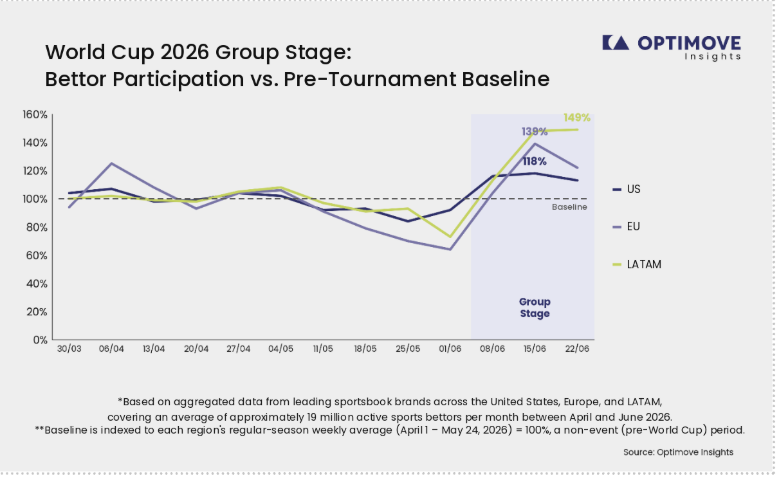
The Number of bettors placing bets increased significantly across all three regions during the first stage of World Cup 2026, but the growth percentage was not uniform. LATAM showed a more pronounced growth, staying 49 percentage points above the baseline, followed by the EU, with 39 points, and the US, with 18 points.
In the United States, the number of bettors held close to the average baseline, moving in a narrow band during the pre-tournament period. Once the World Cup Group Stage began, participation rose, reaching a peak of 118% by June 15th and averaging 102% above the pre-tournament baseline across the full World Cup Group Stage.
Europe and LATAM showed a similar pattern to the US, but a more significant drop in May before the upward trend when the Group Stage began. EU average number of bettors participating stayed effectively flat against the pre-tournament baseline (100%), while LATAM average participation growth settled at 106% above the pre-tournament baseline.
Findings:
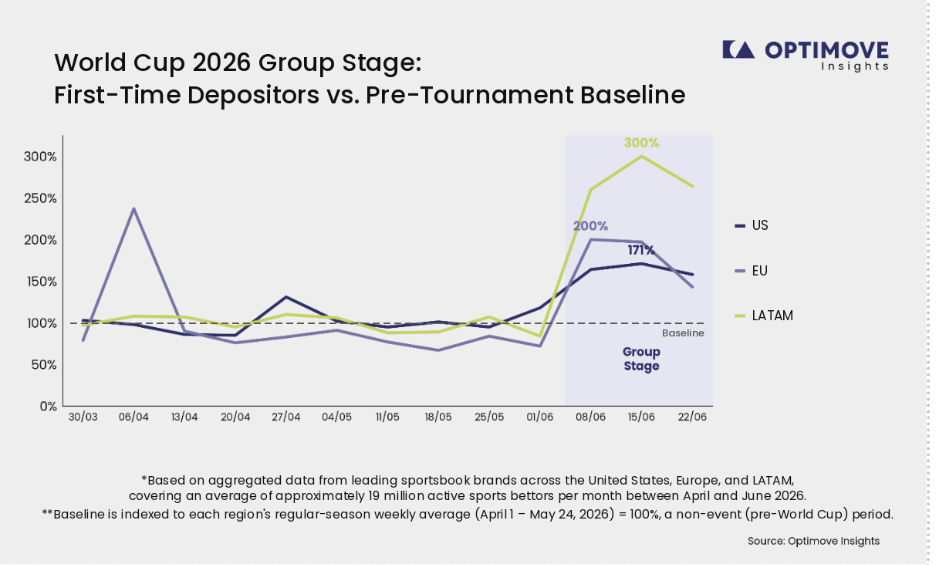
The number of first-time depositors increased across all three regions during the World Cup Group Stage on a larger scale than the number of bettors participating. LATAM's growth was the most pronounced, outpacing both the US and Europe by far.
In all three countries, the number of beginner bettors held close to the pre-tournament baseline before the Group Stage started, but it increased sharply after June 1st, peaking at 171% in the US, 200% in the EU, and 300% in LATAM during the Group Stage.
Findings:
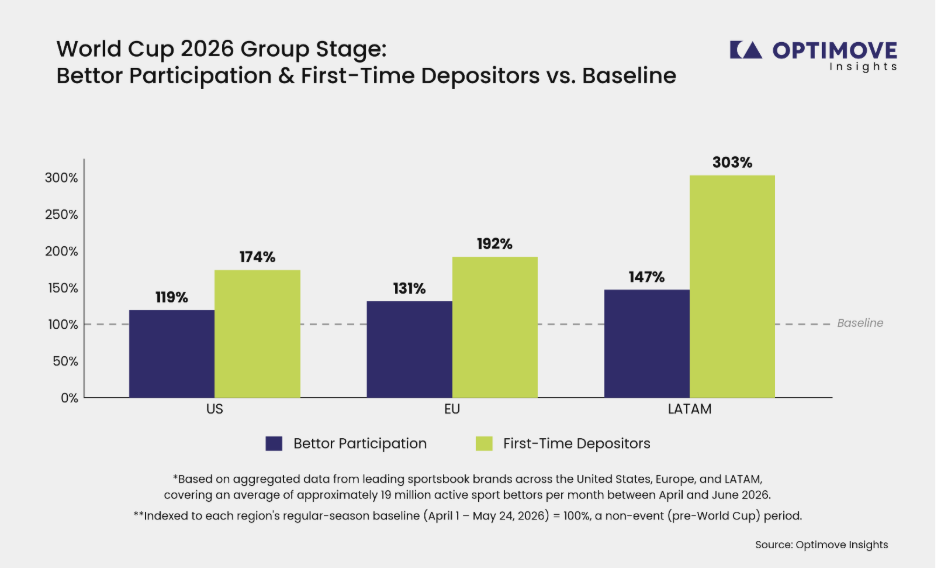
In all three regions, the increase in the number of first-time depositors was, in percentage terms, larger than the increase in the number of bettors during the World Cup Group Stage.
In the United States, the average number of bettors during the World Cup Group Stage landed at 119% of the pre-tournament baseline (19 percentage points above), while the average number of first-time depositors landed at 174% of the pre-tournament baseline (74 percentage points above). The gap between the two was 55 percentage points.
In Europe, the same comparison registered a gap of 61 percentage points, while in LATAM, the gap between the two metrics was 156 percentage points, more than double that of the other regions.
This distinction matters for sportsbooks. The rise in the number of bettors in general reflects existing clients placing bets motivated by an event, while first-time depositors are new customers with no betting history. Converting them into consistent, high-value players is a different challenge than sustaining engagement among bettors who are already active.
Findings:
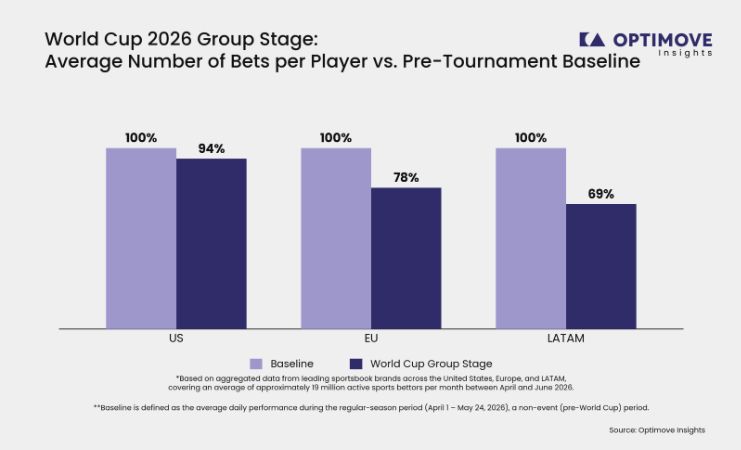
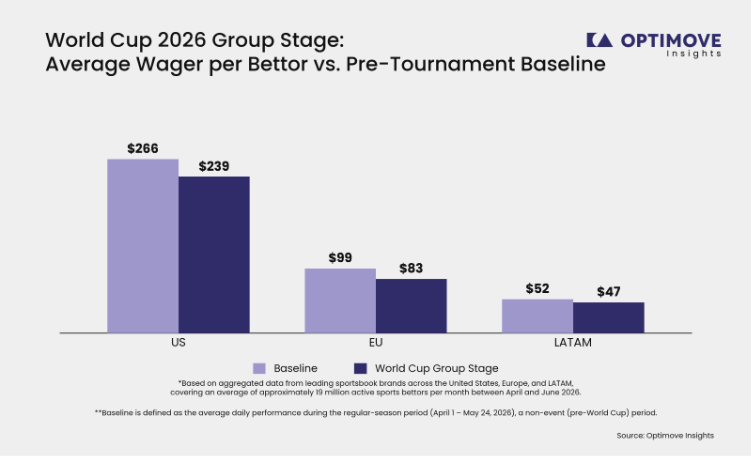
While the number of bettors and first-time depositors increased during the World Cup Group Stage, player depth moved in the opposite direction. Across all three regions, bettors placed, on average, fewer bets and wagered less than they did during the pre-tournament baseline.
The decline in averages was most pronounced in LATAM, which reinforces that the mass of new and returning players in the Group Stages is mostly represented by casual, less engaged bettors. In LATAM, the average number of bets fell to 69%, and the average wager to $47, a 10% decline.
In the United States, the average number of bets per player fell to 94% of the pre-tournament baseline, and the average wager per bettor fell from $266 to $239, also a 10% decline. In Europe, the first metric fell to 78% of the baseline, and the second from $99 to $83, a decline of roughly 16%.
Together, these findings add an important layer to the earlier growth story. The World Cup Group Stage expanded the number of bettors participating and brought in more players, but that growth did not immediately translate into commitment.
For sportsbooks, this confirms that World Cup-driven growth is wide, but not yet fully proven. The next challenge is converting this larger audience into more frequent, consistent, and higher-value players.
The World Cup Group Stage results should be read as both an opportunity and a warning for iGaming operators. The World Cup can quickly expand the bettor base, reactivate dormant customers, and bring new players into the category. But higher participation does not automatically mean higher value. A larger audience can also create pressure on margins, bonus budgets, CRM frequency, trading teams, risk controls, and customer support.
For the knockout phase, operators should move away from broad tournament campaigns and focus on sharper segmentation. Loyal football bettors, casual event-driven users, first-time depositors, reactivated players, bonus-sensitive customers, and high-value bettors should not receive the same journey. As matches become more decisive, campaigns should be triggered by team progression, match timing, betting history, region, customer value, and early signs of engagement.
This is especially important because not every new or returning player will be worth the same level of investment. Some bettors may have joined only for the tournament and may not return, no matter how aggressively they are targeted. The priority should be identifying which customers show signs of becoming consistent, higher-value players and which ones are likely to remain one-off or low-intent. That distinction helps operators protect budget while still acting on the growth opportunity created by the World Cup.
Positionless Marketing can help sportsbooks move at the speed this moment requires. With AI-assisted workflows, marketers can identify audiences, generate localized content, adjust offers, and launch campaigns quickly, without waiting on fixed team handoffs. At the same time, guardrails around budget, eligibility, responsible gaming, risk, and brand tone remain essential.
The goal for the knockout phase is not to chase every spike in activity, but to convert tournament attention into profitable, controlled, and sustainable customer relationships.
Optimove is the creator of Positionless Marketing and the #1 Player Engagement Solution for iGaming and sports betting operators. Positionless Marketing frees marketing teams from the limitations of fixed roles, giving every marketer the power to execute any marketing task instantly and independently. Positionless Marketing has been proven to improve campaign efficiency by 88%, allowing marketing teams to create more personalized engagement with existing customers.
For two years running, Optimove has been positioned as a Visionary in Gartner's Magic Quadrant for Multichannel Marketing Hubs, recognized for its AI-driven decisioning, prescriptive insights, and proven ability to orchestrate thousands of personalized campaigns in real time across channels.
Its Positionless Marketing Platform includes Optimove Engage and Orchestrate for cross-channel campaign decisioning and orchestration; Optimove Personalize, a digital personalization engine; and Optimove Gamify, a loyalty and gamification platform.
All are powered by Optimove AI, the marketing AI suite that brings AI everywhere marketers work. Inside the platform through Native AI agents for decisioning, analysis, and creation, outside it to external AI tools like Claude and ChatGPT through the Optimove MCP, and into custom-built applications on top of the platform through Optimove Custom Apps. Optimove has embedded AI in its platform since 2012, paving the way for Positionless Marketing.
Today, its comprehensive AI-powered suite is at the leading edge of empowering marketers to streamline workflows from Insight to Creation and through Optimization. Optimove provides industry-specific and use-case solutions for leading consumer brands globally.
Optimove Insights is the analytical and research arm of Optimove, dedicated to providing valuable industry insights and data-driven research to empower B2C businesses.
Let AI decide the next best action.