
Unified Growth Solution
World-class tech needs world-class drivers. AI platform and expert services, unified
Read time 9 minutes


Better, Smarter, Faster: How AI is Transforming CDPs
A Customer Data Platform (CDP) is software designed to consolidate and manage customer data from multiple sources, within and without the company. The CDP aggregates all customer data, cleanses it, and unifies it into a single customer view that can be used for marketing purposes and also accessed by other systems.
CDPs allow marketing teams to leverage customer data for objectives including customer segmentation, personalized communications, and analytics aimed at gleaning customer insight, all with minimum involvement from IT.
If your customer data is spread across tools that don't talk to each other, a CDP is usually the answer. Signs a brand has outgrown its current setup:
You may not need a dedicated CDP if your data already lives in one place and you aren't activating it across channels. But as data and cross-channel activation grow, a CDP becomes the foundation everything else builds on.
Most CDPs follow the same four-step process:
The result is a complete, consistent view of each customer that any connected system can use, turning scattered data into marketing that's relevant to the individual.
As customers interact with companies across more channels, through more systems, with more frequency, customer data is rapidly becoming fragmentated. This has fueled a demand for systems that assemble the data from its many sources into a single, complete and consistent customer view, and then share the result with every other system that needs it. This is exactly what CDPs do.
Absolutely! Optimove’s platform or Positionless Marketing Platform is a CDP and much more. Beyond providing a Single Customer View and in-depth analytical reports, Optimove leverages AI to actually foster emotionally intelligent relationships that maximize the value of every customer via true 1:1 personalized multi-channel customer communications.
What sets Optimove apart from a data-only CDP:
Visit the Optimove Product page or request a demo to how you can use Optimove’s Relationship Marketing Hub to drive measurable growth through your existing customers.
While there are many different CDPs on the market, they all have share some key characteristics. According to the CDP Institute, a CDP is a, “marketer-managed system that creates a persistent, unified customer database that is accessible to other systems”. This definition has three primary components:
In short, every CDP ingests nearly any type of data from source systems, stores it without losing any detail, converts it into a complete and consistent view of each customer, and makes the result easily available for various purposes.
Despite sharing some common features, CDPs vary quite widely. From a user’s perspective, the most significant differences relate to product scope. In very broad terms, CDPs can be grouped into three categories:
Some CDPs move past engagement to include their own delivery systems, most often for email. Many marketers find this appealing since it reduces the number of systems they need to integrate. Systems that do this are still considered CDPs so long as users have the option to use external delivery systems as well. The distinction is important because one the primary reasons for buying a CDP is to let marketers use the delivery systems of their choice.
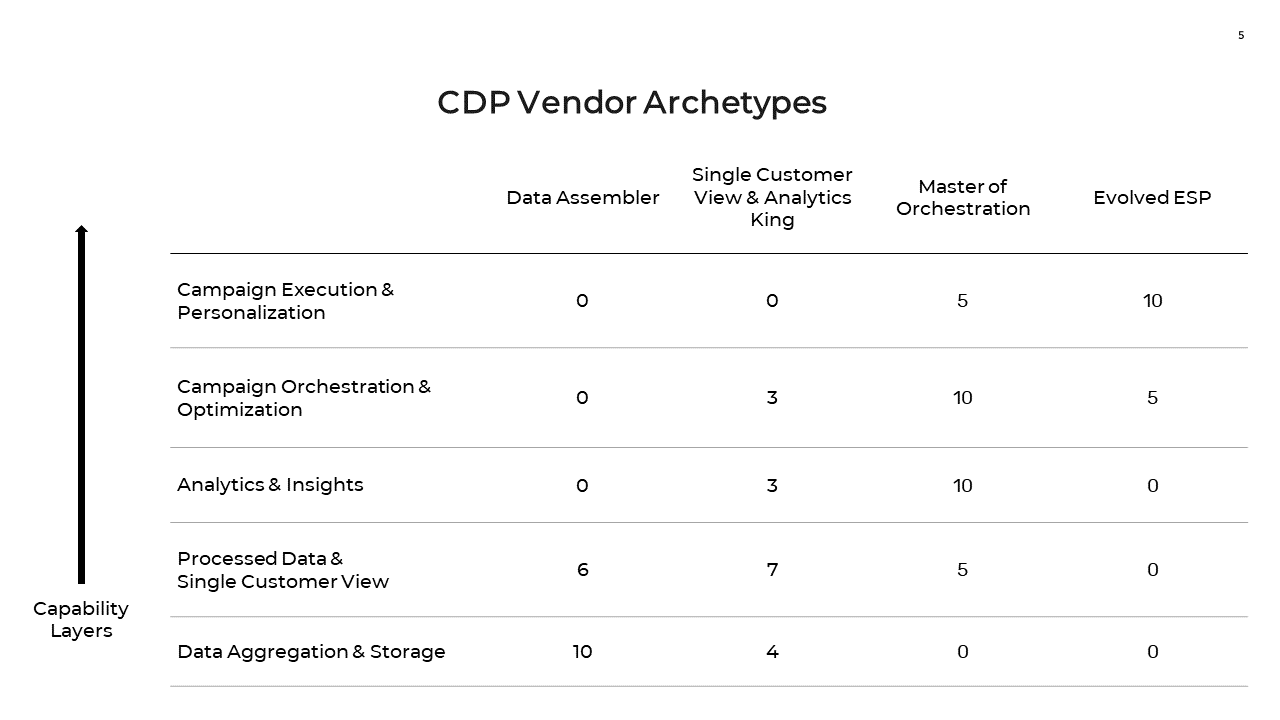
Once you know the three categories, choosing comes down to how far past "data only" your team needs to go, and whether you want a platform that activates data natively or one that hands segments off to external delivery systems. The further you move toward analytics and engagement, the fewer systems you have to stitch together, and the closer the data sits to the moment of action. Platforms that combine the unified database with predictive analytics and native, AI-led orchestration sit at the most complete end of that spectrum, the category Optimove's Relationship Marketing Hub occupies.
In marketing, a CDP is the engine that turns unified customer data into action. Once every interaction is consolidated into a single customer view, marketers can build precise segments, uncover insights, and deliver personalized campaigns without depending on IT for every request.
In practice, marketing teams use a CDP to power:
This is the foundation of relationship marketing: using what you know about each customer to make every communication more relevant and every campaign more effective
CDPs, CRMs, and DMPs all manage customer-related data, but they serve different purposes and different teams.
| Primary use | Common users | |
| CDP | Unifies customer data from all sources into a persistent, single customer view for analytics and cross-channel marketing | Marketing, analytics, and data teams |
| CRM | Manages direct interactions and relationships with known customers and prospects, often centered on sales and service | Sales, service, and marketing teams |
| DMP | Aggregates largely anonymous audience data, traditionally cookie-based, to support advertising and media targeting | Advertising and media teams |
The simplest distinction: a CRM records your direct relationships with known customers, a DMP groups anonymous audiences for advertising, and a CDP unifies all of it, known and anonymous, online and offline, into a single customer view that the rest of your stack can use.
Every channel. Every customer. No handoffs.
Launch and optimize multichannel campaigns at the speed of Positionless Marketing
Frequently Asked Questions
CDP software is used to consolidate customer data from every source into a single, unified customer view and to make that view available for segmentation, analytics, and personalized cross-channel marketing, all managed by marketers, with minimal reliance on IT.
Marketing teams are the primary users, since a CDP is built to be marketer-managed. In practice, analytics and data teams rely on it too, and customer-facing functions like sales and service often draw on the same unified data to inform their work.
A traditional CDP focuses on unifying and storing customer data. Optimove's platform or Positonless Marketing Platform adds predictive analytics, AI decisioning, and native multichannel orchestration on top of the single customer view, so the same platform that unifies your data also acts on it, delivering personalized communications across channels at scale.
An AI-enabled CDP is a Customer Data Platform that applies artificial intelligence across the full marketing workflow, not just to store and unify customer data, but to help decide what to do with it, activate campaigns, and measure results. Rather than treating the CDP as general data infrastructure, an AI-enabled CDP is built for the day-to-day realities of consumer marketing: managing customer data, acting on it, and optimizing outcomes.
Optimove is an AI-enabled CDP by design. It unifies customer data into a single customer view, then uses AI to turn that data into personalized, multichannel campaigns and measurable results.
Optimove can access databases containing customer data using a number of methods: