
Unified Growth Solution
World-class tech needs world-class drivers. AI platform and expert services, unified
Read time 9 minutes


The CRM Marketer Evolution Curve’s Guide
Why it matters:
In reading this post, marketers will learn the six skills CRM marketers need to remove marketing bottlenecks. The fact remains that, in many organizations, marketing execution is stymied by bottlenecks, where there is still a dependency on handoffs between data, creative, execution, and optimization teams.
This is all in an era where CRM teams are under pressure to deliver personalized, timely, cross-channel experiences faster than ever. Beyond the skills, marketers will learn how to work more confidently with AI and turn customer insight into action faster.
In the end, it is Positionless Marketers that close the gap between what customers expect and how traditional marketing teams operate.
Key takeaways:
A Positionless Marketer is a CRM marketer who can execute across the full campaign lifecycle: diagnosing customer behavior, building audiences, creating personalized content, orchestrating journeys, and optimizing offers and send times. They do this without waiting for analysts, designers, or channel-specific owners.
They are not generalists doing everything manually. They are tech- and AI-augmented strategists who use the right platform, data, guardrails, and automation to act when the customer moment demands it.
CRM teams have more channels, more data, and more AI tools than ever. Still, execution often remains slow. Campaign backlogs are long. Decisions sit too far from execution. Marketers spend too much time coordinating between teams instead of acting on customer insight.
That is why being a Positionless Marketer matters. It puts the decision-maker closer to the customer's moment. It also creates a path for career growth, because marketers who can operate across the full marketing lifecycle are trusted with ownership, broader mandates, and greater impact.
These are the six skills that get them there.
Positionless Marketers start with the customer, not the channel, campaign calendar, or internal team structure. They read customer behavior, identify friction points, and determine what the customer needs next before choosing the message, offer, journey, or channel.
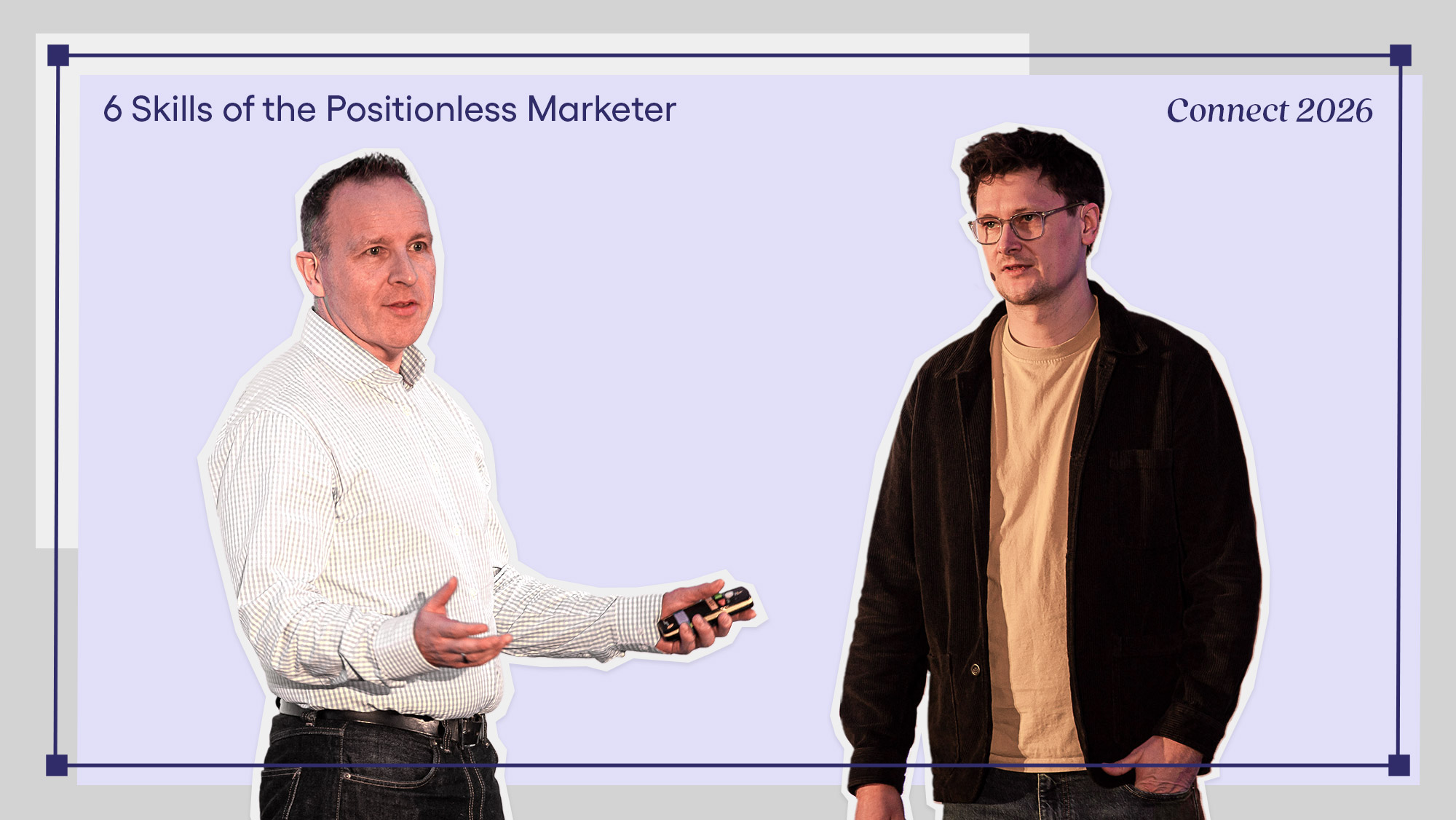
This marks a shift from product-led campaigns to customer-led experiences. At Connect 2026, Paul O’Shea, VP of Customer Success at Optimove, described the teams moving fastest as those that start with the customer, personalize at scale, and don't operate in silos.
Why it matters: Customer expectations are evolving faster than traditional marketing structures can support. When teams start with the customer, they move from running campaigns to delivering experiences that feel relevant in the moment.
A Positionless Marketer must be able to access, question, and interpret customer data without waiting for every answer from BI. They understand lifecycle movement, cohort survival rates, engagement patterns, and segment behavior. They know how to act on what they find.
David Hardy, VP of Professional Services at Optimove, demonstrated this in a live walkthrough at Connect 2026. A CMO asks why churn is increasing. The CRM marketer reviews a dashboard, analyzes migration behavior, looks at cohort data, and identifies that acquisition quality has declined over time. As Hardy noted, “No analyst was needed. No waiting.”
Why it matters: Data literacy turns first-party data into an operating advantage. Marketers who can interpret customer data directly diagnose problems faster, build smarter segments, and prevent campaigns from sitting in a queue while teams wait for an answer.
Positionless Marketers do not manually decide every customer’s next best offer, send time, or content variant. They understand how AI decisioning works, how to define goals and guardrails, and how to let the platform optimize within those parameters.
This includes knowing how to consolidate journeys, identify underused optimization capacity, and configure AI-powered offer and send-time logic. In Hardy’s demo, the marketer discovers the platform is using only 8% of available optimization. That insight becomes the trigger to add AI offer decisioning and send-time optimization to the journey.
Why it matters: AI can continuously decide which customer receives which offer, when they receive it, and in which variation. This lets marketers focus on strategy while the platform handles operational complexity.
Positionless Marketers think beyond one-size-fits-all templates. They know how to turn a single creative framework into many personalized experiences using dynamic content, customer attributes, product affinity, lifecycle stage, and real-time context.
In Hardy’s demo, one template becomes thousands of variants.
A standard email template becomes personalized hero messaging, tier-based content, real-time win details, and dynamic sports events based on product affinity.
That is personalization at scale.
Why it matters: Creative personalization reduces manual production, removes creative bottlenecks, and helps brands deliver more relevant customer experiences. Pre-approved assets and template libraries give marketers the speed to act without sacrificing brand governance or campaign quality.
Positionless Marketers connect insight, audience, message, channel, timing, and optimization into a coherent journey. They consolidate related campaigns, identify overlaps, reduce cross-firing messages, and orchestrate experiences across channels instead of managing disconnected batch sends.
This moves CRM from campaign management to outcome ownership. The question is no longer only, “Did the email send?” It becomes, “Did the customer receive the right experience at the right moment, and what should happen next?”
Why it matters: Journey Orchestration keeps decisions closer to execution. It allows CRM teams to shift from channel ownership to customer outcome ownership, where the greatest revenue impact sits.
Positionless Marketing does not mean “anything goes.” Marketers still have governance, compliance, QA, brand standards, and approval logic. The difference is that guardrails enable faster execution instead of creating process debt.
In enterprise teams, the move to Positionless Marketing often starts with standardizing, automating, and then optimizing. Hardy described one large multi-market client that realized it needed to address process debt alongside technical debt. As he put it, “The processes that were required to support that tech stack… they have to change.”
Clear checklists, pre-approved assets, and lifecycle standards allow marketers to act quickly without letting campaign quality drop.
Why it matters: Governance done well is not a slowdown. It is a safety net that lets marketers move faster with confidence, especially when one person can now do work that previously required a team of five to seven.
Beyond the six skills, Hardy identified three behavioral traits that consistently appear in marketers who thrive in a Positionless model. These traits came directly from conversations with clients in the lead-up to Connect 2026.
Hardy also pointed to the personal impact of this shift. In siloed roles, marketers often see the full campaign but only touch one part of it. Positionless Marketing opens the full cycle. It gives marketers more agency, more ownership, and more opportunity to contribute.
Optimove’s Positionless Marketing Platform is built around three foundational powers that map directly to the skills Positionless Marketers need to master.
Hardy summarized the value at Connect 2026: “Diagnose a challenge with data. Improve with optimization. Elevate with creative. That’s the full cycle: one marketer, AI in the loop.”
The Positionless Marketer is defined by the ability to move across the full CRM lifecycle, with data, AI, creative automation, Journey Orchestration, and governance working together.
Marketers who build these six skills can move at the speed of the customer, personalize at scale, and turn every campaign into a learning loop. The future of CRM has shifted: AI is increasingly handling operational tasks, while humans focus more of their energy on strategy, creativity, and customer outcomes.
Plus, for more insights on how AI can empower marketers to be Positionless, see more about Optimove AI. Optimove AI powers marketers with Native AI inside the platform, an MCP for any AI tool, and Custom Apps.
For more insights, contact us to request a demo.
The CRM Marketer Evolution Curve’s Guide
The CRM Marketer Evolution Curve’s Guide. Learn 5 stages of a marketer’s evolution. Discover your level and how to advance.


Writers in the Optimove Team include marketing, R&D, product, data science, customer success, and technology experts who were instrumental in the creation of Positionless Marketing, a movement enabling marketers to do anything, and be everything.
Optimove’s leaders’ diverse expertise and real-world experience provide expert commentary and insight into proven and leading-edge marketing practices and trends.
A Positionless Marketer needs customer-first strategy, data literacy, AI decisioning and optimization, creative personalization, journey orchestration, and agile governance and quality control.
No. Positionless Marketing does not remove people or eliminate structure. It removes unnecessary friction so marketers can act faster with the right data, AI, creative tools, and guardrails.
Data literacy helps marketers understand customer behavior, identify problems, build better segments, and act without waiting for every question to move through a separate analytics queue.
AI supports the Positionless Marketer by handling operational complexity such as send-time optimization, offer decisioning, journey decisions, and content variant selection.
Enterprise teams should start by standardizing journeys, automating repeatable work, defining governance guardrails, and moving decisions closer to execution while maintaining compliance and brand standards.