

Unified Growth Solution
World-class tech needs world-class drivers. AI platform and expert services, unified
Read time 9 minutes


Future Commerce's Positionless Marketing Guide
Why it matters:
In retail marketing, Valentine’s Day budgets often get wasted on shoppers who would have purchased anyway. This post shows how to shift spend toward high-value customers and real incremental lift. Marketers will learn how dynamic audiences, predictive scoring, and cross-channel orchestration improve relevance, reduce discount dependency, and increase peak-season Return on Investment (ROI).
Key takeaways:
High-value shoppers typically convert with less friction, purchase higher-margin items, and are more receptive to premium positioning, making them the most efficient segment to prioritize when time and budget are constrained.
Just as importantly, Valentine’s Day is not a single “gift buyer” moment. It contains distinct micro-motivations that require different experiences. For instance, a High-Intent Partner shopping for someone else often responds to confidence cues like delivery certainty, premium packaging, and recommendations that simplify the decision. A Self-Gifter, on the other hand, is motivated by emotional framing, such as self-care, reward, and indulgence, and is often more receptive to loyalty-based value rather than discounting.
When retailers treat these segments as a single audience, they either overspend to secure revenue they would have earned anyway or miss out on incremental growth from shoppers who need a different reason to engage.
Below are the key customer segments to focus on:
| Segment Type | Key Behavior | Valentine’s Strategy |
| The VIP Spender | High historic AOV; interest in premium categories | Early access, elevated gifting services, exclusive packaging |
| The Last-Minute Hero | Site/app activity spikes 24–48 hours before Feb 14 | Real-time urgency journeys with delivery/pickup certainty |
| The Self-Gifter | Browses self-care, beauty, wellness, or “treat” categories | “Treat Yourself” messaging + loyalty value boosters |
High-value targeting is not a one-time list pull. It’s a living system that updates as shoppers browse, add to cart, abandon, return, and purchase. The most effective approach is to combine historical value signals with real-time intent, then use automation to act instantly when behavior changes.
Take a look at the five steps below:
If the only definition of high-value is “spent the most last year,” brands will miss shoppers whose intent is high right now. A stronger framework blends multiple signals, such as:
Valentine’s Day is the perfect moment to let these signals work together, since shoppers don’t move in a linear fashion. Someone can look “inactive” historically but suddenly show intense intent in the 72 hours leading up to February 14.
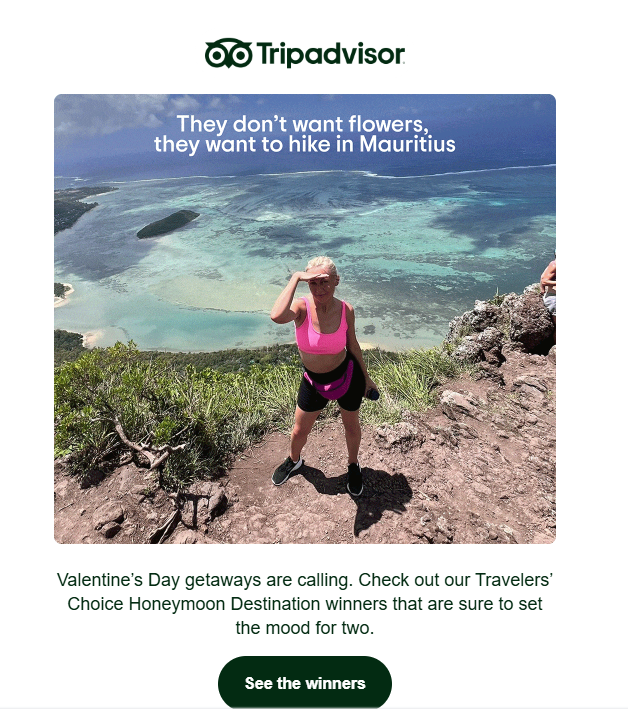
Here's an example of an email to send to the Self-Gifter segment on the days leading up to Valentine's:

And here's an example of an email to send to the Gifter segment:
The main goal of segmentation is to precisely drive customer actions. A strong Valentine’s plan maps each micro-segment to:
To manage high-value segments at scale, retailers need a robust platform, one that can unify behavioral data, build dynamic audiences, and orchestrate real-time triggers across channels.
Here’s how four common options stack up for behavioral segmentation and dynamic audiences in retail:
The key differentiator is dynamic audiences: segments that update automatically based on behavior, without manual refreshes or static exports. For Valentine’s Day, that difference is everything because the “last-minute hero” mentioned above, for example, doesn’t announce themselves a week in advance.
Behavioral segmentation becomes most powerful when it’s tied directly to execution. These three steps assist marketers in translating insight into impact:
1) Create Dynamic Content Blocks
Personalize what shoppers see based on their segment. For example:
Dynamic blocks matter because they reinforce the same message across touchpoints (not just in a single channel.)
2) Set Up Behavioral Triggers
Valentine’s shoppers are action-driven. Brand messaging should respond to behaviors, not calendars.
Examples of high-impact triggers for high-value segments:
3) Cross-Channel Consistency
A common failure mode is when the email promises one thing, and the site experience shows another. If an “Early Access” offer appears in an email, it should also appear:
Consistency builds trust. Trust builds conversion and retention, especially when shoppers are buying gifts.
Even experienced marketing teams can experience performance declines during Valentine’s if segmentation isn’t properly maintained. Watch for these issues:
Retailers should prioritize real-time segmentation over static attributes, using real-time data that reacts to customer behavior in seconds. They should focus on incremental value levers, such as add-ons, premium packaging, complementary recommendations, and loyalty-based rewards, rather than defaulting to deeper discounts.
Marketers should regularly audit predictive logic to ensure models reflect current customer behavior and anticipate category shifts well into 2026, especially as retail continues to evolve toward faster decision cycles and greater sensitivity to relevance.
The retailers that outperform the competition use customer segmentation to identify who matters most, predictive intelligence to prioritize incremental impact, and real-time orchestration to deliver the right experience at the exact moment intent emerges. Valentine’s Day ROI doesn’t come from pushing harder with bigger discounts or batch-and-blast. It comes from targeting smarter: allocating promotional dollars only where they change behavior, protecting margin on customers who'd convert anyway, and timing engagement to capture peak intent. The result is higher revenue per marketing dollar and sustainable customer lifetime value beyond a single holiday spike.
High-value segmentation only drives incremental ROI when teams can act on insights instantly, without waiting on data tickets, engineering cycles, or rigid channel ownership.
That’s where Positionless Marketing matters: it enables marketers to move from audience insight to orchestrated action across channels in real time, using the same dynamic audiences and decisioning logic everywhere the customer engages.
For Valentine’s Day, Positionless Marketing helps retailers stay agile as intent shifts by empowering teams to continuously optimize journeys, promote premium value to VIPs, activate urgency for last-minute shoppers, and reinforce self-gifting narratives—without creating disjointed experiences across email, SMS, web, and app.
The real ROI comes from using behavioral segmentation that blends historical value signals with real-time intent and predictive scoring, so marketing teams know which customers need an incentive, which need a new reason to buy, and which don’t need any outreach at all.
Valentine’s Day success hinges on focusing engagement on the customers who drive the most value and responding to intent as it changes in real-time. With dynamic audiences, predictive prioritization, and cross-channel orchestration, retailers can improve relevance, protect margin, and capture incremental revenue during the peak shopping season and well beyond.
Happy Valentine’s Day!
For more insights, contact us to Request a Demo
Free your marketing team from the bottlenecks of the assembly line


Dafna is a content marketing manager and writer who generates branded content for online industries, specializing in lead generation, SEO, CRM, and lifecycle stage marketing.
With over ten years of professional writing experience, she helps brands grow and increase profitability, efficiency, and online presence. Dafna holds a B.A. in Persuasive Communications from Reichman University (IDC Herzliya).