
Unified Growth Solution
World-class tech needs world-class drivers. AI platform and expert services, unified
Read time 8 minutes


Agents that let you act while others are still analyzing!
Why it matters:
Marketers often struggle to connect the decisions behind CRM execution, from audience selection and journey prioritization to offer choice, send time, and content variation. This article helps them understand how AI decisioning brings those layers together, improves coordination across campaigns, and drives more relevant, measurable customer experiences.
Key takeaways:
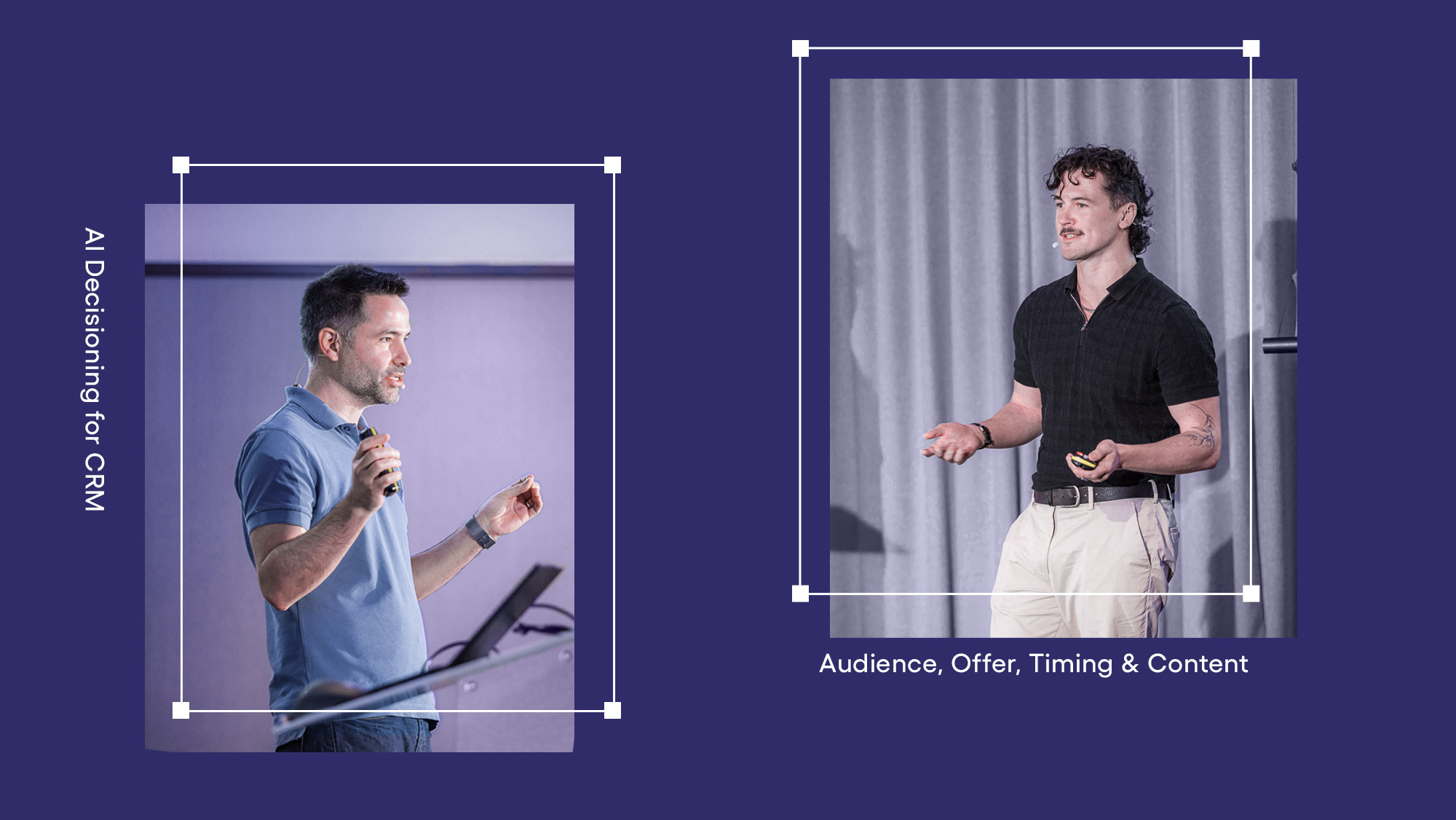
Watch Optimove's Rob Davis and Jack Webster break down how AI decisioning connects every layer of CRM execution at Optimove Connect 2026:
AI decisioning for CRM is the orchestration of all customer communication, enabled by AI tools and agents. It is the system that connects the data that determine who will receive a campaign, which type of customer will enter each journey, what offer they will see, when the message will be delivered, and how the content will be presented.
A CRM program becomes more effective when these decisions are built on one another. Audience shapes journey, which shapes offer and timing, creating a connected chain that stops working as a patchwork of local actions and starts behaving like a cohesive system that marketers can steer, inspect, and refine.
AI decisioning works as a sequence. First, it helps the marketer decide who matters right now. Then it helps decide which journey should win for that customer. From there, it determines which offer makes the most sense, when the message should be sent, and finally, what the customer should actually see. Each step adds context to the next, which is why these decisions work better together than apart.
Most organizations still make CRM decisions separately. Audience selection happens in one place. Journey logic is prioritized elsewhere, often through a mix of manual rules and guesswork. Campaign optimization is handled after the fact. Content testing sits with creative teams.
That fragmentation shows up quickly in execution. Customers become eligible for multiple campaigns at once. Teams spend time forcing mutual exclusivity. Priority rules multiply. Content variants are tested without enough awareness of journey context or customer intent. The result is familiar to any experienced marketer: oversending, misaligned incentives, missed moments, and plenty of manual labor spent preventing collisions that should have been resolved upstream.
See below for more details:
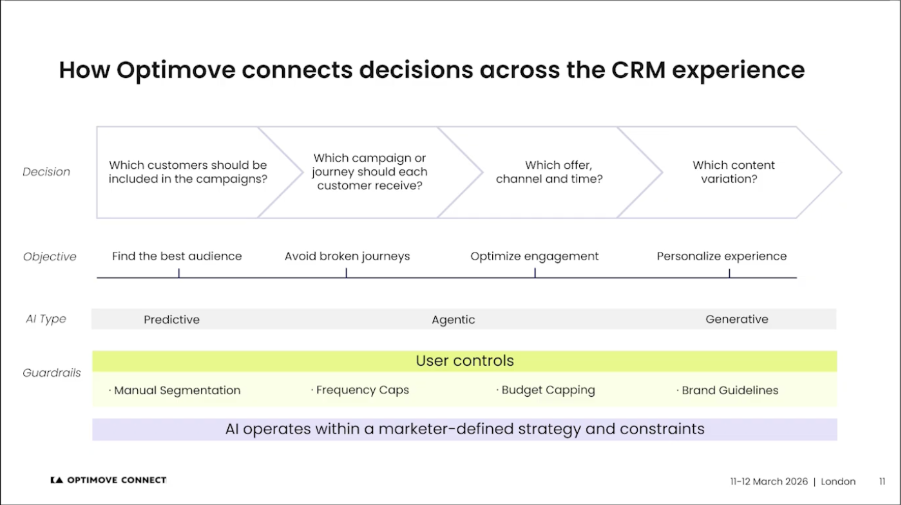
Everything starts with the audience. Before a marketer can optimize a campaign, they need to know which customers actually belong in it. AI helps here by using predictive models, behavioral signals, and segment discovery to identify likely converters, likely churners, high-value customers, or the next best audience to target.
That first decision matters because it shapes everything that follows. If the wrong customers enter the flow, every later decision becomes less effective. Jack showed this clearly in the demo: AI can identify when only part of an audience is responding to a campaign, keep those responders in place, and free everyone else to receive something more relevant. That gives the marketer a more precise starting point instead of treating the entire segment as if it shared the same intent.
Once the right audience is identified, the next question is simple: what should happen to those customers now? This is where journey decisioning comes in. Customers often qualify for multiple campaigns or journeys at the same time, and that creates collisions, overlap, and too much manual prioritization.
AI helps the marketer by resolving those conflicts in context. It can evaluate eligibility, priority, and business goals to determine which campaign or journey should take precedence for each customer. In the demo, I showed that marketers still control the rules that matter most. Fixed-priority campaigns can stay fixed. But beyond that, AI can use auto-priority to select the journey that best supports the business KPI, while also showing clear reporting on who was included, excluded, or redirected and why.
Once the journey is chosen, the marketer needs to decide what the customer should get within that journey. That is the offer decision. This is where many CRM programs still rely on a blunt method: find one winning offer and scale it to everyone.
AI supports the marketer in a more granular way. Instead of looking for one winner for the whole audience, it learns which action works best for each kind of customer. Some customers do not need an incentive. Some respond to a lighter offer. Others require a stronger push. AI keeps adjusting those allocations over time so the marketer can improve response while protecting margin and avoiding unnecessary discounting.
Once the system knows which offer to send, the next decision is timing. A strong message can still miss if it reaches the customer at the wrong moment. Send time should not be treated as a fixed campaign setting when customer behavior is clearly not fixed.
AI helps the marketer by using engagement data to identify when each individual customer is most likely to respond. That means the decision is no longer based on team habit or a generic best practice. It is based on observed behavior. And timing also supports the next layer, because once the system knows when to send, it can make smarter decisions about what content should be shown in that moment.
Content is the final decision in the chain. By this point, the system already knows who the customer is, which journey they should receive, what offer belongs in that moment, and when the communication should arrive. Now the marketer needs the message itself to match that context.
AI helps by optimizing content variation in real time across elements like subject lines, hero copy, and calls to action. Jack showed that the real advantage here is coordination. The system does not just test isolated fragments. It can align the different parts of the message so they remain semantically connected while continuously learning which combinations work best for which customers. That gives the marketer a stronger final layer, because the content reflects the logic built all the way upstream.
No. AI decisioning changes how decisions are executed, not who sets the rules. Optimove’s system runs inside marketer-defined guardrails: eligibility rules, frequency caps, budget limits, channel constraints, brand requirements, and KPI priorities. Those controls shape what the system is allowed to optimize and where it must stop.
Each layer of decision still answers to the marketing strategy. The marketer has the ability to act independently to define who can receive a campaign, which priorities are fixed, which budgets matter, which channels are allowed, and which KPI should guide optimization.
AI then does the hard work underneath that framework, processing outcomes, resolving tradeoffs, and improving execution at a scale no team could manage manually.
Optimove’s approach is designed to keep that control visible. Marketers can see performance, understand why decisions were made, and review how optimization is working instead of handing judgment over to a black box. That makes AI decisioning useful in the way serious marketers actually need it to be useful — as leverage, not surrender.
And that is the real shift. The marketer is no longer stuck doing the manual guesswork. It is equipped with Data Power, Creative Power, and Optimization Power to set the strategy, define the constraints, and manage the system that executes all decisions more intelligently.
AI decisioning gives CRM the structure it has long been missing. Instead of treating audience selection, journey prioritization, offer choice, send time, and content variation as separate tasks, it connects them into a decision chain.
The cost of fragmentation is easy to recognize: overlapping campaigns, manual prioritization, offers pushed too broadly, and content tested without enough context.
AI decisioning helps marketers correct that by improving the logic upstream, not just the execution downstream. It identifies the right audience, resolves journey conflicts, matches the offer more precisely, finds the right moment to engage, and aligns the final message to the full context behind it.
What makes this useful in practice is that control remains in the hands of the team. Optimove’s approach keeps strategy, constraints, and business priorities visible through guardrails such as eligibility, budgets, frequency limits, channel rules, and KPI goals. The result is a CRM system that is more coordinated, more efficient, and more capable of delivering relevance at scale without forcing marketers to trade away judgment for automation.
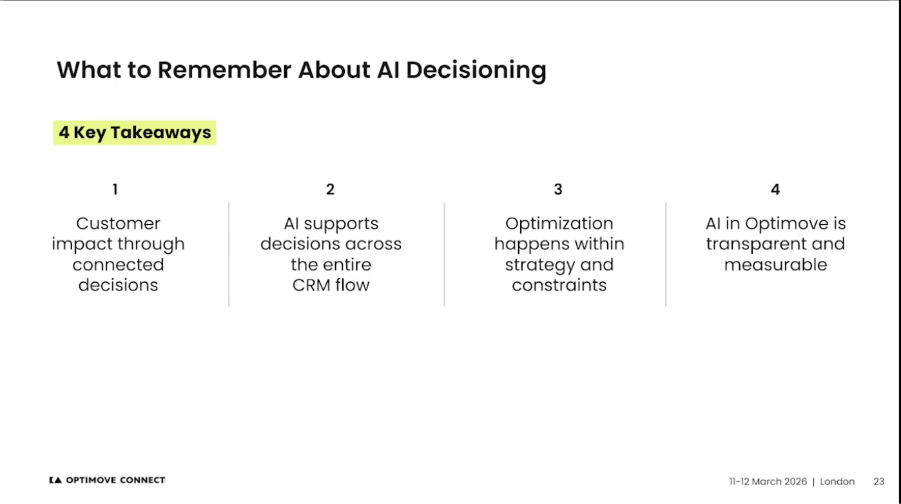
So, here's what to remember:
For more insights, contact us to request a demo.
AI built for marketers.
Predict, create, and optimize — without waiting on data, dev, or design.


Writers in the Optimove Team include marketing, R&D, product, data science, customer success, and technology experts who were instrumental in the creation of Positionless Marketing, a movement enabling marketers to do anything, and be everything.
Optimove’s leaders’ diverse expertise and real-world experience provide expert commentary and insight into proven and leading-edge marketing practices and trends.