
Unified Growth Solution
World-class tech needs world-class drivers. AI platform and expert services, unified
Read time 7 minutes


Why it matters:
In reading this, marketers will learn from an Optimove Connect 2026 session on how CRM teams are changing, including what the data shows and what marketers can do next.
Today, CRM teams are under pressure from every direction. Budgets are being scrutinized more closely. Customers are harder to track. Attention is harder to earn. And loyalty programs are getting more people to sign up while actual loyalty is becoming harder to prove.
This post, the second on this Connect session, covers the remaining four changes discussed.
Key takeaways:
Marketing is becoming more complex. And for CRM teams, it is also becoming less forgiving.
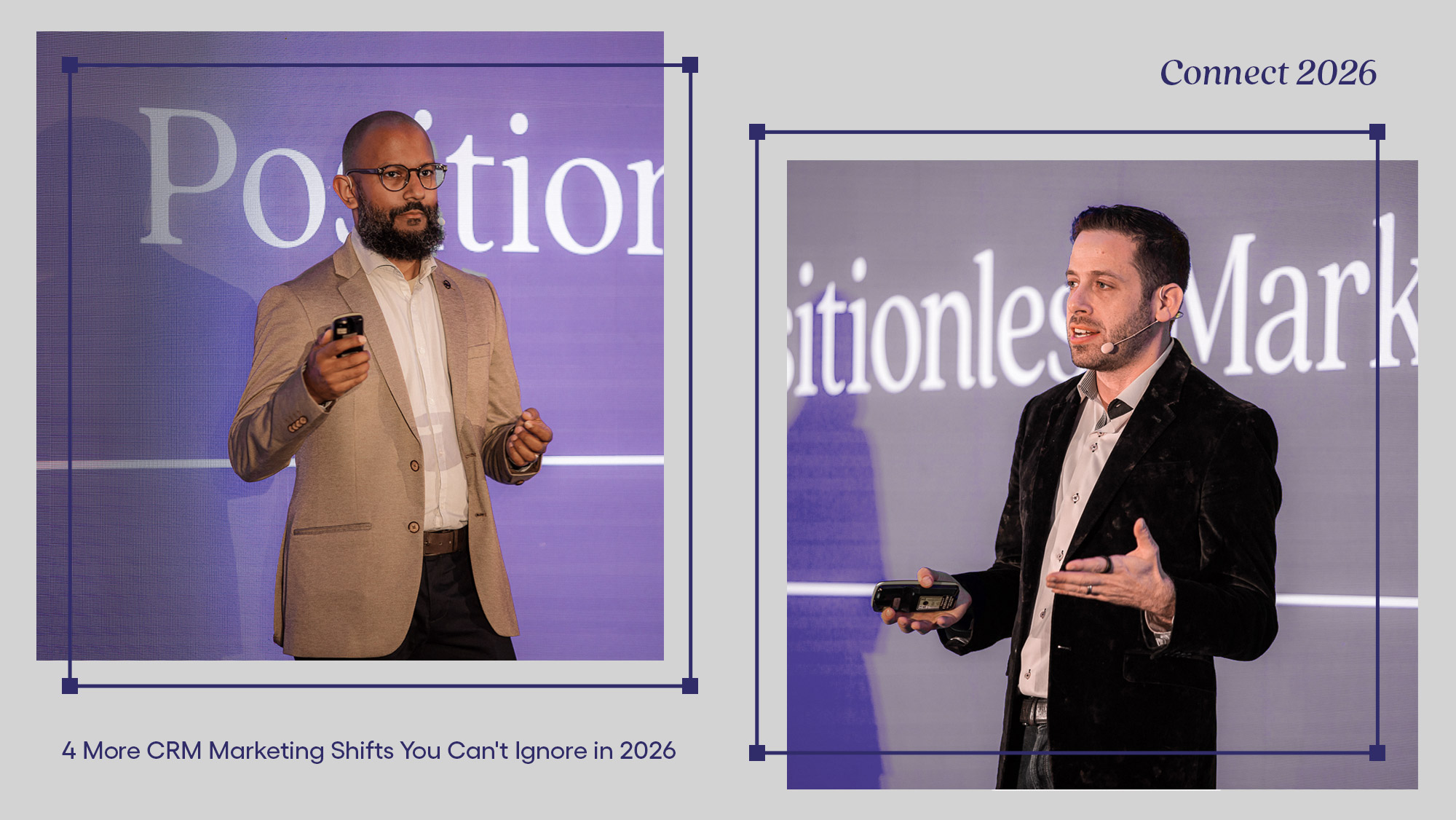
That was one of the clearest takeaways from the Optimove Connect 2026 session, where Ben Tepfer and Punal Shah walked marketing leaders through the nine forces reshaping how their teams operate. Part 1 of this series covered the first five, from building composable tech stacks to replacing one-off testing with structured experimentation.
These are the remaining four.
What connects them is pressure. CRM and marketing teams are being asked to prove their value in cleaner financial terms. At the same time, they are working with less reliable tracking, shorter consumer attention windows, and loyalty signals that do not always reflect real customer behavior.
Marketing used to be measured on activity. Campaigns launched. Emails delivered. Open rates.
Those metrics still matter but are no longer enough to defend budget or prove impact. CRM teams that rely only on channel-level performance are often left trying to explain marketing value in a language finance teams do not use.
According to Gartner, seventy-five percent (75%) of CMOs report increased financial scrutiny compared to three years ago. CFOs, CEOs, and board members are asking hard questions about what marketing actually contributes.
At the same time, measuring marketing effectiveness and ROI has become harder. Privacy changes have erased 30% to 40% of previously trackable conversions, according to eMarketer, making traditional attribution models less reliable. That is why incrementality is becoming more important.
Incrementality measures the revenue lift a CRM campaign creates over a control group. In other words, it helps answer the question every budget owner cares about: what happened because of this campaign that would not have happened otherwise?
This change affects both how performance is measured and how results are communicated. CRM leaders who move from delivering results on opens and clicks to retention performance, incremental revenue, and customer lifetime value (CLV) will have more influence over strategy and budget.
Privacy regulations are more stringent. Tracking signals are weakening. The data layer CRM teams have relied on for years, including third-party cookies, inferred behavioral signals, and cross-site tracking, is dissipating.
But the session made one point clear: customers are not necessarily unwilling to share data. They are unwilling to share it without a good reason. When the exchange is voluntary and the value is obvious, customers are more open to sharing information about their preferences, interests, and intent.
That is why zero-party data can be so valuable.
Zero-party data is information customers proactively share, such as favorite product categories, preferred sports, communication preferences, or shopping interests. It is more accurate than inferred data because it comes directly from the customer. It is also more durable because it does not depend on cookies or third-party tracking.
The challenge goes beyond collecting data. It’s about creating a moment of exchange that feels genuinely worthwhile to the customer.
Static forms often feel like work. Interactive experiences, quizzes, trivia, preference centers, surveys, and gamified journeys can make the exchange feel useful, timely, or even fun.
For example, between major sporting events, brands can use gamified experiences to keep customers engaged while learning what they care about most. By the time the next campaign window opens, the brand already has preference data that can make future messages more relevant from the first touch.
Consumer attention is shrinking, but the real issue for CRM teams is not that people cannot pay attention. It is that they decide very quickly who deserves it.
On social platforms, users decide in under three seconds whether to engage with content. The average attention span sits at 8.25 seconds in 2025, down from 12.1 seconds in 2015, according to DevriX.
For CRM teams, that means the first moment of contact matters more than ever.
The subject line. The opening line of an email. The first words in a push notification. The first frame of a message. These are not minor creative details. They are often the difference between earning attention and being ignored.
A generic “Don’t miss this offer” will struggle to survive the first three seconds. A message that reflects a customer’s favorite category, preferred team, recent behavior, or known interest has a much better chance.
That is why zero-party data and personalization are key to engagement. Knowing what a customer cares about helps the message become relevant immediately.
The implication is simple: CRM copy cannot warm up slowly anymore. It needs to get to relevance fast.
Loyalty program membership is growing. Active engagement is flattening. That gap is the loyalty paradox, and it is costing brands more than they realize.
Customer acquisition costs have risen 222% over ten years (SimplicityDX). Acquiring a new customer now costs five to 25 times more than retaining one. Yet 44% of businesses still prioritize acquisition over retention. And even among those investing in retention through loyalty programs, retaining existing loyal consumers is tougher. Sixty percent (60%) of consumers switched from a brand they considered themselves loyal to because of cost considerations in 2025.
What this reveals is that stated loyalty and actual retention behavior are different. Customers join loyalty programs strategically, collecting benefits and moving on when a cheaper alternative appears. The emotional loyalty that once made switching feel costly is fading.
The brands winning on retention are connecting rewards, recognition, and experiences across the full customer lifecycle -- not just a points mechanic tied to purchase history. Loyalty status should change what a customer sees on a brand's site, which offers appear in SMS and push notifications, and how they are treated at key lifecycle moments.
A 5% improvement in customer retention can lift profits between 25% and 95% (Ringly.io, 2026). CRM teams that connect retention activity to that business outcome will make a compelling case for why loyalty investment belongs in the budget conversation.
Marketers need to test their loyalty programs against one question: does it change what a customer does when a cheaper alternative appears? If the answer is no, they should redesign recognition and experience, not just points. Think of loyalty as a system, not a program.
These four forces point to the same reality: CRM is being held to a higher standard of proof.
Financial scrutiny means CRM needs to speak in revenue terms. Privacy changes mean marketers need to earn the data they use. Shorter attention windows mean every message must become relevant faster. And the loyalty paradox means brands need to prove that loyalty programs are changing behavior, not just collecting members.
The CRM and marketing teams that address these trends together, instead of treating them as separate challenges, will have more influence over strategy and budget in the years ahead.
That is what Positionless Marketing is built for: giving every CRM marketer the Data Power, Creative Power, and Optimization Power to move from insight to action independently, at the speed customers now expect.
For more insights, contact us to request a demo.


Writers in the Optimove Team include marketing, R&D, product, data science, customer success, and technology experts who were instrumental in the creation of Positionless Marketing, a movement enabling marketers to do anything, and be everything.
Optimove’s leaders’ diverse expertise and real-world experience provide expert commentary and insight into proven and leading-edge marketing practices and trends.
CRM teams are being measured on revenue contribution, retention performance, and customer lifetime value, not campaign volume or engagement metrics. Incrementality measurement, which isolates the actual revenue lift a campaign creates over a control group, is becoming the standard for proving CRM's business impact.
Zero-party data is information customers proactively share, such as product preferences, communication preferences, or interests. Unlike tracked behavioral data, it is consent-based and accurate. Brands using zero-party data in CRM workflows see 35 to 60% higher open and engagement rates, and the data remains usable regardless of changes to cookies or tracking regulations.
By treating the first line of every campaign as the most important creative decision. Personalization using zero-party data ensures the opening moment of any message is immediately relevant. Subject lines and opening copy should be tested with the assumption that customers decide in under 3 seconds whether to engage.
The loyalty paradox is the gap between growing loyalty program membership and flattening active engagement. More customers are joining loyalty programs but fewer feel emotionally loyal to brands. CRM teams should shift from points-only mechanics toward recognition and experience-based loyalty that changes customer behavior when cheaper alternatives appear.
With acquisition costs up 222% over eight years, the economic case for retention has never been stronger. A 5% improvement in customer retention can lift profits between 25 and 95%. CRM teams that can demonstrate retention impact in financial terms will have greater influence over budget decisions and marketing strategy.