

Unified Growth Solution
World-class tech needs world-class drivers. AI platform and expert services, unified
Read time 6 minutes


Make loyalty something they want to play
Executive Summary :
The 2022 FIFA World Cup drew a wave of new and casual bettors to global sportsbooks, dramatically expanding active participation while reshaping how bets were placed. Analysis of more than 250 million bets across multiple global brands shows bettor volumes surged through every stage, peaking at the Final with a 91% lift over benchmark, while average bet sizes stayed below benchmark throughout. Ticket structure shifted gradually toward simpler single-leg bets as outcomes grew more consequential. Together, the patterns reflect a "mix effect" common to major sporting events: high-stake bettors continued to wager heavily, while a surge of casual bettors expanded reach without raising average stake size.
For operators preparing for the 2026 World Cup, the data points to one operational reality. Each stage rewards a different marketing strategy, and the speed of the tournament leaves no room for a fixed playbook. This is where Positionless Marketing becomes critical. Any marketer must be able to execute any task, at any moment, without being constrained to a role or workflow. The tournaments are won by the operators whose teams can move at the speed of the customer.
Methodology :
Optimove Insights analyzed sportsbook activity across multiple global brands, examining more than 250 million bets (tickets) placed during the 2022 FIFA World Cup. The measures tracked the average number of bettors, average bet amount, bet type (single or multi-bet), live bets, and pre-match bets. To isolate the tournament's impact, Optimove Insights benchmarked each World Cup stage against the brands' average daily performance. Ticket structure by stage and timing (pre-match vs. live) was reviewed across the tournament overall.
Optimove Insights examined bettor behavior across the Group Stage, Knockout Stage, and Final, benchmarking each phase against the sportsbook's average daily performance.
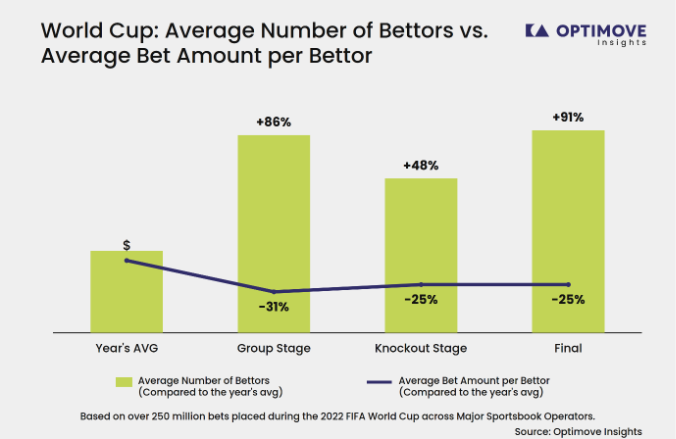
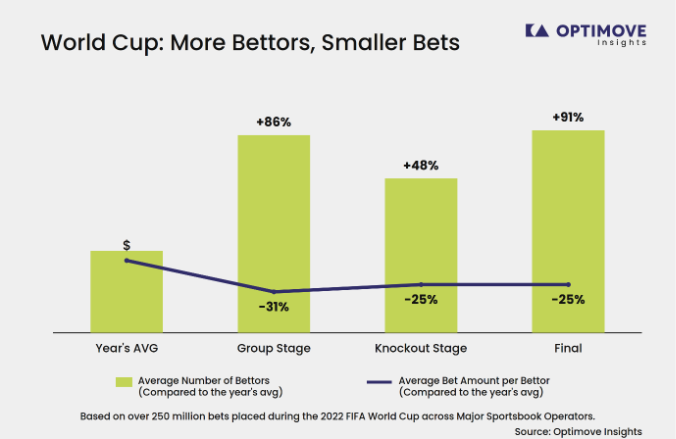
Relative to the benchmark, the Group Stage saw a sharp increase in active bettors (+86%), while average bet amounts per bettor declined to 69% of the benchmark (-31%). This is a common big-event pattern. Mass participation expands early, pulling average stakes down as many bettors place smaller "entry" wagers.
As the tournament progressed into the Knockout Stage, bettor volumes softened relative to the Group Stage but remained well above the benchmark (+48%). The remaining audience became more engaged: average bet amounts per bettor rebounded to 75% of the benchmark (-25%).
By the Final, participation reached the tournament peak relative to the benchmark (+91%), while average bet amounts per bettor stayed at the elevated Knockout level (75% of the benchmark / -25%).
This is consistent with a mixed effect. High-stake bettors continued to wager heavily, while an influx of casual or occasion-driven bettors placed smaller bets. This expanded reach without materially increasing the average amount wagered per bettor.
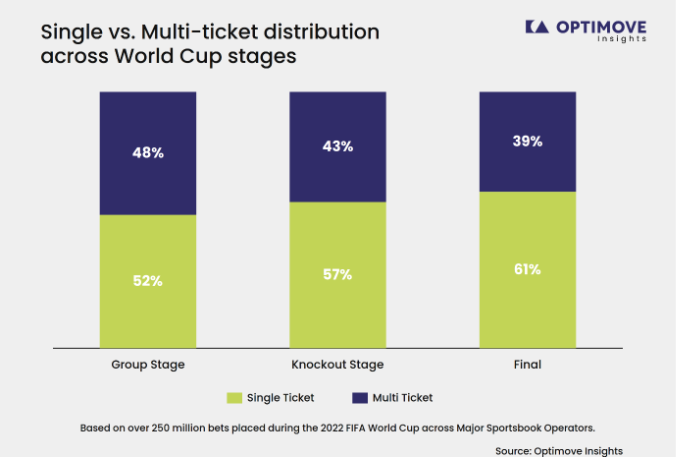
Optimove Insights also examined how bettors structured their bets (tickets) across the tournament. The data shows a largely stable mix with subtle shifts as the World Cup progressed.
During the Group Stage, ticket composition was close to evenly split, with 52% single-ticket bets and 48% multi-ticket bets. This established the tournament's baseline distribution.
In the Knockout Stage, the mix tilted toward singles, reaching 57% single-ticket vs. 43% multi-ticket. The shift is meaningful but not abrupt, pointing to a growing preference for more focused betting as outcomes became more consequential.
The trend continued into the Final, where single-ticket bets reached 61% and multi-ticket bets represented 39%. Multi-ticket betting remained significant, but the overall pattern shows a gradual stage-by-stage move toward simpler ticket structures.
Simpler ticket structures can indicate that there are a greater number of less experienced bettors in the later phases.
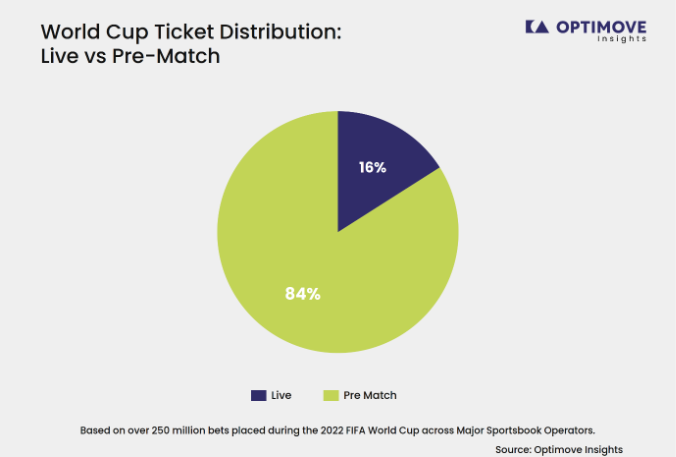
Across the World Cup, betting activity was clearly concentrated before kickoff. Pre-match bets accounted for 84% of all activity, while live (in-play) betting represented 16%.
This indicates that even during a high-engagement tournament, most bettors preferred to place wagers ahead of the match rather than react in real time. Live betting remained a meaningful secondary channel, complementing but not replacing pre-match wagering throughout the tournament.
The 2022 World Cup can be a guide to what operators may face in 2026. It is not a forecast. Markets have evolved. Regulation has expanded. Bettor behavior will shift. But the patterns from 2022 tell us what to look for, what to plan against, and where the surges will likely come from.
What that data cannot do is tell operators exactly when to act, with what offer, for which bettor. By the time a 2026 trend is visible, the moment to act on it will already be passing.
The challenge does not end when the tournament does. The World Cup brings a flood of new and casual bettors. Most of them will not stay. The operators who win the months after the tournament are the ones who can quickly identify which players to keep investing in and which to let go. Marketing budgets are not infinite, and chasing every new face is the fastest way to spend without return.
This is why Positionless Marketing is critical. It enables any marketer to execute any task, at any moment, without being constrained to a fixed role or workflow. During the tournament, that means moving at the speed of the customer. After the tournament, it means turning a flood of new bettors into a smaller pool of profitable ones. The 2022 data describe the shape of the opportunity. Positionless Marketing is how operators capture it during the World Cup and protect it after.
Optimove is the creator of Positionless Marketing and the #1 Player Engagement Solution for iGaming and sports betting operators. Positionless Marketing frees marketing teams from the limitations of fixed roles, giving every marketer the power to execute any marketing task instantly and independently. Positionless Marketing has been proven to improve campaign efficiency by 88%, allowing marketing teams to create more personalized engagement with existing customers.
For two years running, Optimove has been positioned as a Visionary in Gartner's Magic Quadrant for Multichannel Marketing Hubs, recognized for its AI-driven decisioning, prescriptive insights, and proven ability to orchestrate thousands of personalized campaigns in real time across channels.
Its Positionless Marketing Platform includes Optimove Engage and Orchestrate for cross-channel campaign decisioning and orchestration; Optimove Personalize, a digital personalization engine; and Optimove Gamify, a loyalty and gamification platform.
All are powered by Optimove AI, the marketing AI suite that brings AI everywhere marketers work. Inside the platform through Native AI agents for decisioning, analysis, and creation, outside it to external AI tools like Claude and ChatGPT through the Optimove MCP, and into custom-built applications on top of the platform through Optimove Custom Apps. Optimove has embedded AI in its platform since 2012, paving the way for Positionless Marketing.
Today, its comprehensive AI-powered suite is at the leading edge of empowering marketers to streamline workflows from Insight to Creation and through Optimization. Optimove provides industry-specific and use-case solutions for leading consumer brands globally.
Optimove Insights is the analytical and research arm of Optimove, dedicated to providing valuable industry insights and data-driven research to empower B2C businesses.
Loyalty, leveled up.
Connect gamification, loyalty, and rewards in one platform.