Unified Growth Solution
World-class tech needs world-class drivers. AI platform and expert services, unified
Read time 7 minutes


Better, Smarter, Faster: How AI is Transforming CDPs
Why it matters:
This post breaks down the capabilities Optimove introduced at Connect 2026, to help marketers master Templates, Liquid language, Data Connections, and Content Blocks, and explains how each one removes a specific bottleneck in the way email campaigns are built, managed, and scaled.
Key takeaways:
Watch Optimove's Ignatius Fogarty and Edward Aaron-Obelley show how to move email beyond static templates and manual processes, turning it into a dynamic, decision-driven experience powered by real-time data and AI:
Email has significantly evolved over the years and is still constantly adapting to suit customers today. Over the years, it moved from batch-and-blast to triggered automation to lifecycle journeys. It leaned into what no other channel could offer: The space to combine messaging, offers, and brand content in a single, owned touchpoint.
And the numbers still hold; for every $1 spent on email, brands get $36 back. But the way many teams actually deliver marketing emails to their clients is still way behind. So, the channel evolved, but the workflow did not.
If you work in email marketing, the following process is probably familiar. A brief comes in. You build a template. Then you duplicate it for a different region, duplicate it again for a language variant, again for a different offer, again for a new segment. Then QA. Then compliance review. Then someone changes the offer and the cycle starts again.
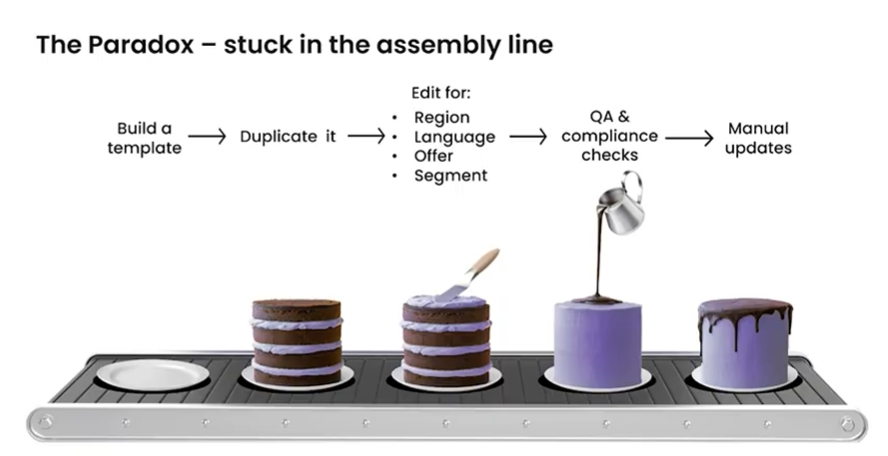
The result is template explosion. Hundreds of near-identical files sitting in a platform, each one a slightly modified version of the last. Hard-coded content that has to be manually updated every time a campaign repeats. One-off campaigns that are never truly one-off because they keep coming back, and someone has to rebuild them each time.
The time lost to this process is significant, and it crowds out the work that actually moves the needle, like thinking about personalization strategy, creative direction, optimization, and building deeper customer relationships.
The foundation of Optimove’s approach is the master template: a single, intelligent campaign framework that produces unlimited personalized variations without duplication.
Instead of a static design, a master template is built around content placeholders. Each placeholder connects to a data source and pulls in the right content for each customer automatically at the point of execution. A banner image placeholder connects to your asset library and selects the correct creative.
For operators - an odds placeholder connects to your sports feed and pulls in the relevant match data.
For retailers - a promotional offer placeholder connects to your promo engine and assigns the right offer based on customer eligibility.
The template does not change. The data does. That distinction is what makes scale possible.
Learn more about email that drives revenue, not just opens.
Data Connections are how dynamic content gets into the master template. Rather than hard-coding offers, images, or copy variants into individual templates, marketers upload a structured dataset, essentially a campaign brief in database form, and let Optimove pull the right content for each customer at send time.
The setup works through a primary key: a customer attribute that Optimove uses to match each recipient to the correct row of content. Therefore, a customer who supports Liverpool gets the Liverpool image, the Liverpool subject line, the Liverpool offer. A customer whose team is unknown gets a well-designed fallback. The same logic applies to multi-language campaigns, where a single template can serve dozens of language variants without any duplication.
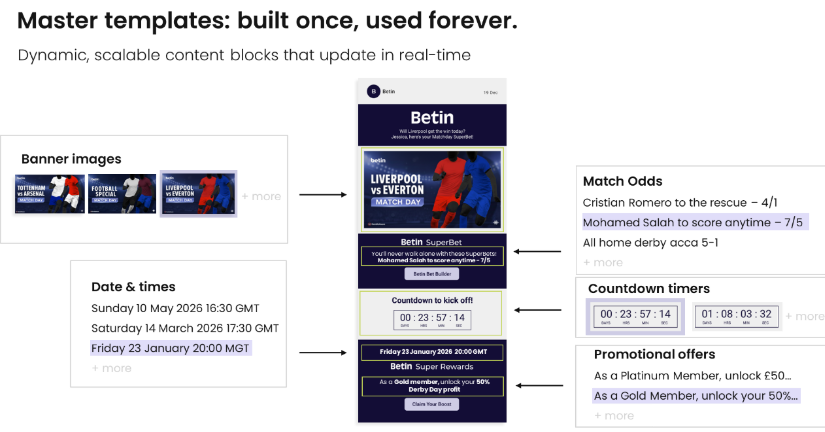
When a campaign runs again, the update happens in the data, not the template. So, marketers edit the CSV or push a new API payload, and every variation updates automatically.
Liquid is Optimove’s new templating language, and it is what gives master templates their intelligence. Originally developed by Shopify and widely used across the industry, Liquid allows marketers to write condition-based logic directly inside a template.
For example, a gaming operator running a weekly sports newsletter uses a single Liquid line to greet each reader by name and reference the team they support. If that data exists, it appears. If it does not, a default greeting takes its place. Therefore, there is just one template used, and every customer is covered with no manual intervention required.
Liquid also handles loyalty status personalization, offer assignment, and conditional content blocks, all within one template, with fallbacks built in at every step. And because the syntax is clean and readable, it is accessible to marketers as well as developers, though engineers who encounter it tend to get genuinely excited about what it makes possible at more advanced levels.
Content Blocks are a new capability launching shortly, and they take the master template concept one level further. Where content tags in Optimove have historically required careful maintenance across multiple templates, Content Blocks are modular, reusable components built with a visual drag-and-drop editor and referenced in templates via Liquid.
The practical value is significant. If terms and conditions change, or a legal disclaimer needs updating, or a promotional image needs to be swapped out, the change is made once in the Content Block, and it propagates automatically to every template that references it. No hunting through dozens of templates, or risk of missing an instance.
Content Blocks also support nesting, so a master block can reference multiple child blocks, each with its own conditional logic, creating a system where personalization at scale is genuinely manageable rather than theoretically possible.
Beyond data connections and Liquid, Optimove Engage includes a library of dynamic widgets that add real-time interactivity to email content. These are not industry-specific but apply across all verticals.
For example, a countdown timer configured to a match start, a sale end, or a booking deadline creates urgency that static text cannot. A real-time weather widget personalizing content to a customer's location adds immediate relevance. A carousel widget cycling through recommended products or live odds gives customers a reason to engage rather than skim. A poll widget, where customers vote on a preference and that data feeds back into recommendations, turns a passive read into an active signal.
Welcome email use cases benefit particularly from unique coupon widgets that generate individual discount codes at open time, alongside video widgets for brand storytelling and gallery widgets for showcasing bestsellers or featured products. Every widget connects to the master template structure, so the same personalization logic that drives content selection also drives which widgets appear and how they are configured.
Every capability described here, master templates, Liquid language, Data Connections, and Content Blocks, works across all of Optimove’s native channels. A Data Connection built for an email campaign can power the same personalization logic in an SMS or push notification. A Content Block updated for email updates for every channel simultaneously.
This is what cross-channel consistency looks like when it is built into the infrastructure rather than managed manually. The same message, adapted for each channel’s format, reaches each customer with the same relevant content wherever they are.
The assembly line model of email production is not an inevitable cost of doing business. It is a solvable problem. Master templates, Liquid language, Data Connections, and Content Blocks each remove a specific layer of manual work, and together they shift the email production model from reactive execution to scalable, always-on personalization.
The time saved by eliminating duplication, hard-coding, and repetitive QA cycles can go toward strategy, creativity, and the kind of marketing that actually builds customer relationships and long-term loyalty.
For more insights, contact us to request a demo.
Better, Smarter, Faster: How AI is Transforming CDPs

Writers in the Optimove Team include marketing, R&D, product, data science, customer success, and technology experts who were instrumental in the creation of Positionless Marketing, a movement enabling marketers to do anything, and be everything.
Optimove’s leaders’ diverse expertise and real-world experience provide expert commentary and insight into proven and leading-edge marketing practices and trends.