
Unified Growth Solution
World-class tech needs world-class drivers. AI platform and expert services, unified
Read time 16 minutes


Executive Summary :
Optimove Insights’ 2026 EU World Cup Betting Intentions Report shows that European bettors are entering the tournament as an experienced, confident, year-round engaged audience. Their appetite for the World Cup is strong, but their rhythm of engagement is more measured than in markets where the sport is still emerging.
Three out of four EU bettors plan to wager on the 2026 FIFA World Cup, and the overwhelming majority of them have done so before. Over nine in ten have bet on a previous World Cup. National team loyalty is widespread but distributed: eight in ten bettors who have a favorite team are already following other teams closely before any elimination occurs, and four out of five say they will keep betting after their team is out. Elimination, in this market, is a softer transition than a hard cutoff.
EU bettors prefer single, considered bets to multi-bets, and pre-match wagering remains the foundation of their engagement. Live betting is additive, not the default. They are highly responsive to promotions and offers, with offer-driven communications outweighing pure relevance as the primary trigger to open a sportsbook message. Mobile push notifications dominate as the preferred outreach channel, ahead of email.
For most EU bettors, the World Cup is not a gateway to a new behavior. It is an intensification of one they already practice. Year-round soccer betting is the baseline, the Premier League is the dominant post-tournament destination, and trusted, familiar betting sites carry as much weight as promotions in driving site choice.
The operators winning this World Cup in Europe will do three things. First, they will deepen primary-site loyalty during a concentrated revenue moment. Next, they will deliver offers and timing that respect a measured engagement rhythm. And finally, they will use personalization as a differentiator in a market that is broadly satisfied but rarely impressed by current outreach.
Positionless Marketing gives marketers the speed, data access, and execution power to do exactly that, without losing momentum between insight and activation.
Methodology :
Optimove Insights surveyed 882 World Cup bettors in early 2026, with household incomes equivalent to €70,000 (£60,000) or higher. The analysis in this report focuses on the EU cut, comprising approximately one-third of respondents, 283 EU bettors.
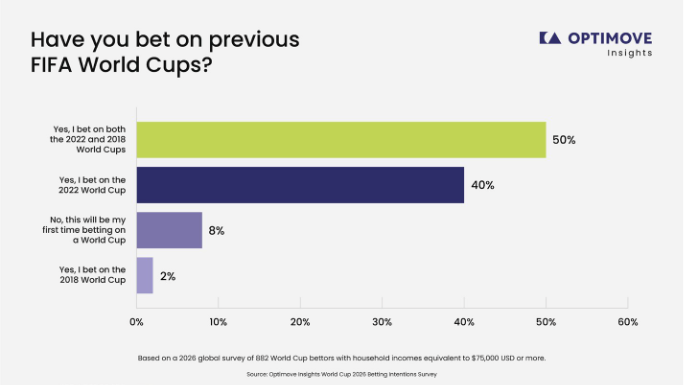
Three-quarters (75%) of EU bettors say they plan to bet on the 2026 World Cup. Among those who plan to bet, 92% have bet on a previous World Cup, including 50% who bet on both 2018 and 2022. Only 8% will be betting on a World Cup for the first time.
This is a deeply experienced group of World Cup bettors. Year-round soccer betting is the norm: 33% bet on soccer several times per week, and another 24% bet weekly. Almost no one in this audience is new to the sport: only 5% did not bet on soccer at all in the past 12 months.

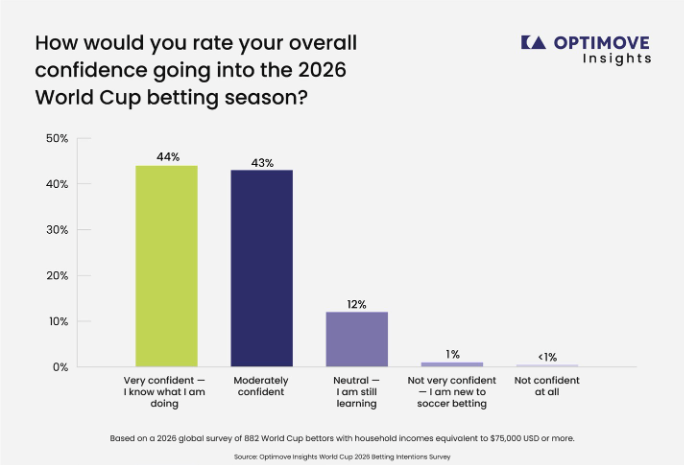
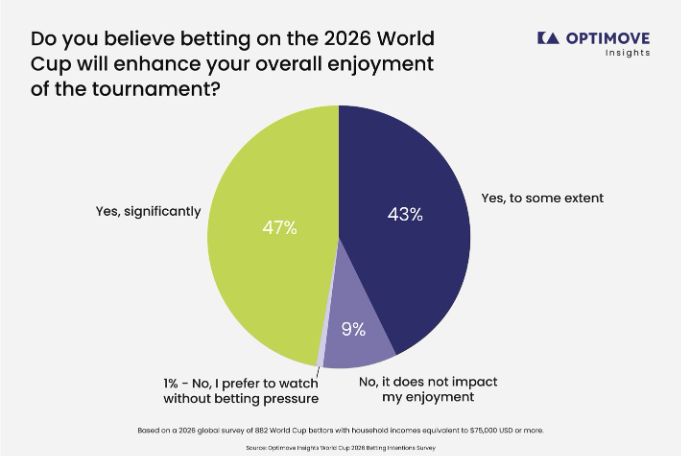
Confidence is high but distributed evenly: forty-four (44%) rate themselves as very confident in their betting knowledge, and another 43% as moderately confident, totaling 86% combined confidence. Forty-seven percent (47%) say betting will significantly enhance their tournament enjoyment, and another 44% say it will enhance enjoyment to some extent, 91% combined.
The EU World Cup bettor in 2026 is bringing years of soccer betting experience into the World Cup, and they are using the tournament as a concentrated, high-stakes expression of an existing behavior. The 92% who have bet on a previous World Cup, combined with the 95% who bet on soccer at least occasionally in the past year, confirms that the World Cup audience and the year-round soccer audience are largely the same.
Confidence at this level changes what bettors expect from their sportsbook. They are not looking for tutorials, basic offers, or handholding. They are looking for sharper odds, faster execution, deeper market access, and communications that respect their knowledge. Notably, the EU split between very confident and moderately confident is flat, which suggests a deep middle of capable, fluent bettors who do not consider themselves experts but expert enough to know what they are doing.
Operators should approach the EU World Cup audience as fluent, year-round customers being given a tournament-shaped peak in their existing engagement. Welcome offers and broad promotions will move the small first-timer segment, but the substantive revenue opportunity is depth, recency, and relevance for a base that is already active.
Marketers need real-time visibility into bettor behavior and the ability to segment based on past activity and confidence level. They also need the operational speed to deliver tailored communications at the moments when bettors are most engaged.
Positionless Marketing enables marketers to move directly from behavioral data to audience definition to campaign execution, ensuring that each communication meets the bettor at their level of fluency and intent.
Eighty-four percent (84%) of EU bettors say they support a favorite national team during the World Cup. But only 44% describe their loyalty as exclusively strong, while 40% say they have a favorite team but also follow other teams closely. The remaining 16% engage with the tournament as a whole rather than around any single team.

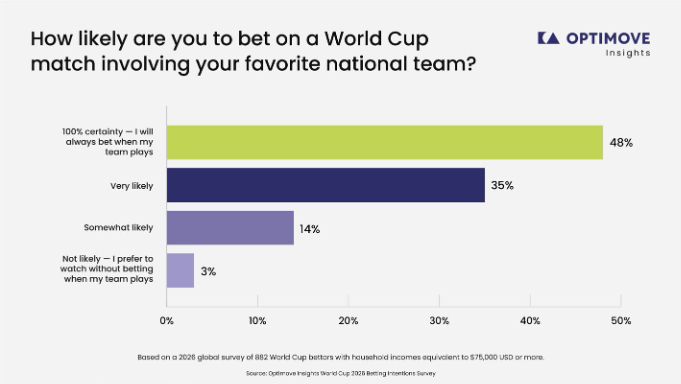
When their national team plays, 48% say they are certain they will bet, and another 35% are very likely to bet, 83% combined are very favorable to bet.
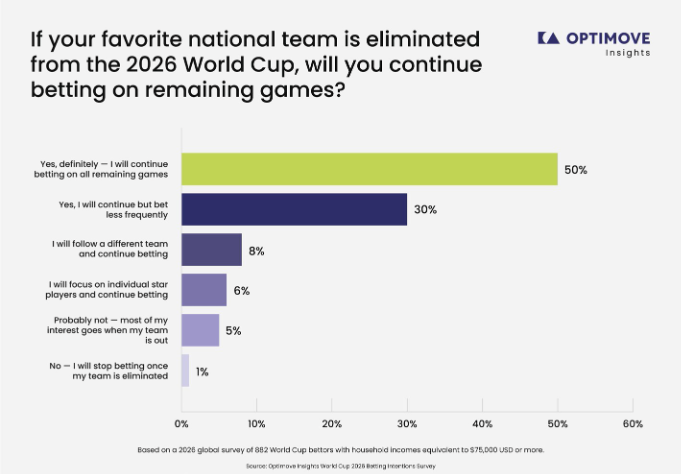
The headline finding for operators sits in what happens when that team is eliminated. 50% say they will definitely continue betting on remaining games, and another 30% will continue but bet less frequently, which is 80% who are likely to keep betting. Only 1% say they will stop entirely.
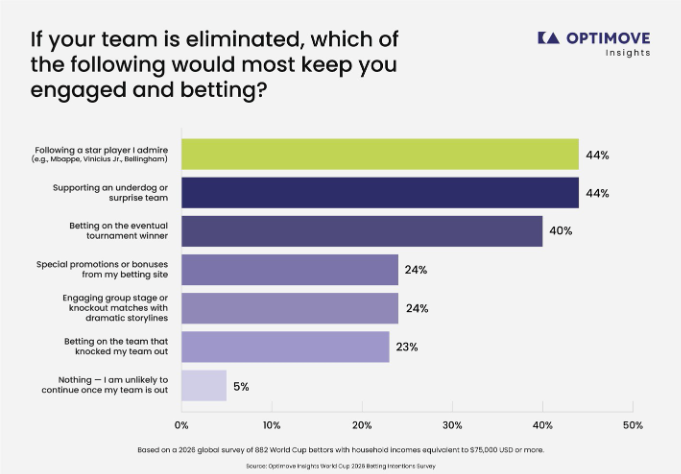
Reasons they will stay engaged after elimination are that 44% will follow a star player they admire (Mbappé, Vinicius Jr., Bellingham named in the question), forty-four percent (44%) will support an underdog or surprise team, and 40% will bet on the eventual tournament winner, and 23% will bet on the team that knocked their team out.
European national team loyalty is real, but it is rarely exclusive. Eight in ten EU bettors with a favorite team are already following other teams closely before any elimination occurs. It likely means the emotional risk window around their team’s exit is small compared to markets where allegiance is more singular.
This shifts the retention picture. The bettor who is heartbroken when their team loses is, in the EU case, often already engaged with the broader tournament. By the next match day, many don’t need a new reason to engage; they already have one. This is why operators should plan campaigns that go beyond each bettor’s favorite team. EU bettors stay engaged after their team is out, and they want to be part of the whole tournament from the start, not just when their team plays.
What changes after elimination is what keeps bettors interested. Only 44% will follow a star player, and just 23% want to bet on the team that beat their team. More bettors are drawn to underdog stories (44%) and picking the eventual winner (40%). Revenge bets are not popular.
Tournament communications should cover the full World Cup, not just the matches a bettor’s favorite team plays. In the EU, that should start on day one, not after their team is knocked out. From the beginning, messages should highlight other teams the bettor follows, point to interesting storylines across the tournament, and avoid making everything about one team.
When elimination of a favorite does happen, the best ways to keep bettors engaged are predictions about who will win the tournament and stories about underdog teams. Star players and revenge matches do not work as well.
Positionless Marketing makes this kind of timing possible. It reads each bettor’s mood and interests in real time, treats elimination as a turning point rather than an ending. Being Positionless ensures marketers are empowered to send the right message to the right bettor at the right moment.
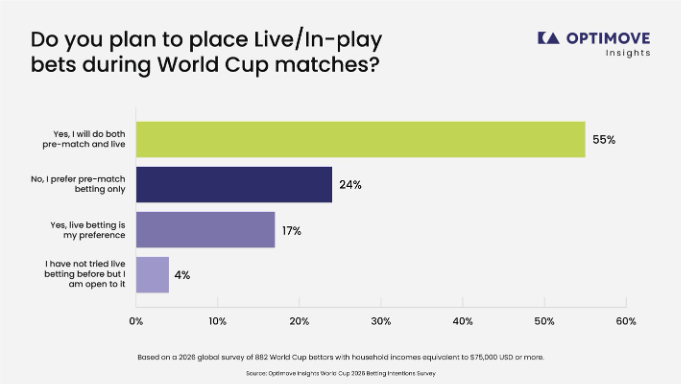
Seventy-two percent (72%) of EU bettors plan to engage with live or in-play betting during the World Cup. However, only 17% say live betting is their preference. Fifty-five percent (55%) will bet both pre-match and live, and 24% prefer pre-match only.
Frequency is moderate as 18% plan to bet on every match day, thirty-five percent (35%) several times per week, and 22% once per week.

Single-betting per match is preferred by 38% of respondents, while 31% have no fixed preference, and 31% say they will place multiple bets. The most common bet types are match results (75%), Both Teams to Score (49%), Over/Under (35%), and correct score (34%). Same Game Parlays (11%) and traditional accumulators (16%) are less preferred.

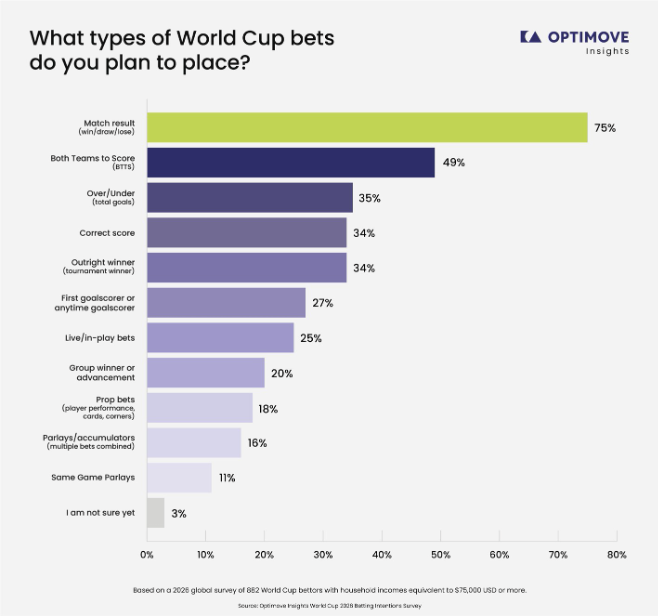
The European World Cup bettor in 2026 will make pre-match betting central, with live as an enhancement rather than a replacement. It has direct operational implications: pre-match marketing windows still matter, and the day-before push remains a primary engagement window. In-play marketing should be designed as an additive layer on top of an established pre-match relationship.
The single-bet preference is a deliberate, considered bettor. This is a player who builds a position before kickoff and tends to stick with it. This audience does not require ten in-match offers per match to feel engaged. What they require is the right offer at the right moment, fewer pushes that land harder.
In-match marketing has to be valuable enough to justify each notification, not loud enough to dominate a measured experience. Real-time triggers tied to match events still matter, but the communication threshold means operators who over-push live betting will lose engagement faster than they gain incremental wagers.
The opportunity is to combine strong pre-match preparation (relevant offers the day before and morning of) with selective, combined with high-quality relevant live triggers. For example, a goal scored in a match the player bet. Positionless Market-ing makes this possible by collapsing the gap between data, decision, and delivery, while knowing to only send when the moment justifies it.
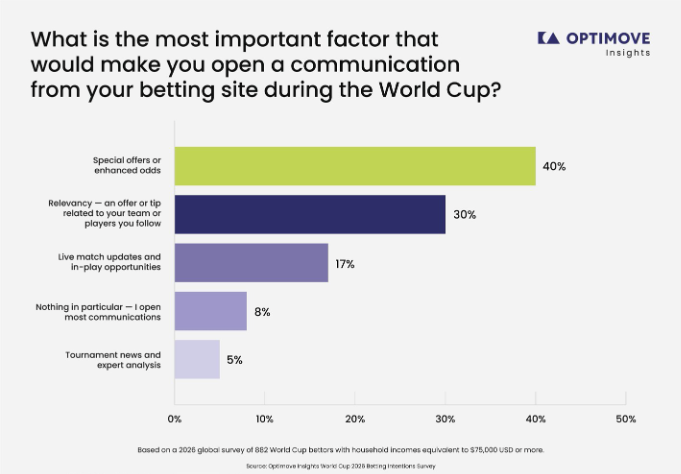
EU bettors are more offer-led than relevance-led when deciding whether to open sportsbook communications. Forty percent (40%) say special offers and enhanced odds are the most important factor, while 30% say relevancy (an offer or tip related to their team or players they follow), and 18% say live match updates and in-play opportunities. Only 5% open sportsbook communications primarily for tournament news and expert analysis.
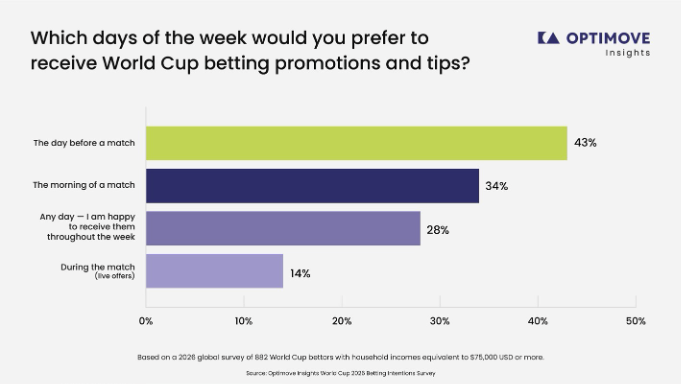
Forty-three percent (43%) prefer communications the day before a match, thirty-four percent (34%) the morning of a match, fourteen percent (14%) during the match itself, and 28% are happy to receive them on any day of the week.
Regarding personalization messages, thirty-eight percent (38%) responded that their preferred site personalizes World Cup communications well, forty-three percent (43%) feel it is somewhat personalized, 13% say messaging is generic, and 6% have not noticed personalization in communications.

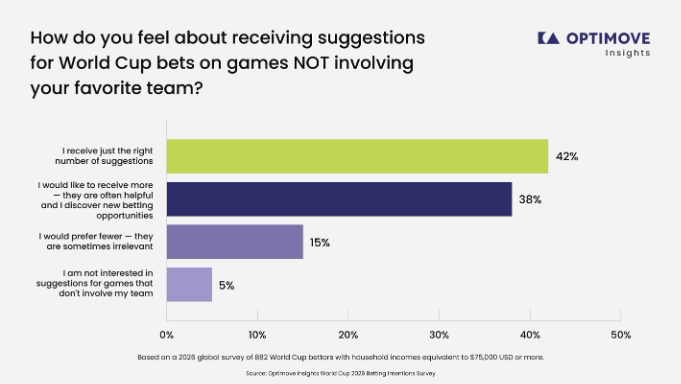
Thirty-eight percent (38%) say they want more suggestions for games not involving their team, while 42% feel they are already receiving the right amount.
On preferred outreach channels, forty-three percent (43%) prefer mobile app push notifications, twenty-one percent (21%) prefer email, eighteen percent (18%) prefer in-app messages while using the platform, and 8% prefer SMS. The mobile app is also the dominant betting interface (63%), with online sportsbooks at 22% and in-person at a casino or sportsbook at 12%.
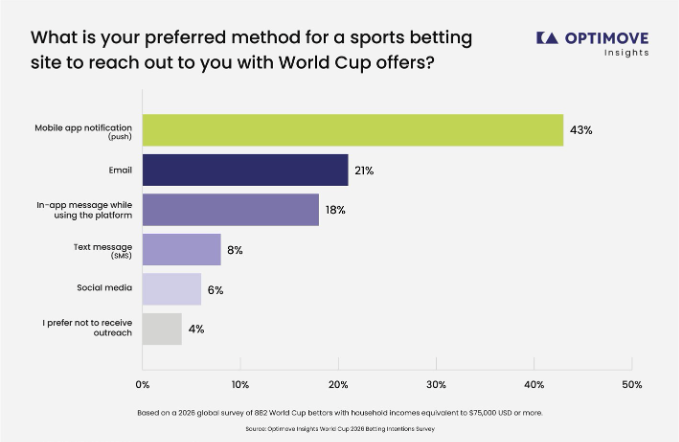
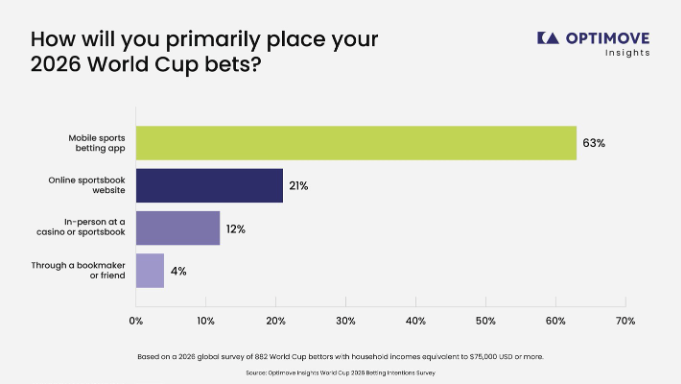
The European World Cup bettors respond more to good promotions than to personalized content. Promotions and better odds are what get bettors to open a message. Personalization is what gets them to act on it.
The flatter timing distribution, and the high any-day-of-the-week share (28%), suggest EU bettors expect a steady flow of communications throughout the tournament rather than concentrated outreach the day before each match.
In the EU, mobile app push is roughly twice as preferred as email. Programs built primarily around email schedules will systematically underperform programs built around push and in-app messaging.
Operators should weight their communication mix toward the channels EU bettors actually want, not the channels they are easiest to manage. Push and in-app messaging together represent over 60% of channel preference. That requires investment in the targeting, creative, and frequency discipline appropriate to those channels.
On content, sportsbooks should lead with the offer and reinforce with relevance. The bettor opens the message because the promotion is compelling; they act on it because it is timed and tied to teams and players they care about.
Positionless Marketing gives marketers the speed and ownership to build layered communication in a single workflow, identifying the right segment, choosing
the right channel, dropping the right offer, and timing it to the rhythm of the tournament.
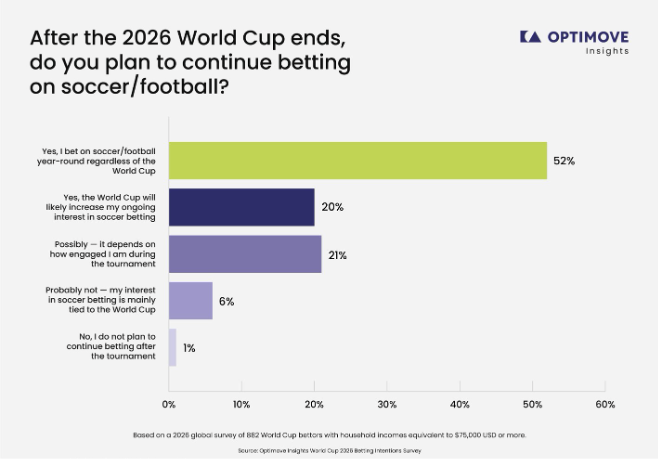
An overwhelming 93% of EU World Cup bettors plan to continue betting on soccer after the tournament ends. More than half (52%) already bet on soccer year-round regardless of the World Cup, while 20% expect the tournament to increase their ongoing interest. Finally, twenty-one percent (21%) say they will continue if they are engaged enough during the tournament itself.
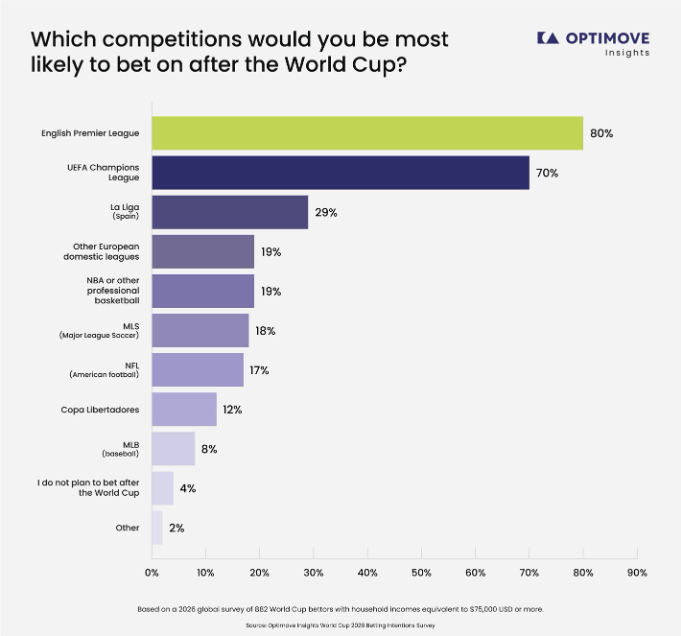
Post-tournament betting preferences are sharply European: eighty percent (80%) will move to the English Premier League, seventy percent (70%) to the UEFA Champions League, and 29% to La Liga. Cross-sport movement is moderate: 19% will bet on basketball, 17% on the NFL, and 8% on MLB.
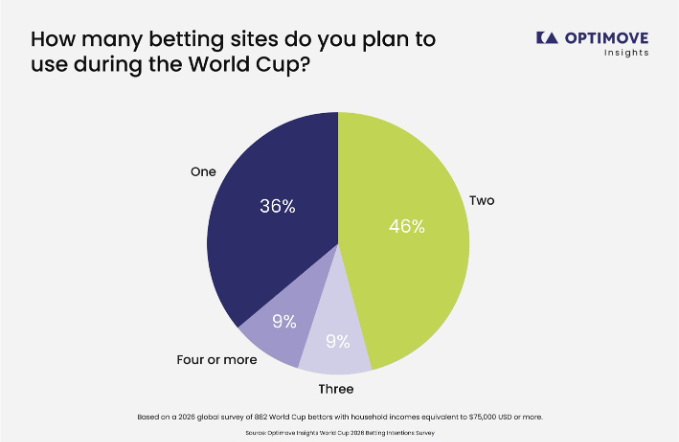
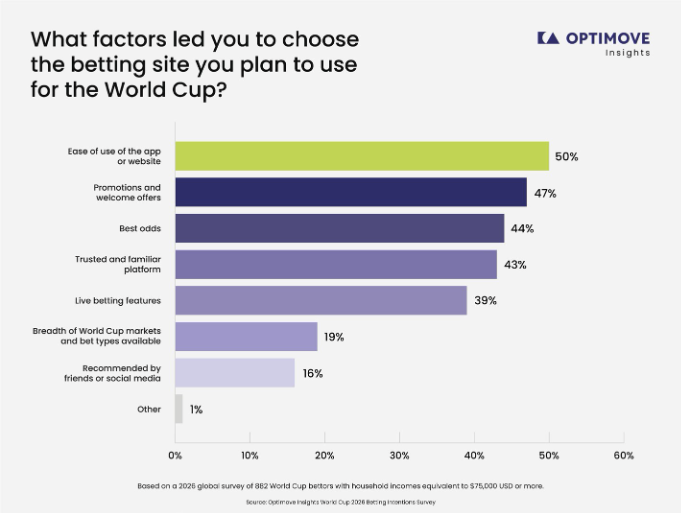
Sixty-four percent (64%) of EU bettors plan to use two or more sportsbooks during the tournament, with 46% using two and 18% using three or more. Site choice criteria are more diverse than promotions alone: half (50%) noted ease of use, 47% cite promotions and welcome offers, 44% cite best odds, and 43% cite a trusted, familiar platform. Live betting features are also significant at 39%.
For EU operators, the World Cup is not a customer acquisition window. Almost all of the audience is already a soccer bettor, and most of them will continue betting on soccer after the tournament, regardless of any World Cup-specific marketing. The opportunity is not to convert new customers; it is to deepen primary-site loyalty during a concentrated, high-volume revenue moment.
Operators who already have the relationship will retain a higher share of EU World Cup spend than they would in markets where bettors choose primarily on welcome offers.
The two-or-more-sites figure (64%) is meaningful, but most EU bettors will run a primary site with one secondary, rather than spreading wagers across three or four. That pattern means the World Cup is the moment to defend and deepen the primary relationship, not to win share through a single-tournament push.
Operators should design the World Cup customer journey for retention and depth rather than pure acquisition. That means rewarding existing high-value customers, capturing data not just about World Cup betting behavior but about adjacent interests (Champions League, Premier League, domestic leagues), and building post-tournament communication tracks that begin during the tournament rather than after the final whistle.
Positionless Marketing supports cross-tournament thinking by giving marketers a unified, real-time view of each bettor and the speed to act on it.
As the World Cup ends and the Champions League knockout rounds approach, the Premier League runs uninterrupted, and other domestic leagues continue, the Positionless Marketer, empowered with full ownership of the workflow, can move from World Cup engagement to year-round retention without missing the handoff.
The 2026 World Cup is a concentrated revenue moment for European sportsbooks operating in an already mature year-round soccer betting market. EU bettors are entering the tournament experienced, confident, broadly engaged across multiple teams, and committed to staying engaged after their favorite team is eliminated. They prefer pre-match wagering with selective live additions, single bets to multi-bet portfolios, and offers that earn their attention before personalization deepens it. Mobile push, not email, is their preferred channel.
The operators who win the 2026 World Cup in the EU will not be the ones who shout the loudest. They will be the ones who can read intent in real time, deepen primary-site loyalty during a peak engagement window, and deliver communications timed to a measured rhythm. They will seamlessly move bettors from World Cup engagement into year-round retention without missing the handoff to the Premier League, Champions League, and domestic seasons that pick up immediately after.
Positionless Marketers can deliver that. They move directly from behavioral data to audience selection to campaign execution, meeting each bettor at the right moment, with the right message, through the right channel. In a tournament where the moments matter most, the difference between winning and losing is the speed at which a marketer can act.
Optimove, the creator of Positionless Marketing, frees marketing teams from the limitations of fixed roles, giving every marketer the power to execute any marketing task instantly and independently. Positionless Marketing has been proven to improve campaign efficiency by 88%, allowing marketing teams to create more personalized engagement with existing customers.
For two years running, Optimove has been positioned as a Visionary in Gartner’s Magic Quadrant for Multichannel Marketing Hubs, recognized for its AI-driven decisioning, prescriptive insights, and proven ability to orchestrate thousands of personalized campaigns in real time across channels. AI-led marketing is a hallmark of Optimove’s visionary leadership. By embedding AI directly into its platform as early as 2012, Optimove paved the way for today’s Positionless Marketing standard.
Its Positionless Marketing Platform includes Optimove Engage and Orchestrate for cross-channel campaign decisioning and orchestration; Optimove Personalize, a digital personalization engine; and Optimove Gamify, a loyalty and gamification platform.
Today, its comprehensive AI-powered suite is at the leading edge of empowering marketers to streamline workflows from Insight to Creation and through Optimization. Optimove provides industry-specific and use-case solutions for leading consumer brands globally.
Optimove Insights is the analytical and research arm of Optimove, dedicated to providing valuable industry insights and data-driven research to empower B2C businesses.