Unified Growth Solution
World-class tech needs world-class drivers. AI platform and expert services, unified
Read time 7 minutes


Ready to join the Positionless Marketing movement?
Why it matters:
Reading this blog empowers marketers to rethink loyalty from a passive points system into an active driver of customer behavior and engagement. It shows how gamification and real-time, personalized experiences can create momentum that keeps customers coming back. Ultimately, marketers will gain practical insight into building more engaging, effective loyalty strategies that drive long-term value.
Many brands still treat loyalty like a ledger: customers earn points, points sit there, and maybe one day they get redeemed. But modern loyalty is not really about accumulation. In fact, it is not even about customers earning things from a brand. It is made of every touchpoint that the client has with it.
Loyalty is built through movement.
And it couldn't be different when it comes to loyalty programs: what makes them a powerful tool for tightening bonds with customers is the brand's ability to create momentum, making clients feel they are progressing through their own agency, being recognized, and getting closer to something meaningful.
Traditional loyalty programs often fail for a simple reason: they are too passive.
Customers sign up once, earn points over time, often don't know what to do with them or how much they are worth, and then either forget the program exists or only think about it when a redemption reminder appears. There is no emotional connection. There is usually no real sense of identity. There is no engagement. And because of that, there is very little momentum.
That is the core issue. Loyalty without momentum becomes just consideration.
When contact is purely transactional, it may still function operationally, but it no longer shapes behavior in a meaningful way. It does not motivate the next action. It does not create anticipation or connection. And it does not make customers feel like they are part of something that is moving forward and worth being part of.
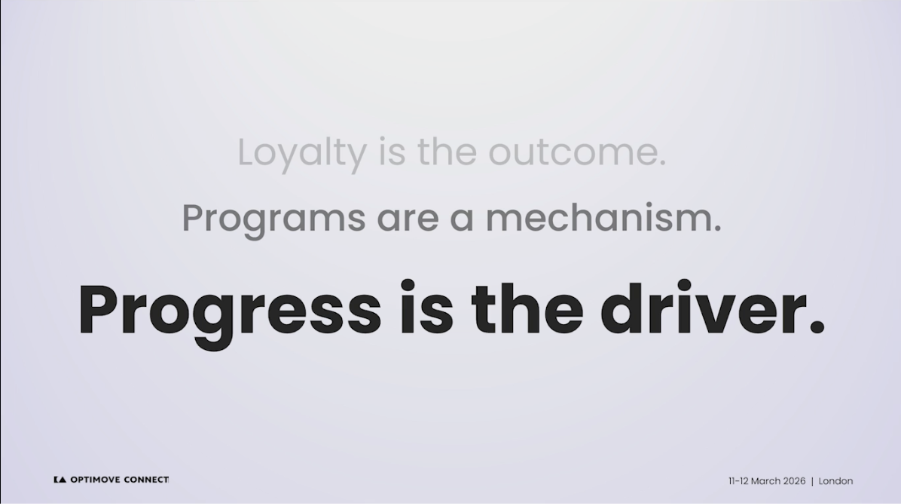
First, brands should not look at loyalty as a program. It is a business outcome. It is what brands earn when they consistently create experiences that customers want to return to. Programs matter, but only insofar as they help drive that outcome.
Modern loyalty requires a more diversified approach. It must move beyond a frictionless relationship, such as 'point banking,’ to a dynamic that shapes behavior, creates dialogue, builds emotional connection, and becomes part of the wider customer experience. In “How To Modernize Your Loyalty Program,” Forrester Research outlines how modern loyalty evolves these strategies
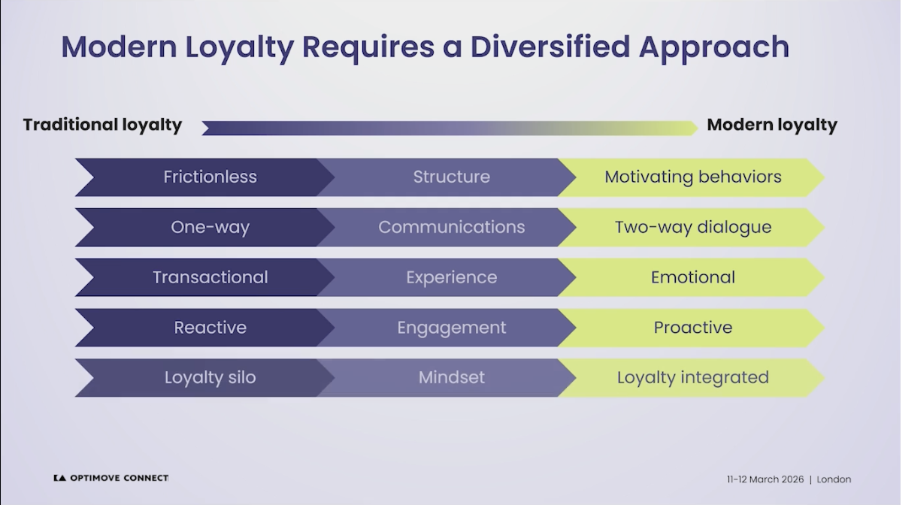
A modern loyalty approach gives customers a reason to act now, not later. It must be a two-way dialogue that reflects the customer's different preferences, habits, and motivations.
The same is true emotionally. Legacy programs are mostly transactional. Modern loyalty must feel personal. Customers increasingly expect recognition, relevance, and experiences that feel designed for them rather than broadcast to everyone at once.
It also must be proactive. Loyalty should respond to signals, timing, and behavior in real-time instead of waiting passively in the background. And finally, it must be integrated. Loyalty cannot live in a silo. It must be embedded in the brand’s larger CRM, decisioning, and orchestration strategy.
One of the biggest mindset shifts is understanding that loyalty is not a journey with a neat endpoint. It is a loop.
A customer takes an action. The brand recognizes it. The customer gets feedback, a reward, or progress. That creates momentum, which leads to a new goal. Then the loop starts again.
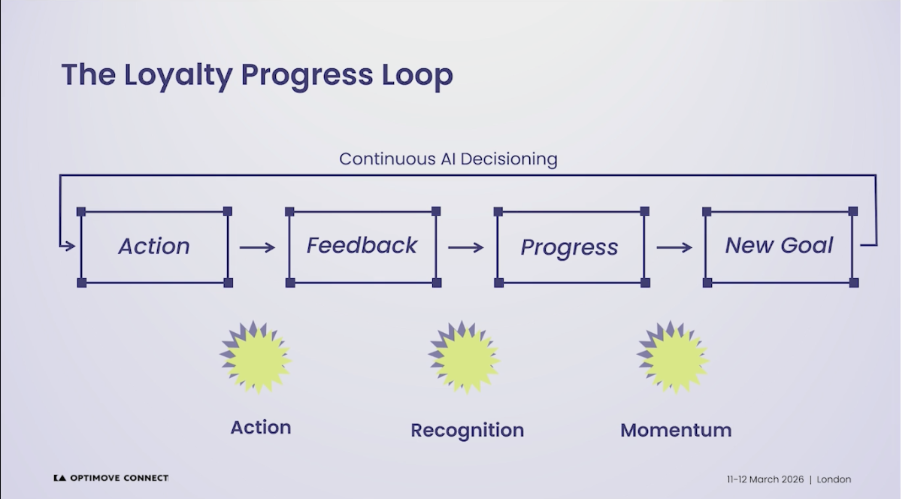
The brands that build strong loops based on each client's momentum are the ones that make progress visible. They show customers what they did, what it unlocked, and what comes next. That could be the next level, a time-sensitive mission, a streak, a badge, or a new challenge. The specific mechanic can vary, but the principle stays the same: action should create recognition, and recognition should create momentum.
This is where modern loyalty becomes much more powerful than simple accumulation. Instead of just storing value, it creates forward motion.
Gamification is a way of achieving loyalty through structure, visibility, and emotional pull. It is a way to make progress tangible.
Levels make advancement visible. Badges turn achievement into identity. Missions give customers direction. Leaderboards introduce status. Currencies create flexible reward systems that do not always depend on monetary incentives. Tournaments and limited-time challenges add urgency and energy.
All of these mechanics help answer the same customer question: What should I do next, and why should I care?
That is why gamification is not separate from loyalty. It is one of the most effective ways to activate it.
Another common misconception is that stronger engagement always requires a bigger discount, richer bonus, or more generous giveaway. In my experience, that is not always true.
Non-monetary rewards can be incredibly effective when they reinforce progress.
That is the opportunity gamification creates. Brands can motivate behavior through recognition, status, habit formation, and visible achievement, through spending.
Creating game mechanics is easy, but adding the right mechanic at the right moment is much harder. And gamification only works when it reflects customer context.
A customer who responds well to streaks and repeat missions is telling you something different from a customer who values exclusivity, status, or one-time challenges. A player who enters competitive experiences may need a different next step from one who responds better to habit-building missions. Those differences matter.
That is why the best loyalty experiences are fueled by customer signals. Some people call that zero-party data or declared data. I think of it more simply: it is listening.
When brands listen well, they can personalize not just the message or offer, but the loyalty mechanic itself. That is where gamification becomes much more than a surface-level tactic. It becomes part of a responsive system designed around how each customer actually engages.
At Optimove, we think about loyalty as deeply connected to the broader customer experience. This is not something that should sit outside the CRM stack. It should work natively inside it.
That is why we built our approach so that loyalty and gamification can operate within a wider decisioning and orchestration environment. Optimove Gamify powers the progression layer that creates momentum. Optimove Loyalty brings together levels, badges, missions, leaderboards, and currencies to help brands build programs that feel integrated and personalized. Optimove Minigames add another engagement and retention layer with ready-to-deploy branded experiences. And Optimove Promotions helps marketers balance generosity more intelligently by deciding when a monetary reward makes sense and when a non-monetary incentive is a better lever.
The key point is that all of this should work together.
A game can become the first touch in a campaign. Completion of a mission can change the next offer. A loyalty signal can move someone into a new audience. A challenge can shape the next message, channel, or promotion. When loyalty, gamification, AI decisioning, and journey orchestration work in sync, the customer experience feels much more alive.
Modern loyalty is evolving beyond points and passive participation. The brands that win will be the ones that create forward motion: visible, personalized, motivating experiences that keep customers engaged over time.
Gamification is a tactic in Loyalty, and it is key because it gives consumers that forward motion and a structure that they can actually feel.
If you want to build loyalty experiences that feel more relevant, timelier, and more motivating, start with the customer, listen to their signals, and design for progress.
For more insights, contact us to request a demo.
Join the Positionless Marketing movement
Boost campaign efficiency by 88% by breaking free of fixed-role marketing!


Ben Tepfer is a storyteller with over a decade of experience in product marketing. He is passionate about driving growth through innovative product marketing strategies. As the Director of Product Marketing at Optimove, Ben drives the shaping of the narrative and positioning of the company's cutting-edge technology.
Ben specializes in developing comprehensive product marketing strategies through storytelling to showcase the unique value propositions of Optimove that resonate with target audiences across diverse industries. Beyond his day-to-day responsibilities, Ben is a thought leader in marketing technology.
He frequently shares his insights at industry conferences, contributes articles to leading publications, including Entrepreneur, Adweek, Cheddar, Huffington Post, VentureBeat, and MediaPost, and engages with the marketing community.