

Unified Growth Solution
World-class tech needs world-class drivers. AI platform and expert services, unified
Read time 14 minutes


Executive Summary :
Optimove Insights’ 2026 World Cup US Betting Intensions Report shows that American bettors are entering the tournament with high intent, real confidence, and open to personalized, in-the-moment engagement.
Nearly three out of four US bettors plan to place at least one wager on the 2026 FIFA World Cup, and most are not casual participants. They bet on soccer year-round, prefer live and in-play wagering, and plan multiple bets per match. National team loyalty is the dominant emotional driver, but more than six in ten say they will keep betting even after their team is eliminated, opening a critical retention window for operators.
Bettors are clear about what they want from their sportsbook. They want communications that are timed to the rhythm of the tournament, suggestions that go beyond the games their own team is playing, and personalization that feels relevant rather than generic. The mobile app is the primary doorway, promotions are the leading reason for choosing a site, and the day before a match is the moment most are open to receiving outreach.
The operators winning this World Cup will be those who can identify intent in real time, engage bettors through the highs and lows of their team’s tournament arc, and deliver personalized communications across every stage of the journey. Positionless Marketing gives marketers the speed, data access, and execution power to do exactly that, without losing momentum between insight and activation.
Methodology :
Optimove Insights surveyed 882 World Cup bettors in early 2026, all with household incomes equivalent to $75,000 USD or more. The analysis in this report focuses on the US cut, comprised 335 bettors, approximately one-third of respondents.
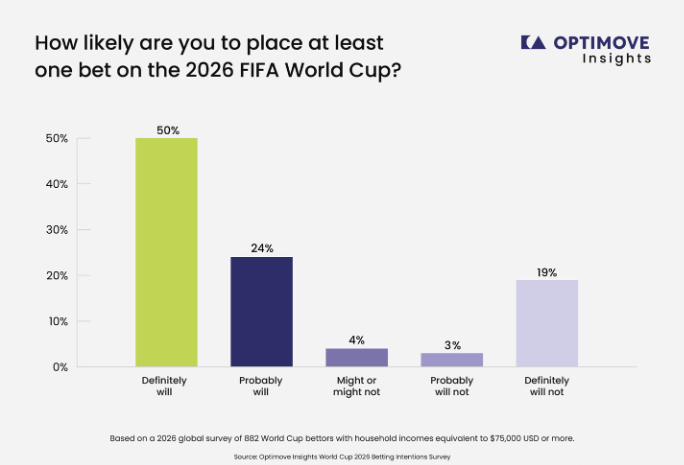
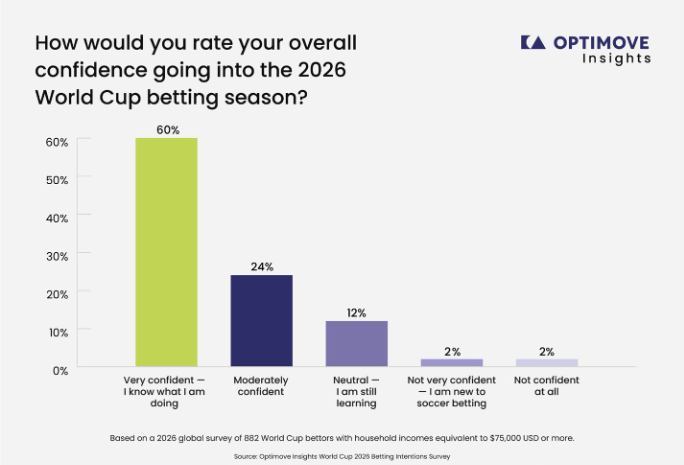
Half of US bettors say they will definitely place at least one bet on the 2026 World Cup. Among those intending to bet, 60% describe themselves as very confident in their betting knowledge, and another 24% as moderately confident.
This is not a tentative audience. 80% have bet on a previous World Cup, 58% bet on soccer several times per week, and 80% have wagered on the FIFA World Cup before. 65% say betting will significantly enhance their tournament enjoyment, with another 25% saying it will enhance enjoyment to some extent.
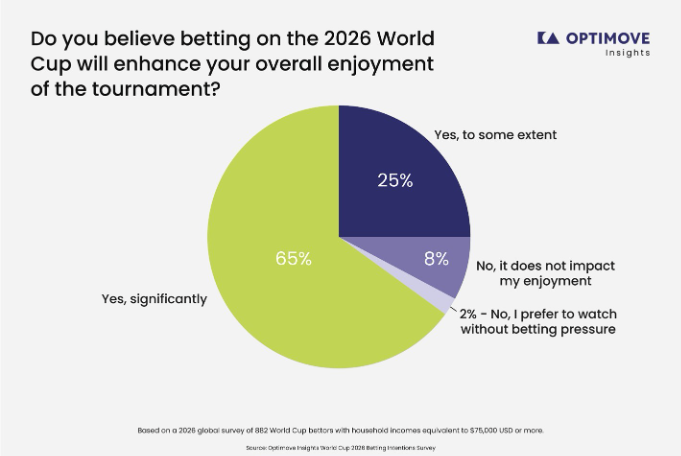
The US World Cup bettor in 2026 is not a casual fan testing the waters. This is a confident, deeply engaged participant for whom betting and watching are closely linked. The 90% combined who say betting enhances tournament enjoyment is a clear signal: for this audience, the wager is part of the experience, not a side activity to it.
Confidence at this level changes what bettors expect from their sportsbook. They are not looking for tutorials, basic offers, or handholding. They are looking for sharper odds, faster execution, deeper market access, and communications that respect their knowledge. A first-time bettor wants reassurance. A confident bettor wants relevance.
Operators should approach the World Cup audience as an engaged, primarily fluent group that rewards precision over volume. Welcome offers and broad pro-motions will pull some bettors in, but retention through the tournament will be driven by the depth, speed, and relevance of what comes next.
Marketers need real-time visibility into bettor behavior, the ability to segment based on past activity and confidence level, and the operational speed to deliver tailored communications at the moments when bettors are most engaged. Positionless Marketing enables marketers to move directly from behavioral data to audience definition to campaign execution, ensuring that each communication meets the bettor at their level of fluency and intent.
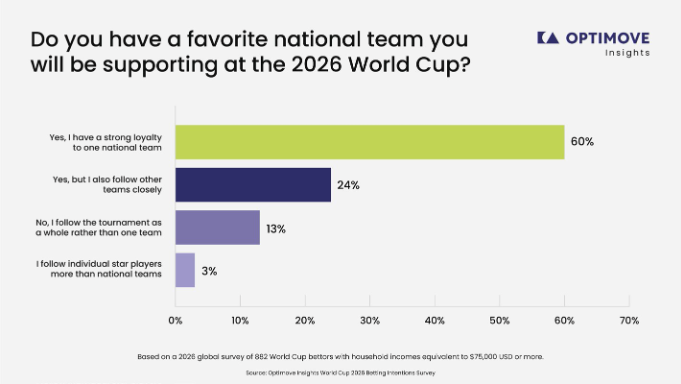
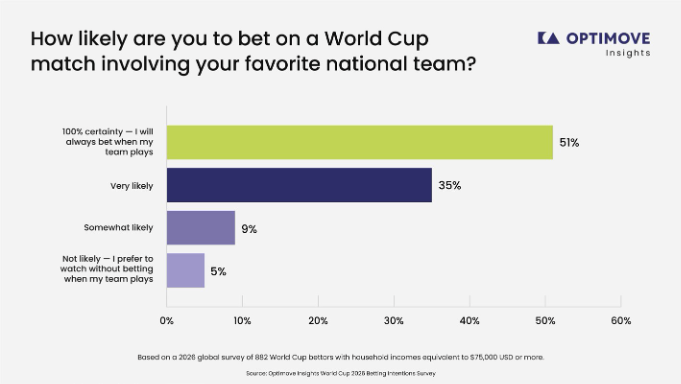
Eighty-four percent (84%) of US bettors favor their national team during the World Cup, with 60% describing their loyalty as strong. When their national team is play-ing, 51% say they will bet with 100% certainty, and another 35% say they are very likely to.
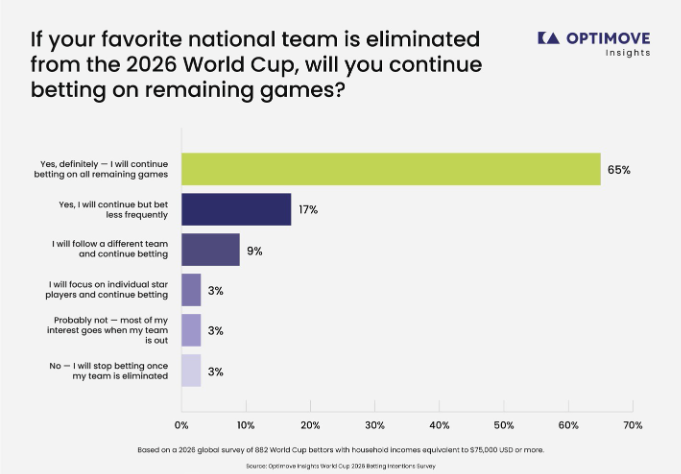
The headline finding for operators sits in what happens when that team is eliminated. 65% of bettors say they will definitely keep betting on remaining games, and another 17% will continue but bet less frequently. Only 3% say they will stop entirely.
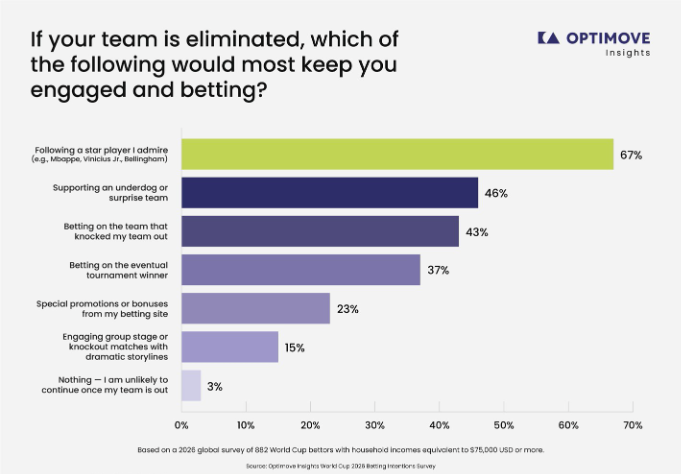
What keeps them engaged when their team is out reveals where the retention opportunity lives: 67% will follow a star player they admire (Mbappé, Vinicius Jr., Bellingham named), 46% will support an underdog, 43% will bet on the team that knocked their team out, and 37% will bet on the eventual tournament winner.
National team loyalty is the strongest emotional anchor in this audience’s tournament experience, but it is not the entire experience. The bettor who is heartbroken when their team loses is also the bettor who, by the next match day, is looking for a new reason to engage.
The operators who plan only for the high points of their bettors’ tournament arc will lose them when their team exits. The operators who plan for the full arc, including the elimination moment, will retain engagement when it matters most. The data is clear that bettors want to keep betting; they just need a reason to. Star players, underdog narratives, and the team that beat their team are all proven retention vehicles.
Tournament communications should be built around the full arc of each bettor’s experience, not just the matches their team plays. Operators should pre-build retention pathways for the moment of elimination, with content and offers that introduce alternative storylines (rival players, surprise teams, the tournament winner race) before the bettor has time to disengage.
This is the kind of orchestration Positionless Marketing is built for: identifying the bettor’s emotional state in real time, recognizing the elimination moment as a critical retention window, and triggering personalized re-engagement with the right alternative narrative. The marketer who can move from signal to message in minutes, not days, will be the one who keeps the bettor in the experience after their team is out.
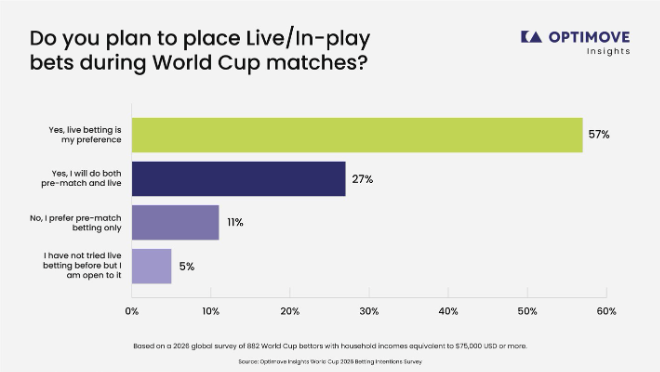
Eight-four percent (84%) of US bettors plan to engage in live or in-play betting during the World Cup, with 57% saying live betting is their preference and another 27% planning to do both pre-match and live. Only 11% say they prefer pre-match betting only.
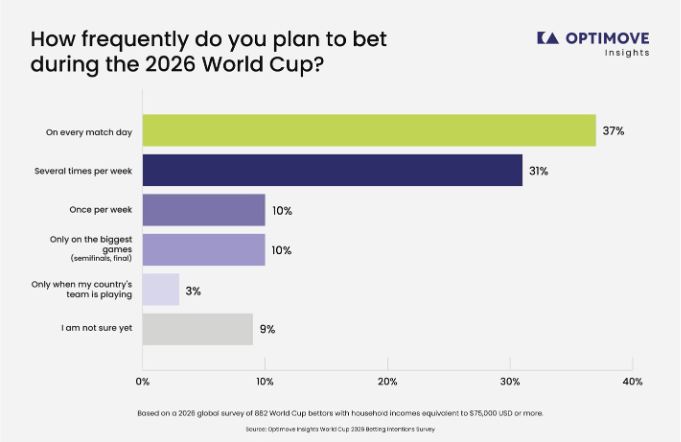
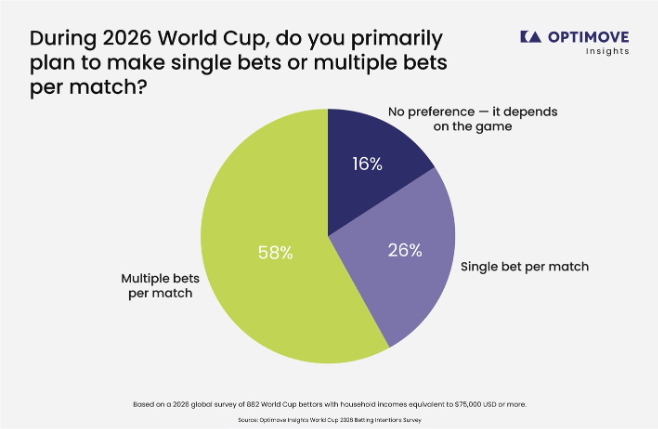
The volume and frequency are similar, as 37% plan to bet on every match day, and 31% will bet several times per week. Fifty-eight percent (58%) plan multiple bets per match rather than a single wager. Match results, both teams to score, and over/ under are the most common bet types, but the average bettor is mixing bet types within a single match.
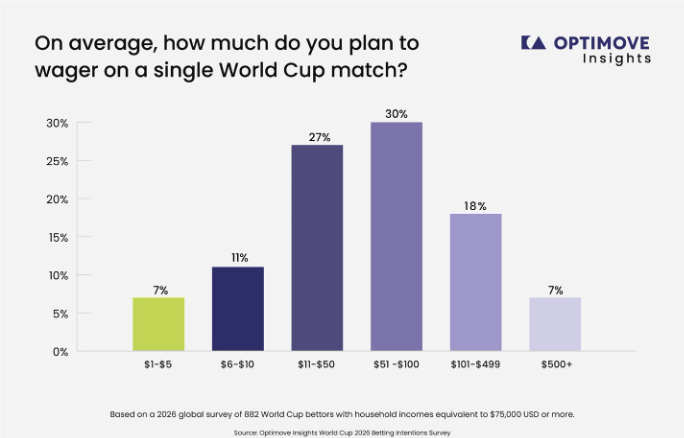
Wagering amounts are not casual. 30% plan to wager $51-$100 per match, 26% plan $11-$50, 18% plan $101-$499, and 7% plan $500 or more.
The American World Cup bettor in 2026 expects the sportsbook to keep up with the speed of the match. Live betting is not a feature for this audience; it is the preferred experience. The same is true of multi-bet behavior, where bettors layer match results, over/under, and player props into a single match’s wager portfolio.
This has direct implications for sportsbooks. A bettor placing multiple live bets across a 90-minute match will not tolerate slow load times, delayed odds, or communications that arrive after the moment has passed. The operator who can deliver real-time markets, real-time offers, and real-time engagement during the match will capture far more wallet-share than the operator who relies on pre-match marketing alone.
In-match marketing has to be fast enough to match the pace of the game. That means real-time triggers tied to match events (goals, red cards, penalties), live odds adjustments delivered through push notifications and in-app messages, and the ability to surface new bet types based on what is happening on the pitch.
Positionless Marketing makes this possible by collapsing the gap between data, decision, and delivery. A goal scoring is a trigger. The audience is identified in seconds. The personalized in-play offer ships before the match restarts. There is no time for handoffs between data, creative, and execution; the marketer **who owns the full workflow, supported by AI, is the one who captures the live-**betting moment.
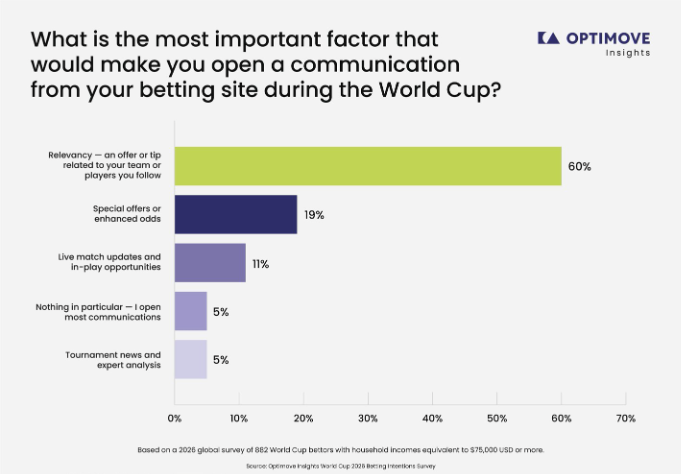
US bettors are clear about what makes them open a communication from their sportsbook. Sixty percent (60%) say the most important factor is relevance, defined as an offer or tip related to their team or the players they follow. Special offers and enhanced odds rank second at 19%, with everything else trailing.
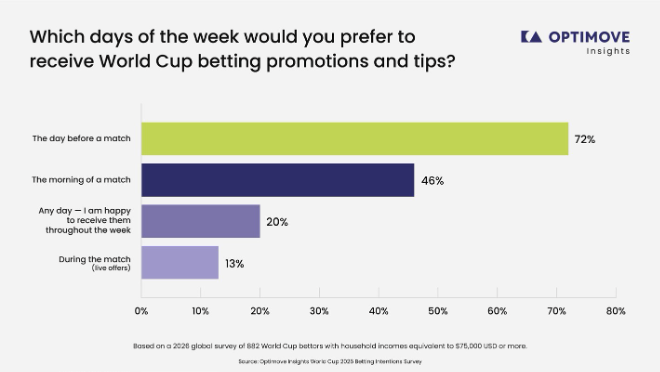
Timing matters as much as content. Seventy-two percent (72%) prefer to receive communications the day before a match. Forty-six percent (46%) want them the morning of a match, and 20% during the match itself. Only 13% are happy to receive communications on any day of the week.
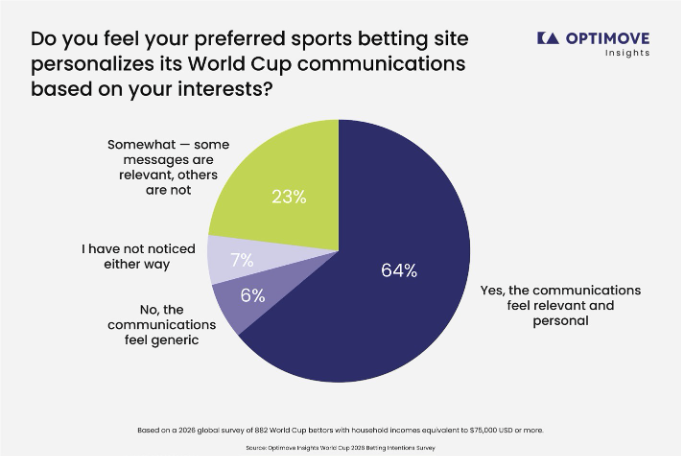
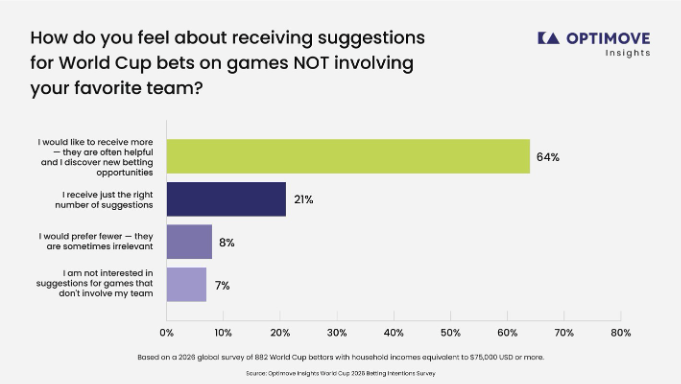
The personalization expectation is high and largely being met. Sixty-four percent (64%) feel their preferred betting site already personalizes communications well, and 64% want more suggestions for games not involving their favorite team. They want to be treated as bettors who follow the whole tournament, not just their team.
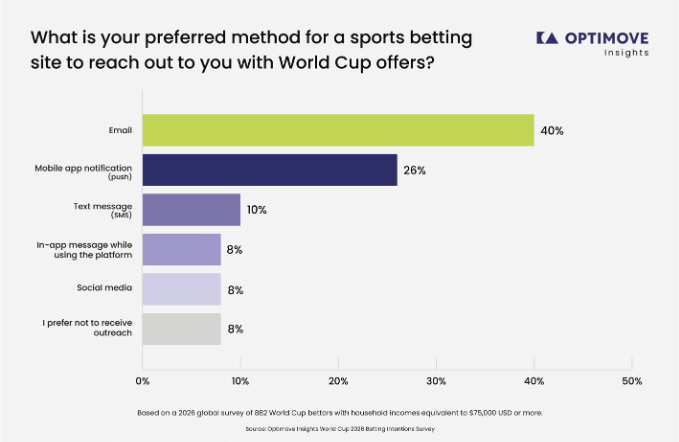
When asked about preferred outreach channels, forty percent (40%) prefer email, twenty-six percent (26%) prefer mobile app push notifications, and 10% prefer SMS. The mobile app remains the primary betting interface (65%), with online sportsbooks at 22%.
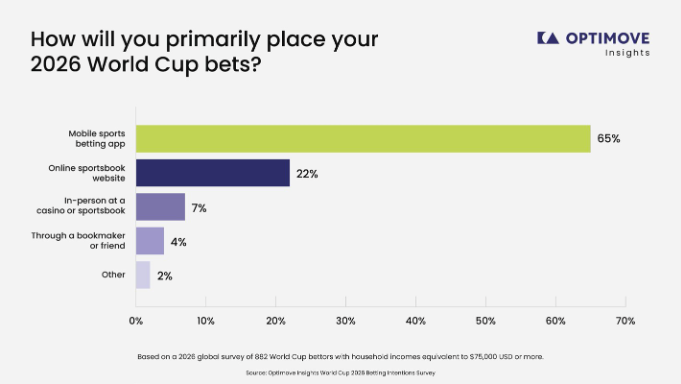
The American World Cup bettor is not asking for less communication. They are asking for better communication. The volume of outreach during the tournament will be high regardless of which operator a bettor chooses. The differentiator is whether each message feels relevant, well-timed, and personally meaningful.
Relevance, in this audience’s definition, has two layers. The first is content: offers and tips tied to the bettor’s team and players. The second is timing: the day before a match is the prime engagement window. Get either wrong and the message likely gets ignored. Get both right, and the message probably gets opened and acted upon.
The 64% who want more suggestions for non-team games is a particularly important signal. It tells operators that their bettors see themselves as tournament participants, not just team supporters. Communications that respect this broader identity will outperform communications that limit themselves to the bettor’s home country.
Operators need to move beyond batch-and-blast campaign calendars. Each bettor’s communication stream should be timed to the rhythm of the matches they care about, content-matched to the players and teams they follow, and broad enough to introduce new betting opportunities they have not considered.
This is precision marketing, and it cannot be delivered through traditional hand-off-based workflows. By the time the data team has built the segment, the creative team has produced the asset, and the campaign team has scheduled the send, the match has already kicked off. Positionless Marketing gives marketers the speed and ownership to identify the right moment, build the right message, and deliver it at the right time, all in a single workflow.
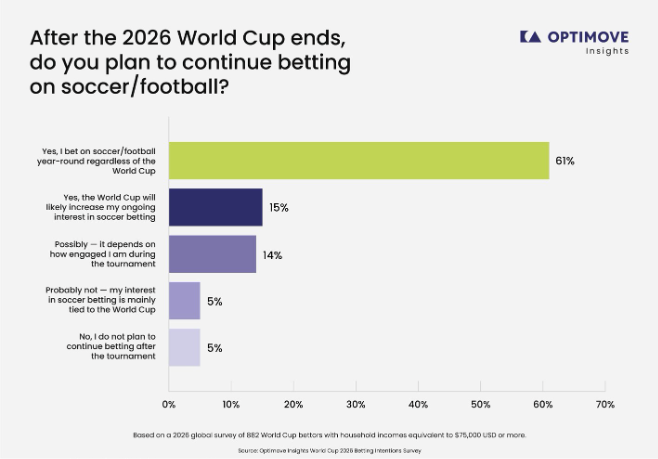
Seventy-six percent (76%) of US World Cup bettors say they will continue betting on soccer after the tournament ends. Sixty-one percent (61%) already bet on soccer year-round, and another 15% expect their World Cup engagement to increase their long-term interest in the sport.
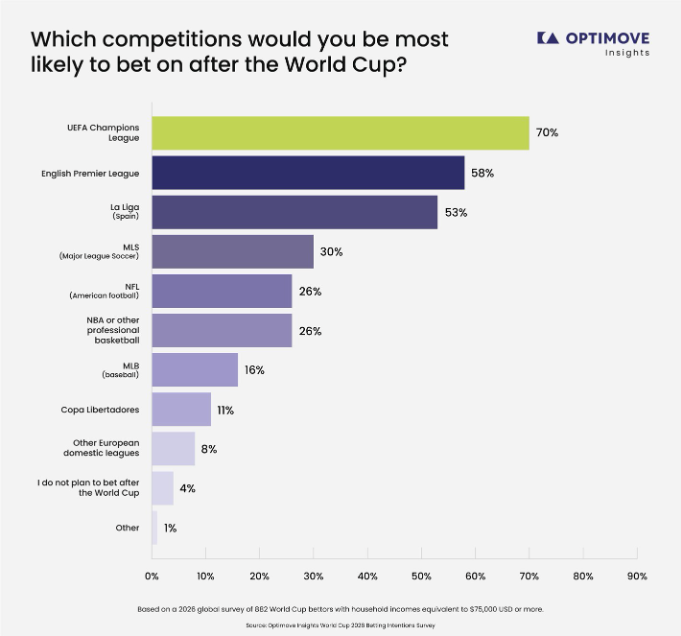
When asked which competitions they will move to after the World Cup, 70% named the UEFA Champions League, fifty-eight percent (58%) named the English Premier League, and 53% named La Liga. Cross-sport movement is also significant: twenty-six percent (26%) will bet on the NFL after the World Cup, twenty-six percent (26%) on the NBA, and 16% on MLB.
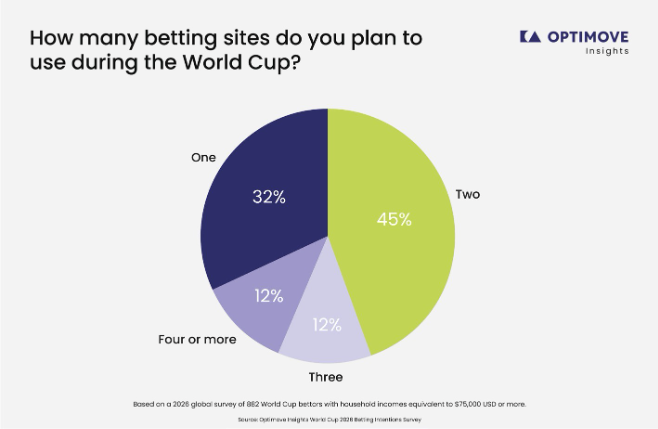
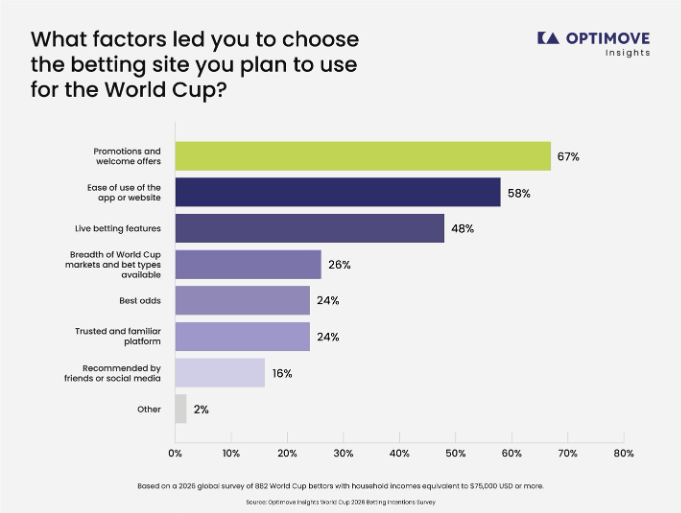
Eight-four percent (84%) of bettors plan to use two or more sportsbooks during the tournament, with 45% using two and 24% using three or more. Welcome promotions (67%) and ease of use (58%) are the leading reasons for choosing a site.
For operators, the World Cup is not a six-week revenue moment. It is a customer acquisition window with a long tail. The bettor who signs up for the tournament will, in most cases, still be active after it ends, often across multiple sports and multiple sportsbooks.
This changes the economics of World Cup marketing. The first-time deposit is not the goal; the long-term relationship is. Operators who treat the World Cup as a transactional moment will lose ground to operators who use the tournament as the beginning of a year-round relationship across soccer leagues and adjacent sports.
The multi-site behavior is equally important. With 84% of bettors using two or more sportsbooks, no operator owns the relationship outright. The operator who delivers the most relevant, best-timed, and most personalized experience during the tournament is the one most likely to become the bettor’s primary site after it ends.
Operators should design the World Cup customer journey with post-tournament retention in mind from day one. That means capturing data not just about World Cup betting behavior but about adjacent interests: which leagues the bettor follows, which players they admire, which other sports might draw them in.
Positionless Marketing supports this kind of cross-tournament thinking by giving marketers a unified, real-time view of each bettor and the speed to act on it. As the World Cup ends and the Premier League returns, Champions League knockout rounds approach, and the NFL playoffs intensify, the marketer with full ownership of the workflow can move from World Cup engagement to year-round retention without missing the handoff.
The 2026 World Cup is a concentrated betting opportunity during the year for US sportsbooks, but it is not a uniform opportunity. American bettors are entering the tournament confident, engaged, multichannel, and emotionally invested in
their national team while remaining open to broader engagement throughout the tournament arc. They want personalization, they want timing, and they expect their sportsbook to keep up with the pace of the match.
The operators who win the 2026 World Cup will not be the ones with the loudest promotions or the broadest welcome offers. They will be the ones who can read intent in real time, retain bettors through the elimination of their favorite team, deliver in-match offers at the speed of live play, and turn the tournament into the beginning of a long-term relationship rather than the end of a short one.
Positionless Marketers can deliver that. They move directly from behavioral data to audience selection to campaign execution, meeting each bettor at the right moment, with the right message, through the right channel. In a tournament where the moments matter most, the difference between winning and losing is the speed at which a marketer can act.
Optimove, the creator of Positionless Marketing, frees marketing teams from the limitations of fixed roles, giving every marketer the power to execute any marketing task instantly and independently. Positionless Marketing has been proven to improve campaign efficiency by 88%, allowing marketing teams to create more personalized engagement with existing customers.
For two years running, Optimove has been positioned as a Visionary in Gartner’s Magic Quadrant for Multichannel Marketing Hubs, recognized for its AI-driven decisioning, prescriptive insights, and proven ability to orchestrate thousands of personalized campaigns in real time across channels. AI-led marketing is a hallmark of Optimove’s visionary leadership. By embedding AI directly into its platform as early as 2012, Optimove paved the way for today’s Positionless Marketing standard.
Its Positionless Marketing Platform includes Optimove Engage and Orchestrate for cross-channel campaign decisioning and orchestration; Optimove Personalize, a digital personalization engine; and Optimove Gamify, a loyalty and gamification platform.
Today, its comprehensive AI-powered suite is at the leading edge of empowering marketers to streamline workflows from Insight to Creation and through Optimization. Optimove provides industry-specific and use-case solutions for leading consumer brands globally.
Optimove Insights is the analytical and research arm of Optimove, dedicated to providing valuable industry insights and data-driven research to empower B2C businesses.