

Unified Growth Solution
World-class tech needs world-class drivers. AI platform and expert services, unified
Read time 6 minutes


Summary:
The Cheltenham Festival is the most concentrated four-day betting window in the jump racing calendar — and one of the most commercially significant moments of the year for UK sportsbook operators.
As the 2026 Festival approaches, running from Tuesday 10 March to Friday 13 March, Optimove Insights analyzed betting behavior across the 2025 Festival to identify the patterns that matter most for operators preparing for the next cycle.
The analysis draws on 68.8 million bets placed across multiple UK brands during the 2025 Festival, benchmarked against a neutral non-event week in January. It evaluates three core performance indicators: daily bettor activity, first-time depositor acquisition, and average bet amount per bettor.
The findings show that Cheltenham does more than create a temporary spike in engagement. It materially expands the active player base, elevates staking intensity, and compresses acquisition and retention opportunities into a defined four-day window.
For operators, the competitive question is not whether activity will rise, but how effectively that surge is converted into sustained player value once the final race is run.
The results show a clear uplift in activity during the festival days, with the most pronounced increases concentrated within the event window.
Betting trend analysis for the Cheltenham Festival 2025 draws on a sample of 68.8 million bets placed across multiple UK brands during the festival period. Results were benchmarked against a neutral, non-event week in January, based on daily performance. The analysis covers the Festival itself (11–14 March 2025) and one week before and after the event.
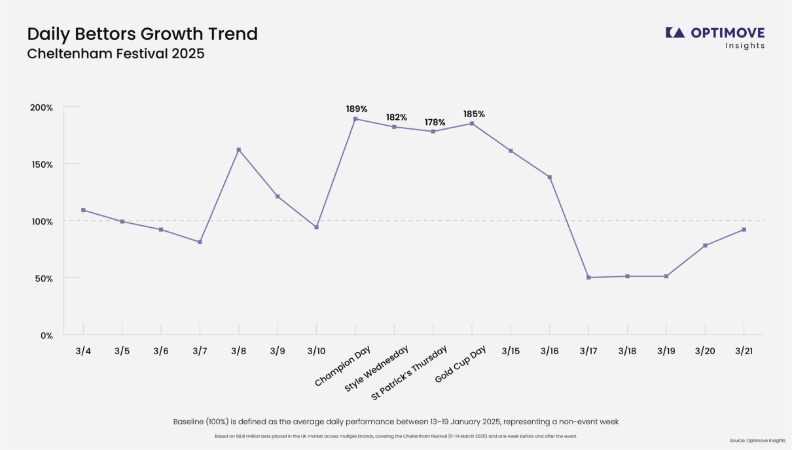
Peak activity was observed across the four festival days, with daily bettors reaching between 178% and 189% above baseline levels, highlighting a sustained uplift rather than a single-day spike. Following Gold Cup Day, activity gradually normalized before dipping below baseline mid-week, suggesting that the uplift was closely aligned with the event window itself.
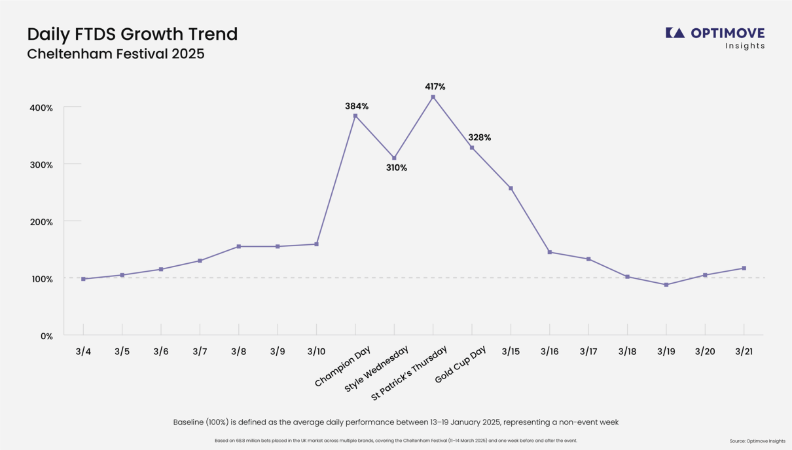
From 11–14 March, Daily First-Time Depositors (FTDs) ranged between 310% and 417% above baseline levels, peaking on St Patrick's Thursday: more than four times a typical non-event day.
Unlike general engagement, which showed a gradual build-up into the festival, FTD growth accelerated sharply from Champion Day onwards, suggesting strong event-driven acquisition dynamics.
The magnitude of the uplift indicates that Cheltenham did not only reactivate existing users, it significantly expanded the active player base. Following Gold Cup Day, FTD levels quickly returned closer to baseline, indicating that acquisition was largely concentrated within the festival days.
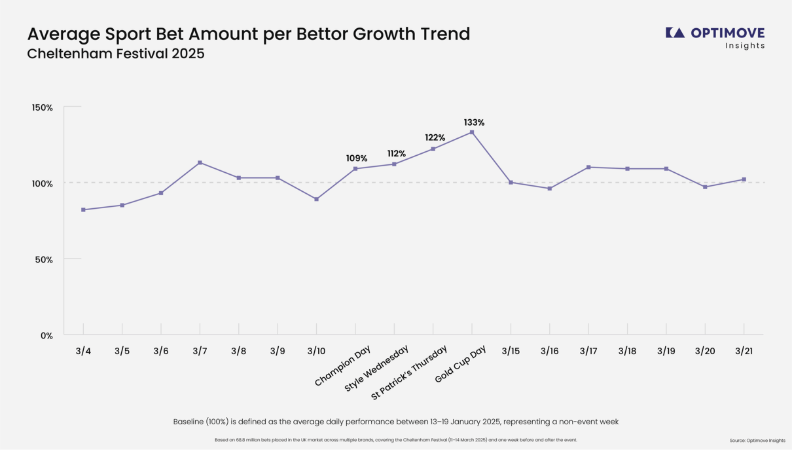
Average bet amount per bettor increased above baseline during the Cheltenham Festival days. From Champion Day through Gold Cup Day, the metric stayed consistently elevated, ranging between 109% and 133% above the January baseline and peaking on Gold Cup Day at 133%.
This pattern suggests that the Festival period drove not only higher engagement and acquisition, but also a meaningful uplift in average wager per active bettor. After the Festival, average bet amounts gradually returned toward baseline levels.
The data shows that Cheltenham's impact was driven by both expanded participation and elevated wager per active bettor. Across all four Festival days, the number of bettors increased materially above baseline, while average bet amount per bettor also trended upward, peaking on Gold Cup Day at 33% above baseline.
The analysis indicates both a larger base of active bettors and higher average bet amounts per bettor during the Festival days, suggesting that increased participation coincided with increased staking intensity.
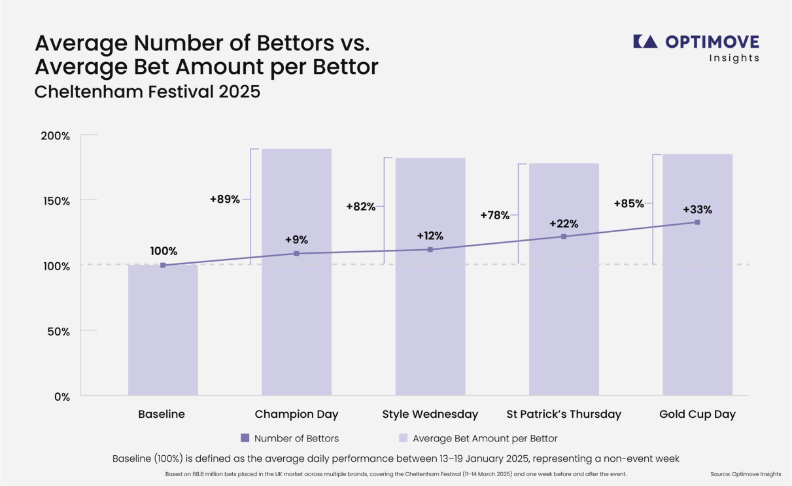
Cheltenham 2025 reinforces a clear pattern: the Festival delivers a concentrated expansion of audience, intensity, and opportunity within four days. Daily bettors nearly doubled, first-time depositors surged more than fourfold, and average wager per bettor rose meaningfully across the event window. Just as clearly, activity normalized quickly once the final race concluded.
For operators preparing for Cheltenham 2026, the opportunity lies not only in maximizing the spike, but in converting that spike into sustained value.
Here are five recommendations to guide sportsbook operators’ planning:
Preparation must begin well before Champion Day. Likely racing bettors, cross-sell candidates, dormant users, and high-propensity first-time depositors should already be identified and structured into pre-built journeys. Event success favors operators who enter the week organized, not reactive.
Cheltenham traffic is not homogenous. Existing racing bettors, football cross-sell bettors, and first-time depositors behave differently and require different engagement strategies. Real-time cohort updates and dynamic messaging are essential to capitalize on heightened intent during the event window.
The sharp spike in first-time depositors represents expanded audience reach, but normalization happens quickly. A structured 30-day onboarding and cross-sell strategy should already be in place before the Festival begins. The objective is not just conversion — it is loyalty formation.
Average wager per bettor rose significantly during the Festival. Some increases reflect temporary excitement; others may indicate long-term value potential. Operators should use behavioral signals during the event to reassess value tiers and nurture high-potential segments accordingly.
The data shows activity dips quickly after Gold Cup Day. Without deliberate follow-up communication and cross-sell planning, momentum fades. A structured post-event retention wave can prevent reversion to baseline from becoming churn.
Executing these priorities requires more than strong offers or bigger budgets. It requires speed, autonomy, and the ability to move from insight to activation without friction. High-velocity moments like Cheltenham compress months of engagement into days, exposing operational bottlenecks.
This is why Positionless Marketing is strategically important. When marketers can independently access data, generate creative, launch journeys, and optimize in real time, they are better equipped to convert short-term spikes into long-term value.
Cheltenham 2026 will once again deliver scale. Competitive advantage will belong to operators who are structured to act at the speed of the moment and to sustain value long after the final race is run.