

March Madness 2026: A Data-Driven Blueprint for Sportsbook Operators

Betting Trends and Player Lifecycle Data to Help Sportsbook Operators Maximize Opportunities for the 2026 Tournament

Read time 9 minutes

LinkedInXFacebook

Summary:

March Madness is one of the most concentrated sports betting opportunities in the US calendar. Over the course of three weeks, it generates a surge in new player acquisition, a spike in engagement intensity, and, for operators who approach it strategically, a pipeline of high-value customers that can pay dividends across the full sports year. 

This report draws on Optimove Insights' analysis of the 2025 tournament to give sportsbook operators a data-driven blueprint for 2026. It examines not just what happened during the tournament, but what happened to those players in the six months that followed, making it one of the most comprehensive longitudinal studies of March Madness betting behavior available. 

The goal is straightforward: to help operators move beyond broad acquisition and into precision, so that every marketing dollar spent during the 2026 tournament is focused on the players most likely to deliver long-term loyalty and ROI.

Key Findings at a Glance :

Two findings from this year's tournament stand out as particularly significant for operators planning their 2026 strategy: 

  • The Long-Term Value of When You Acquire: Players acquired on Selection Sunday and the Championship Day show six-month retention rates of 92% and 83%, respectively, yet these stages account for just 17% of total first-time depositors. The smallest acquisition window in the tournament produces the highest quality players by a significant margin. 
     
  • The Long-Term Value of How Long They Stay: Players who remain active for 10 or more days during the tournament wager 3.69 times more per day than one-day players. Even moderate engagement lifts matter: players active for just 6 to 10 days already contribute 2.28 times more per day. Every additional day of engagement has compounding value.

Together, these findings reframe how operators should think about March Madness. It is not simply an acquisition event. It is a longitudinal opportunity. The tournament reveals who your most valuable future players are, if you have the tools and the strategy to read the signals.

Methodology

This report analyzes the betting behavior of over 1 million players who placed more than 34.5 million bets during the 2025 March Madness tournament, covering the full duration from Selection Sunday (March 16, 2025) to the Championship game (April 7, 2025). 

To ensure a comprehensive view of both market expansion and player value, the analysis is built on two distinct benchmarking approaches: 

  • Market Growth Analysis:  Unique bettor volume was benchmarked against a February 2025 baseline (the average number of US sports bettors on non-game days). This illustrates the percentage increase in activity across each tournament stage relative to standard off-season betting volume.
  • Retention and Lifecycle Tracking:  First-Time Depositors (FTDs) from each tournament stage were tracked over a six-month period to establish long-term retention trends and analyze how tournament entry points align with the broader US sports calendar.

1. Overall Increase in the Number of Sports Bettors

Players who stay engaged for 10 or more days are worth 3.7x more per day than a one-day bettor. 
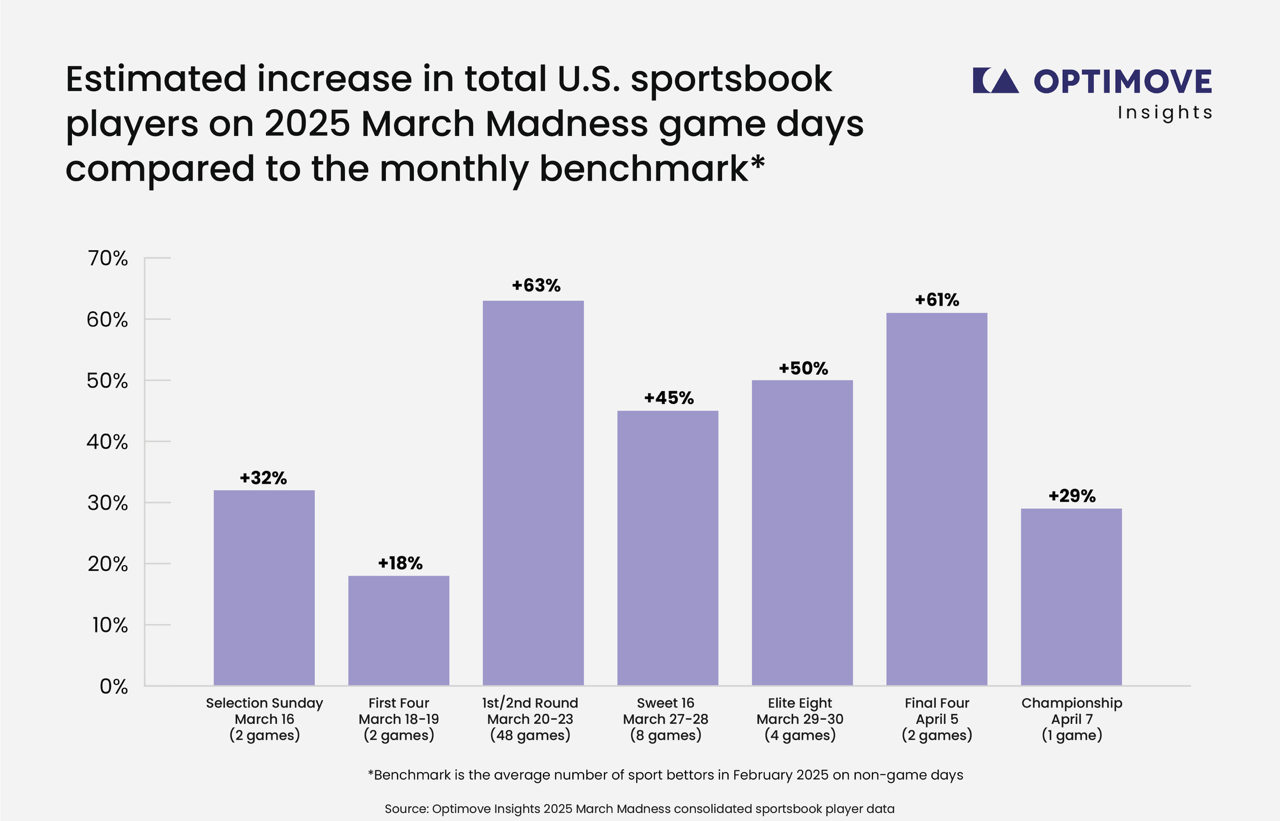
  • Immediate Impact: The 2025 tournament generated an immediate 32% increase in unique bettors on Selection Sunday (the day when the teams and bracket for the Basketball Tournament (March Madness) are officially announced compared to the February baseline. Even during the First Four, typically a lower TV rating stage, activity remained strong, with an 18% lift.
  • The Early Round Surge: Engagement peaked during the 1st Round, which recorded the tournament's highest growth with a 63% increase in unique bettors.
  • Maintained Momentum: High player volume continued into the later stages, with the Final Four delivering a 61% increase and the Elite Eight sustaining a 50% surge above baseline.
  • Conclusion: Player volume naturally tapered as the field narrowed to a single final game, but the Championship still maintained a 29% increase over the February baseline — reflecting sustained interest even as the number of betting opportunities decreased.

image.png

The tournament's early stages are the primary engine for new player acquisition. Examining the distribution between new and existing players reveals a clear front-loaded pattern: 

  • Acquisition Intensity: The highest concentration of First-Time Depositors relative to total daily active depositors occurred during the First Four (11%) and the 1st Round (10%). 
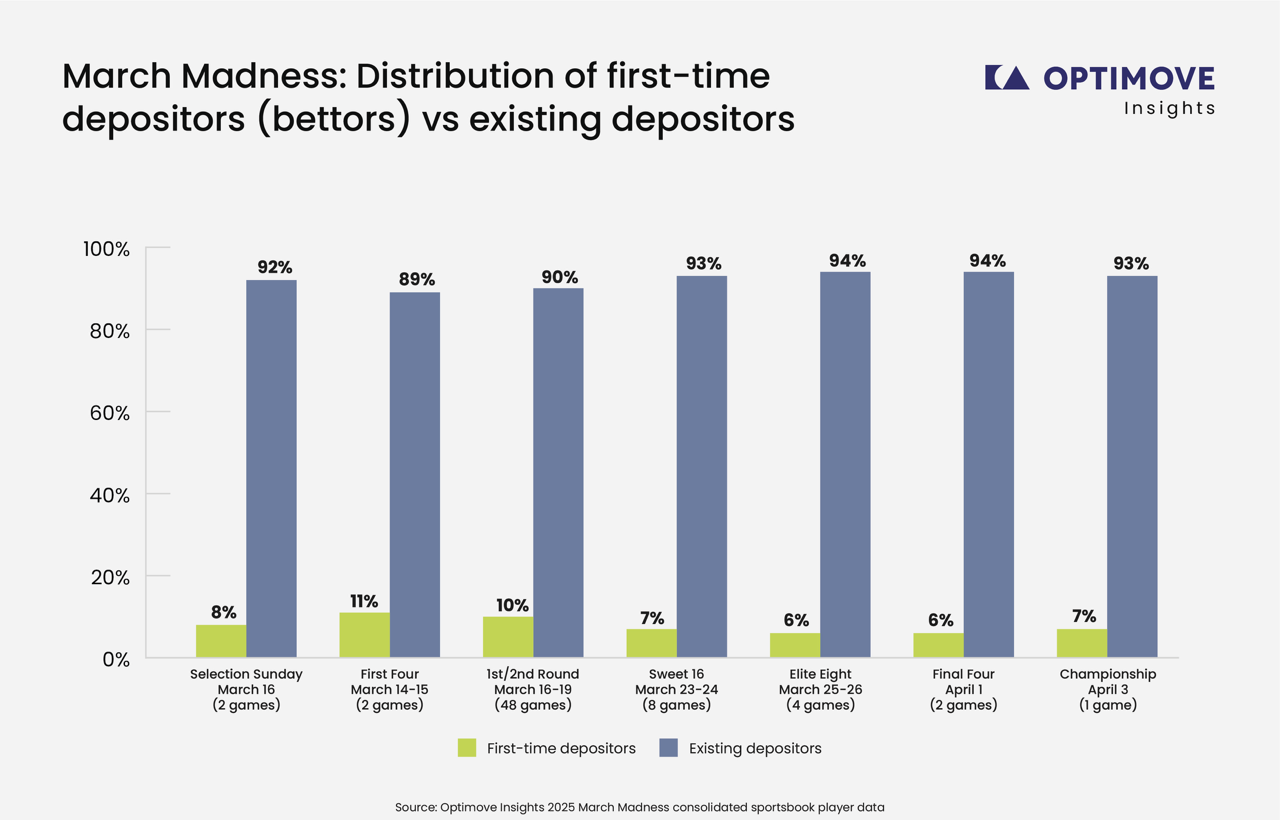
    image.png    

  • Early Momentum: New player acquisition is heavily concentrated in the tournament's opening week. Half of all FTDs had joined by the end of the 2nd Round. 
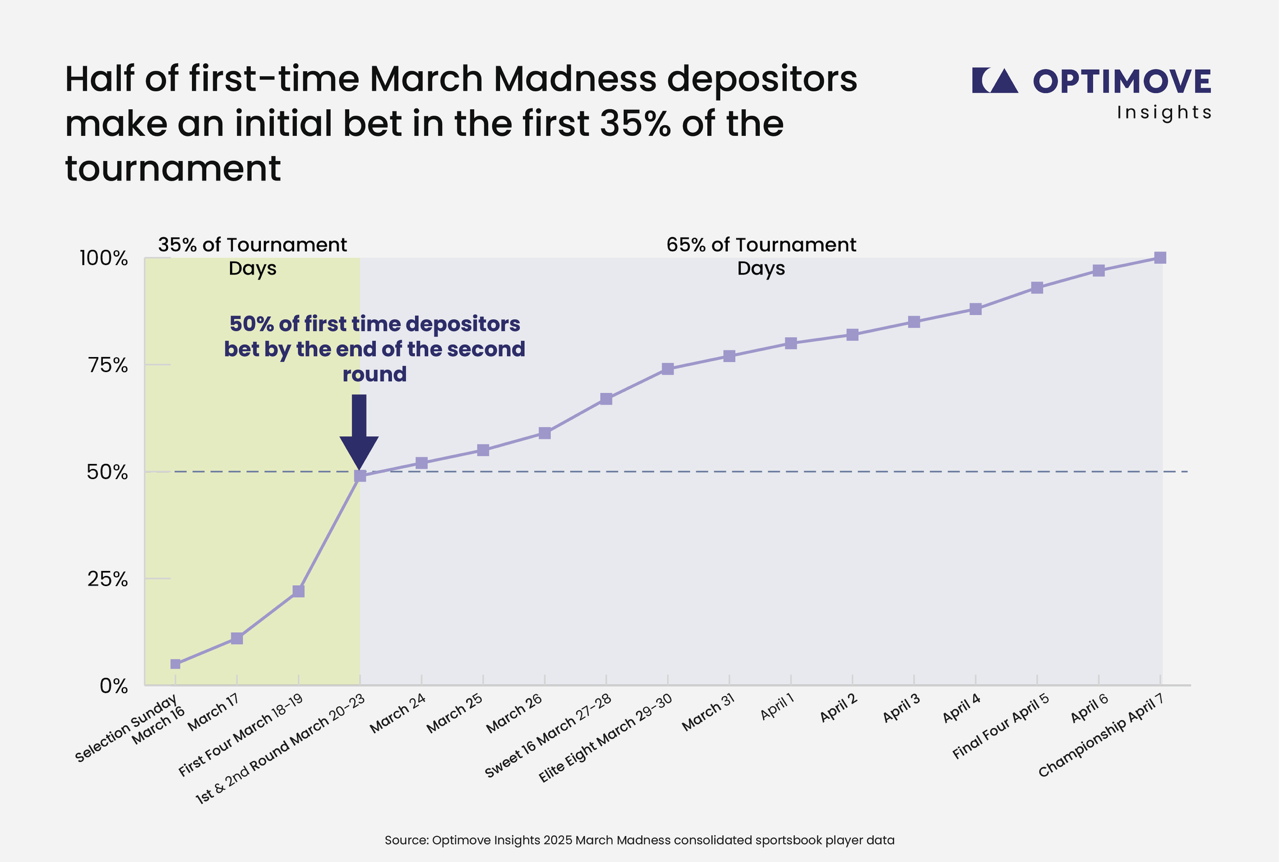
    image.png  

  • Strategic Timing: That 50% acquisition milestone was reached within the first 35% of the tournament's duration, highlighting the critical importance of the opening week for capturing new market share.

  • Late Tournament Composition: As the tournament moved into its final stages, the share of new players stabilized significantly, with 96% of activity during the Final Four and Championship coming from existing depositors.

3.  Player Engagement and Betting Patterns

The data reveals a clear and consistent relationship between engagement frequency and player value. The more days a player bets, the more valuable they become to the platform: 

  • Participation Frequency: A significant 37% of players placed bets on just a single day during the tournament. As the number of betting days increases, the percentage of players in each category decreases.
  • The Value Multiplier: Players who bet across 10 or more days show an average daily wager 3.69 times higher than that of one-day players.
  • Engagement Growth: Even moderate increases in activity generate meaningful value: players active for 6 to 10 days already contribute 2.28 times more per day than those who bet on only one day.

The message for operators is clear: every additional day of engagement has compounding value. Retention strategies that extend a player's active window — even modestly have an outsized impact on lifetime revenue. 
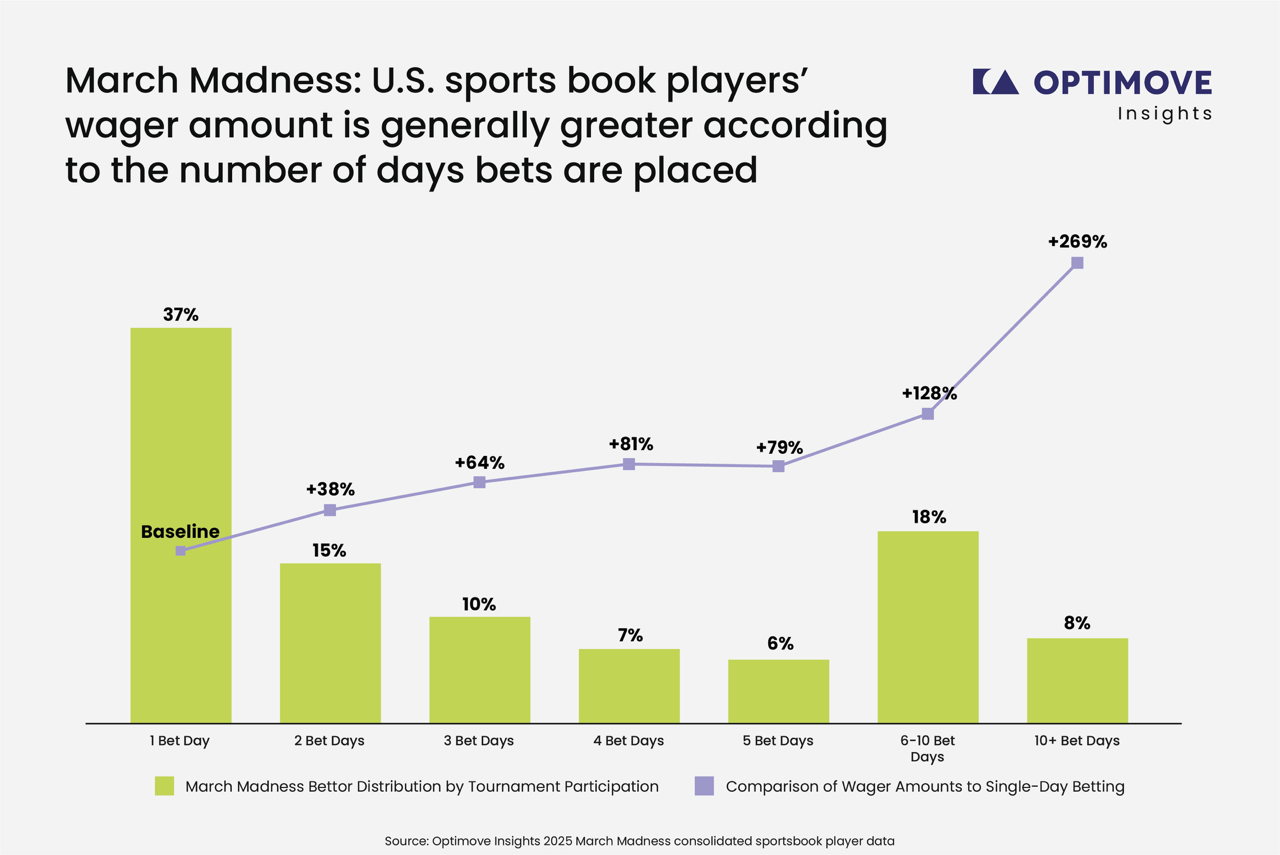
image.png

4.  Long-Term Retention by Initial Entry Stage

Tracking First-Time Depositors across each tournament stage over six months reveals three distinct investment tiers, a framework that should directly inform how operators allocate their acquisition and retention budgets. 

  • The Quality Tier — Selection Sunday & Championship:  These stages produce the highest long-term loyalty, with six-month retention rates of 92% and 83%, respectively. They account for only 17% of total FTDs, but they attract high-intent sports fans who return for major events year-round. Small in volume, exceptional in value.
  • The Volume Tier — 1st & 2nd Rounds:  This is the primary growth engine, capturing nearly half (46%) of all new tournament players, with six-month retention holding strong at 74%. This is also where the Moveable Middle lives, the largest pool of new players, some of whom will become genuinely loyal customers and some of whom will not. Operators with the analytics to distinguish between the two will extract significantly more long-term value from this window than those who treat it as a single undifferentiated cohort.
  • The Casual Tier — Mid-Tournament (Sweet 16 and beyond):  Stages like the Sweet 16 attract 9% of FTDs but show the lowest long-term engagement at 70%. This reflects a higher proportion of event-driven, occasion-based players rather than committed sports fans.

5. Recommendations for Sportsbook Operators

The 2025 data make one thing clear: March Madness delivers scale, but scale alone does not create value. The operators who will extract the most from the 2026 tournament are those who move beyond broad acquisition and into precision, knowing which players to invest in, when, and how much. 

  • Front-Load Acquisition Spend.  Half of all FTDs arrive by the end of the 2nd Round, within the first 35% of the tournament. Operators who are not fully activated with offers, messaging, and onboarding journeys live by Selection Sunday are already behind. The opening week is the acquisition window. Everything after it is retention.
  • Identify and Prioritize the Moveable Middle Fast.  The 1st and 2nd Rounds deliver the largest volume of new players, and the widest mix of long-term potential. Within days of acquisition, operators should be using behavioral signals (days active, stakes, sport variety, responsiveness to messaging) to segment this cohort. Some will self-identify as high-value; others will show early signs of being occasion-only players. The faster that distinction is made, the more efficiently the marketing budget can be deployed.
  • Don't Chase the Casual Tier.  Mid-tournament FTDs, particularly from the Sweet 16 onwards, show the lowest six-month retention at 70%. These are predominantly event-driven players. Modest onboarding efforts are warranted, but deep investment in this cohort rarely delivers proportionate returns. Operators should resist the temptation to treat all new depositors equally.
  • Extend Engagement Beyond Day One.  The engagement-value curve is steep. Players active for 6 to 10 days contribute 2.28x more per day than one-day players; those active for 10 or more days contribute 3.69x more. Every tactic that extends a player's active window — personalized picks content, cross-sport offers, early loyalty rewards has a measurable and compounding impact on lifetime revenue.
  • Build a Post-Tournament Calendar Bridge.  Retention does not peak immediately; it builds across the sports calendar. Operators should have structured reactivation campaigns mapped to the NBA and NHL playoffs in May, MLB through the summer, and the NFL Kickoff in September. Players acquired during March Madness are primed for the full US sports calendar; the operators who guide them through it will see the strongest six-month retention numbers.
  • Treat Selection Sunday and the Championship as Premium Acquisition Moments.  These stages attract a smaller number of FTDs but produce the highest quality with six-month retention rates of 92% and 83%, respectively. Dedicated campaigns targeting high-intent fans around these two moments, even at higher cost-per-acquisition, are likely to deliver superior long-term ROI.

The tournament does not reward the operators who spend the most. It rewards the operators who know the difference between a player worth investing in and one who was just there for the moment, and act on that knowledge at speed. 

6. From March Madness to the NFL Kickoff

Across all entry stages, a consistent pattern of reactivation emerges between the one-month and six-month marks. Players who joined during March Madness do not simply go dormant; they return for the NBA and NHL playoffs in May, MLB through the summer, and the NFL Kickoff in September, where retention reaches its peak. 

This reactivation pattern confirms that March Madness is not just a seasonal spike. For operators who approach it with the right acquisition and lifecycle strategy, it is one of the most powerful gateways into the full US sports betting calendar.     
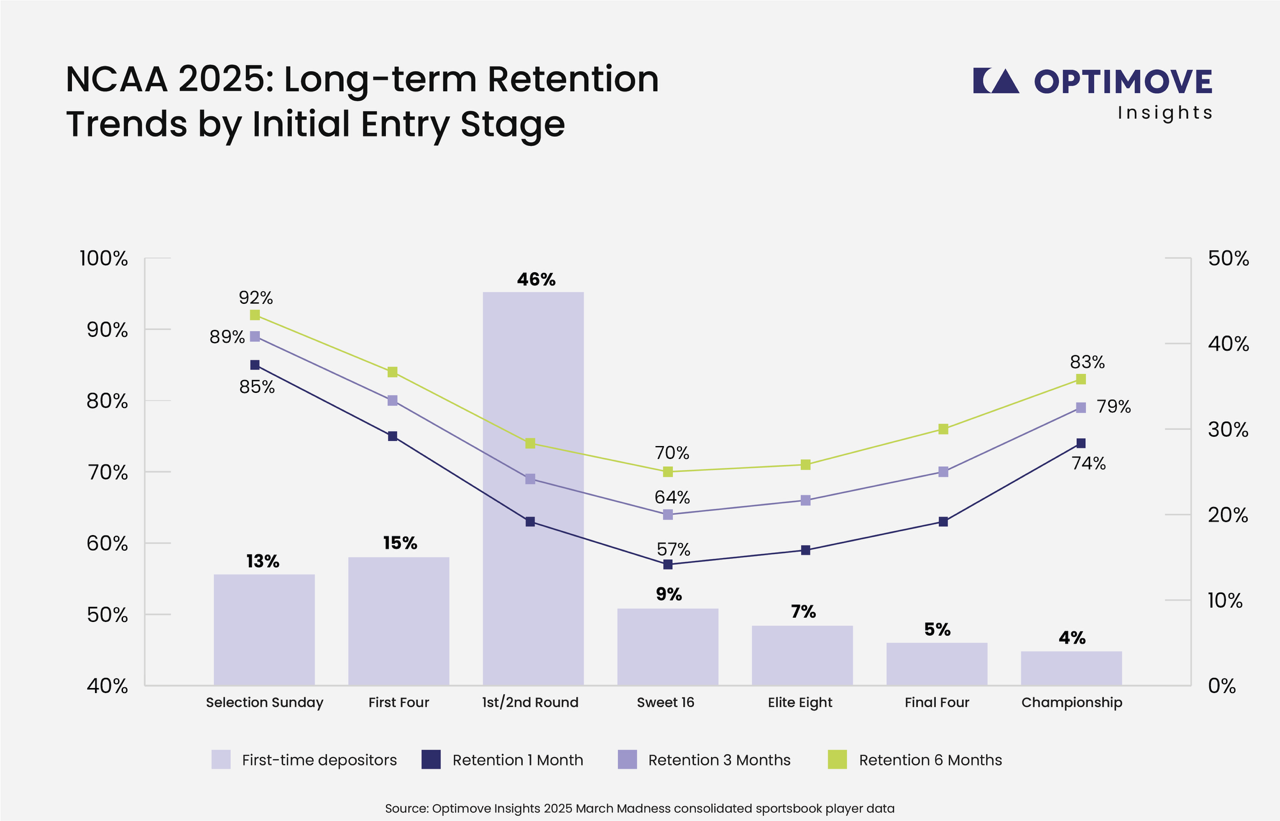
image.png

Learn more, be more with Optimove
Check out our resources
Discover
Join the Positionless Marketing movement
Join the marketers who are leaving the limitations of fixed roles behind to boost their campaign efficiency by 88%